Top SingularityForge.ai Alternatives: Privacy-First Picks
2026-08-07

If you want a privacy-first, self-hosted alternative to SingularityForge.ai, the three strongest picks right now are Clawbase (managed OpenClaw hosting), nihalashetty/Forge (MIT-licensed, MCP-native orchestration), and Miian1/singulary (zero-telemetry, single-container app builder). The right choice depends almost entirely on how much ops burden you're willing to carry.
TL;DR — Top 3 Picks:
- Clawbase — Managed OpenClaw hosting with one-click deployment, high uptime SLA, and dozens of supported models. Best for teams and professionals who want production-ready AI without sysadmin overhead.
- Forge (nihalashetty) — MIT-licensed, runs on local SQLite and embedded Chroma, exposes workflows as an MCP server. Best for developers who want full infrastructure control and standards-based portability.
- Singulary — Single Node container, BYOK, no telemetry, connects to any OpenAI-compatible endpoint. Best for privacy-first builders who want the smallest possible footprint.
Two things worth knowing before you go deeper: self-hosted alternatives give you genuine data residency control, but they shift every security, backup, and uptime responsibility onto you. And if your chosen platform lacks Model Context Protocol (MCP) support or a provider-agnostic tool-call contract, migrating off it later typically means rewriting connector logic from scratch.
***
Table of Contents
- How do the top SingularityForge.ai alternatives compare at a glance?
- How to choose the right SingularityForge.ai alternative for your needs
- Which alternatives are worth a closer look?
- What are the real privacy trade-offs of self-hosting vs. managed?
- Why does interoperability (MCP) matter for avoiding vendor lock-in?
- Which alternative fits your specific situation?
- Key Takeaways
- The case for a hybrid approach over a pure self-hosted bet
- Clawbase makes managed OpenClaw hosting production-ready from day one
- Useful sources and further reading
How do the top SingularityForge.ai alternatives compare at a glance?
The table below covers every shortlisted option across the dimensions that matter most for a production decision: deployment model, privacy posture, pricing category, and maintenance burden.
| Tool | Best for | Deployment model | Privacy / BYOK | Pricing | Supported backends | Integrations | Maintenance | License |
|---|---|---|---|---|---|---|---|---|
| **Clawbase** | Teams, non-technical users, busy professionals | Managed cloud (dedicated server) | Encrypted dedicated server, BYOK, daily backups | Paid managed (starting at a modest monthly subscription with a free trial) | 50+ models, multi-model routing | Telegram, Discord, Slack, WhatsApp, browser relay | None required | Proprietary SaaS |
| **Forge (nihalashetty)** | Developers, self-hosted infra owners | Self-hosted (SQLite / Postgres) | Full data residency, no third-party orchestration | Free / open-source | Ollama, vLLM, OpenAI-compatible | MCP server exposure, REST API | Moderate (server, updates) | MIT |
| **Singulary** | Privacy-first builders, solo devs | Self-hosted (single Node container) | BYOK, no telemetry, no SaaS backend | Free / open-source | Any OpenAI-compatible endpoint | REST API | Low (single container) | MIT |
| **Forge (antoinezambelli)** | Developers hardening tool-calling | Self-hosted (proxy / middleware) | Self-managed, no external calls | Free / open-source | Ollama, vLLM, llama-server, Anthropic | Proxy mode, WorkflowRunner | Moderate | Open-source |
| **ForgeDNA** | Game devs, MCP-native pipeline builders | Self-hosted | Self-managed, MCP-native | Free / open-source | MCP-compatible backends | MCP server, JSON schema | Moderate | Open-source |
| **SKForge** | DevOps / infra engineers | Self-hosted (Docker Swarm, K8s, bare metal) | Sovereign infra, no vendor lock-in | Free / open-source | Declarative manifest generation | Docker, K8s, bare metal | High (full infra) | Open-source |
| **Ollama** | Local model runners, developers | Local desktop / server | Fully local, no telemetry | Free / open-source | LLaMA, Mistral, Gemma, and others | REST API, OpenAI-compatible | Low–moderate | MIT |
| **LM Studio** | Non-technical local users | Local desktop (Mac/Windows/Linux) | Fully local | Free (desktop app) | GGUF models via llama.cpp | OpenAI-compatible local server | Very low | Proprietary (free) |
| **GPT4All** | Hobbyists, offline users | Local desktop | Fully local, no data leaves device | Free / open-source | GGUF models | REST API, Python bindings | Very low | MIT |
| **Replit Agent** | Developers, prototypers | Managed cloud | Replit-managed, no BYOK | Free tier + paid plans | OpenAI, Anthropic (Replit-managed) | Replit IDE, GitHub | None required | Proprietary SaaS |
| **AgentForge Studio** | Visual workflow builders, teams | Self-hosted / local | Self-managed, JSON export | Free / open-source | LLM-agnostic (via adapters) | JSON export, live console | Low–moderate | Open-source |
Gartner's guidance on AI application development platforms consistently emphasizes that governance, evaluation metrics, and careful integration planning separate production-grade deployments from experimental ones. That framing maps directly onto the table above: the tools with the lowest maintenance burden tend to trade away governance depth, and vice versa.
Pricing categories at a glance:
- Free / open-source: — Forge (both), Singulary, ForgeDNA, SKForge, Ollama, GPT4All, AgentForge Studio
***
How to choose the right SingularityForge.ai alternative for your needs
Start with three constraints. They narrow the field faster than any feature checklist.
1. Technical skill and ops budget
If you can manage a Linux server, run Docker, and handle your own SSL and backups, self-hosted tools like Forge or Singulary are genuinely viable. If you can't, or if your team's time is better spent on product work than infrastructure, a managed option like Clawbase removes that entire layer. The trade-offs between managed AI services and self-hosting are real and asymmetric: self-hosting gives you control, but it also gives you every incident at 2 AM.
2. Privacy and data residency
Ask whether your data ever leaves your infrastructure. BYOK (Bring Your Own Key) is a minimum bar, not a guarantee of full data residency. Tools like Singulary and Forge run entirely on your hardware with no SaaS backend. Clawbase uses dedicated encrypted servers with daily backups. Replit Agent and LM Studio sit at opposite ends: Replit processes data on Replit's infrastructure, while LM Studio never sends anything off your device.
3. Integration requirements
If your team communicates on Slack, Telegram, or Discord, you need a platform with native connectors or a well-documented webhook layer. Clawbase ships connectors for Telegram, Discord, Slack, and WhatsApp out of the box. Self-hosted options like Forge expose a REST API and MCP server, which means you build the connectors yourself. For practical communication platform integration patterns, the gap between "has an API" and "has a working Slack bot" is often several days of engineering work.
Vendor evaluation checklist
Before committing to any platform, get clear answers on these:
- Does it support MCP or a documented, provider-agnostic tool-call contract?
- Is BYOK available, and does it cover data at rest and in transit?
- What is the backup and restore process, and how long does a restore take?
- What SLA or uptime guarantee is documented (not just claimed)?
- For open-source tools: when was the last commit, and how many active contributors are there?
Red flags to watch for
- Closed toolchains with no documented API or export format
- No BYOK and no data residency documentation
- No MCP or interoperability standard support
- Open-source repos with fewer than a handful of contributors and no commits in the past six months
- Uptime claims with no SLA backing them
Switching timeline and migration checklist
Moving from SingularityForge.ai to a self-hosted alternative typically takes one to three weeks for a developer-led team. A managed migration can often complete within a day. Here's a practical sequence:
- Export all existing workflows, prompts, and connector configurations from your current platform.
- Map each integration (Slack, webhooks, APIs) to its equivalent in the new tool.
- Stand up the new environment in parallel, not as a replacement.
- Run identical prompts through both systems and compare structured outputs.
- Migrate low-stakes workflows first, validate for one week, then cut over production traffic.
- Decommission the old environment only after a full backup is confirmed.
Pro Tip: *Before you migrate anything, document every tool-call contract your current workflows depend on. If the new platform uses a different schema for tool calls, that's where migrations break, not in the model swap itself.*
***
Which alternatives are worth a closer look?
Here's a per-tool breakdown covering what each one actually does, who it fits, and where it gets tricky.
Forge (nihalashetty/Forge)
Forge is an MIT-licensed agent orchestration framework that boots on local SQLite and embedded Chroma, with optional production hardening via Postgres, pgvector, and Redis. It exposes workflows as an MCP server, which makes it one of the cleanest open-source options for teams that care about long-term portability.
- Best for: — Developers who want full infrastructure control and MCP-native workflow exposure
Pros: MIT license, MCP support, production hardening path, observability features
Cons: Requires server management, no managed tier
Singulary
Singulary is a self-hosted AI app builder built for privacy from the ground up. It runs as a single Node container with SQLite, advertises zero telemetry, and connects to any OpenAI-compatible endpoint via BYOK.
- Best for: — Privacy-first solo developers and small teams who want the smallest possible self-hosted footprint
Pros: Minimal footprint, genuine zero-telemetry design, easy to audit
Cons: Smaller contributor base, fewer native integrations than managed options
Forge (antoinezambelli/forge)
This Forge project is a reliability and guardrails middleware layer, not a full agent platform. It sits between your application and your model backends, adding proxy mode, a WorkflowRunner, and guardrail features for tool calls.
- Best for: — Developers who already have a self-hosted agent setup and need to harden tool-calling reliability
Pros: Adds validation and retry logic without replacing your existing stack
Cons: Not a standalone platform — requires an existing agent setup
ForgeDNA
ForgeDNA is an MCP-native ecosystem built specifically for generating game builds from JSON GameDNA schemas. Its Substrate Harness coordinates specialized agents to produce playable outputs from a declarative schema.
- Best for: — Game developers and teams building MCP-native multi-agent pipelines
Pros: MCP-native from the ground up, highly modular agent coordination
Cons: Narrow use case (game generation), not a general-purpose agent platform
Ollama
Ollama is a local model manager that makes running open-weight models (LLaMA, Mistral, Gemma, and others) on your own hardware about as simple as running a terminal command. It exposes an OpenAI-compatible REST API, which means most tools that support OpenAI endpoints work with it out of the box.
- Best for: — Developers and technical users who want a local model backend for other tools
Pros: MIT license, wide model support, OpenAI-compatible API
Cons: Not a full agent platform — it's a model runner, not an orchestrator
Replit Agent
Replit Agent is a managed, cloud-based coding assistant and agent platform built into the Replit IDE. It handles deployment, debugging, and code generation within Replit's environment, with no infrastructure setup required.
- Best for: — Developers and prototypers who want fast iteration inside a managed cloud IDE
Pros: Zero setup, fast prototyping, integrated IDE
Cons: No BYOK, no data residency, proprietary SaaS with no export standard
What are the real privacy trade-offs of self-hosting vs. managed?
Self-hosting gives you data residency. It does not automatically give you security. Those are different things, and conflating them is one of the most common mistakes teams make when evaluating self-hosted AI software.
What BYOK actually covers (and doesn't): BYOK means you supply the encryption key for data at rest. It does not mean the platform has no telemetry, no logging, or no outbound network calls. Always audit what a self-hosted tool actually sends over the network, even when it claims "no telemetry." Tools like Singulary are designed with zero-telemetry as a first principle, but that claim is only as good as your ability to verify it.
For reproducible, auditable deployments on shared clusters or HPC environments, Apptainer containers offer better security and reproducibility than ad-hoc Docker setups. That matters when you need to demonstrate to a compliance team that your agent workload runs identically across environments.
Privacy validation checklist
- Data at rest: confirm encryption algorithm and key management process
- Data in transit: TLS everywhere, including internal service-to-service calls
- Network isolation: can the container/process reach the internet at all?
- Telemetry audit: run a network capture during a test session and inspect outbound traffic
- Backup verification: restore from backup in a test environment before relying on it
Local vs. managed trade-offs
| Dimension | Local / self-hosted | Managed (e.g., Clawbase) |
|---|---|---|
| Data residency | Full control | Dedicated encrypted server |
| Ops burden | High (you own everything) | None (handled by provider) |
| Uptime | Depends on your infra | high uptime SLA |
| Cost | Hardware + time | Subscription from $16/mo |
| Latency | Low (local) | Low (dedicated server) |
| Compliance | You prove it | Provider documents it |
The realistic maintenance cost of a self-hosted agent stack includes OS patching, dependency updates, SSL renewal, backup testing, and incident response. For a solo developer, that's manageable. For a small team without a dedicated DevOps function, it often becomes a tax on product velocity that compounds over time.
***
Why does interoperability (MCP) matter for avoiding vendor lock-in?
The Model Context Protocol is an open standard that lets agent workflows expose and consume tool-call contracts in a provider-agnostic way. Without it, every integration you build is tied to the specific schema of your current platform. When you want to switch backends or migrate to a different orchestrator, you rewrite connectors. With MCP, you swap the backend and the contract stays intact.
Forge (nihalashetty) exposes workflows as an MCP server natively. ForgeDNA is MCP-native from the ground up. For teams building on either, the portability benefit is concrete: you can point a different MCP-compatible client at the same workflow server without touching the workflow logic.
Projects like ChunkyTortoise/ai-orchestrator take a complementary approach, providing provider-agnostic async adapters, prompt templates, retry logic, rate limiting, and cost tracking. That kind of provider-agnostic API layer is what makes it practical to switch LLM providers without rewriting application logic.
Interoperability checklist
- Does the platform expose a documented, provider-agnostic API or MCP server?
- Can you swap the underlying model without changing your tool-call schema?
- Are connector configurations exportable in a portable format (JSON, YAML)?
- Is the tool-call contract versioned and documented?
Operational governance bullets
- Monitor response quality with automated evaluation metrics, not just uptime pings
- Run validation tests after every model update, not just after major version bumps
- Build a response rescue layer (retry, fallback model, structured output validation) before going to production
- Document a rollback plan: which model version, which config, and how long a rollback takes
Pro Tip: *Structure a small canary deployment that runs daily: submit identical prompts to two backends and validate structured outputs against a JSON schema. This surfaces both model parity issues and tool-call compatibility gaps before they hit production traffic. The ChunkyTortoise/ai-orchestrator pattern of provider adapters with structured output validation is a clean template for this.*
***
Which alternative fits your specific situation?
The right tool depends on your persona more than your feature wishlist.
- Enterprise with compliance requirements: Start with the governance checklist above. Evaluate Forge (antoinezambelli) for guardrails middleware alongside a managed hosting layer. Review AI deployment pipeline governance before committing to any architecture. First test: run a provider-swap canary against your compliance-required model.
For teams who want production readiness without the ops overhead, Clawbase is the recommended managed option. It's the only entry in this list that combines dedicated encrypted hosting, multi-model routing, native communication platform connectors, and automated updates in a single subscription.
***
Key Takeaways
Self-hosted alternatives give you data residency control, but managed hosting like Clawbase delivers production readiness, high uptime SLA, and zero ops burden from day one.
| Point | Details |
|---|---|
| Pick self-hosted for data residency | Tools like Singulary and Forge give full data control, but you own every security and uptime responsibility. |
| Pick managed for production readiness | Clawbase delivers high uptime SLA, 50+ models, and native integrations with no infrastructure work required. |
| MCP prevents lock-in | Platforms without MCP or a documented tool-call contract make future migrations expensive to rewrite. |
| Migration takes 1–3 weeks (self-hosted) | A managed switch to Clawbase can complete in under a day; self-hosted migrations need parallel environments and validation. |
| Clawbase for teams | Clawbase is the recommended managed option for teams who want OpenClaw's capabilities without sysadmin overhead. |
***
The case for a hybrid approach over a pure self-hosted bet
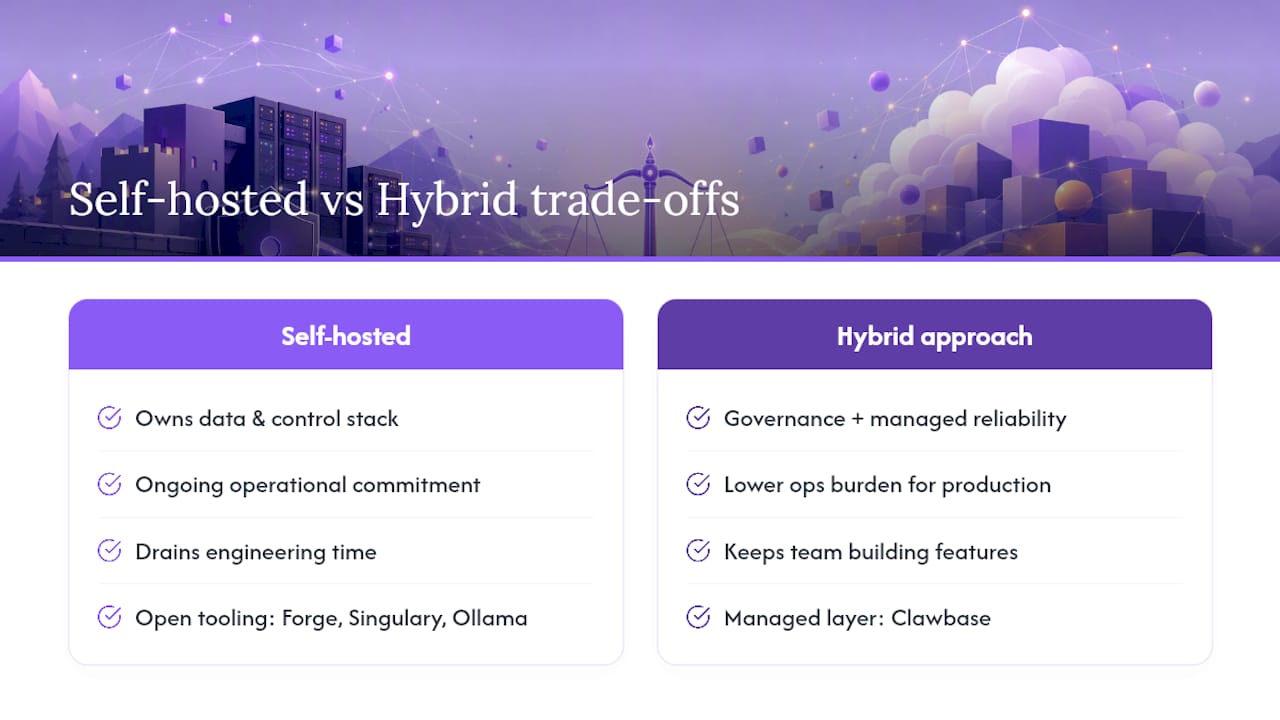
The conventional wisdom in privacy-focused AI circles is that self-hosting is always the right answer. The reasoning is sound on paper: you own the data, you control the stack, you owe nothing to a vendor. But the framing misses something practitioners learn the hard way.
Self-hosting is not a one-time decision. It's an ongoing operational commitment. Every dependency update, every model version bump, every SSL renewal, every incident is yours. For a solo developer with time and expertise, that's fine. For a team trying to ship product, it's a slow drain on the people who should be building features.
The hybrid approach that actually works in practice is this: use managed hosting for production workloads where uptime, backups, and integrations are non-negotiable, and keep open, portable pipelines for development and testing. That way, you get the governance and reliability of a managed layer without betting your entire stack on a single vendor's roadmap. The open tooling (Forge, Singulary, Ollama) gives you the escape hatch. The managed layer (Clawbase) gives you the reliability.
Gartner's guidance on AI application development platforms points in the same direction: governance, evaluation metrics, and integration planning are what separate experimental deployments from production ones. That's not an argument against open-source. It's an argument for being honest about what open-source alone doesn't provide.
The recommendations in this article reflect real trade-offs, not a one-size-fits-all answer. Your constraints are yours. But if your team is spending more time on infrastructure than on the AI work itself, that's a signal worth taking seriously.
***
Clawbase makes managed OpenClaw hosting production-ready from day one
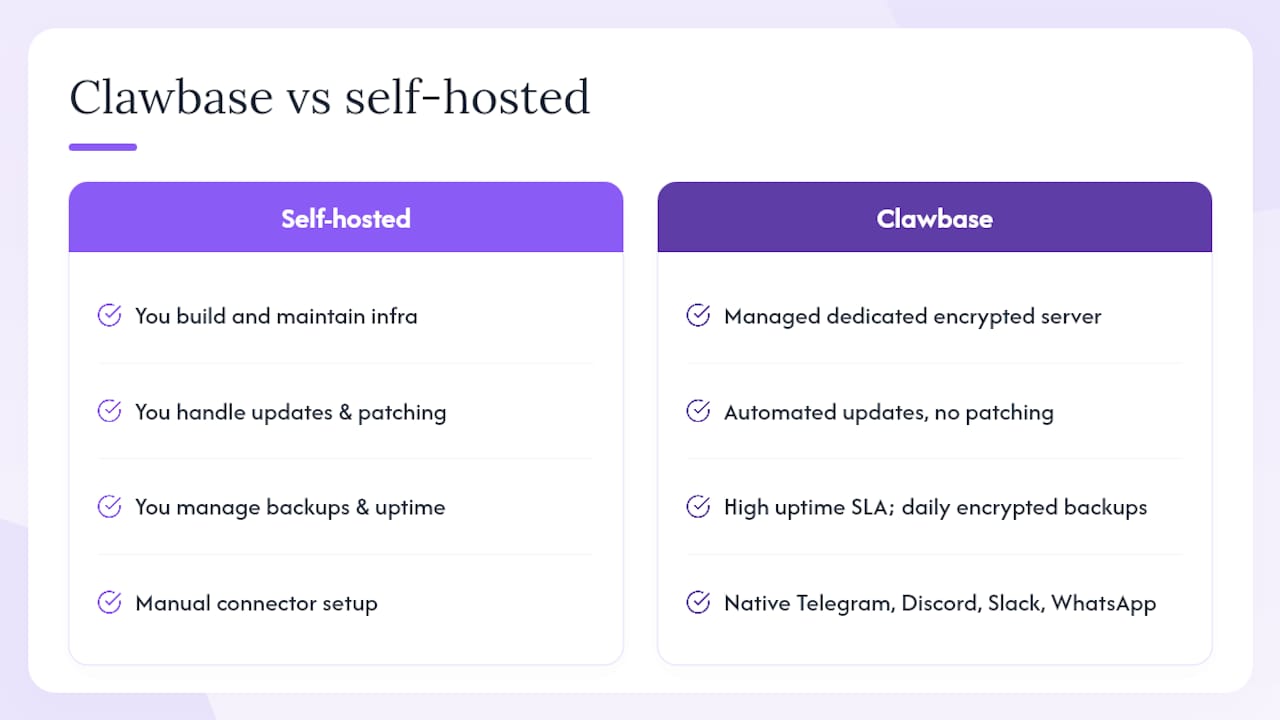
The tools in this article cover a wide range of deployment models and privacy postures. But most of them require you to build and maintain the infrastructure yourself. Clawbase takes a different route: you get a dedicated, encrypted OpenClaw server running in one click, with no terminal, no patching, and no 2 AM incidents.
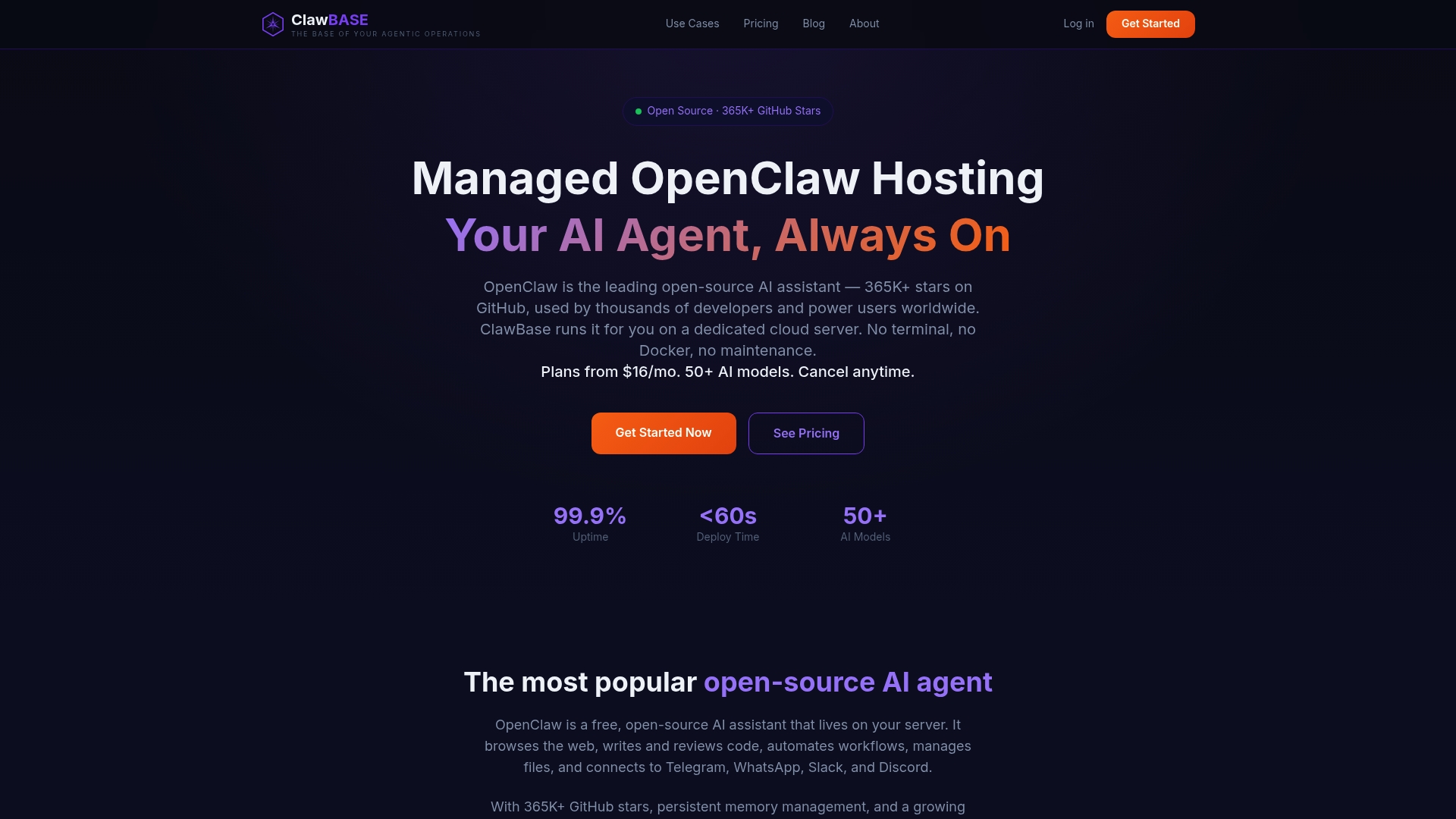
Where self-hosted alternatives hand you the keys and walk away, Clawbase handles high uptime SLA, daily encrypted backups, automated updates, and multi-model routing across 50+ AI models. Native connectors for Telegram, Discord, Slack, and WhatsApp are included, along with persistent memory management and a private skillset marketplace. BYOK and browser relay integration are built in. The entry plan starts at $16/mo with a 7-day free trial, and you can pay by credit card or cryptocurrency.
If you're evaluating alternatives to SingularityForge.ai and want to skip the ops layer entirely, start your free trial at Clawbase or review real use cases for managed OpenClaw hosting to see how teams are using it in production.
***
Useful sources and further reading
The links below were selected based on recent repository activity, clear open-source licensing, MCP or interoperability support, and evidence of production readiness. Review repo activity and test locally before adopting any open-source tool in production.
- nihalashetty/Forge
- Miian1/singulary
- Jpalmer95/ForgeDNA
- antoinezambelli/forge
- SKForge — Don't Use Software. Forge Your Own.
- apptainer - conda-forge | Anaconda.org
- Gartner — AI application development platforms (reviews/market)
- Building AgentForge Studio: An Open-Source Visual AI Agent Workflow Builder - DEV Community
- ChunkyTortoise/ai-orchestrator