Communication Platform AI Integration Examples for Teams
2026-07-04

AI integration in communication platforms is defined as the practice of embedding artificial intelligence directly into messaging, voice, and email systems to automate tasks, route conversations, and enrich every interaction with context. The best communication platform AI integration examples share three traits: multi-channel reach, persistent memory, and real-time decision making. Teams that deploy these integrations report faster lead qualification, reduced manual triage, and customer service that runs around the clock. Understanding which integration pattern fits your workflow is the difference between a tool that helps and one that just adds noise.
1. What are the leading communication platform AI integration examples?
AI communication tools work best when they span every channel a customer or teammate uses. Businesses can deploy AI assistants across voice, SMS, and email in a single business day without dedicated engineering teams, with support for 34+ languages and bi-directional CRM synchronization. That means a sales team in Chicago can qualify a Spanish-speaking lead over SMS, escalate to a voice call, and log the full interaction in their CRM without touching a keyboard.
The most effective multi-channel deployments share a common architecture:
- Sub-second response triggers that detect intent and route to the right channel instantly
- Human escalation logic that transfers full conversation history so the customer never repeats themselves
- Lead qualification scoring built directly into the messaging flow
- Analytics dashboards that surface conversation trends across all channels
Continuous AI interactions require autonomous handoff to human agents, transferring the full conversation history to avoid user repetition. This setup directly boosts customer satisfaction because the human agent picks up exactly where the AI left off.
Pro Tip: *Set your escalation trigger on intent signals, not just keywords. An AI that escalates when it detects frustration or a pricing question converts better than one that escalates only on the word "help."*

2. How AI voice generation models integrate with communication platforms
Voice is the channel most teams underestimate. Enterprise-grade AI voice generation costs approximately $22 per million characters, supports 15 languages, and uses expressive speech synthesis that preserves speaker identity. That price point makes it practical for mid-size teams to deploy branded voice agents without recording studios or voice actors.
The practical integration points for AI voice models include:
- Interactive voice response (IVR) replacement: AI voice agents handle inbound calls with natural language instead of rigid menu trees
- Outbound notification calls: appointment reminders, payment alerts, and shipping updates delivered in a consistent brand voice
- Long-form content narration: product documentation or training materials converted to audio for distributed teams
- Voice assistant integration: embedding synthesized voice into internal tools like knowledge bases
Speaker consistency matters more than most teams realize. When a customer hears the same voice across a welcome call and a follow-up reminder, brand trust builds faster. The role of AI models in responses extends well beyond text, and voice synthesis is now a first-class integration target for any serious communication stack.
3. What frameworks enable multi-agent AI collaboration in messaging platforms?
Multi-agent frameworks are the architecture layer that lets several AI models work together inside a single conversation thread. Multi-agent AI frameworks integrate up to 18 LLM providers with platforms like WhatsApp, Telegram, and Microsoft Teams, and include end-to-end encryption with automatic failover to maintain continuity.
A practical multi-agent setup for a business team looks like this:
- Intake agent receives the message on WhatsApp or Telegram and classifies intent
- Specialist agent handles the specific task, such as contract lookup or inventory check
- Memory agent writes the interaction summary to a shared knowledge store
- Escalation agent monitors confidence scores and triggers human handoff when needed
- Audit agent logs every decision for compliance review
Apple Messages for Business now supports AI agents as verified business accounts, which introduces new compliance requirements alongside new business models. That development signals that native messaging apps are becoming primary deployment surfaces, not secondary ones.
The cross-agent collaboration pattern also solves a problem that single-model deployments cannot: no one LLM is best at every task. Routing a legal question to a model fine-tuned on contracts while routing a tone-sensitive customer complaint to a model optimized for empathy produces better outcomes than forcing one model to do everything.
4. What middleware and architecture best practices support AI communication integration?
Middleware is the connective tissue that keeps AI agents stable across channels. Model Context Protocol (MCP) lets developers focus on AI logic by handling communication plumbing such as webhooks and session management. Without a middleware layer, teams end up writing custom glue code for every channel, which breaks every time an API changes.
Pro Tip: *Store session state in an external database from day one. Rebuilding memory architecture after launch is far more expensive than designing it correctly upfront.*
Session states stored externally in databases like Cosmos DB or Redis give AI agents persistent memory across SMS, voice, and chat. That persistence is what allows an AI to recall that a customer called last Tuesday about a billing issue when they send a chat message on Friday.
| Architecture layer | Entry-level approach | Enterprise approach |
|---|---|---|
| Session memory | In-process storage, resets on restart | External DB (Redis, Cosmos DB), persistent across channels |
| Authentication | Static API keys | OAuth token vaulting with identity management |
| Channel routing | Single channel webhook | Middleware abstraction (MCP, connector SDKs) |
| Failover | Manual restart | Automatic failover with health monitoring |
OAuth token vaulting and identity management are non-negotiable for AI agents acting as verified users on platforms like Slack and Apple Messages for Business. A token that expires mid-conversation breaks the user experience and can create security gaps. The role of APIs in AI integration covers this authentication layer in detail for teams building their first production deployment.
5. How AI chatbots connect to native messaging apps
Native messaging apps are where users already spend their time, which makes them the highest-value integration surface. AI chatbots connecting LLMs to iMessage can operate without dedicated Apple hardware using APIs like Sendblue, and support models including OpenAI GPT-4 and Anthropic Claude. That removes a major barrier for teams that want to reach customers on iMessage without building a native iOS app.
Mass adoption of AI agents in consumer messaging depends on meeting users in native apps with trusted interfaces, moving beyond standalone web widgets. The implication is direct: teams that deploy AI only on their website chat widget are leaving the majority of their audience unreached.
The practical checklist for native app integration covers three areas. First, verify that the messaging platform's terms of service permit automated AI responses, since Apple, WhatsApp, and SMS carriers each have distinct rules. Second, build opt-in and opt-out flows before launch, not after a compliance complaint. Third, test message formatting on the target device, because rich cards that render beautifully on Android may display as plain text on older iOS versions.
6. How businesses choose the right AI integration approach
The right AI communication integration depends on three factors: the channels your customers actually use, the volume of conversations you handle, and your team's technical capacity. A support team handling 500 tickets per day has different needs than a sales team running 50 outbound calls per week.
Deep AI integration hydrates enterprise context with real-time conversation intelligence instead of relying on static CRM logs. That distinction matters because a CRM log tells you what happened; real-time conversation intelligence tells you what is happening right now, which is what AI needs to act usefully.
Key factors to evaluate before committing to an integration pattern:
- Language support: Does the platform cover all languages your customers speak? Entry-level tools often cap at 5–10 languages, while enterprise platforms reach 34 or more.
- Scalability: Can the integration handle a 10x spike in volume without degrading response quality?
- Data security: Where does conversation data reside, and who can access it? Regulated industries need on-premise or private cloud options.
- Integration ease: Does the platform offer a connector SDK or require custom API work for every channel?
- Human handoff quality: Does the AI transfer full context, or does the human agent start from scratch?
Teams without dedicated engineering resources benefit most from no-code AI assistant approaches, which reduce deployment time from months to days. Enterprise teams with existing infrastructure should prioritize middleware compatibility and token management over ease of setup.
Key takeaways
The most effective AI communication integrations combine persistent memory, multi-channel reach, and clean human handoff to deliver measurable gains in speed and customer satisfaction.
| Point | Details |
|---|---|
| Multi-channel deployment | AI assistants covering voice, SMS, and email in one system reduce manual triage and improve lead qualification. |
| Persistent session memory | External databases like Redis or Cosmos DB give AI agents context across every channel and conversation. |
| Multi-agent frameworks | Routing tasks to specialized models outperforms forcing a single LLM to handle every conversation type. |
| Middleware is non-negotiable | MCP and connector SDKs prevent brittle custom glue code and keep integrations stable as APIs change. |
| Native app reach | Deploying AI on iMessage, WhatsApp, and Telegram reaches users where they already communicate, not just on web widgets. |
What I've learned from watching teams get AI communication integration wrong
Most teams I've observed treat AI communication integration as a feature addition rather than an architecture decision. They bolt a chatbot onto an existing platform, watch it fail on edge cases, and conclude that "AI isn't ready." The real problem is almost always missing context, not missing capability.
Real-time conversation intelligence outperforms static CRM data because it gives the AI something to reason about in the moment. Teams that skip this step end up with an AI that knows a customer's name but not why they called yesterday. That gap is what makes interactions feel robotic.
The other mistake I see constantly is siloed communication logs. Voice calls live in one system, chat in another, and email in a third. The AI never gets a complete picture, so its responses are always partial. The fix is not a bigger model. It is a unified session store that every channel writes to and reads from.
The future of AI-driven communication belongs to teams that treat human handoff as a first-class feature, not an afterthought. When an AI transfers a conversation, it should pass a structured summary, the customer's emotional state, and the next recommended action. That is the standard worth building toward.
> *— Iosif Peterfi*
Clawbase for teams building AI communication integrations
Running an AI agent that connects to Telegram, Discord, or other messaging platforms requires a reliable backend. Clawbase provides managed AI agent hosting starting at $16/mo, with 99.9% uptime, persistent memory management, and access to over 50 AI models. No server configuration, no maintenance overhead.
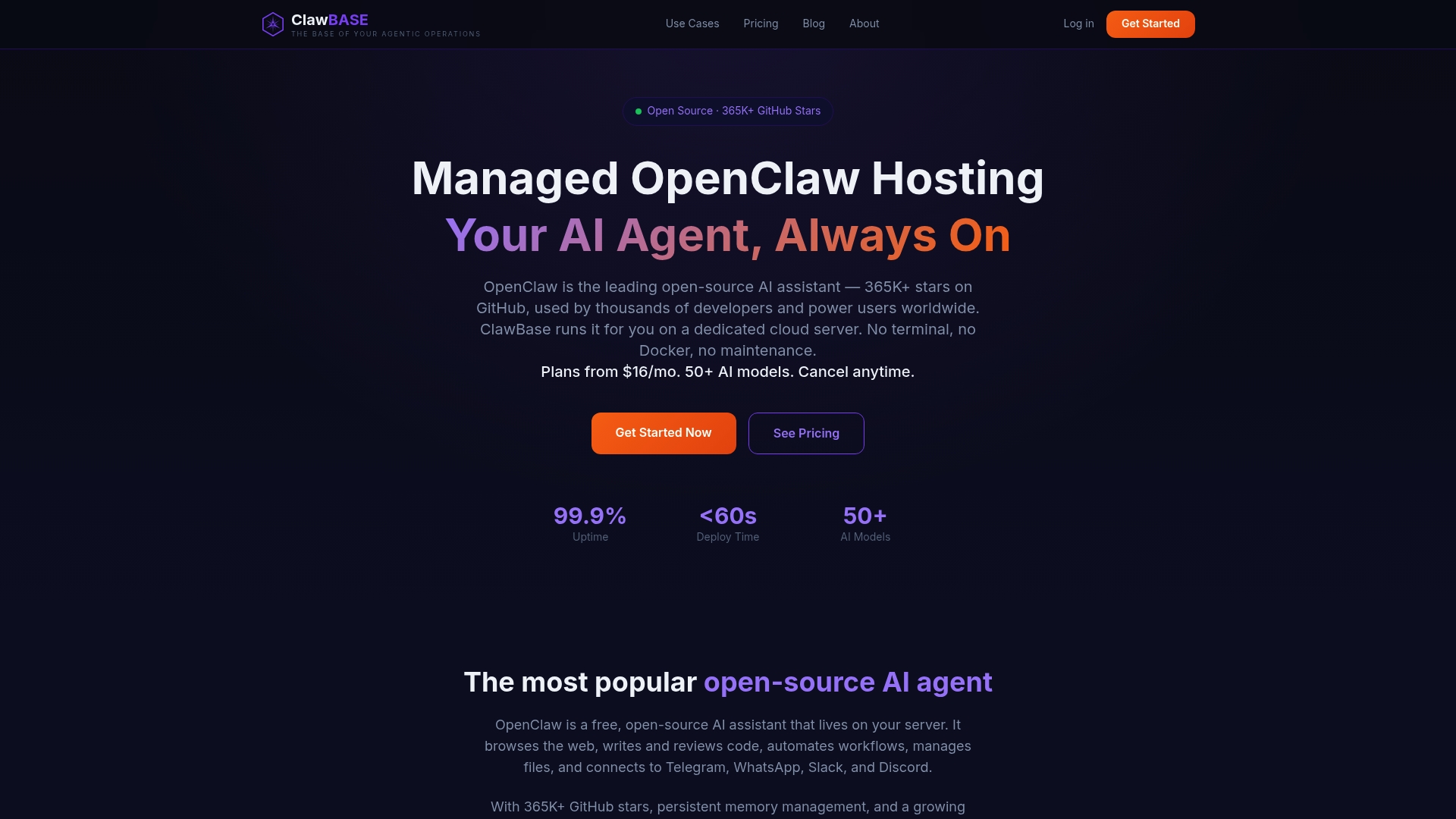
Teams that want to see exactly how AI agents handle communication automation, file management, and workflow tasks can review the full list of AI agent use cases on the Clawbase site. The platform deploys with one click and works with the communication channels your team already uses.
FAQ
What are communication platform AI integration examples?
Communication platform AI integration examples are deployments where AI handles tasks like routing, response generation, and CRM sync inside messaging, voice, or email systems. Real-world examples include AI voice agents replacing IVR systems and multi-agent bots running inside WhatsApp or Microsoft Teams.
How long does it take to deploy an AI communication assistant?
Businesses can deploy AI communication assistants across voice, SMS, and email in a single business day without dedicated engineering teams. Managed hosting platforms like Clawbase reduce that timeline further by eliminating server setup.
What is the Model Context Protocol in AI communication integration?
Model Context Protocol (MCP) is a middleware standard that handles webhooks, session management, and channel routing so developers can focus on AI logic rather than communication plumbing. It keeps multi-channel integrations stable as underlying platform APIs change.
Do AI agents work inside native messaging apps like iMessage?
Yes. AI chatbots can connect to iMessage using APIs like Sendblue without requiring dedicated Apple hardware, and they support large language models including OpenAI GPT-4. Apple Messages for Business also now accepts verified AI agent accounts.
How does persistent memory improve AI communication tools?
Persistent memory stores session state in external databases like Redis or Cosmos DB, so an AI agent recalls previous interactions across SMS, voice, and chat. Without it, every conversation starts from zero, which frustrates customers and reduces automation value.