Best OpenLazarus.ai Alternatives for Developers in 2026
2026-07-26

What are the best openlazarus.ai alternatives right now?
The strongest alternatives to OpenLazarus.ai in 2026 are n8n, Clawbase, Microsoft Copilot Studio, Relevance AI, and Lindy.ai — each covering a distinct slice of the AI agent market. Whether you need self-hosted workflow automation, a managed agent with persistent memory, or a no-code enterprise builder, one of these platforms fits the job.
| Platform | Ease of Use | Integration Depth | Memory | Human-in-the-Loop | Pricing | AI Model Access | Hosting |
|---|---|---|---|---|---|---|---|
| **Lazarus** | Medium | Medium | Ephemeral | Limited | Open source / free | Claude SDK | Self-hosted |
| **n8n** | Medium | Very High | None native | Moderate | Free | External via API | Cloud + Self-hosted |
| **Manus AI** | High | High | Persistent | Moderate | Paid tiers | Proprietary | Cloud |
| **OpenAI AgentKit** | Low (dev) | Medium | Configurable | Configurable | API usage-based | GPT-4o, o-series | Cloud |
| **Microsoft Copilot Studio** | High | Very High | Session-based | Strong | — | GPT-4 family | Cloud / Hybrid |
| **OpenAI GPTs** | Very High | Medium | Thread-based | Minimal | Free | GPT-4o | Cloud |
| **Relevance AI** | High | High | Persistent | Strong | Free | Multi-model | Cloud |
| **Bardeen** | Very High | High | Minimal | Moderate | Free | GPT-4 family | Cloud |
| **Lindy.ai** | Very High | High | Persistent | Moderate | — | Multi-model | Cloud |
| **Clawbase** | Very High | High | Persistent | Moderate | From $16/mo | 50+ models | Dedicated server |
Lazarus itself is the open-source foundation — a Node.js/TypeScript backend with a Next.js frontend, built around the Claude SDK, with native integrations for Slack, Discord, WhatsApp, and email. It is powerful but demands real sysadmin time to run reliably. Every platform in this list addresses that tradeoff differently.

***
Table of Contents
- How do these platforms compare on features, security, and ecosystem?
- How do you choose the right AI agent platform in 2026?
- What can AI agents actually do on platforms like these?
- The bottom line on picking your AI agent platform
- Key Takeaways
- Clawbase: managed AI agent hosting without the setup headache
How do these platforms compare on features, security, and ecosystem?
Integration and communication tools
n8n leads on raw integration breadth, connecting hundreds of services through a visual workflow builder. Microsoft Copilot Studio plugs directly into the Microsoft 365 stack, making it the obvious pick for enterprises already running Teams and SharePoint. Relevance AI and Lindy.ai both offer pre-built connectors for Slack, Gmail, HubSpot, and Notion. Bardeen specializes in browser-based automation with a Chrome extension at its core.
Clawbase integrates natively with Telegram and Discord out of the box, which is a meaningful advantage for developer teams who live in those channels. For data extraction workflows, Alectura pairs well with any of these platforms by adding structured extraction from unstructured documents.

Memory: persistent vs. ephemeral
Memory is where platforms diverge most sharply. Think of it like layers in a brain: short-term context (what happened in this session), medium-term episodic recall (what this user did last week), and long-term knowledge (facts that never expire). Most platforms only implement the first layer.
- Ephemeral only: Lazarus (base), n8n, OpenAI AgentKit (default config), Bardeen
- Thread/session-based: OpenAI GPTs, Microsoft Copilot Studio
- Persistent across sessions: Manus AI, Relevance AI, Lindy.ai, Clawbase
Clawbase uses persistent memory management tied to a dedicated server instance, so your agent retains context between conversations without any extra configuration.
Human-in-the-loop controls
Human-in-the-loop (HITL) controls are table stakes for any regulated or compliance-sensitive workflow. Platforms like Microsoft Copilot Studio and Relevance AI build approval gates and escalation paths directly into their workflow editors. OpenAI AgentKit lets developers implement HITL programmatically, which is flexible but requires engineering effort. Bardeen and OpenAI GPTs offer minimal native controls, making them better suited to low-stakes automation.
Enterprise document processing platforms such as Instabase, Nanonets, and Tungsten Automation take HITL further, embedding validation checkpoints and anomaly detection specifically for compliance-heavy sectors like finance and insurance.
Pricing and cost structure
| Platform | Free Tier | Paid Entry | Notes |
|---|---|---|---|
| Lazarus | Yes (self-host) | Infrastructure cost | Requires DevOps overhead |
| n8n | Yes (self-host) | — | Generous self-host option |
| OpenAI GPTs | Yes (GPT-4o) | — | Per-thread memory only |
| Relevance AI | Yes (limited) | — | Multi-model, good free tier |
| Bardeen | Yes | — | Browser automation focus |
| Lindy.ai | No | — | Strong memory, no free tier |
| Microsoft Copilot Studio | No | — | Enterprise grade |
| Clawbase | No | From $16/mo | Dedicated server, 50+ models |
Security, privacy, and scalability
Microsoft Copilot Studio and Relevance AI publish SOC 2 compliance documentation. n8n's self-hosted model gives teams full data sovereignty, which matters for organizations in regulated industries. Clawbase runs each user on a dedicated server rather than a shared multi-tenant environment, which limits cross-tenant data exposure by design. Manus AI and Lindy.ai are cloud-only, so data residency depends entirely on their infrastructure agreements.
On scalability, n8n and Microsoft Copilot Studio handle enterprise workloads well. Relevance AI scales agent teams horizontally. Clawbase's dedicated-server model scales vertically per instance, which suits teams with predictable, steady workloads rather than massive burst traffic.
Community and ecosystem
n8n has one of the largest open-source communities in the workflow automation space, with thousands of community nodes and active forums. OpenAI GPTs benefit from the GPT Store and a massive user base. Relevance AI has a growing marketplace of pre-built agent templates. Lazarus, being newer and open source, has a smaller but technically engaged contributor base on GitHub.
***
How do you choose the right AI agent platform in 2026?
The decision comes down to six variables. Work through them in order and the shortlist practically writes itself.
- Integration requirements: List every tool your agent must touch. If it is mostly Microsoft 365, Copilot Studio wins. If it is a custom stack, n8n or OpenAI AgentKit gives you the most flexibility.
- Memory needs: If your agent must remember user preferences or prior sessions, rule out ephemeral-only platforms immediately. Persistent memory is not optional for personalization use cases.
- Human-in-the-loop controls: Any workflow touching financial data, legal documents, or customer PII needs approval gates. Relevance AI and Copilot Studio handle this natively; others require custom development.
- Hosting preference: Self-hosting maximizes control and data privacy but adds operational burden. Managed cloud removes that burden at the cost of some control. Dedicated-server hosting, like Clawbase offers, sits between the two.
- AI model access: If you want to swap between GPT-4o, Claude, Mistral, and others without re-architecting, pick a platform with multi-model support. Clawbase gives access to over 50 models from a single interface.
- Budget: n8n and Relevance AI offer the most capable free or low-cost tiers. Lindy.ai and Copilot Studio are priced for teams with real budgets.
Pro Tip: *Before committing to any platform, run a two-week proof of concept on your actual use case, not a demo scenario. Memory behavior and HITL latency only reveal themselves under real workload conditions.*
For developers who want open-source flexibility without the ops overhead, n8n self-hosted is the strongest starting point. For enterprises needing governance and Microsoft ecosystem depth, Copilot Studio is the clear choice. For teams that want a managed, always-on agent with persistent memory and broad model access from day one, Clawbase is worth a close look.
***
What can AI agents actually do on platforms like these?
The practical scope of AI agents in 2026 is wider than most teams realize. Here are the use cases that show up most consistently across these platforms, drawn from real-world automation workflows:
- Document processing: Extract structured data from invoices, contracts, and forms. Platforms like Nanonets and ABBYY specialize here, but Relevance AI and n8n handle it well with the right integrations.
- Customer onboarding: Automate intake forms, identity verification steps, and welcome sequences without human intervention at each stage.
- Compliance assistance: Flag anomalies, route documents for review, and maintain audit trails. AI compliance workflows built on agent platforms reduce manual review time significantly.
- IT operations: Monitor system health, triage support tickets, and trigger remediation scripts automatically.
- Finance and legal workflows: Summarize contracts, extract key clauses, and route approvals through defined escalation paths.
- Developer tooling: Generate code, run tests, and post results to Slack or Discord, which is where Lazarus's native integrations shine.
Memory persistence amplifies every one of these use cases. An agent that remembers a user's prior document submissions or approval history can skip redundant steps and catch inconsistencies that a stateless agent would miss entirely.
***
The bottom line on picking your AI agent platform
No single platform wins across every dimension. The right choice depends on where your workload sits on the complexity-control-cost triangle.
- For open-source control: n8n or Lazarus (self-hosted)
- For enterprise governance: Microsoft Copilot Studio
- For no-code speed: Bardeen or Lindy.ai
- For multi-model flexibility with persistent memory: Relevance AI or Clawbase
- For developer-first API access: OpenAI AgentKit
Test before you commit. Most platforms offer a free tier or trial period. Prioritize memory behavior and HITL controls in your evaluation — those two features separate production-ready agents from demos. And check practical agent capabilities against your actual workflows before signing any contract.
***
Key Takeaways
Persistent memory and human-in-the-loop controls are the two features that most reliably separate production-ready AI agent platforms from demo-grade tools in 2026.
| Point | Details |
|---|---|
| Memory matters most | Platforms with persistent memory enable personalization and context retention across sessions; ephemeral-only tools cannot. |
| HITL is non-negotiable for compliance | Approval gates and escalation paths are required for any workflow touching regulated data or PII. |
| Hosting model shapes data privacy | Dedicated-server and self-hosted options give teams the most control; cloud-only platforms depend on vendor data agreements. |
| Multi-model access future-proofs your stack | Platforms supporting 50+ AI models let you swap providers without re-architecting your agent workflows. |
| Clawbase fits teams wanting managed simplicity | One-click deployment, very high uptime, persistent memory, and access to dozens of AI models starting at an affordable monthly price with no sysadmin overhead. |
***
Clawbase: managed AI agent hosting without the setup headache
Most of the platforms in this comparison ask you to choose between power and convenience. Clawbase is built around the premise that you should not have to make that trade. It delivers a fully managed OpenClaw instance on a dedicated server, starting at $16/mo, with one-click deployment, no maintenance burden, and persistent memory that actually works across sessions.
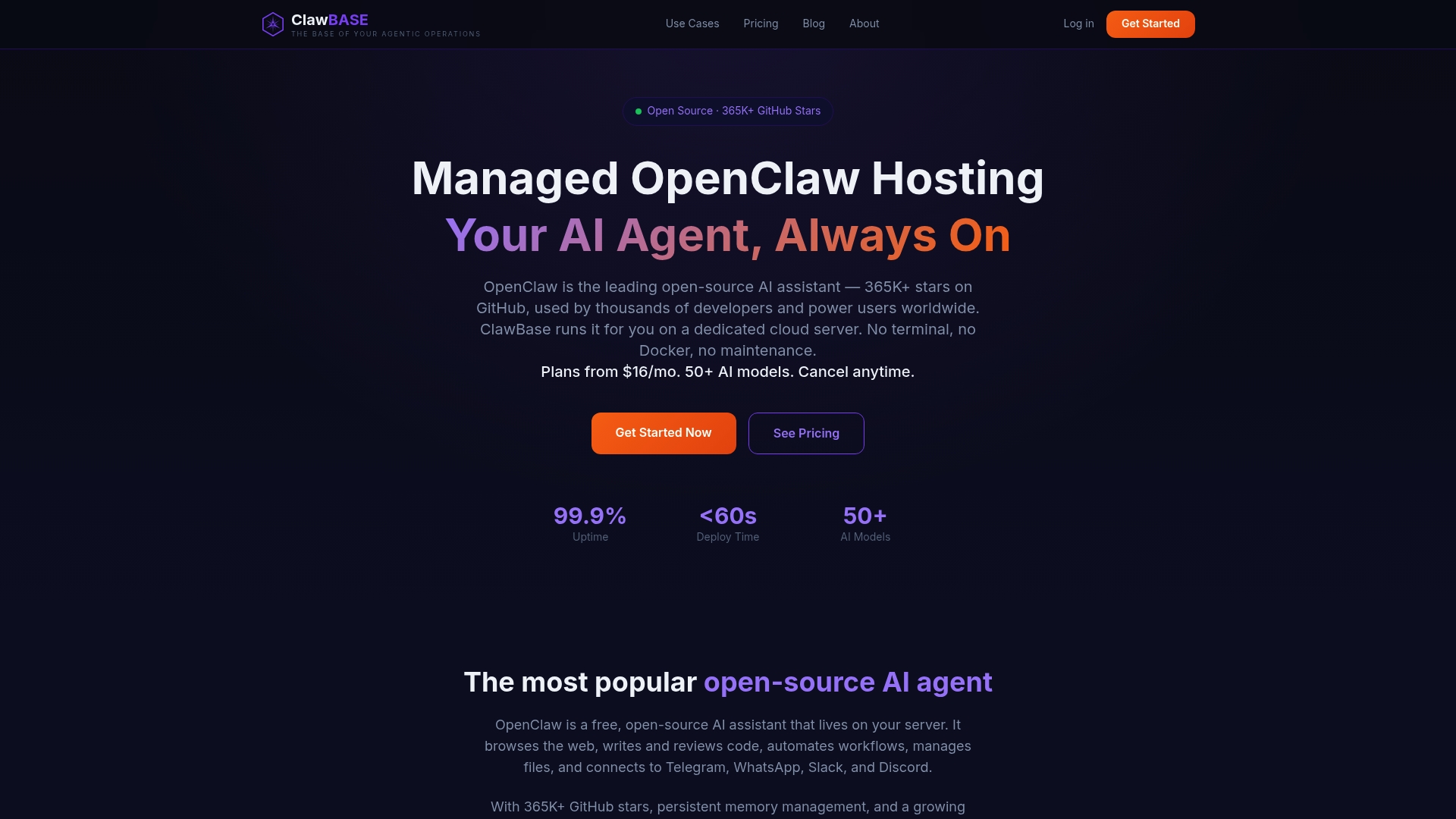
Where Lazarus gives you the raw open-source foundation and n8n gives you workflow breadth, Clawbase gives you a private, always-on AI agent with native Telegram and Discord integration, access to over 50 AI models, and 99.9% uptime backed by dedicated infrastructure. You get the flexibility of a developer-grade platform without spending a weekend on server configuration. If you have been evaluating AI agent platforms and keep hitting the wall of setup complexity, Clawbase removes that wall entirely. Start your instance today at clawbase.to.