The Role of APIs in AI Integration: 2026 Guide
2026-06-07

APIs are the foundational interface layer that makes AI integration possible, connecting AI models to the data sources, services, and execution environments they need to function beyond static inference. Without APIs, an AI system is a closed box: capable of reasoning, but unable to act. The role of APIs in AI integration has expanded dramatically since 2024, driven by the emergence of standardized protocols like the Model Context Protocol (MCP) and the widespread adoption of agent-first architectures by platforms including OpenAI, Anthropic, and Google DeepMind. Understanding how APIs enable AI agents to retrieve data, trigger actions, and coordinate workflows is now table stakes for any team building production AI systems.
How do APIs enable AI systems to access data and execute actions?
Agents rely on APIs for four core functions: persistence, real-time data access, action execution, and specialization. Each function addresses a distinct limitation of the base model. A large language model trained on a static dataset knows nothing about your current inventory, your customer's latest order, or the state of a running process. APIs close that gap by giving the agent a live connection to the systems that hold that information.
The four major API roles in AI agent architectures break down as follows:
- Memory and persistence: APIs connected to vector databases like Pinecone or Weaviate allow agents to store and retrieve conversation history, user preferences, and prior task states. This is what makes an agent feel continuous rather than amnesiac. You can read more about how persistent memory works in practice with OpenClaw agents.
- Real-time data access: REST APIs and GraphQL endpoints give agents access to live business data, weather feeds, financial markets, and sensor streams. The difference between an agent calling a REST endpoint and reading a static dataset is the difference between a live dashboard and a printed report.
- Action execution: Write-access APIs let agents do things, not just know things. Sending an email via the Gmail API, creating a Jira ticket, or updating a Salesforce record are all action executions that transform an AI from an advisor into an operator.
- Specialization: Agents can call specialized external models or services through APIs, such as a dedicated image recognition model, a translation service, or a financial calculation engine, extending their capability without retraining.
The concept of an "agent harness" describes the orchestration layer that manages which APIs an agent can call, in what sequence, and under what conditions. Without this harness, agents make uncoordinated API calls that produce inconsistent results or consume runaway resources.
What are the major architectural patterns for AI API integration?
Successful AI integration architectures combine streaming, orchestration, and interface layers, each with distinct roles and technology stacks. Choosing the wrong layer for a given task is one of the most common and expensive architectural mistakes teams make.

The three dominant patterns in 2026 are REST APIs, MCP, and Apache Kafka. They are not competing alternatives. They solve different problems at different layers of the stack.
| Pattern | Best use case | Maturity | Scalability | Architectural role |
|---|---|---|---|---|
| REST API | Synchronous operational data access | High | Moderate | Interface layer |
| MCP | AI agent tool discovery and invocation | Emerging (2024) | High | Agent-to-tool interface |
| Apache Kafka | Event streaming, data consistency at scale | High | Very high | Data consistency layer |
| API Gateway | Auth, rate limiting, policy enforcement | High | High | Governance and control plane |
| A2A Protocol | Multi-agent communication | Early stage | Moderate | Agent-to-agent coordination |
MCP is the standardized interface enabling AI agents to discover and invoke tools, adopted by major LLM providers since late 2024. Its significance is structural: rather than each agent needing a custom integration for every tool, MCP provides a single protocol that any compliant agent can use to find and call any compliant tool. This mirrors what HTTP did for web browsers.
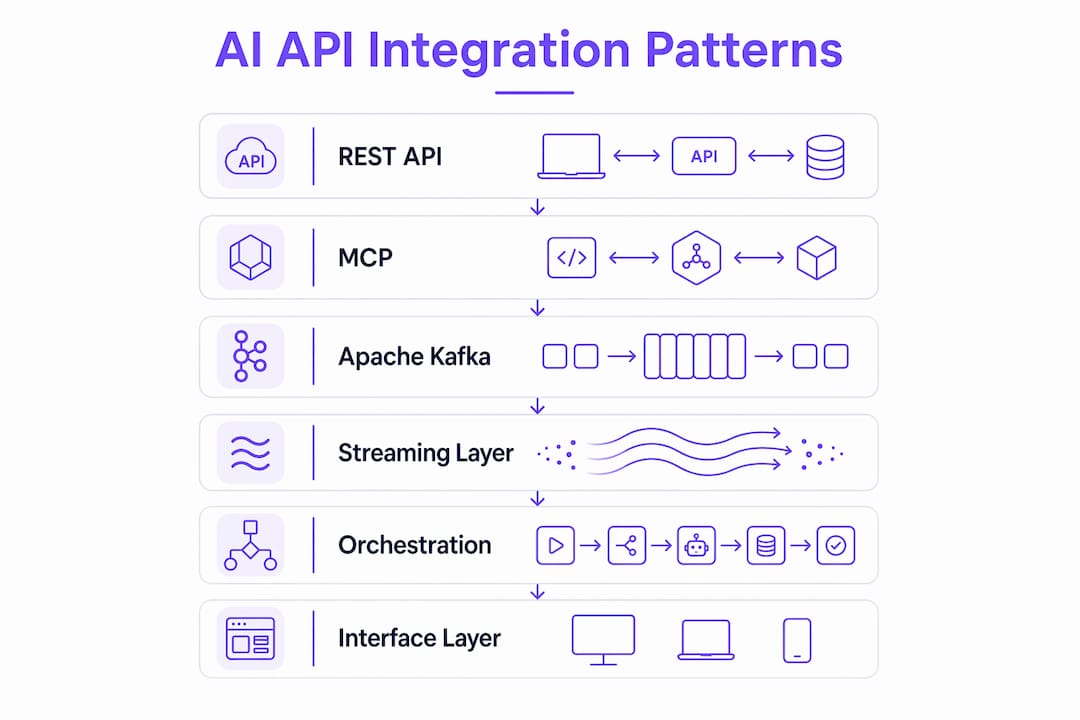
Decoupling data consistency from the interface layer using Kafka allows AI agents to consume fresh, governed data via APIs without overwhelming upstream systems. Kafka handles the volume and ordering guarantees; REST or MCP handles the agent-facing interface. These two layers work together, not in competition.
AI gateway architectures enable unified management of AI and traditional API traffic for cost control and policy enforcement. A gateway sitting in front of all agent API calls gives you a single inspection point for authentication, rate limiting, logging, and anomaly detection. That centralized visibility is what separates a governed AI system from an uncontrolled one.
Pro Tip: *Deploy an API gateway specifically configured for AI traffic patterns. AI agents make non-deterministic, multi-step call sequences that look nothing like human-driven API usage. Standard gateway configurations tuned for human traffic will miss the anomalies that matter most for AI governance.*
How should APIs be designed differently for AI agent consumers?
AI agents treat APIs as black boxes. They depend entirely on what the API tells them about itself, because they cannot read supplementary documentation, ask a colleague, or infer intent from context the way a human developer can. This changes API design from a developer experience problem into a machine reasoning problem.
APIs that are self-describing, consistent in naming, and explicit in error handling optimize usage by AI agents and reduce failures. The practical implications are significant. Every endpoint needs a clear, semantic name that describes the action and the resource. Every error response needs a machine-readable code and a human-readable explanation that an agent can use to decide its next step.
Key design principles for AI-native APIs:
- Idempotency by default: Agents retry failed calls. If your "POST /orders` endpoint creates a duplicate order on retry, you have a production incident waiting to happen. Design write endpoints to be idempotent using request IDs or conditional logic.
- Coarse-grained, task-oriented tools: Task-oriented, coarse-grained API tools aligned to user outcomes reduce failure rates when exposed to autonomous agents. Instead of exposing
GET /customer,GET /orders, andGET /preferencesas three separate calls, exposeGET /customer-contextthat returns everything an agent needs to handle a customer interaction in one call. - Inline examples and schemas: Automated enrichment of API documentation can improve AI agent invocation and payload accuracy by up to 25%. That improvement comes from giving agents concrete examples of valid payloads, not just abstract schema definitions.
- Explicit error taxonomy: Define a finite set of error codes with clear semantics.
INSUFFICIENT_PERMISSIONS,RESOURCE_NOT_FOUND, andRATE_LIMIT_EXCEEDEDgive an agent a decision tree.500 Internal Server Errorgives it nothing. - Stable contracts: Non-deterministic agent behavior makes breaking API changes catastrophically unpredictable. Version your APIs aggressively and maintain backward compatibility longer than you think you need to.
Designing for AI agents shifts API paradigms toward public, semantic, and machine-readable interface standards rather than human-written documentation. This is a fundamental shift. The OpenAPI spec becomes the source of truth, not a supplement to it.
Pro Tip: *Run your API spec through an LLM before shipping it. Ask the model to invoke your endpoints based only on the spec. If it gets the payload wrong or misunderstands the endpoint's purpose, your documentation is the problem, not the model.*
What are the best practices for enterprise AI API integration?
Implementing API-driven AI integration at enterprise scale requires more than connecting an agent to a few endpoints. It requires an architectural strategy that accounts for data freshness, governance, versioning, and the operational reality that AI agents behave differently in production than they do in testing.
Here is a practical sequence for building a production-grade AI API integration architecture:
- Adopt an API-first strategy from day one. API-first architecture provides abstraction and enables AI systems to scale without cascading integration complexity. Define your API contracts before writing implementation code. This prevents the common failure mode where internal services get tightly coupled to specific agent behaviors.
- Build a context aggregation layer. Rather than letting agents call dozens of microservices directly, create context APIs that aggregate multi-source data into AI-optimized payloads. A single
GET /agent-contextendpoint that combines user profile, recent activity, and relevant knowledge base entries is faster, cheaper, and more reliable than three separate calls.
- Implement orchestration APIs for multi-step workflows. Orchestration APIs coordinate agent workflows and human-in-the-loop interventions. When an agent needs to complete a five-step process that includes a human approval at step three, the orchestration layer manages state, timeouts, and handoffs. Without it, you are managing that complexity inside the agent's prompt, which is fragile.
- Centralize authentication and rate limiting at the gateway. Governance via least-privilege authentication, rate limiting, and audit logs at the API gateway is critical for safe AI integration. Every agent should authenticate with scoped credentials that grant access only to the APIs it needs for its specific task. Broad credentials are a security liability in any system. In an autonomous agent system, they are a serious risk.
- Version your context APIs alongside your AI models. When you update a model, its expectations about API response structure may change. Treat context API versions as first-class artifacts in your release process, not as afterthoughts.
- Monitor for AI-specific traffic patterns. The non-deterministic call patterns of AI agents require governance models beyond traditional API monitoring. Set up alerts for unusual call sequences, unexpected payload sizes, and cost spikes. An agent stuck in a retry loop can exhaust a rate limit budget in minutes.
You can see how enterprise AI API integration plays out across real production environments, including patterns for MCP adoption and agent orchestration at scale.
Key takeaways
APIs are the non-negotiable infrastructure layer that determines whether an AI system can act, scale, and be governed in production.
| Point | Details |
|---|---|
| Four core API functions | Agents depend on APIs for memory, real-time data, action execution, and specialization. |
| MCP as the emerging standard | MCP provides a unified agent-to-tool interface adopted by major LLM providers since late 2024. |
| AI-native API design | Self-describing, idempotent, coarse-grained endpoints reduce agent failure rates significantly. |
| Gateway governance | Centralized API gateways are required to manage auth, rate limits, and audit trails for AI traffic. |
| API-first architecture | Defining API contracts before implementation prevents cascading complexity as AI systems grow. |
Why API discipline is the real differentiator in AI projects
From where I sit, the teams that struggle most with AI integration are not struggling with the models. They are struggling with the plumbing. I have seen projects where the underlying LLM was excellent but the integration architecture was so fragile that the agent produced inconsistent results in production. The model got the blame. The APIs were the actual problem.
The shift to agent-first architectures makes API quality a direct determinant of AI quality. When an agent calls a poorly designed endpoint and gets back an ambiguous error, it does not fail gracefully. It hallucinates a recovery path. That is not a model failure. That is a design failure that the model is forced to compensate for.
What I find genuinely exciting about MCP is that it creates a shared vocabulary between agents and tools. MCP servers offer centralized update points for AI tool integrations, which means you can improve how dozens of agents interact with a service by updating one MCP server. That kind of leverage is what makes large-scale agent ecosystems maintainable rather than chaotic.
My honest recommendation: treat your API documentation as a first-class product. Invest in schema enrichment, inline examples, and semantic naming with the same rigor you apply to model selection. The AI and API collaboration that produces reliable, scalable systems is built on that foundation, not on prompt engineering alone.
> *— Iosif Peterfi*
How Clawbase handles API orchestration for AI agents
If you are building or deploying AI agents and want to skip the infrastructure complexity, Clawbase is worth a close look. Clawbase provides managed hosting for OpenClaw agents with built-in support for MCP, persistent memory, and integration with over 50 AI models. You get the API orchestration layer, authentication management, and uptime guarantees without configuring a single server.
The platform is designed specifically for teams that want production-grade AI agent capabilities without the sysadmin overhead. Explore the full range of AI agent use cases that Clawbase supports, from workflow automation to file management and communication platform integrations. Managed hosting starts at $16/mo at Clawbase, with plans that scale as your agent workloads grow.
FAQ
What is the role of APIs in AI integration?
APIs serve as the interface layer that connects AI models to external data sources, services, and execution environments. They enable agents to retrieve real-time data, trigger actions, maintain persistent state, and coordinate multi-step workflows.
What is MCP and why does it matter for AI agents?
MCP, or Model Context Protocol, is a standardized interface that allows AI agents to discover and invoke tools without custom integrations for each service. It has been adopted by major LLM providers since late 2024 and functions as a universal protocol for agent-to-tool communication.
How is API design different for AI agents vs. human developers?
AI agents cannot read supplementary documentation or infer intent from context. APIs designed for agent consumption must be self-describing, use consistent semantic naming, return explicit error codes, and expose coarse-grained task-oriented endpoints rather than fine-grained microservice calls.
Why do AI integrations need a dedicated API gateway?
AI agents produce non-deterministic, multi-step call patterns that differ fundamentally from human-driven API traffic. A dedicated gateway provides centralized authentication, rate limiting, cost monitoring, and audit logging tuned to those patterns, which standard gateway configurations miss.
What is an API-first strategy in the context of AI systems?
An API-first strategy means defining API contracts before writing implementation code. For AI systems, this prevents tight coupling between agent behaviors and internal services, making it possible to update models or services independently without breaking the integration.