Top 5 Utilink.xyz Alternatives for 2026
2026-06-20
Finding managed AI agent hosting that balances hands-off deployment, compliance needs, and model selection is complex for teams judging alternatives to Utilink.xyz. Many services lock advanced features behind expensive tiers, block workflow integrations, or limit fast no-code onboarding for non-technical teams. This list breaks down hosting models, pricing, and automation support so teams can match the right substitute to their workflow and scaling plans.
Table of Contents
ClawBase
At a Glance
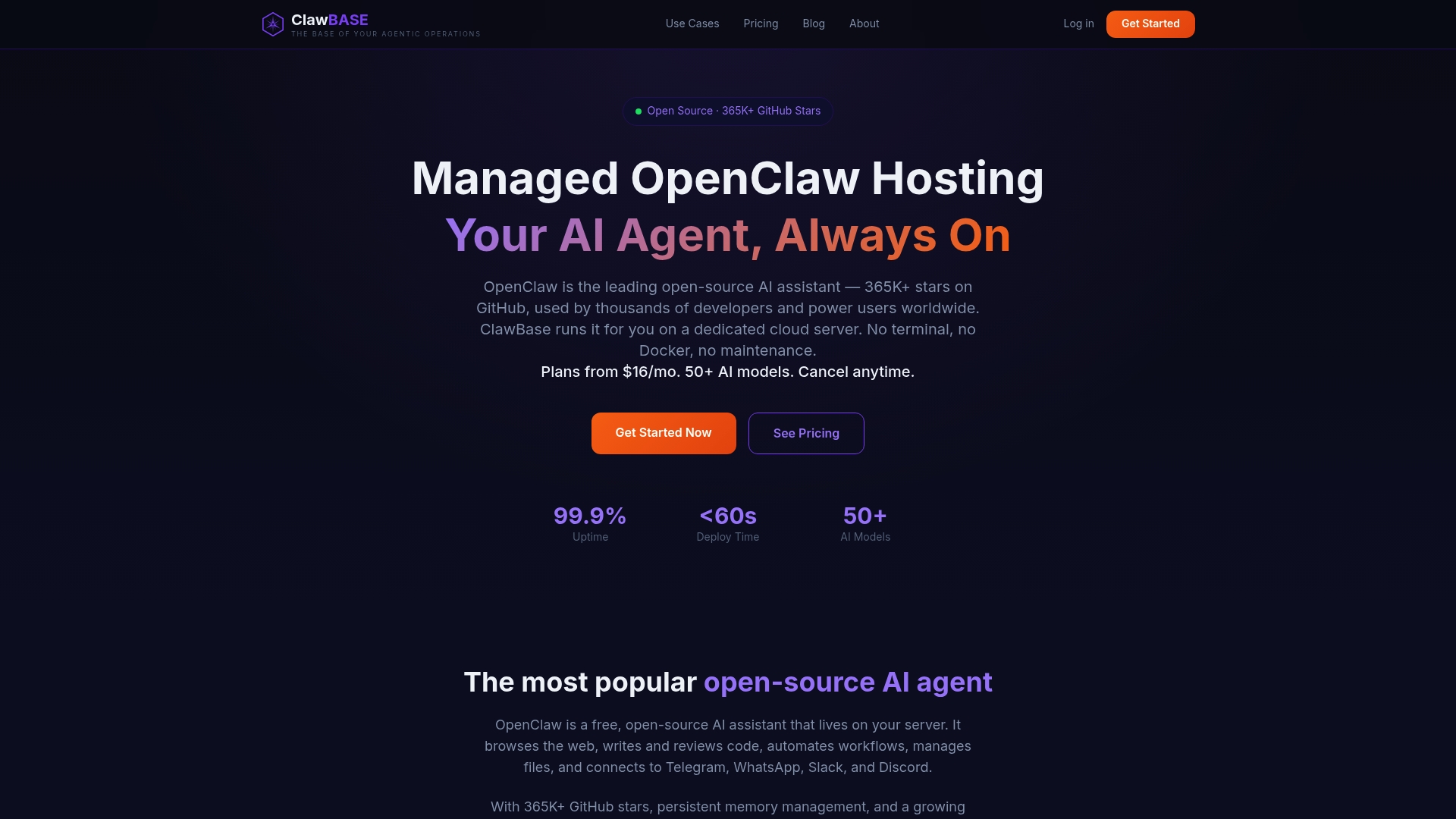
ClawBase's marketing materials state 99.9% uptime and support for over 50 AI models. It delivers dedicated, encrypted OpenClaw instances with auto-updates and backups. Plans start from $16/month and include a free seven-day trial for the basic plan.
Core Features
ClawBase runs managed hosting for the OpenClaw assistant on dedicated, encrypted instances and handles updates, backups, and scaling. It supports a multimodel approach and offers a ClawHub marketplace of pre-built skillsets such as SEO, code review, and security scans. Messaging integrations include Telegram, WhatsApp, and Discord for always-on assistants that talk where your team already works.
Key Differentiator
The core distinction is fully managed hosting of OpenClaw so you skip server setup and ongoing maintenance. That hands-off hosting couples with a library of ready-made skillsets and multimodel support to reduce engineering time when adding capabilities.
Pros
No server or sysadmin knowledge is required. You click to deploy a private OpenClaw instance while ClawBase manages scaling, updates, and backups. The service claims high availability and broad model support, which helps teams keep an always-on agent without running their own infrastructure.
Cons
- Limited hands-on customization if you are not technically inclined.
Notable Integrations
- Telegram
- Discord
Who It's For
Solo creators and small teams that want a plug-and-play personal AI agent without system administration. Developers who want a private, always-on assistant but prefer not to manage servers will find the deployment model helpful. Teams that rely on messaging apps for daily work will benefit from the built-in chat integrations.
Unique Value Proposition
One-click deployment of a private, dedicated OpenClaw instance on an encrypted server removes the heavy lift of setup and maintenance. That reduces the time developers spend on ops and lets nontechnical people run a persistent agent for automation and workflows. For teams, the combination of managed hosting and ready-made skillsets shortens the path from idea to usable automation.
Real World Use Case
A freelancer deploys a dedicated instance to automate email triage, schedule management, and code review. The assistant runs inside Telegram and Discord for instant notifications while ClawBase handles uptime, updates, and backups. That frees the freelancer to focus on client work rather than server upkeep.
Pricing
Plans start from $16/month for the Lite plan with annual billing options. A free seven-day trial is available for the basic plan to test integrations and skillsets before committing.
Website: https://clawbase.to
Agntable
At a Glance
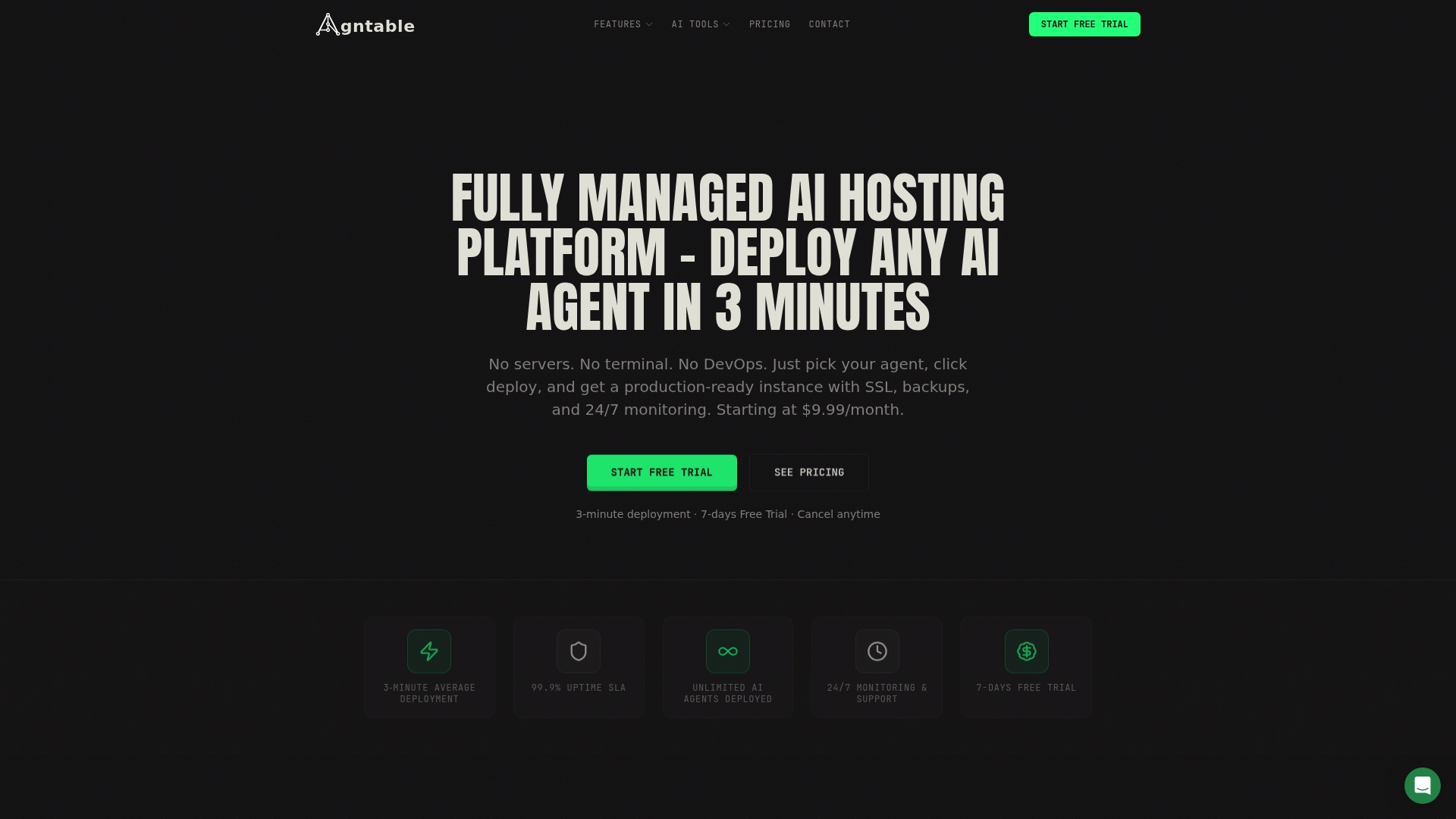
According to the company, you can deploy an AI agent in just three minutes. The platform targets open source AI agents with a fully managed hosting model that handles updates, backups, scaling, and security. Pricing starts at $9.99/month, with a 7-day free trial available.
Core Features
Agntable delivers one click deployment of AI agents along with built in security that includes automatic SSL and network isolation. The platform performs daily backups with point in time recovery and applies automatic updates for features and security patches. It also offers one click scaling for CPU and RAM to increase capacity without manual server management.
Key Differentiator
Agntable focuses on rapid deployment for open source AI agents while combining security and automated scaling. That timeline for quick deployment supports a workflow where teams treat agents as disposable, replaceable services rather than long lived infrastructure. This focus narrows the product to users who want managed agent hosting rather than full on-premise control.
Pros
Agntable simplifies deploying open source AI agents by removing DevOps and infrastructure setup, which speeds prototypes and reduces operational overhead. The built in security features and daily backup options suit teams that need baseline compliance and recoverability without running their own infrastructure. Flexible plans plus a 7-day free trial let teams validate workflows before committing to a monthly plan.
Cons
- Trusts third party monitoring and automation, which may not meet specific compliance requirements for sensitive data. This may force teams handling regulated data to invest in add ons or different deployment models.
- No custom hardware or on premise deployment option is listed. Organizations that require local hardware control will not find an on site path in the product notes.
- Pricing is charged per agent, which can become costly when you need many concurrent agents. The per agent model raises ongoing operational costs for multiagent deployments.
Who It's For
Agntable fits non technical people and small developer teams who want managed agent hosting without DevOps. Startups and agencies that must spin up agents quickly for experiments will benefit from the time to deploy and automatic maintenance. Organizations that require dedicated on premise hardware or strict private monitoring will find the fit weaker.
Real World Use Case
A marketing agency deploys separate AI agents per client to run campaign automation and data enrichment tasks. The agency spins up and scales each agent through Agntable, avoids server maintenance, and restores a misconfigured agent from daily backups. This setup saves the team time that would otherwise go to server patches and capacity planning.
Pricing
Plans start at $9.99/month for the Starter tier, with Pro at $24.99/month and Business at $49.99/month. All plans include a 7-day free trial so teams can test deployments and backups before paying.
Website: https://agntable.com
RunAgent
At a Glance
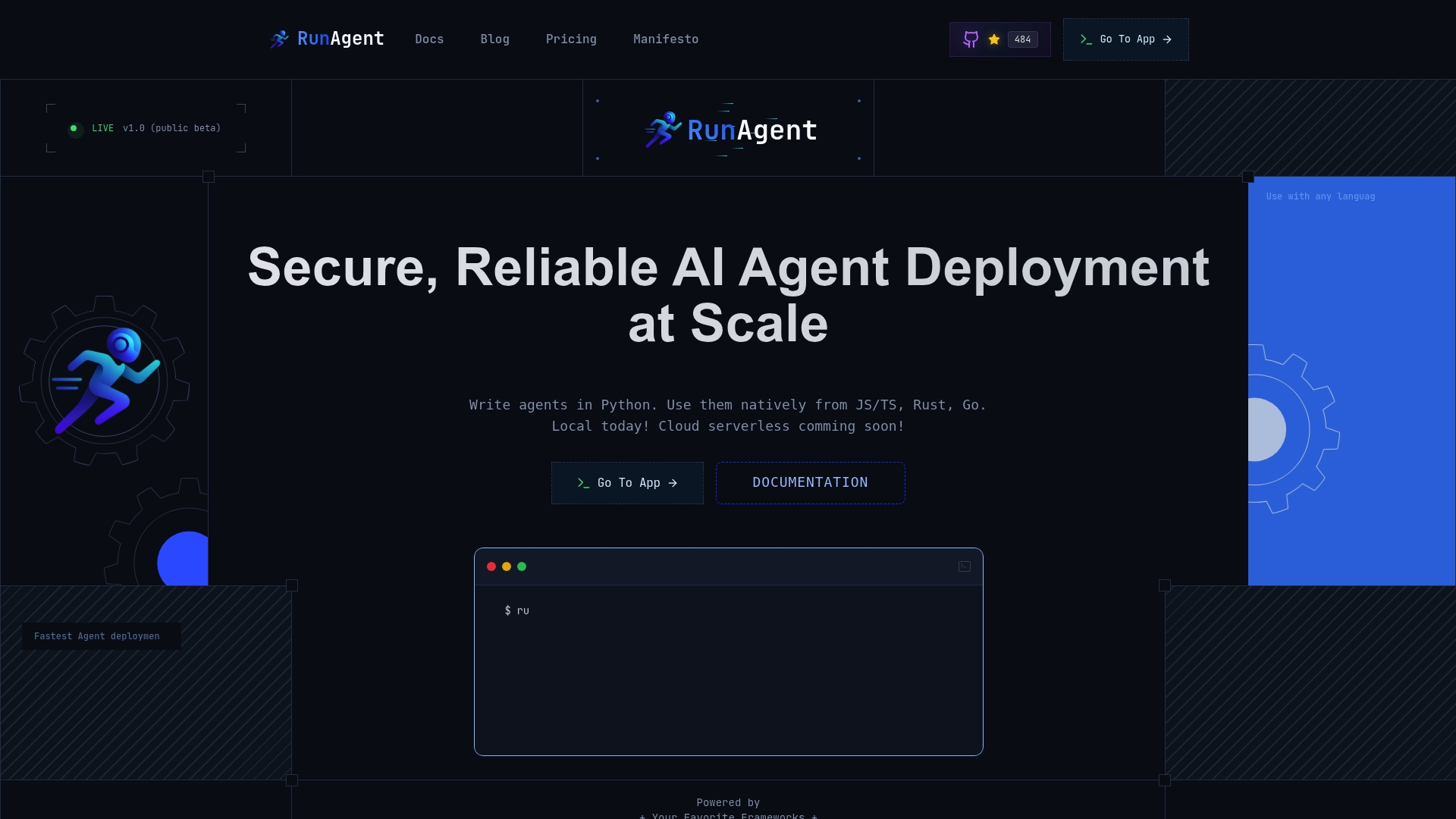
RunAgent supports writing agents in Python while offering native SDKs for JavaScript TypeScript, Rust, and Go. It combines CLI-first deployment with local hot reloading and serverless cloud hosting. The platform advertises features that address conversation streaming, stateful ness, and orchestration for multi-turn reasoning.
Core Features
RunAgent provides multi-language SDK support so teams can use Python, JavaScript TypeScript, Rust, or Go without rewriting core logic. The CLI-first workflow covers init, serve, and deploy commands and supports local hot reloading for rapid iteration. Serverless cloud hosting offers auto-scaling and production-oriented observability to track agent behavior in real time.
Key Differentiator
RunAgent focuses on agent-specific infrastructure rather than generic model hosting. It tackles conversation streaming, stateful ness, and orchestration as first-class concerns, which reduces glue code for long-lived multi-turn agents. That focus makes it easier to move prototypes into production while preserving agent memory and live streams.
Pros
RunAgent enables teams to build agents in their existing stacks, which speeds cross-team collaboration and reduces context switching. The CLI-first deployment model keeps iteration fast, and local hot reloading shortens debug cycles during agent development. Cloud auto-scaling and built-in observability simplify operations for production agents, and the vendor cites active documentation and community support for onboarding.
Cons
- Limited public documentation may slow initial onboarding for complex agent designs.
- The cloud deployment model can introduce a learning curve for teams new to serverless orchestration.
- As a newer platform, long-term stability and feature completeness are still evolving.
When It May Not Fit
RunAgent may not fit teams that need an enterprise vendor with years of proven uptime and a large public knowledge base. It is also a poor match for groups that need turnkey managed agents with heavy handholding during initial setup. Teams that prefer a single-language, opinionated framework might find the multi-language focus adds unnecessary complexity.
Who It's For
RunAgent suits AI developers and engineering teams building multi-language, stateful agents that must scale in cloud environments. It fits groups that accept a CLI-driven workflow and want explicit control over streaming and memory management. Enterprises planning to deploy multi-turn assistants across languages will find the feature set relevant.
Real World Use Case
A company builds an assistant that must call internal APIs, keep conversation memory, and support both Python and TypeScript microservices. Developers iterate locally with hot reloading, test conversation streams in real time, and then deploy to the serverless cloud for automatic scaling. Observability traces help debug orchestration when multiple agent threads interact.
Pricing
Pricing is not specified publicly. The vendor describes a subscription-style model with free credits and paid tiers, so expect usage and tiered plan options rather than a one-time license. For exact costs, contact sales or check the vendor site for plan details.
Website: https://run-agent.ai
Phinite
At a Glance
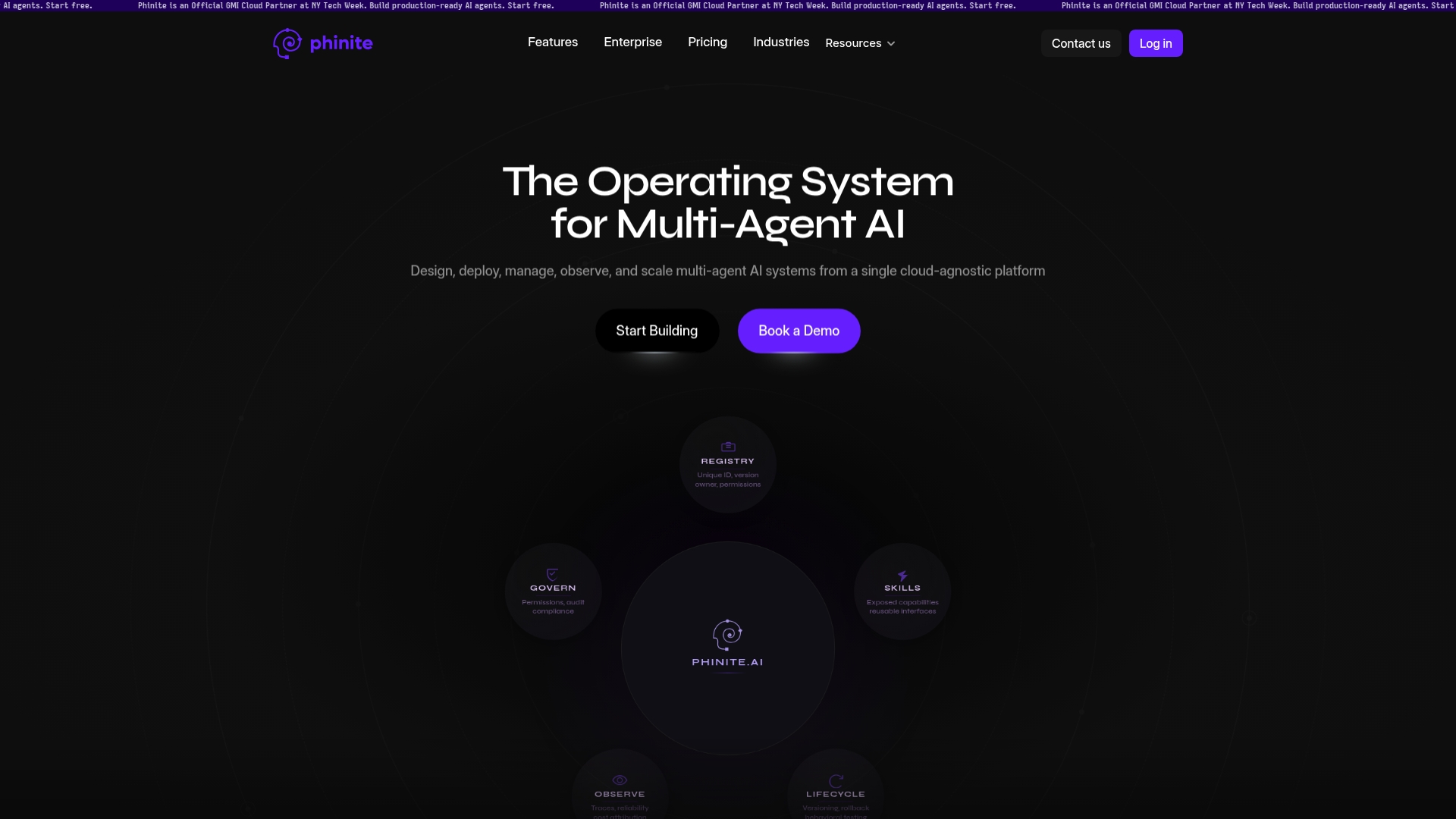
Plans start at $20/month on a usage-based model with a free tier. Phinite packages its billing around consumption, which suits phased prototyping and scaled deployments. The product targets teams running many coordinated agents and offers tools for observability and governance.
Core Features
Phinite provides visual workflows for designing agent topologies and hands-on lifecycle features such as versioning and rollback. It supports lifecycle management across deployment stages and offers real-time supervision and monitoring of agents. The platform also delivers multichannel deployment for voice, chat, and email plus API support and enterprise security controls.
Key Differentiator
Phinite focuses on unified full lifecycle management and orchestration of multi-agent AI from a cloud-agnostic control plane. That emphasis lets teams design topology visually, push changes, and roll back versions without flipping between tools. The orchestration layer pairs lifecycle controls with audit logging and governance workflows aimed at regulated or large enterprise environments.
Pros
Phinite consolidates agent design, deployment, and monitoring into a single operational surface, which reduces context switching for engineering teams. It supports deployments across voice, chat, and email, so operations and contact-center teams can reuse the same agent topologies. The platform includes enterprise-grade security and governance with audit logs and data privacy protections. Flexible, usage-based pricing helps teams scale costs with consumption rather than fixed per-seat bills.
Cons
- The platform has a steep learning curve for teams new to AI orchestration and agent topology design.
- Pricing for very large agent systems can be hard to estimate from the public materials.
- The product offers limited consumer-level features and fewer tailored options for small businesses.
When It May Not Fit
Small teams without an engineering lead may find the platform overly complex for pilot projects. Organizations that need clear, predictable per-seat billing instead of usage pricing might prefer a different commercial model. Budgets for massive multi-agent deployments should account for potentially high costs at scale.
Who It's For
This product fits IT teams, AI engineers, and enterprise developers managing multi-agent AI at scale. It suits groups that need governance, auditability, and cross-channel deployments. The ideal buyer runs coordinated agent systems across departments or contact centers.
Real World Use Case
A large customer service organization deploys agents on chat, email, and voice channels to handle tier one support. Engineers manage agent versions and rollbacks during high-impact changes and monitor performance in real time. Security and audit logs help compliance teams review interactions and data handling.
Pricing
Phinite uses usage-based billing with a free tier. Public materials list tiered plans starting at $20/month and custom enterprise pricing for large deployments. The vendor states you pay for actual consumption rather than per-seat licensing.
Website: https://phinite.ai
MindStudio AI
At a Glance
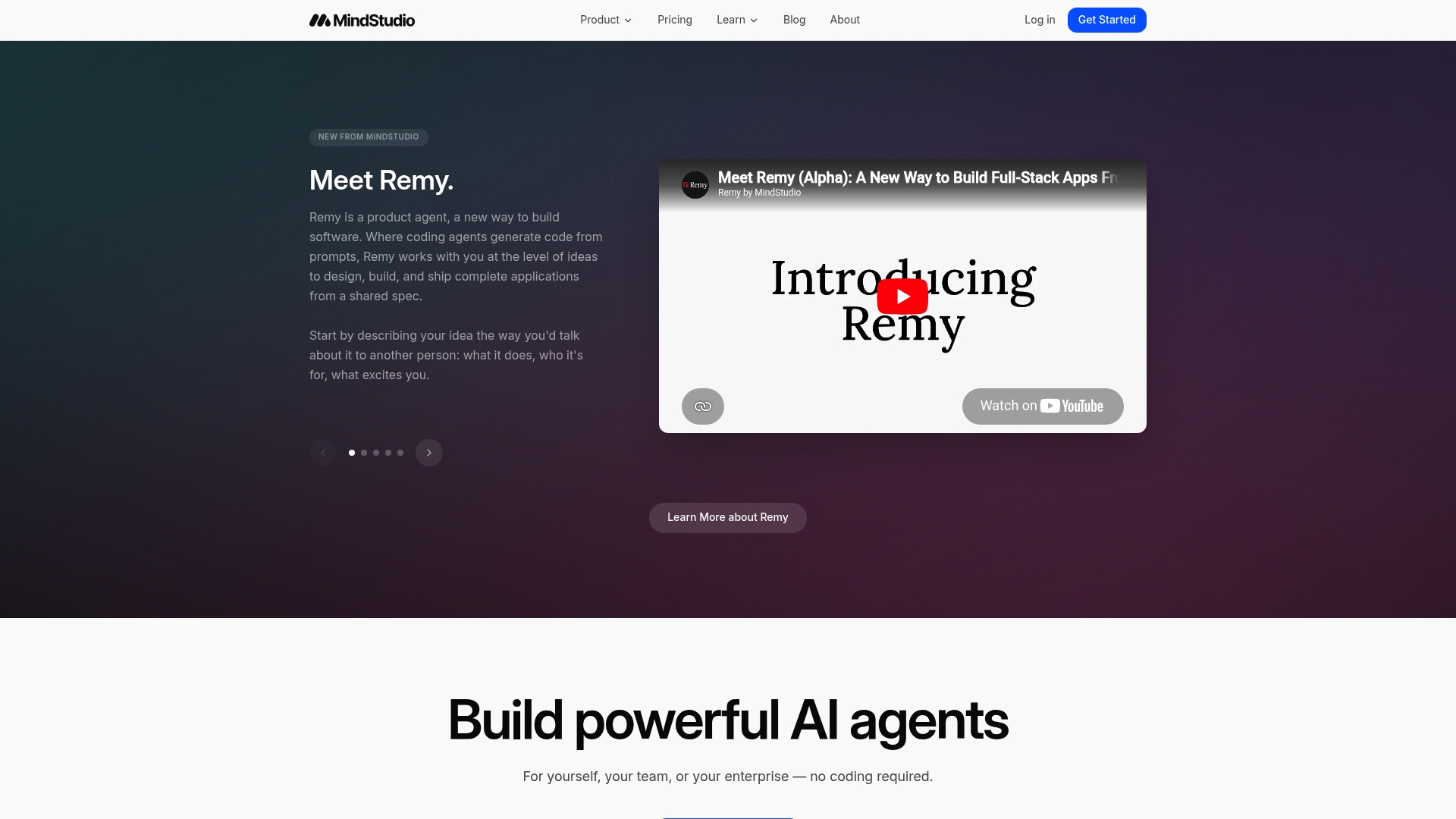
MindStudio AI reports access to over 200 AI models. That coverage includes OpenAI, Anthropic, Google Gemini, and other commercial engines. The product emphasizes a Visual IDE and visual builders for designing AI native agents without deep coding skills.
Core Features
MindStudio lets you build and deploy AI agents as web apps, backend automations, browser extensions, and API endpoints while offering pre built integrations with business apps and social platforms. The platform combines a visual builder for no code workflows with support for custom code in JavaScript and Python for advanced logic. It also offers role based access and audit tooling aimed at teams that need controlled deployments.
Key Differentiator
MindStudio focuses on making AI agents accessible while keeping enterprise security options visible. The platform pairs visual agent creation with options for SSO and private hosting, which appeals to teams that must control data and deployment. That trade off between ease of use and enterprise controls defines its place among alternatives.
Pros
The interface lowers the barrier for non technical people to assemble agent logic while still letting engineers add scripts where needed. The wide model access and pre built integrations let teams swap models or connectors without reworking pipelines. Enterprise features such as SSO, audit logs, and private hosting support compliance needs and give IT teams a deployment path that stays inside corporate boundaries.
Cons
- Pricing details for larger scale deployments are limited. This makes budgeting uncertain for heavy usage.
- The platform relies on third party models, which can introduce additional usage costs and data privacy considerations. Some model calibration details are not specified.
- Advanced customization requires coding experience in JavaScript or Python. Non technical teams will hit a learning curve for complex behaviors.
When It May Not Fit
If you must run all inference fully offline, MindStudio may not match your needs because cloud model access requires internet connectivity unless you self host. If your team has zero coding capability and needs deep custom agents, the learning curve for advanced scripts may slow rollout. Large enterprises that need transparent public enterprise pricing may find the custom quote model inconvenient.
Who It's For
Individuals, professionals, and small to mid sized teams that want a no code or low code path to build AI agents will find this product sensible. Technical teams that want to add custom JavaScript or Python logic can extend agents beyond templates. Security conscious organizations that require SSO and private hosting will see clear advantages.
Real World Use Case
A marketing team configures an agent to queue social posts, scan brand mentions, and draft captions. The agent runs scheduled automations and hands high priority alerts to a human reviewer. That setup cuts manual scheduling work and speeds campaign launches.
Pricing
According to the company, a free tier exists with limited features and paid plans start at $20/month for unlimited agents. Enterprise options are available with custom pricing and are not publicly detailed. Evaluate the free tier to test connectors and basic agent flows before committing.
Website: https://mindstudio.ai
Comparison of alternatives
Selecting the ideal AI agent hosting service requires a careful evaluation of your unique preferences and operational requirements. Each listed solution in this comparative analysis offers strengths that align with different scenarios; therefore, understanding key distinctions is crucial.
Deployment efficiency and tailored usability
ClawBase excels at providing users—particularly those without extensive technical expertise—a straightforward, managed experience. It eliminates the need for advanced configuration and maintenance tasks, offering a cost-effective entry point. In contrast, Agntable enables rapid deployment workflows suitable for experimentation, albeit at a significant long-term cost due to per-agent pricing.
Flexibility in agent development and control
RunAgent appeals to development teams requiring advanced language support and CLI-first workflows. Its ability to smoothly integrate multi-language agents provides flexibility for complex requirement scenarios. However, its steep learning paths and reliance on emerging platform maturity make it less user-friendly for non-technical users. Phinite, on the other hand, caters to enterprises seeking cloud-agnostic solutions for intricate multi-agent environments, employing visualization and managed lifecycle capabilities that prioritize governance and traceability.
Best fit
- Teams or individuals aiming for plug-and-play hosted AI assistants at moderate pricing will appreciate ClawBase for its simplicity and included skillsets.
- Those prioritizing the ability to quickly deploy and iterate multiple agents would benefit most from Agntable.
- Developer teams needing extensive SDK support and multi-language compatibility should consider RunAgent.
- Organizations focusing on compliance and lifecycle orchestration for complex AI systems might opt for Phinite.
- Non-technical users or small-medium enterprises will find MindStudio AI’s visual builders aligned with their needs, offering a blend of simplicity and extendable customization.
Our pick
ClawBase offers a unique blend of managed service simplicity and adaptable skillset support, delivering foundational innovations at a competitive price point. This makes ClawBase ideal for small to medium teams balancing ease of use and operational autonomy. However, technical teams focusing heavily on custom integrations may favor platforms that target specific development environments.
Managed AI agent hosting solutions vary widely in deployment models, integrations, and ease of use. The following comparison highlights key features for informed decisioning.
| **Product** | **Key Differentiator** | **Core Features** | **Pricing** | **Notable Limitation** |
|---|---|---|---|---|
| ClawBase | Fully managed OpenClaw hosting with prebuilt skillsets | Multimodel support, dedicated encrypted instances, messaging integration | Starting at $16/month | Limited hands-on customization for nontechnical users |
| Agntable | Rapid deployment timeline for disposable agents | One-click deployment, integrated security, daily backups | Starting at $9.99/month | No on-premise or custom hardware options |
| RunAgent | Agent-specific infrastructure with multilang SDK support | CLI-first tools, local hot-reloading, serverless cloud | Price not published | Uncertain long-term stability as a newer platform |
| Phinite | Visual lifecycle management and governance | Multichannel deployment, audit controls, cloud-agnostic orchestration | Starting at $20/month | Steep learning curve for agent topology design |
| MindStudio AI | Visual IDE for agent creation with enterprise controls | Wide model access, no-code support, SSO integration | Starting at $20/month | Custom script requirements for advanced features |
What Challenges Do Utilink.xyz Alternatives Face in Simplifying AI Agent Deployment?
Many users of utilink.xyz alternatives struggle with the technical demands of managing AI assistants, particularly the need for sysadmin expertise and ongoing server maintenance. Clawbase addresses this challenge by offering one-click deployment of OpenClaw on dedicated, encrypted servers. This eliminates downtime worries with 99.9 percent uptime and provides access to over 50 AI models, making persistent memory management and workflow automation easy for solo creators and small teams.
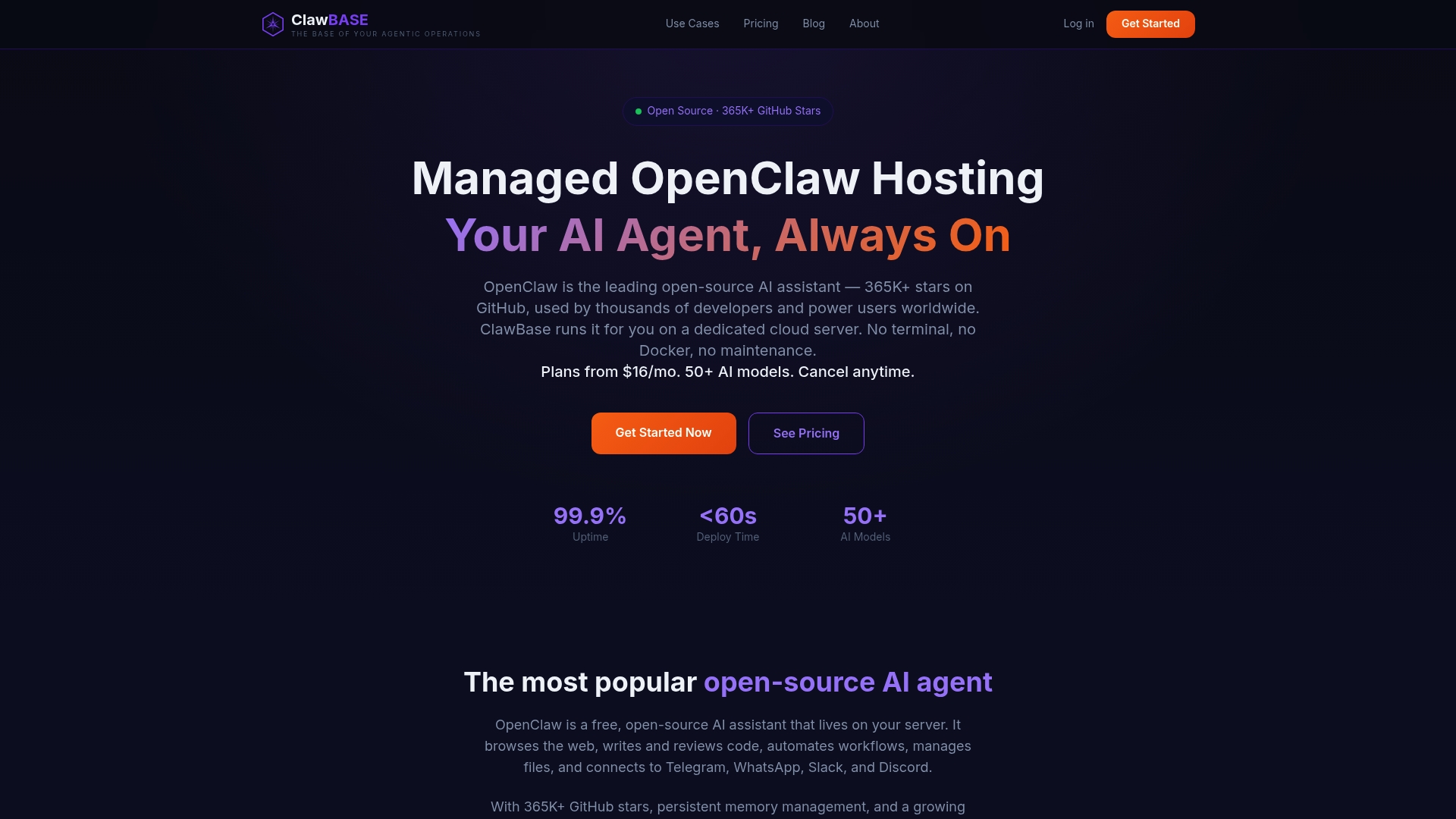
If you want a private, always-on AI agent integrated into popular platforms like Telegram and Discord without managing infrastructure, visit Clawbase. Test the simple deployment yourself and start automating notifications, file management, and multi-model tasks without technical barriers.
FAQ
#### How does Clawbase handle security for managed AI agent hosting?
Clawbase offers dedicated, encrypted OpenClaw instances to ensure the security of your managed AI agents. This feature includes automatic updates and backups, making it a reliable choice for maintaining data protection. Teams can expect a secure environment without needing to manage the infrastructure themselves.
#### What is the difference between Clawbase and Agntable?
Agntable simplifies the deployment of open-source AI agents with its focus on rapid deployment and built-in security features. Clawbase excels in providing fully managed hosting for OpenClaw, which is beneficial for teams that prefer a hands-off approach but might have less control over specific open-source agents. Teams needing quick setup may find Agntable more suitable, whereas those wanting continuous management and support should consider Clawbase.
#### Can I integrate Clawbase with messaging platforms?
Clawbase supports integrations with popular messaging platforms like Telegram, WhatsApp, and Discord. This capability allows for always-on assistants to communicate in familiar environments, enhancing team collaboration. Expect streamlined interaction with clients or colleagues through these messaging apps.
#### What pricing options does Clawbase offer for managed hosting?
Clawbase plans start from $16/month, with a free seven-day trial available for the basic plan. This pricing structure allows teams to evaluate the service before committing, making it an accessible option for diverse budgets.
#### Are there any limitations to Clawbase's customization options?
Clawbase provides limited customization for users who aren’t technically inclined. While it excels in managed hosting of OpenClaw, those wanting extensive hands-on tweaks may need to explore alternative platforms that offer deeper customization capabilities.