What a Zero Trust AI Assistant Actually Means
2026-08-25
A zero trust AI assistant is a private OpenClaw instance running on a dedicated, encrypted server where no one, not even the host administrator, can read your prompts or memory without cryptographic attestation proof. Managed one-click hosting can deliver this without any sysadmin work on your part, provided the vendor uses Trusted Execution Environments and attestation-gated key release. ClawBase builds its private OpenClaw hosting around exactly this model.
Here's what that gets you in practice:
- No implicit trust of the host, the network, or any single administrator account
- Cryptographic proof, not a privacy policy promise, backing the "we can't read your data" claim
- A dedicated server instance instead of a shared multi-tenant pool
Key Takeaways
A zero trust AI assistant delivers privacy through attestation and hardware isolation rather than through a provider's policy promise, and managed hosting can deliver that architecture without requiring any sysadmin work from the user.
| Point | Details |
|---|---|
| Zero trust means verification, not promises | Attestation proves which code is running instead of asking you to trust a privacy policy. |
| TEEs protect memory and keys | Confidential computing isolates inference data even from host administrators, with GPU overhead typically under 2%. |
| Managed hosting removes ops burden | Dedicated encrypted instances, automated updates, and backups replace the sysadmin work self-hosting demands. |
| Ask vendors for attestation proof | Isolation, key rotation, and connector scoping matter more than marketing language. |
| ClawBase applies this model directly | One-click deployment on dedicated encrypted servers, persistent memory, and 50+ models with no required sysadmin skills. |
Table of Contents
- What Does "Zero Trust" Mean for a Private AI Assistant?
- Should You Self-Host or Use Managed Hosting?
- What Technical Controls Actually Prove Zero Trust?
- What Questions Should You Ask a Managed AI Hosting Provider?
- How ClawBase Delivers on the Zero Trust Checklist
- Where Zero Trust AI Assistants Make the Biggest Difference
- What Are the Real Limitations of Zero Trust AI Assistants?
- How Do Zero Trust and Traditional AI Assistants Compare on Privacy?
- What's Next for Zero Trust AI Assistant Technology?
- The Gap Between the Zero Trust Label and the Zero Trust Architecture
- Get a Private, Zero Trust Assistant Without Touching a Server
- Sources
What Does "Zero Trust" Mean for a Private AI Assistant?
Zero trust started as an enterprise network security model, but applied to a personal AI assistant, it means something narrower and more concrete: the system verifies every request instead of assuming the server, the operator, or the network path is safe by default. A conceptual framework for intelligent virtual assistants frames this as continuous verification and least privilege, with no component implicitly trusted just because it sits inside the provider's infrastructure.
For a private OpenClaw deployment, that translates into three concrete guarantees. First, the provider can't read your prompts or model outputs without producing attestation proof that the code running is the code it claims to be. Second, you retain control over persistent memory and encrypted backups rather than handing that data to a black box you can't inspect. Third, every connector or integration, whether it's Telegram, Discord, or a file system hook, operates on a scoped permission rather than blanket access to your assistant.
- Continuous verification instead of one-time login trust
- Least-privilege access for every connector and integration
- No assumption that "inside our data center" equals "safe by default"
- Attestation proof standing in for a marketing promise
Pro Tip: *Ask any provider claiming "zero trust" to show you the attestation flow, not just describe it. If they can't name the hardware or the verification step, the claim is marketing language, not architecture.*
Should You Self-Host or Use Managed Hosting?
Self-hosting OpenClaw yourself means provisioning a server, configuring TLS certificates, setting up model serving infrastructure, managing storage for persistent memory, and monitoring uptime around the clock. It's entirely doable if you have the sysadmin background. It's also a second job if you don't.
Managed hosting shifts that operational weight without necessarily sacrificing the privacy guarantees, as long as the provider uses isolated, per-customer instances rather than pooling everyone's data on shared compute, as explained in this introductory cybersecurity perspective on AI. A comparison of self-hosted versus managed AI deployments found managed setups deliver better reliability for most users precisely because dedicated ops teams handle patching, monitoring, and failover that individual users tend to defer or skip.
Here's the practical breakdown:
- Self-hosting requires server provisioning, security patching, backup scheduling, and model updates on your own timeline
- Managed hosting hands those tasks to a provider while (done right) preserving dedicated, encrypted instances
- Local-only inference remains the strongest privacy option but caps you to whatever hardware you own and skips cloud-scale model access entirely
Trade-offs worth weighing:
- Managed hosting wins on uptime and maintenance if you lack the time or skills to run a server
- Self-hosting wins if you need total infrastructure control and already have the expertise
- Local-only wins on privacy but loses on model selection and horsepower
What Technical Controls Actually Prove Zero Trust?
Anyone can claim "zero trust." Verifying it means checking for specific, auditable controls, not taking a vendor's word for it.
Trusted Execution Environments create hardware-isolated memory regions where code and data stay encrypted even from the host operating system. Intel TDX, AMD SEV-SNP, and NVIDIA's confidential computing on Hopper-generation GPUs are the relevant technologies here, and the performance cost is smaller than most people assume. Enterprise confidential computing deployments measure GPU overhead as small., which means you're not trading meaningful speed for isolation.
Attestation-based key release is the mechanism that makes TEEs useful rather than theoretical. Instead of a static decryption key sitting on disk, the system releases the key only after the enclave proves, cryptographically, which exact code is running inside it. This is a stronger identity primitive than a certificate, because certificates prove who issued them, while attestation proves what's actually executing.
Secure model loading matters more than most buyers realize. A model file is executable in a meaningful sense, and a poisoned model checkpoint is a real supply-chain risk. Enforcing SafeTensors-only loading with checksum verification, and pinning inference servers like vLLM in confidential mode, closes that door.
- TLS 1.3 for every connection in and out of the server
- Logging that strips plaintext prompts before writing to disk
- Short-lived, attestation-gated secrets instead of static environment variables
- Audit trails tying every key release back to a specific attestation proof
Pro Tip: *A TEE protects memory and keys from the outside. It does nothing to stop malicious code that's already running inside the enclave. That's why attestation and strict model-loading controls have to work together, not as substitutes for each other.*
What Questions Should You Ask a Managed AI Hosting Provider?
Most vendors will tell you their platform is secure. Few will answer specific questions about how. Push past the marketing copy with these:
On isolation: Is your instance a dedicated server, or are you sharing compute with other customers behind a software boundary?
On attestation: Which CPU or GPU attestation authority does the provider use, and can you request an attestation proof log for your own instance?
On key management: Are secrets released through an HSM or KMS gated by attestation, and how often do keys rotate?
- Ask whether memory persistence is stored encrypted at rest and whether you can export or delete it on demand
- Ask how third-party integrations (Telegram, Slack, WhatsApp, Discord) are scoped, meaning whether a connector gets broad account access or a narrow, auditable permission
- Ask what the uptime SLA actually guarantees and what the incident response process looks like when something breaks
- Ask what onboarding requires from you: a passkey, a specific device, or nothing beyond an email address
- Dedicated versus shared infrastructure
- Attestation authority and proof availability
- Key rotation cadence and HSM involvement
- Backup retention window and deletion rights
- Connector permission scoping
Pro Tip: *If a sales rep can't answer the attestation question specifically, ask to speak with an engineer. A provider that genuinely runs TEE-backed inference will have someone who can name the exact hardware.*
How Long Does Setup Actually Take?
A one-click deployment on a managed platform typically follows this sequence:
- Sign up and select a server region and model preference
- The platform provisions your dedicated, encrypted instance automatically
- You connect messaging integrations like Telegram or Discord if you want always-on access
- The assistant initializes persistent memory and you start interacting immediately
A simple setup with no integrations usually takes under 15 minutes. Adding messaging platform connections or custom skillsets can stretch that to an hour, mostly waiting on API key exchanges with those platforms.
Cost typically follows a subscription base fee covering the dedicated server and a model usage allotment, with heavier model usage sometimes metered separately. Before starting, have your preferred messaging platform accounts ready and decide which AI models you expect to use most, since that shapes which plan tier fits.
How ClawBase Delivers on the Zero Trust Checklist
Every control described above is a checklist, and checklists only matter if a real product clears them. ClawBase runs OpenClaw on dedicated, encrypted servers with one-click deployment, meaning you get an isolated instance rather than a shared pool, without touching a terminal.
The platform backs that with persistent memory management, daily encrypted backups, and access to more than 50 AI models with multi-model routing, so switching between models doesn't mean rebuilding your setup. Integrations connect to Telegram, Discord, Slack, and WhatsApp through scoped connectors rather than blanket account access, and the service targets 99.9% uptime with automated updates handled entirely on the provider side.
For the technical detail behind how TEEs protect prompts and inference activations on a private assistant, the deeper breakdown of private AI assistant advantages covers the architecture reasoning in more depth. If you're evaluating whether always-on deployment fits your workflow, the setup walkthrough for always-on assistants maps out what changes once your assistant runs continuously rather than on demand.
| What matters | ClawBase's approach |
|---|---|
| Instance isolation | Dedicated server per customer, not shared multi-tenant compute |
| Memory and backups | Persistent memory management with daily encrypted backups |
| Model access | Over 50 supported AI models with multi-model routing |
| Setup effort | One-click deployment, no sysadmin skills required |
| Integrations | Scoped connectors to Telegram, Discord, Slack, and WhatsApp |
Where Zero Trust AI Assistants Make the Biggest Difference
Not every use case needs a fortress. But several genuinely benefit from the privacy guarantees a zero trust setup provides, and the difference shows up fastest in professional and regulated contexts.
Independent professionals handling client information, legal correspondence, or financial planning notes get the clearest win. A research analysis of agentic zero trust design points out that the real operational benefit is reducing blast radius: if a connector or integration gets compromised, scoped permissions and attestation-gated access limit how far that compromise spreads, rather than exposing your entire assistant history.
Small business teams coordinating over Slack or Discord benefit similarly. Routing internal discussions or draft documents through an assistant that keeps memory on a dedicated, encrypted instance means a breach at the messaging platform layer doesn't cascade into your assistant's stored context.
Students and researchers working with sensitive drafts, whether that's unpublished research or personal academic records, get a private workspace that doesn't live on shared infrastructure with unrelated users.
Busy professionals juggling multiple accounts and calendars benefit less from the cryptography itself and more from the operational side: a managed, always-on assistant that doesn't require patching or babysitting frees up hours that would otherwise go to infrastructure maintenance instead of the actual work.
The common thread across all these scenarios isn't paranoia. It's that sensitive, recurring, personal data flowing through an assistant deserves infrastructure that doesn't ask you to just trust the provider's word.
What Are the Real Limitations of Zero Trust AI Assistants?
Zero trust architecture solves specific problems. It doesn't solve everything, and pretending otherwise sets up unrealistic expectations.
Attestation protects the pipeline, not the model's judgment. A TEE can prove that the exact code you expect is running, but it can't stop that code from producing a wrong or biased answer. Security and accuracy are separate problems.
Malicious code already inside the enclave is a real gap. If a compromised dependency or a poisoned model checkpoint gets loaded before attestation catches it, the TEE will faithfully protect that malicious code's execution too. This is exactly why SafeTensors enforcement and checksum verification on model loading matter as much as the enclave itself.
Performance overhead, while small, is not zero.
Attestation infrastructure adds operational complexity for the provider. Someone has to run the attestation authority, validate tokens against an HSM or KMS, and keep audit logs tying key releases back to specific proofs. That complexity is exactly what managed hosting is supposed to absorb on your behalf, but it means the quality of a "zero trust" claim depends heavily on how seriously a given provider implements it, not just whether they use the phrase.
Non-technical users also face a verification gap: most people asking these questions can't independently audit an attestation flow themselves, which puts real weight on provider transparency and third-party documentation.
How Do Zero Trust and Traditional AI Assistants Compare on Privacy?
A traditional cloud AI assistant, the kind most consumer chat tools default to, generally retains technical access to your conversation history. The provider's infrastructure can read stored prompts and outputs because nothing cryptographically prevents it, regardless of what the privacy policy promises. That access might never be misused, but it exists, and you have no way to verify it isn't.
A zero trust AI assistant closes that gap architecturally rather than contractually. TEE-backed inference combined with user-controlled keys can make provider access to plaintext conversations cryptographically impossible, not just against policy. The difference is between "we promise not to look" and "we cannot look even if we wanted to."
The practical comparison breaks down across a few axes:
- Data access: Traditional assistants retain technical access by default; zero trust assistants use attestation to prevent it
- Verification: Traditional assistants ask you to trust a privacy policy; zero trust assistants offer attestation proofs you or a third party can check
- Isolation: Traditional multi-tenant assistants share infrastructure; zero trust deployments favor dedicated, isolated instances
- Supply chain: Traditional assistants rarely disclose model-loading controls; zero trust deployments enforce SafeTensors and checksum verification
The trade-off runs the other direction on convenience. Traditional assistants tend to be faster to start using since there's no dedicated instance to provision, and they often come free or nearly free because the business model runs on data and aggregate usage rather than a subscription. Zero trust deployments ask for more setup consideration and a subscription commitment in exchange for that architectural guarantee.
What's Next for Zero Trust AI Assistant Technology?
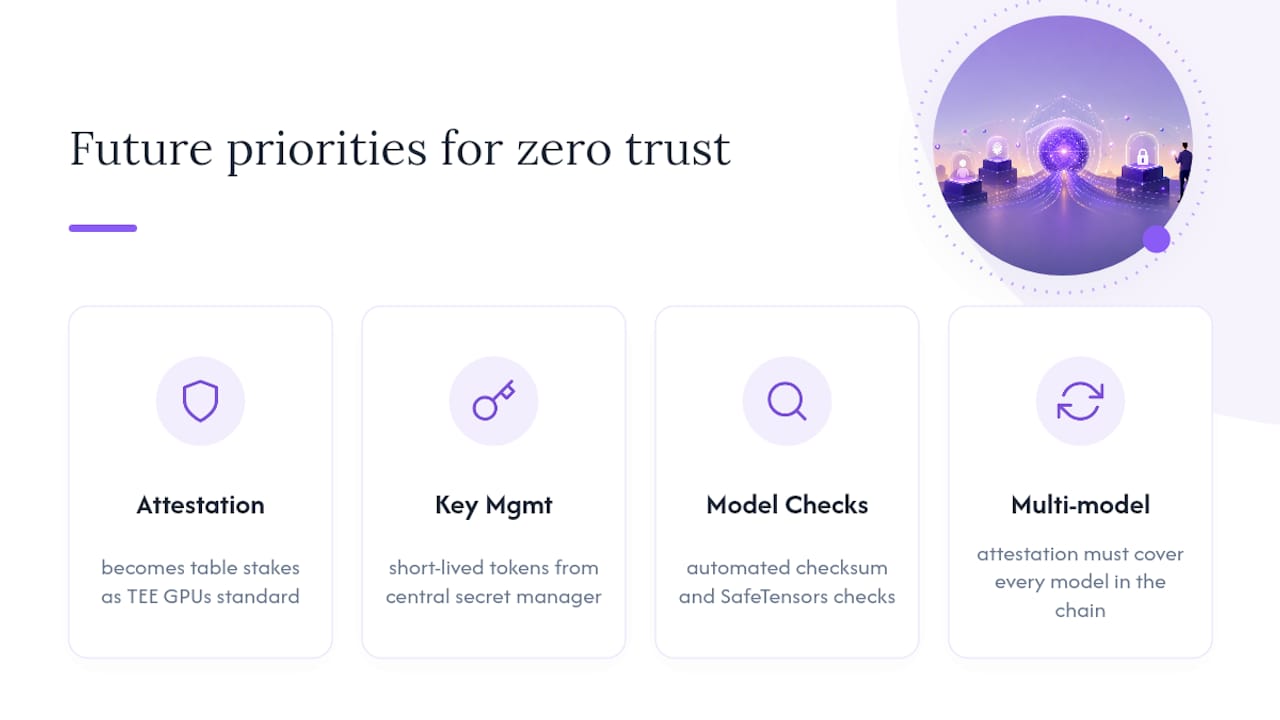
Attestation is likely to become table stakes rather than a differentiator. As TEE-capable hardware, meaning newer GPU generations with confidential computing support, becomes standard in cloud data centers rather than a premium option, the cost argument for skipping attestation weakens every year.
Expect key management to keep tightening around attestation-gated release. Short-lived tokens issued by a central secret manager, rather than static credentials sitting on an inference host, are already the recommended pattern for serious deployments, and that pattern will likely spread from enterprise setups down into consumer-facing managed hosting.
Model supply-chain verification will probably get more automated. Checksum verification and SafeTensors enforcement are manual policy today; the next step is tooling that flags a compromised or unverified model checkpoint before it ever loads, without a human checking a hash by hand.
Multi-model routing adds a wrinkle worth watching. As assistants increasingly route a single conversation across several underlying models depending on the task, attestation has to extend to every model in that chain, not just the primary one. A zero trust claim that only covers one model in a multi-model pipeline isn't a complete claim.
Passkey and device-bound authentication will likely replace passwords as the default onboarding step for privacy-focused assistants, tightening the link between "who you are" and "what your assistant can access" without adding friction for non-technical users.
None of this changes the core proposition. It just means the gap between a real zero trust implementation and a marketing label should keep narrowing as the underlying hardware and tooling mature.
The Gap Between the Zero Trust Label and the Zero Trust Architecture
The phrase "zero trust" has drifted into marketing shorthand faster than the actual architecture has spread. That's the uncomfortable truth this topic keeps running into: plenty of AI products now claim some version of zero trust without a single attestation proof backing the claim.
The conventional advice tells buyers to look for "end-to-end encryption" and call it a day. That advice is outdated for AI assistants specifically, because encryption in transit says nothing about what happens once your prompt reaches the inference server. The server still has to decrypt it to run the model, and that's exactly the moment a traditional architecture exposes your data to whoever administers that server. Zero trust architecture, done properly with TEEs and attestation, is the only approach that closes that specific gap rather than just moving it around.
What should a buyer actually prioritize first? Not the uptime number, not the model count, not even the price. Ask for the attestation flow first. Everything else, including reliability and model selection, is table stakes that most competent providers already clear. The attestation question is the one that separates a provider that built real architecture from one that adopted the vocabulary. A managed product like ClawBase earns the zero trust label by pairing dedicated encrypted instances with the operational discipline of persistent memory management and automated backups, not by simply using the phrase in its marketing.
> *— Iosif Peterfi*
Get a Private, Zero Trust Assistant Without Touching a Server
Everything this article just walked through, TEEs, attestation, SafeTensors enforcement, dedicated instances, adds up to real architecture, but building it yourself still means becoming a part-time sysadmin. ClawBase removes that step entirely: one-click deployment puts a private OpenClaw assistant on a dedicated, encrypted server in minutes, with no configuration, patching, or monitoring left to you.
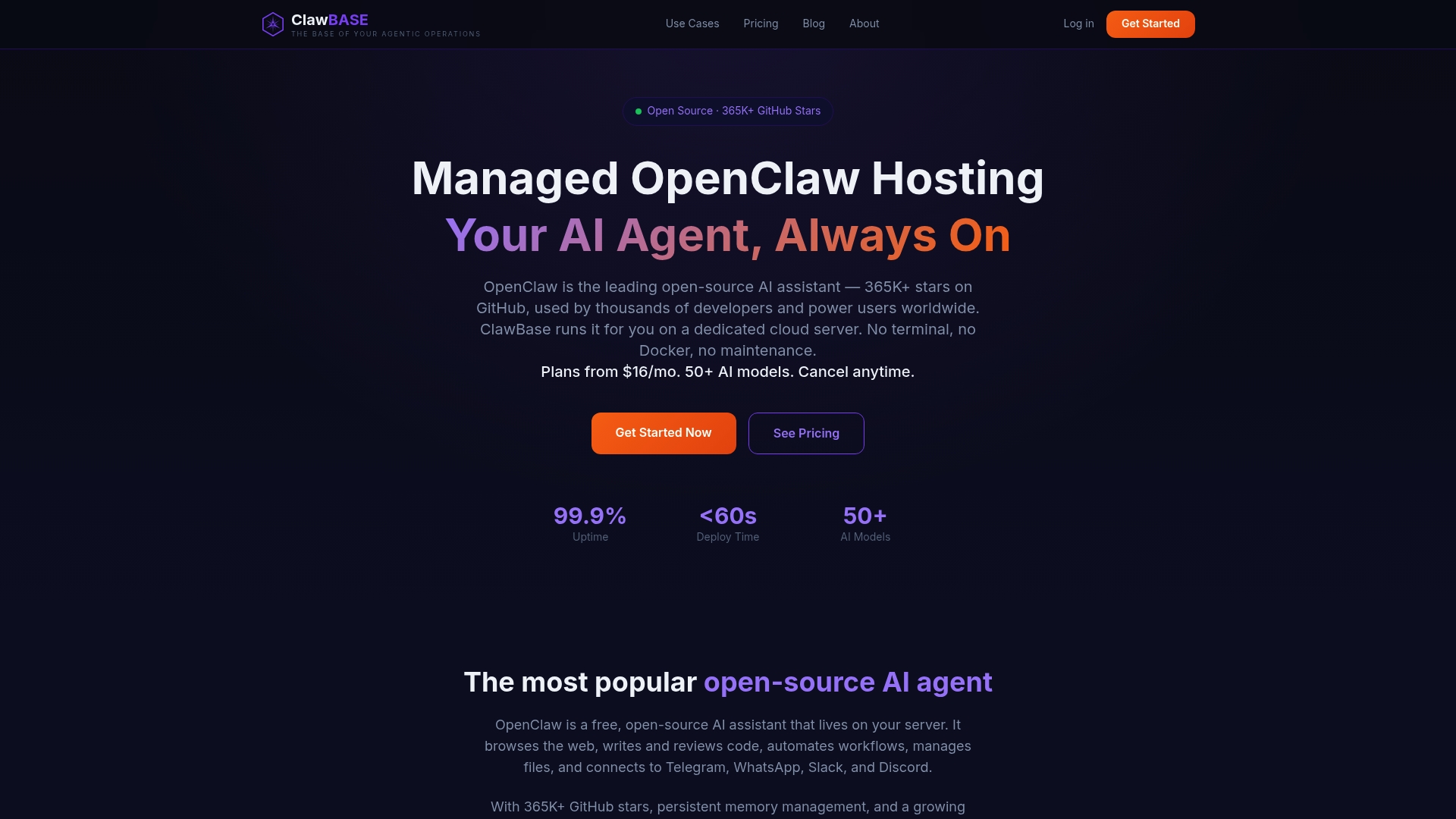
The platform includes persistent memory management, daily encrypted backups, and access to more than 50 AI models with multi-model routing, all under a 99.9% uptime target. If you run integrations across Telegram, Discord, Slack, or WhatsApp, connecting them takes a few minutes rather than an afternoon of API debugging. For readers who want the coding-free setup path spelled out step by step, the no-code setup guide walks through exactly what onboarding looks like.
Start the 7-day free trial on ClawBase's managed OpenClaw hosting and see the dedicated instance running before you commit to a subscription tier.
Sources
- Intelligent Virtual Assistants (IVAs): Trust and Zero Trust
- Confidential computing AI inference — enterprise CISO guide
- Zero Trust Architecture for AI Agents: Identity, Attestation, and Least Privilege