Private AI Assistant Advantages for Professionals in 2026
2026-06-18

A private AI assistant is defined as an AI system that processes your data locally or within a controlled, secure environment rather than sending it to shared public cloud servers. The private AI assistant advantages over public tools are concrete: your data stays yours, your workflows become faster, and the assistant adapts to your specific needs over time. Tools like Elephas and Joanium have demonstrated that professionals and home users alike can reclaim hours of lost productivity each week while keeping sensitive information completely off third-party servers. This article breaks down every major benefit, with real examples and honest comparisons, so you can decide whether a private AI assistant belongs in your stack.
1. What are the core private AI assistant advantages?
Private AI assistants deliver three advantages that public tools cannot match: data privacy, persistent personalization, and offline reliability. Public AI tools like ChatGPT process your inputs on shared infrastructure, which creates real exposure for sensitive data. A private assistant runs on your device or a dedicated server you control, so your prompts never leave your environment.
The productivity gains are measurable. Freelancers reclaim up to 2 hours daily by automating repetitive administrative tasks with AI assistants. That is two hours redirected from inbox management and scheduling into billable, creative work.

Privacy is the foundation that makes everything else possible. Trust and control are the core advantage of private AI in business settings, enabling transparent and secure AI use for sensitive data. Without that foundation, every other feature is a liability.
2. How private AI assistants protect your data
Data residency is the technical term for where your information lives and who can access it. In a private AI setup, data residency stays within your device or your organization's infrastructure. Public AI models process your inputs on shared servers, and your prompts can contribute to model training unless you explicitly opt out.
The risk with public tools is not hypothetical. Many "local" AI apps collect telemetry or sync data to the cloud, defeating true privacy. Open-source, air-gapped models with no telemetry are the only reliable guarantee of data residency. Tools like Joanium and Elephas are built on this principle.
Compliance drift is a major risk when professionals fail to verify that AI tools do not train on user prompts. A single misconfigured tool can expose client contracts, personal health records, or financial data. Verifying contractual and technical blocks on data training is not optional for anyone handling regulated information.
> "The question is not whether AI will handle your sensitive data. The question is whether you control where that data goes."
Pro Tip: *Before adopting any AI tool, check its privacy policy for two specific phrases: "we do not train on user data" and "data is processed locally." If neither phrase appears, treat the tool as a public AI regardless of how it is marketed.*
For professionals managing secure data exchange across multi-cloud environments, private AI architecture is the only deployment model that satisfies most regulatory frameworks.
3. Time-saving and productivity benefits of AI assistants
Private AI assistants automate the tasks that consume the most time without producing the most value. Email drafting, meeting scheduling, invoice generation, and document summarization are all table stakes for a well-configured private assistant. The difference from public AI is that a private assistant remembers your preferences, your clients, and your workflows across sessions.
The productivity data is clear:
- Administrative automation. Drafting emails, filing documents, and generating reports happen in seconds rather than minutes.
- Scheduling without back-and-forth. A private assistant integrated with your calendar handles meeting requests without exposing your schedule to third-party servers.
- Persistent context. Unlike stateless public models, a private assistant remembers your last conversation, your project names, and your preferred formats.
- Offline availability. Your assistant works without an internet connection, which matters during travel or in secure facilities.
- Reduced cognitive load. When the assistant handles routine decisions, you spend mental energy on work that actually requires judgment.
AI assistants reduce customer service response times by 35% by automating triage and initial query handling. That same automation principle applies to individual professionals managing their own communications.
Pro Tip: *Start with one workflow, not five. Pick the task that costs you the most time each week, automate it completely with your private assistant, and only then expand. Trying to automate everything at once leads to a poorly configured assistant that does nothing well.*
Learning also improves with personalized AI support. AI assistants improve learning outcomes by 15% through adaptive, personalized experiences compared to traditional methods. For professionals using AI to stay current in fast-moving fields, that gap compounds quickly. You can explore practical scheduling automation approaches to see how this plays out in daily workflows.
4. Customizability and control in private AI environments
Customization is where private AI assistants separate themselves from public tools entirely. You can fine-tune the model, write custom system prompts, and connect the assistant to your existing tools. Public AI gives you a text box. Private AI gives you an architecture you control.
The key customization levers in a well-built private assistant include:
- Custom system prompts that define the assistant's persona, scope, and response style for your specific use case
- Multi-model support that lets you switch between providers like Mistral, LLaMA, or GPT-class models without rebuilding your setup
- Tool integrations connecting the assistant to Gmail, Google Calendar, Telegram, Discord, and file management systems
- Persistent memory management using local vector stores so the assistant maintains context across sessions, not just within a single conversation
True private AI requires persistent local memory to maintain session context, unlike stateless public models. Managing local databases and vector stores adds complexity, but it is what makes the assistant genuinely useful over time rather than just impressive in a demo.
The table below shows how customization options differ across deployment types:
| Feature | Private local AI | Managed private AI | Public cloud AI |
|---|---|---|---|
| Custom system prompts | Full control | Full control | Limited |
| Model switching | Manual setup | One-click | Provider-locked |
| Persistent memory | Requires configuration | Included | Session-only |
| Tool integrations | DIY | Pre-built | API-dependent |
| Data residency | On-device | Dedicated server | Shared cloud |
Joanium's multi-model desktop app illustrates this well. It connects to Gmail, Calendar, and messaging platforms while keeping all data local. That kind of integration used to require a developer. Now it is table stakes for serious private AI tools.
5. Private AI vs. public AI: when each makes sense
The choice between private and public AI is not binary. Hybrid AI use is optimal: cloud models handle non-sensitive tasks, while private local models handle sensitive contracts or personally identifiable information. This approach reduces both risk and cost.
| Dimension | Private AI | Public AI |
|---|---|---|
| Data residency | Local or dedicated server | Shared cloud |
| Offline capability | Yes | No |
| Setup time | Hours to days | Minutes |
| Compliance suitability | High | Low to medium |
| Customization depth | Full | Limited |
| Cost model | Fixed or per-server | Per-token or subscription |
| Vendor lock-in | Low | High |
| Model quality ceiling | Depends on hardware | Frontier models available |
Matching AI deployment to data risk is the practical rule: use private AI for regulated or mission-critical data, and public AI for low-risk tasks like brainstorming or general research. This is not a compromise. It is the most cost-effective and secure architecture available.
For professionals who need to understand agent communication security in depth, the distinction between private and public AI deployment becomes even more consequential when AI agents communicate with each other across systems.
6. Who should use a private AI assistant?
Private AI assistants are the right fit for a specific set of users. Not everyone needs one, but the people who do will find public AI genuinely inadequate for their needs.
The clearest candidates are:
- Legal and financial professionals who handle client data subject to confidentiality obligations
- Healthcare workers managing patient records or clinical notes that fall under HIPAA or similar regulations
- Freelancers and consultants who want to automate administrative work without exposing client information to third-party servers
- Privacy-conscious individuals who simply do not want their personal communications analyzed by a public AI provider
- Remote teams operating in environments with unreliable internet access, where offline capability is a practical requirement
The indicators that you need a private assistant are straightforward. If you regularly work with confidential communications, client contracts, or personal financial data, a public AI tool is a compliance risk. If you have tried public AI and found it forgets your context every session, a private assistant with persistent memory solves that directly.
Getting started does not require technical expertise. Local apps like Elephas and Joanium install like any desktop application. Managed private cloud options like Clawbase handle the server infrastructure entirely, so you get a no-code AI assistant experience with enterprise-grade privacy. For users who are new to AI tools entirely, a beginner-friendly setup removes the last technical barrier.
Pro Tip: *Read the privacy policy before you paste anything sensitive into an AI tool. Look specifically for whether the provider uses your inputs to train future models. If the policy is vague or silent on this point, assume the answer is yes.*
Key takeaways
Private AI assistants deliver the strongest advantages when data sensitivity, workflow customization, and persistent context are priorities that public AI tools cannot meet.
| Point | Details |
|---|---|
| Data stays local | Private AI processes your data on-device or on a dedicated server, preventing third-party access. |
| Productivity gains are real | Freelancers reclaim up to 2 hours daily by automating administrative tasks with a private assistant. |
| Hybrid deployment works best | Use private AI for sensitive data and public AI for low-risk tasks to balance cost and security. |
| Customization requires setup | Persistent memory, model switching, and tool integrations need configuration but pay off over time. |
| Verify privacy claims | Many "local" AI apps still collect telemetry. Open-source, no-telemetry tools are the only reliable option. |
Why I think private AI is the most underrated productivity decision you can make
I started testing private AI assistants because I was frustrated with public tools forgetting my context every session. What I found surprised me. The privacy benefit was obvious, but the productivity gain from persistent memory was the real unlock. When your assistant remembers your clients, your preferred formats, and your ongoing projects, the quality of its output improves every week. Public AI resets to zero every time.
The adoption curve for private AI is still early, and that is actually an advantage for professionals who move now. The ecosystem of tools is expanding fast. Elephas, Joanium, and managed platforms like Clawbase are making private AI accessible without requiring sysadmin skills. The technical barrier that kept most people on public AI is disappearing.
My honest recommendation: do not wait for private AI to become mainstream before you experiment with it. The professionals who build their workflows around private assistants now will have a compounding advantage. Their assistants will know their work deeply by the time everyone else is starting from scratch. The cloud-hosted AI assistant model, when done right, gives you the best of both worlds: private data handling with managed infrastructure you do not have to maintain yourself.
> *— Iosif Peterfi*
Get started with private AI through Clawbase
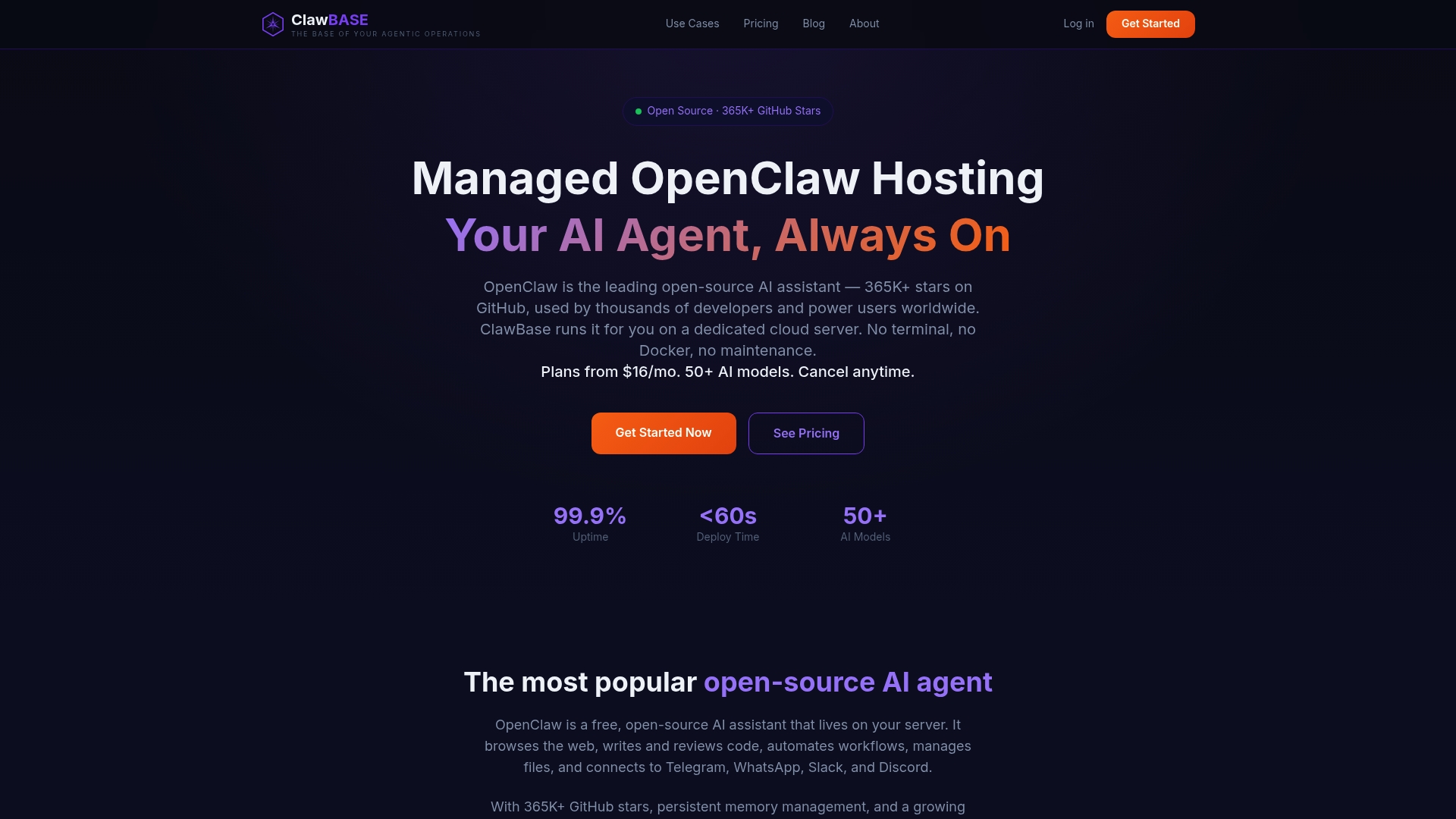
Clawbase makes private AI deployment practical for professionals who want the advantages without the setup complexity. Built on OpenClaw, an open-source AI assistant, Clawbase handles server configuration, uptime, and maintenance so you focus on your work instead of your infrastructure. Plans start at $16/mo and include persistent memory management, access to over 50 AI models, and integrations with Telegram and Discord out of the box. There is no coding required and no server knowledge needed. If you are ready to move your workflows to a private AI environment, explore Clawbase to see which plan fits your use case, or browse the OpenClaw use cases to see exactly what a private AI agent can do for your specific workflow.
FAQ
What is a private AI assistant?
A private AI assistant is an AI system that processes your data locally or on a dedicated server you control, rather than on shared public cloud infrastructure. This keeps your prompts, files, and personal information off third-party servers.
Are private AI assistants better than ChatGPT?
Private AI assistants are better for sensitive data, offline use, and persistent personalization. ChatGPT and similar public tools offer access to frontier models and require no setup, making them better for general, low-risk tasks.
Do private AI assistants work without internet?
Yes. Local private AI assistants run entirely on your device and do not require an internet connection. Managed private cloud options like Clawbase require connectivity to reach the server but keep all data within a dedicated, private environment.
How do I know if an AI tool is truly private?
Check whether the tool uses open-source models with no telemetry and whether the provider contractually blocks training on your data. Many tools marketed as "local" still sync data to the cloud, so verifying the technical architecture matters.
What is the fastest way to get started with a private AI assistant?
Install a local app like Elephas or Joanium for an on-device setup, or use a managed platform like Clawbase for a one-click private AI deployment that requires no technical configuration.