Best Elseif.ai Alternatives for Team AI Workflows in 2026
2026-08-04

The best elseif.ai alternatives fall into three categories: visual workflow builders (Flowise, Langflow), RAG and knowledge management platforms (AnythingLLM), and multi-agent frameworks (CrewAI, AutoGen, Manus AI, Lindy). For most teams that want a private, always-on AI assistant without sysadmin overhead, Clawbase — managed OpenClaw hosting — is the recommended pick. It deploys in one click, runs on a dedicated encrypted server, and connects to Slack, Discord, Telegram, and WhatsApp out of the box.
- Visual builders: Flowise and Langflow for drag-and-drop workflow prototyping
- RAG/knowledge platforms: AnythingLLM for embedding-based document retrieval and knowledge graph queries
- Multi-agent frameworks: CrewAI, AutoGen, and Manus AI for autonomous orchestration; Lindy for no-code agent automation
- Managed OpenClaw hosting: Clawbase for teams that need persistent memory, 99.9% uptime, and multi-channel integrations without maintaining infrastructure
- Self-hosted open-source: Best for developer-heavy teams with dedicated DevOps capacity and a need for full infrastructure control
***
Table of Contents
- How do the top Elseif.ai alternatives compare at a glance?
- How do you pick the right Elseif.ai alternative for your team?
- Managed vs. self-hosted: which path fits your team?
- Which alternative fits your specific use case?
- Clawbase: managed OpenClaw hosting for teams that want it running now
- Key Takeaways
- Why managed OpenClaw hosting makes sense for most teams
- Useful sources and further reading
How do the top Elseif.ai alternatives compare at a glance?
Elseif.ai is a cloud and self-hosted AI platform offering chatbots, agents, chatflows, and workflow tools, with plans with multiple tiers, including Professional and Team options. It targets enterprise teams that want a broad AI studio. The alternatives below solve the same core problem — AI workflow automation and team collaboration — but with different tradeoffs on hosting model, deployment effort, and data control.
| Tool | Best For | Hosting Model | Time to Deploy | Pricing Model | Data Privacy | Model Support | Integrations | Persistent Memory | Scalability / SLA | Multi-Agent |
|---|---|---|---|---|---|---|---|---|---|---|
| **Clawbase (OpenClaw)** | Teams wanting managed, private AI assistant | Managed SaaS (dedicated server) | 1–3 days | Subscription from a low monthly rate | Private dedicated server, encrypted backups | 50+ models, multi-model routing | Slack, Discord, Telegram, WhatsApp | Yes, built-in | 99.9% uptime SLA | Yes |
| **Flowise** | Visual workflow prototyping | Self-hosted / cloud | 1–2 weeks (self-hosted) | Open-source (free); cloud plans vary | Depends on deployment | LangChain-compatible | Webhooks, APIs | Limited | No SLA (self-hosted) | Partial |
| **Langflow** | Non-technical builders, rapid UI prototyping | Self-hosted / cloud | 1–2 weeks | Open-source (free); cloud plans vary | Depends on deployment | LangChain-compatible | REST APIs, webhooks | Limited | No SLA (self-hosted) | Partial |
| **AnythingLLM** | Enterprise RAG and knowledge management | Self-hosted / cloud | 1–2 weeks | Open-source (free); cloud tiers | Configurable | Multiple LLM providers | API, webhooks | Yes (vector DB) | Varies | No |
| **CrewAI** | Multi-agent orchestration, R&D teams | Self-hosted / cloud | 2–4 weeks | Open-source (free); enterprise pricing | Configurable | Multiple providers | API-based | Limited | No SLA (self-hosted) | Yes |
| **AutoGen** | Research, complex agent pipelines | Self-hosted | 2–4 weeks | Open-source (free) | Full control | Multiple providers | API-based | Limited | No SLA | Yes |
| **Manus AI** | Autonomous task execution | Cloud (managed) | Days | Subscription (invite-based) | Vendor-managed | Proprietary routing | Limited | Partial | Vendor SLA | Yes |
| **Lindy** | No-code agent automation | Managed SaaS | Hours to days | Subscription | Vendor-managed | Multiple providers | Slack, email, CRM | Partial | Vendor SLA | Partial |
Key tradeoffs at a glance:
- Managed platforms (Clawbase, Lindy, Manus AI) trade infrastructure control for speed, uptime guarantees, and lower ops burden.
- Self-hosted tools (Flowise, Langflow, AnythingLLM, CrewAI, AutoGen) give you full data sovereignty but require continuous maintenance and internal ops resources — costs that compound quickly.
- RAG-focused stacks like AnythingLLM excel at embedding-based semantic search and vector similarity retrieval but need careful chunking configuration and vector DB tuning.
- Multi-agent frameworks like CrewAI and AutoGen are purpose-built for orchestration complexity; they are not drop-in replacements for a team assistant.
***
How do you pick the right Elseif.ai alternative for your team?
Start with four variables before you evaluate any specific tool.
1. Who operates the system? Non-technical teams need a managed platform with a UI. Developer teams with DevOps capacity can absorb the overhead of self-hosting. This single question eliminates half the shortlist immediately.
2. How sensitive is your data? If your workflows touch PII, HIPAA-adjacent data, or proprietary IP, you need either a private dedicated server (like Clawbase's encrypted cloud instances) or a fully self-hosted stack where you control the storage layer. Vendor-managed multi-tenant SaaS platforms require a careful review of their data retention and subprocessor agreements.
3. What integrations are non-negotiable? Slack, Discord, and Telegram are table stakes for most team workflows. Verify that your shortlisted platform supports them natively, not just through a third-party webhook layer that breaks on API updates.
4. What is your budget shape? A subscription model (Clawbase, Lindy) has predictable monthly spend. Self-hosted open-source tools look free until you account for GPU ops, persistent memory management, load balancing, and backup infrastructure — costs that often exceed managed plan spend over a 12-month horizon.
Vendor questions to ask before committing
- What vector DB does the platform use, and can you export embeddings in a portable format?
- What is the maximum context window per supported model, and does the platform support multi-model routing?
- How is data encrypted at rest and in transit? What is the backup cadence?
- Does the platform support enterprise auth (SSO, SAML, SCIM)?
- What is the support SLA, and is there a dedicated channel for production incidents?
Red flags to watch for
- Proprietary connectors with no data export path (RAG index lock-in is a real migration risk — re-indexing and vector DB compatibility checks are among the most common failure points when switching platforms)
- Unclear data retention policies or missing DPA documentation
- No documented migration path for existing knowledge bases
- Missing enterprise auth methods for teams above 10 users
> "Pilot on a representative subset of your data first. Validate retrieval accuracy after re-indexing before committing to a full migration — document ingestion semantics differ enough across platforms to break retrieval relevance without retuning." — AI migration best practices
Pro Tip: *Set a two-week PoC deadline. Self-hosted tools that are not running in a staging environment within 14 days with a real dataset are a signal that the ops burden will follow you into production.*
***
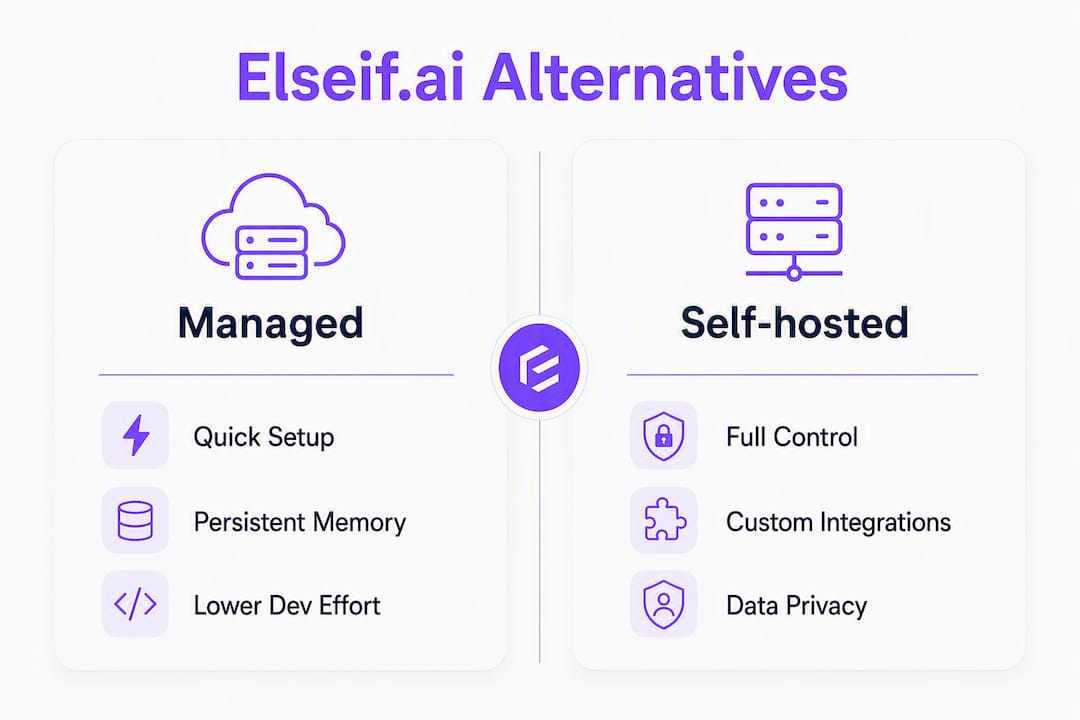
Managed vs. self-hosted: which path fits your team?
This is the decision that shapes everything downstream — cost, security posture, time-to-value, and ongoing ops load.
What managed hosting gives you
- One-click or guided deployment with no server configuration
- Automated updates, so model compatibility and security patches do not become a recurring sprint item
- Built-in backup cadence and encrypted storage
- A defined uptime SLA (Clawbase guarantees 99.9%) and priority support
- Faster path from pilot to production: days, not weeks
What self-hosting gives you
- Full infrastructure control and data sovereignty
- No per-user licensing fees (though ops costs replace them)
- Deep customizability: custom vector DBs, fine-tuned chunking strategies, bespoke model routing
The hidden cost of self-hosting is the one teams consistently undercount. Persistent memory management, daily backups, GPU scheduling, load balancing, and SaaS application monitoring — uptime, model latency, storage health — all require dedicated ops time. For teams without a full MLOps function, managed hosting consistently delivers faster time-to-value and more stable operations.
Typical timelines:
- Self-hosted minimal PoC: 1–2 weeks with engineers, 4–8 weeks to production
- Managed deployment (Clawbase): 1–3 days to a live, production-ready assistant
Pro Tip: *Before migrating to any self-hosted stack, confirm the platform's persistent memory strategy and backup runbook. Losing conversation context or RAG indices during a server migration is a painful and avoidable setback.*
***
Which alternative fits your specific use case?
Industry roundups consistently sort these tools into three categories, each with distinct deployment effort and skill requirements.
Visual workflow builders (Flowise, Langflow)
Best for teams that want to prototype AI pipelines visually without writing orchestration code. Flowise and Langflow both sit on LangChain-compatible stacks, so model swapping is relatively straightforward. Expect 1–2 weeks to a working self-hosted environment and moderate integration effort for enterprise apps. Context window support depends on the underlying model provider you configure.

RAG and knowledge management (AnythingLLM)
Best for enterprise knowledge apps where embedding-based semantic search and vector similarity retrieval are the core value. AnythingLLM supports multiple LLM providers and persistent vector DB storage. The tradeoff: chunking strategy and vector DB tuning require hands-on configuration, and migrating a RAG pipeline to a different platform carries real re-indexing risk.
Multi-agent frameworks (CrewAI, AutoGen, Manus AI)
Best for R&D teams and ML engineers building autonomous orchestration systems. CrewAI and AutoGen support complex agent pipelines with role-based task delegation. Manus AI offers a managed path to autonomous task execution. Interoperability protocols like MCP are becoming important here — platforms that support them let you compose smaller agents and avoid vendor lock-in as your stack grows.
- Lindy fits non-technical teams that want no-code agent automation with Slack and email integrations and a fast setup time.
- Clawbase fits teams that want a private, always-on AI assistant with persistent memory, multi-model routing, and multi-channel integrations — without managing any of the infrastructure themselves. See AI workflow automation use cases for concrete examples.
***
Clawbase: managed OpenClaw hosting for teams that want it running now
Most teams evaluating elseif.ai replacement options are not looking for another platform to configure. They want a private AI assistant that is already running, already connected to their communication stack, and already backed up.
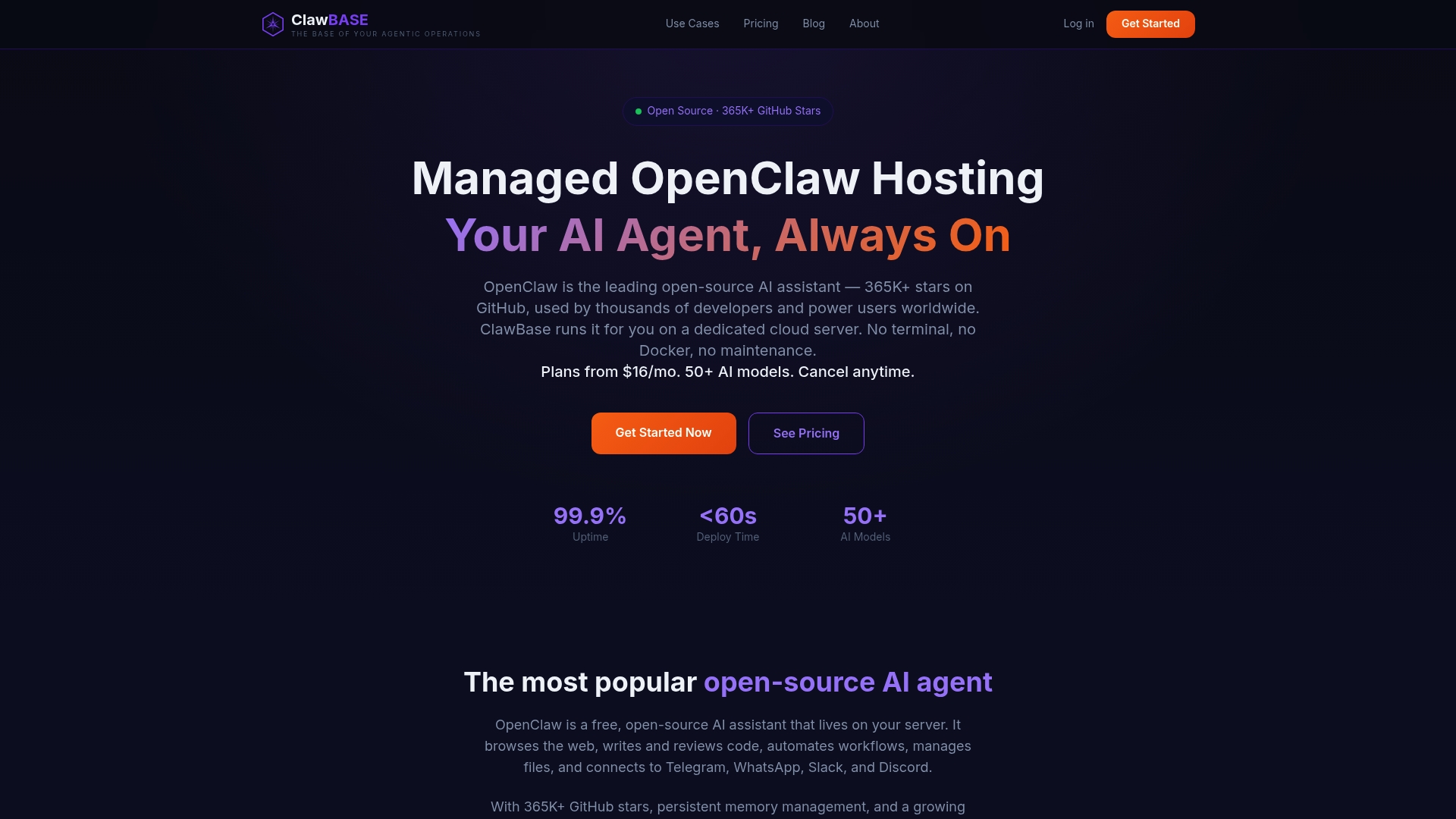
Clawbase delivers exactly that. One-click deployment puts a dedicated OpenClaw instance on an encrypted cloud server. Persistent memory management means your assistant retains context across sessions — think of it as the long-term memory layer that most self-hosted tools leave you to build yourself. With over 50 supported AI models and multi-model routing, you can switch between GPT-4o, Claude, Mistral, and others without reconfiguring your stack. Native integrations cover Telegram, Discord, Slack, and WhatsApp. Daily encrypted backups and automated updates run without any action on your end.
Entry plans start at a low monthly subscription rate, with monthly or annual billing and a 7-day free trial on the entry plan. Payment accepts credit card and cryptocurrency. A live instance is typically ready within 1–3 days of signup. Explore concrete agent use cases to validate fit before committing, then start your trial directly at clawbase.to.
***
Key Takeaways
For most teams, the fastest path to a production-ready AI assistant is a managed platform with persistent memory, native integrations, and a clear uptime SLA — not a self-hosted stack that trades licensing fees for ops overhead.
| Point | Details |
|---|---|
| Category determines fit | Visual builders suit prototyping; RAG stacks suit knowledge apps; multi-agent frameworks suit autonomous orchestration. |
| Self-hosting has hidden costs | Persistent memory, backups, and monitoring often add significant operational costs over time |
| Migration risk is real | RAG pipeline re-indexing and vector DB compatibility are the most common failure points when switching platforms. |
| Deployment speed matters | Managed deployment (Clawbase) is typically faster than self-hosted proof-of-concept deployments, which require more engineering time |
| Clawbase is the managed pick | 99.9% uptime, 50+ models, and native Slack/Discord/Telegram/WhatsApp integrations with no sysadmin requirement. |
***
Why managed OpenClaw hosting makes sense for most teams
The conventional wisdom in the AI tooling space is that open-source self-hosted platforms are the "serious" choice — more control, more credibility, more flexibility. I think that framing misleads most teams.
The teams I see struggle most with AI workflow adoption are not the ones that picked the wrong model. They are the ones that underestimated the ops surface: persistent memory that resets after a server restart, backups that were never configured, model latency spikes that nobody is monitoring. These are not edge cases. They are the default outcome when a team without dedicated MLOps capacity tries to run production AI infrastructure.
Managed hosting does not mean giving up control. It means choosing where to spend your engineering attention. For a team whose core competency is not infrastructure, spending that attention on the AI workflows themselves — the prompts, the integrations, the knowledge base quality — produces better outcomes than spending it on GPU scheduling and backup runbooks.
That said, self-hosted frameworks are the right call for specific profiles: full-stack ML research teams, organizations with strict on-premises data requirements, and engineers building highly custom agentic systems where agentic modularity and interoperability protocols are architectural requirements. For everyone else, the managed path is faster, more stable, and — when you count ops time honestly — often cheaper.
***
Useful sources and further reading
- AI Tool Alternatives & Migration Guides | AI Suggests — managed vs. self-hosted tradeoffs and migration best practices
- 10 Best Dify Alternatives & Competitors | DataStackHub — category mapping for visual builders, RAG stacks, and multi-agent frameworks
- SaaS Application Monitoring for MSPs | Netverge — what to monitor when self-hosting AI services
- Industry Lens: Agentic Interoperability — MCP and multi-agent interoperability standards
- What Is Self-Hosted AI Software? | Clawbase — plain-English overview of self-hosted AI tradeoffs
- Why Developers Use Managed AI Services | Clawbase — reasons teams prefer managed hosting
- Open-Source AI Scalability Challenges | Clawbase — infrastructure and security implications of self-hosting
- Professional AI Automation Mistakes to Avoid | Clawbase — operational pitfalls and migration red flags