Open-Source AI Scalability Challenges: 2026 Guide
2026-06-11

Open-source AI scalability challenges are primarily rooted in distributed systems engineering, not model capability gaps. Tools like Dynamo, RAG pipelines, and modular inference stacks expose this reality at production scale: the bottleneck is almost never the algorithm. It is the infrastructure holding it together. Switching to modular architectures has cut monthly inference costs from $47,000 to $2,800 for some teams, a reduction of over 90%, without any change to model quality. If you are a technical or business professional trying to scale open-source AI in production, the problems you will hit are coordination, memory, and orchestration.
1. Core distributed systems bottlenecks in open-source AI
Scaling open-source AI is fundamentally a distributed systems problem, not a model capability problem. The bottlenecks shift dynamically between retrieval phases, memory phases, and compute phases depending on workload type. Most teams discover this only after they have already over-invested in model fine-tuning.

Large GPU training clusters suffer from frequent hardware failures and low utilization, typically achieving only 30 to 50% of theoretical compute capacity. Each GPU-hour costs $2 to $4, compared to $0.03 per hour on commodity cloud compute, which means suboptimal utilization compounds into serious financial damage fast. The core culprits are collective communication overhead, synchronization delays, and node failures that interrupt the entire cluster.
Key distributed systems challenges include:
- Collective communication bottlenecks: AllReduce operations across hundreds of GPUs create network saturation that limits throughput regardless of raw compute power.
- Straggler nodes: A single node running only 5% slower can drag down the entire synchronized training run due to collective communication delays. Detection is non-trivial.
- Fault tolerance as the default mode: Node failures are routine at scale, not exceptional. Systems that treat fault tolerance as an afterthought pay for it in utilization and uptime.
- Synchronization overhead: Gradient synchronization across large clusters introduces latency that grows with cluster size, creating a ceiling on effective parallelism.
Pro Tip: *Build predictive failure monitoring into your cluster from day one. Waiting for a node to fail before responding is the single fastest way to destroy GPU utilization on a large training run.*
2. How modular infrastructure cuts costs and improves performance
The most impactful architectural shift in scaling open-source AI is moving from monolithic inference systems to modular, composable components. Each layer, caching, routing, prefill, and decode, can then be scaled and optimized independently.
- Semantic caching layers intercept repeated or near-identical queries before they reach the model. Routing 89% of queries to cheaper models and caching 73% of queries is what drove one team's costs from $47,000 to $2,800 monthly, with no output quality loss.
- Query routing directs simple queries to lightweight models and complex queries to larger ones. This alone can reduce average inference cost by an order of magnitude.
- Disaggregated serving separates the prefill phase (processing the input prompt) from the decode phase (generating tokens). Disaggregated architectures deliver 2x faster time to first token and 80% fewer SLA breaches by eliminating redundant prefill computations.
- Orchestration layers like Dynamo coordinate multiple GPUs into a single logical inference cluster, handling load balancing, KV cache offloading to CPU and SSD, and request scheduling.
| Architecture | Cost profile | Latency impact |
|---|---|---|
| Monolithic inference | High, fixed cost per request | Baseline TTFT |
| Modular with caching | Up to 94% cost reduction | Marginal increase for cached queries |
| Disaggregated serving | Moderate reduction | 2x TTFT improvement |
| Full orchestration (Dynamo) | Optimized per workload | SLA breaches reduced by 80% |
Pro Tip: *Start with semantic caching before touching disaggregated serving. The cost savings are immediate and require no changes to your model or serving infrastructure.*
3. Long-context and memory-heavy workload scaling challenges
Memory bandwidth is the primary constraint on production LLM throughput, not raw FLOP count. Production LLMs achieve only 100 to 300 tokens per second in practice, far below theoretical hardware speeds. This "memory wall" is what actually limits scale.
The KV cache is the specific mechanism where this pain concentrates. As context windows grow to 128K or 1M tokens, KV cache size exceeds physical GPU memory, forcing eviction strategies that introduce their own failure modes. The most insidious of these is silent quality degradation.
Key challenges in long-context scaling:
- KV cache overflow: Cache size grows linearly with context length. At million-token contexts, no single GPU holds the full cache, requiring offloading to CPU or SSD with associated latency penalties.
- Silent quality degradation: Pruning KV caches and using FP8 Tensor Cores without explicit out-of-memory errors can cause accuracy to drop from 91% to 13%. The process does not crash. It just silently produces wrong answers.
- Positional coherence breaks: Naive token eviction during long-context inference can break positional coherence, degrading output quality in ways that are distinct from memory exhaustion and much harder to detect.
- Memory bandwidth saturation: Data transfer between GPU HBM and compute cores becomes the bottleneck before compute itself does, making memory management a higher priority than adding more GPUs.
Understanding how your AI agent manages memory across long sessions is directly relevant here. The OpenClaw memory management architecture addresses this with layered memory structures that mirror how human working memory prioritizes recent and relevant context.
| Context length | KV cache size (7B model) | Primary risk |
|---|---|---|
| 4K tokens | ~500 MB | Minimal |
| 32K tokens | ~4 GB | Approaches GPU memory limits |
| 128K tokens | ~16 GB | Requires offloading strategies |
| 1M tokens | ~128 GB | Silent degradation likely without active management |
4. RAG and heterogeneous pipeline orchestration challenges
Retrieval-augmented generation (RAG) pipelines are not single systems. They are distributed architectures composed of vector databases, graph databases, embedding encoders, rerankers, and LLMs, each with different scaling characteristics and failure modes.
Retrieval-heavy RAG spends over 80% of its time in the retrieval phase. Long-context RAG shifts the bottleneck entirely to memory bandwidth. This means the same pipeline architecture can have completely different performance profiles depending on query type, and a single optimization strategy will not work for both.
The specific challenges in heterogeneous AI pipelines include:
- Workload heterogeneity: Vector similarity search, graph traversal, and LLM inference have fundamentally different compute, memory, and I/O profiles. Scaling one component without the others creates new bottlenecks immediately.
- Vector database sharding: Similarity-aware sharding groups semantically related vectors on the same shard to minimize cross-node communication during approximate nearest neighbor (ANN) search. Random sharding destroys query performance at scale.
- Graph database horizontal scaling: Graph databases struggle with horizontal scaling due to cross-node traversal costs. Neo4j's Infinigraph introduced property sharding in 2025, distributing property data while retaining graph topology on a single shard to reduce network calls.
- Shifting bottlenecks: A pipeline optimized for retrieval-heavy workloads will underperform on long-context generation workloads. Profiling must be continuous, not one-time.
- Orchestration failure costs: Suboptimal orchestration in a RAG pipeline does not just slow things down. It can cause cascading failures where a slow retrieval phase causes LLM timeout errors, inflating both latency and cost simultaneously.
Optimizing retrieval and orchestration layers is more impactful for accuracy and latency than improving the LLM itself. Fixing retrieval alone improved answer accuracy from 52% to 89%, cut latency from 3.8 seconds to 1.2 seconds, and reduced hallucination rates by 87%. That is a stronger return than most model upgrades deliver.
Pro Tip: *Profile your RAG pipeline separately for retrieval-heavy and generation-heavy query types. They will show different bottlenecks, and treating them as one system leads to optimizations that help one workload while hurting the other.*
For teams building pipelines that call external tools and APIs, understanding AI function calling mechanics is a prerequisite for designing orchestration layers that do not introduce unnecessary latency.
5. Share-nothing architectures and stateful agent scaling
Horizontal scaling of stateful AI agents introduces a specific class of problem that stateless web services do not face. Share-nothing architectures distribute agent state across nodes to avoid coordination overhead, but they create cold-reconstruction latency spikes when a node is added or replaced.
Share-nothing agent scaling requires proactive cache warming to maintain SLA consistency. Without it, the first requests routed to a new node experience latency spikes that violate SLAs even when the overall system is healthy. This is a subtle but operationally significant failure mode that standard load testing rarely catches.
The practical implication is that observability and fault tolerance are not optional features for scaled open-source AI. They are foundational requirements. Teams that treat monitoring as a post-launch concern consistently discover scaling problems through user complaints rather than dashboards.
Key takeaways
Open-source AI scalability challenges are distributed systems problems first, and solving them requires modular infrastructure, active memory management, and continuous pipeline profiling.
| Point | Details |
|---|---|
| Distributed systems are the bottleneck | GPU utilization of 30 to 50% is typical; the constraint is coordination, not raw compute. |
| Modular infrastructure cuts costs dramatically | Caching and query routing can reduce monthly inference costs by over 90% without quality loss. |
| Silent memory failures are the biggest risk | KV cache pruning can drop accuracy from 91% to 13% with no error logs or crashes. |
| RAG bottlenecks shift by workload type | Retrieval-heavy and long-context RAG require separate profiling and optimization strategies. |
| Observability is non-negotiable | Predictive failure monitoring and continuous profiling are prerequisites for production-grade scale. |
Why distributed systems expertise is the real unlock
I have spent considerable time working with open-source AI infrastructure, and the pattern I see repeatedly is this: teams invest heavily in model selection and fine-tuning, then hit a wall when they try to scale. The wall is almost never the model. It is the plumbing.
The gap between open-source AI breakthroughs and enterprise readiness is real, and it is widening as models improve faster than infrastructure practices do. The community produces excellent models. The operational knowledge to run them at scale is harder to find and slower to spread.
What I find most encouraging is the emergence of vendor-neutral inference standards and community-driven orchestration frameworks. Dynamo is a good example: it treats a datacenter as a single logical inference unit, which is the right abstraction for teams running more than a handful of GPUs. The teams I have seen succeed at scale are the ones who treat observability as a first-class engineering concern from the start, not something bolted on after the first production incident.
My honest recommendation: before you scale horizontally, instrument everything. Straggler nodes, KV cache eviction rates, retrieval latency distributions, and GPU memory bandwidth utilization should all be visible in your dashboards before you add a single GPU. Scaling a system you cannot see clearly is how you end up with 30% utilization and a $47,000 monthly bill.
If you are evaluating common setup errors in your current open-source AI deployment, that is a productive starting point before tackling the larger scaling architecture questions.
> *— Iosif Peterfi*
Skip the infrastructure headache with Clawbase
Solving open-source AI scalability challenges at the infrastructure level requires significant engineering depth. For teams that want production-grade AI agent capabilities without building and maintaining that infrastructure themselves, Clawbase offers a direct path.
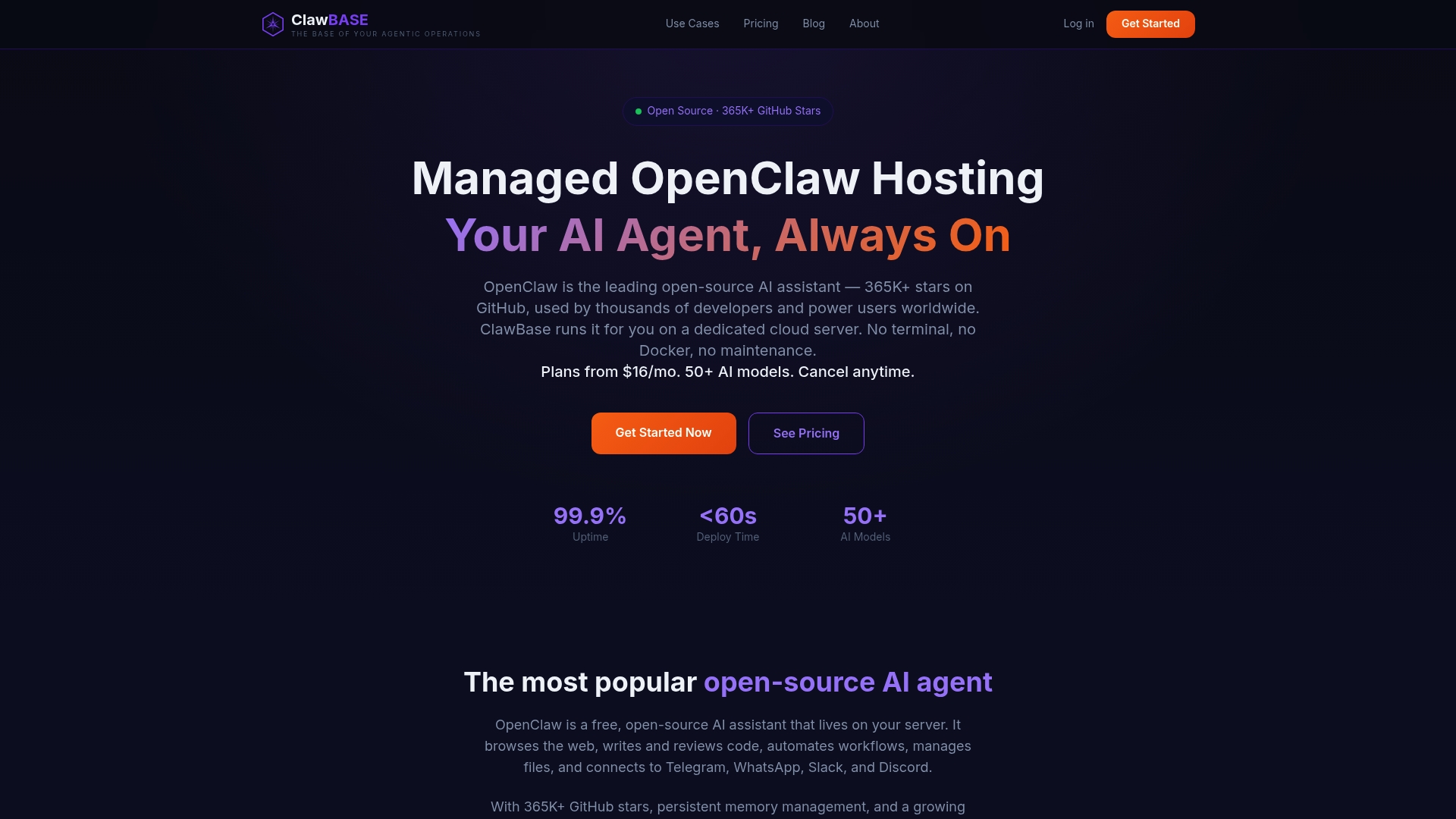
Clawbase provides managed OpenClaw hosting starting at $16 per month, with one-click deployment on a dedicated server, 99.9% uptime, and persistent memory management built in. You get access to over 50 AI models, Telegram and Discord integrations, and workflow automation without the sysadmin overhead. If you want to see what a production-ready AI agent actually does in practice, the OpenClaw use cases page covers real-world applications across file management, scheduling, and multi-platform communication.
FAQ
What are the main open-source AI scalability challenges?
The primary challenges are distributed systems bottlenecks including collective communication overhead, low GPU utilization (30 to 50% in large clusters), KV cache memory limits, and heterogeneous pipeline orchestration in RAG systems. These are infrastructure problems, not model problems.
How much can modular infrastructure reduce AI inference costs?
Modular architectures using semantic caching and query routing have reduced monthly inference costs by over 90%, from $47,000 to $2,800, without any degradation in output quality.
What is silent quality degradation in LLM scaling?
Silent quality degradation occurs when KV cache pruning or FP8 precision settings cause model accuracy to drop sharply (from 91% to 13% in documented cases) without triggering any error logs or out-of-memory crashes. It is one of the most dangerous failure modes in long-context inference.
Why do RAG pipelines have unique scaling challenges?
RAG pipelines combine vector databases, graph databases, encoders, and LLMs, each with different scaling profiles. The bottleneck shifts between retrieval and memory phases depending on query type, requiring separate profiling strategies for each workload pattern.
What is the fastest way to improve RAG pipeline performance?
Fixing the retrieval and orchestration layers delivers the highest return. Optimizing retrieval alone has been shown to improve answer accuracy from 52% to 89%, reduce latency from 3.8 seconds to 1.2 seconds, and cut hallucination rates by 87%.