The Role of Logging in AI Systems: 2026 Guide
2026-07-07

Logging in AI systems is defined as structured, decision-level record-keeping that captures not just inputs and outputs but the intermediate reasoning steps an AI takes, including confidence scores, tool selections, and retrieval contexts. This goes far beyond traditional application logging. Where a standard log records that a function ran, an AI-native log records *why* the model chose one tool over another, what similarity score triggered a retrieval, and how certain the system was at each step. Without this depth, reproducibility drops to near zero in multi-tool AI workflows. Regulations like the EU AI Act now treat traceability as a legal obligation, making the role of logging in AI systems a compliance requirement, not just a developer convenience.
What types of data and decisions are logged in AI systems?
Application logs miss the reasoning that drives AI behavior. A traditional log tells you a function executed and returned a value. An AI-native log tells you which retrieval chunks scored above a similarity threshold, which tool the model selected from a set of candidates, and what confidence metric pushed the decision one way or another. That distinction matters enormously when you need to reproduce a failure or explain a decision to a regulator.
The core data types captured in modern AI logging fall into several categories:
- Tool selection events: Which tool or API the model chose, the alternatives it considered, and the confidence score attached to that choice
- Retrieval similarity scores: The vector similarity values returned during embedding-based semantic search, including which chunks were retrieved and their ranking
- Policy evaluation flags: Whether content filtering or safety guardrails triggered, and at what threshold
- Model versioning metadata: Which model version processed the request, enabling regression comparisons across deployments
- Intermediate reasoning states: Chain-of-thought steps, sub-task delegations in multi-agent workflows, and uncertainty estimates at each node
Structured hierarchical logging with trace IDs and parent-child span relationships ties all of these events into a coherent decision tree. Each span in the tree represents one step in the AI's reasoning path. You can reconstruct the full causal chain of any decision by walking the tree from root to leaf.
Pro Tip: *Assign a unique trace_id to every user request and propagate it through every downstream model call, tool invocation, and retrieval step. This single practice makes cross-service debugging orders of magnitude faster.*

The difference between logging a function call and logging a decision point is the difference between knowing a car moved and knowing why the driver turned left. AI systems require the latter.
How does logging improve AI system reliability and debugging?
Detailed logging is the only credible path to root-cause analysis in non-deterministic AI systems. When a model produces a wrong answer, the failure could originate from a bad retrieval, a misconfigured tool, a model regression, or simple probabilistic variance. Without structured logs, you cannot tell which one caused the problem.
Here is a systematic approach to using logs for reliability:
- Instrument every model call with an AI-judge score. Automated trace diagnostics using AI-native platforms have shown 30%+ improvements on benchmark performance. The AI-judge scores each call for quality, flagging low-confidence outputs before they reach users.
- Apply mutation testing to logged sessions. Mutation testing of logged AI sessions perturbs individual steps in a recorded trace to identify which step caused a silent failure. This technique catches bugs that only appear under specific input combinations.
- Use causal inference on structured logs. Causal inference on structured logs separates propagation errors caused by upstream changes from independent probabilistic failures. Without this distinction, teams waste hours debugging model variance when the real cause is a changed retrieval index.
- Run coordination checks from OpenTelemetry spans. Regression testing without systematic logging is guesswork. Coordination checks derived from OpenTelemetry spans build root-cause graphs that show exactly where error propagation began.
- Set regression alerts on key quality metrics. Track confidence score distributions across model versions. A sudden drop in average confidence on a specific tool call is an early signal of a model regression before user complaints surface.
Pro Tip: *Log the "alternatives considered" field alongside every tool selection. When a model picks the wrong tool, this field shows you what it was weighing, which is far more useful than just knowing what it chose.*
Silent failures are the most dangerous failure mode in AI systems. A model that returns a plausible but wrong answer leaves no error trace in a standard application log. Only decision-level logging exposes these cases.
What are best practices for implementing effective AI logging?
Effective AI logging requires treating decision points as first-class events, not afterthoughts attached to function calls. The goal is targeted instrumentation that captures what matters without drowning your storage and processing pipeline in noise.
The key principles are:
- Capture decisions, not just executions. Log tool selection rationale, retrieval scores, and confidence metrics as structured fields, not free-text strings. Structured fields are queryable; free text is not.
- Use hierarchical spans with trace correlation. Every log event should carry a
trace_id, aspan_id, and aparent_span_id. This structure lets you reconstruct the full AI agent architecture decision path from any single event. - Balance granularity against overhead. Logging every token probability is rarely useful and always expensive. Log at the decision boundary: when the model selects a tool, completes a retrieval, or evaluates a policy rule.
- Integrate with continuous monitoring. Logs feed alerting systems only when they are structured consistently. Define a schema for your AI logs and enforce it across all services. Schema drift silently breaks dashboards and alerts.
- Version your log schema alongside your model. When a model update changes the set of tools available or the retrieval strategy, the log schema should reflect that change. This keeps historical comparisons valid.
The comparison between logging approaches shows a clear pattern. Entry-level setups capture raw inputs and outputs with minimal structure. Production-grade AI logging captures hierarchical decision spans, quality scores, and retrieval metadata with schema enforcement. The gap between these two approaches is the gap between debugging by guesswork and debugging by evidence.
Pro Tip: *Start with systematic logging practices for your three most critical AI workflows before expanding coverage. Full coverage from day one creates noise that obscures the signals you actually need.*
How does logging support compliance and auditing under AI regulations?
Logging traceability is a compliance requirement under the EU AI Act for high-risk AI systems. The regulation requires that AI systems maintain evidence trails of interactions, decisions, and model behavior. A log that only records inputs and outputs does not satisfy this requirement. Regulators need to see the intermediate decision data that explains *how* the system reached its output.
Audit logging for AI compliance must capture:
- Model version identifiers tied to every inference event, so auditors can verify which model version made which decision
- Content filtering decisions including the policy rule triggered and the confidence score at the time of filtering
- Retrieval provenance showing which documents or knowledge sources informed the model's response
- Human override events when a human operator intervened in an AI decision, with timestamps and operator identifiers
- Data lineage records connecting training data sources to deployed model versions for high-risk applications
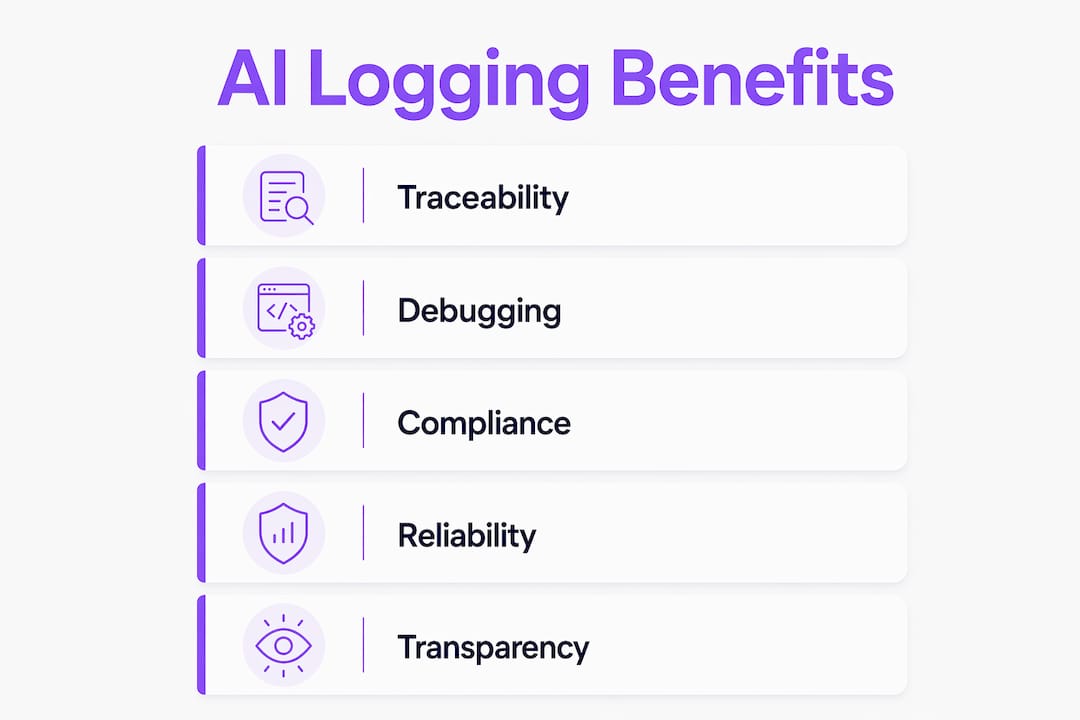
Traceability and transparency are the two pillars of AI compliance. Traceability means you can reconstruct any decision from logs. Transparency means those logs are readable by auditors who were not present when the decision was made. Both requirements push toward structured, schema-enforced logging with long retention periods.
Post-incident analysis also depends entirely on log quality. When an AI system makes a harmful or incorrect decision, the investigation starts with the logs. If the logs only show inputs and outputs, the investigation ends there too. Decision-level logs let you trace the failure back to a specific retrieval, a misconfigured policy rule, or a model version that should have been rolled back.
What tools and platforms facilitate advanced AI logging?
Several open-source platforms now address AI-native logging directly, moving beyond generic observability tools that were built for deterministic software.
- TraceMind: TraceMind automatically scores every AI call, detects hallucinations, and supports regression alerts. It provides quality scoring and root-cause diagnosis as first-class features, not add-ons.
- Anjor: Anjor instruments AI workflows automatically, capturing tool calls, costs, and failure patterns without requiring code changes to the agent. Its dashboards and health checks work out of the box on existing deployments.
- OpenTelemetry spans: The OpenTelemetry standard provides the hierarchical span structure that AI-native logs require. Most production AI logging pipelines build on OpenTelemetry and extend it with AI-specific fields.
The tradeoff between self-hosted and managed logging infrastructure is real. Self-hosted platforms give you full control over data retention and schema, but require engineering time to maintain. Managed services reduce operational burden but introduce data-sharing considerations that matter for compliance-sensitive deployments.
For teams running managed AI services, the logging infrastructure often comes bundled with the hosting platform. This is a significant advantage. You get structured logs, quality scoring, and alerting without building the pipeline yourself.
The most effective logging setup combines OpenTelemetry for span structure, a quality-scoring layer like TraceMind for call evaluation, and an alerting system that fires on confidence score drops or hallucination detection events. Each layer addresses a different failure mode.
Key Takeaways
Effective AI logging captures decision-level events, not just execution traces, making it the foundation of reliable, auditable, and compliant AI systems.
| Point | Details |
|---|---|
| Decision-level logging is required | Log tool selections, confidence scores, and retrieval contexts, not just inputs and outputs. |
| Hierarchical spans enable debugging | Trace IDs and parent-child span relationships let you reconstruct any AI decision path. |
| Compliance demands structured logs | The EU AI Act requires evidence trails of AI decisions, including model versioning and content filtering records. |
| Mutation testing catches silent failures | Perturbing logged sessions identifies failure modes that only appear under specific input combinations. |
| Targeted instrumentation beats full coverage | Log at decision boundaries, not every token, to keep signal-to-noise ratio high. |
Why I think most teams are still logging the wrong things
Most engineering teams I have worked with treat AI logging as an extension of their existing application observability stack. They pipe model calls into the same logging infrastructure they use for microservices, capture the request and response, and call it done. That approach misses the point entirely.
The insight that changed how I think about this: an AI system's behavior is not determined by its inputs alone. It is determined by the interaction between inputs, retrieved context, model state, and tool availability at the moment of inference. A log that does not capture all four of those dimensions cannot explain any non-trivial failure. You end up with a record that proves something happened but cannot tell you why.
The shift from execution logs to reasoning logs is not just a technical upgrade. It reflects a deeper change in what we are trying to understand. With deterministic software, knowing what ran is enough. With probabilistic AI, you need to know what the model was weighing when it made its choice. That requires logging alternatives considered, confidence distributions, and retrieval metadata as structured fields.
The teams that get this right are the ones building AI systems they can actually trust in production. The ones that do not are flying blind, debugging by intuition, and hoping their next model update does not break something they cannot see. Rigorous logging is not overhead. It is the mechanism that turns an AI system from a black box into something you can reason about, improve, and defend to a regulator.
> *— Iosif Peterfi*
How Clawbase supports AI agent logging and observability
Clawbase manages the infrastructure behind OpenClaw deployments so your team can focus on what the AI does, not on keeping the server running. Every Clawbase deployment runs with 99.9% uptime, persistent memory management, and access to over 50 AI models, giving you a stable foundation for building observable AI agents.
For teams that want to put logging best practices into action without standing up their own observability pipeline, Clawbase provides the managed environment where those practices can run. Structured decision logs, tool call tracking, and workflow automation are all within reach on a platform that requires no sysadmin expertise. See what AI agents built on Clawbase can do by exploring the OpenClaw use cases page, or start with the Clawbase managed hosting overview to understand the infrastructure behind it.
FAQ
What is the role of logging in AI systems?
Logging in AI systems captures structured records of decision-level events, including tool selections, confidence scores, and retrieval contexts, enabling reproducibility, debugging, and regulatory compliance. Without decision-level logs, non-deterministic AI behavior cannot be reliably reconstructed or audited.
Why do standard application logs fail for AI diagnostics?
Standard application logs record execution events but miss the probabilistic reasoning that drives AI decisions, including retrieved contexts, confidence scores, and alternatives considered. This gap makes hallucination detection and root-cause analysis impossible with traditional logging alone.
What does the EU AI Act require for AI logging?
The EU AI Act requires high-risk AI systems to maintain evidence trails of AI interactions and decisions, including model version identifiers and content filtering records, to support traceability and accountability.
How does hierarchical logging help with AI debugging?
Hierarchical logging uses trace IDs and parent-child span relationships to build a decision tree for every AI request. This structure lets engineers walk the full causal chain of any failure, separating model variance from upstream propagation errors.
What open-source tools support AI-native logging?
TraceMind and Anjor are two open-source platforms built for AI-native logging. TraceMind scores every AI call and detects hallucinations automatically, while Anjor instruments existing AI workflows without requiring code changes.