The Role of AI Models in Responses: 2026 Guide
2026-06-23

AI models in responses are defined as machine learning systems that generate context-aware, adaptive replies by recognizing patterns in training data and applying them to new conversational inputs. This is the standard industry term for what many call "AI-driven response systems" or automated reply engines. Tools like Google Gemini, OpenAI's model suite, and the Responses API now power everything from customer support chat to organizational email workflows. The shift from simple autoresponders to these adaptive systems represents a fundamental change in how communication works at scale. Understanding the role of AI models in responses is no longer optional for organizations that want to stay competitive.
How do AI models generate context-aware responses?
AI models generate responses through statistical pattern matching, not reasoning or memory in the human sense. AI models are statistical predictors that lack true understanding, relying entirely on the provided context window to produce plausible output. The context window is the slice of conversation history the model can "see" at any given moment. A larger context window means the model can reference earlier parts of a conversation and produce replies that feel more coherent and relevant.
Training these models involves a process called backpropagation. The model makes a prediction, compares it to the correct answer, and adjusts its internal weights to reduce the error. This cycle repeats billions of times across massive datasets. The result is a system that has internalized the statistical structure of language well enough to generate fluent, contextually appropriate text.

The architecture behind the response system matters as much as the model itself. Stateful AI architectures store conversation history for up to 30 days, enabling more contextually aware and adaptive replies than stateless systems that treat every message as a fresh input. The Responses API and xAI's system both support this stateful model. Stateless systems are simpler to deploy but produce replies that feel disconnected when a conversation spans multiple turns.
A less discussed technical challenge is interruption handling. Most voice AI pipelines are transcribe-to-LLM-to-TTS workflows that fail when users interrupt naturally. True interactive models maintain state and time awareness, allowing mid-response interjections. This distinction separates basic voice bots from genuinely conversational AI agents.
Common pitfalls in AI response generation include:
- Context overflow: When conversation history exceeds the context window, the model loses earlier details and produces inconsistent replies.
- Hallucination: The model generates confident but factually wrong statements because it optimizes for plausibility, not accuracy.
- Tone drift: Without explicit instructions, the model's tone can shift across a long conversation.
- Over-reliance on recency: Models weight recent tokens more heavily, which can cause them to ignore important context from earlier in the thread.
Pro Tip: *When deploying a stateful AI response system, set explicit system-level instructions that define tone, persona, and scope. This reduces tone drift and keeps the model on task across long conversations.*
Traditional autoresponders vs. AI-driven response systems
Traditional autoresponders and AI-driven response systems solve the same surface problem but in fundamentally different ways. Traditional autoresponders send preset messages, while AI email responders draft personalized replies based on conversation context. That distinction has real operational consequences.
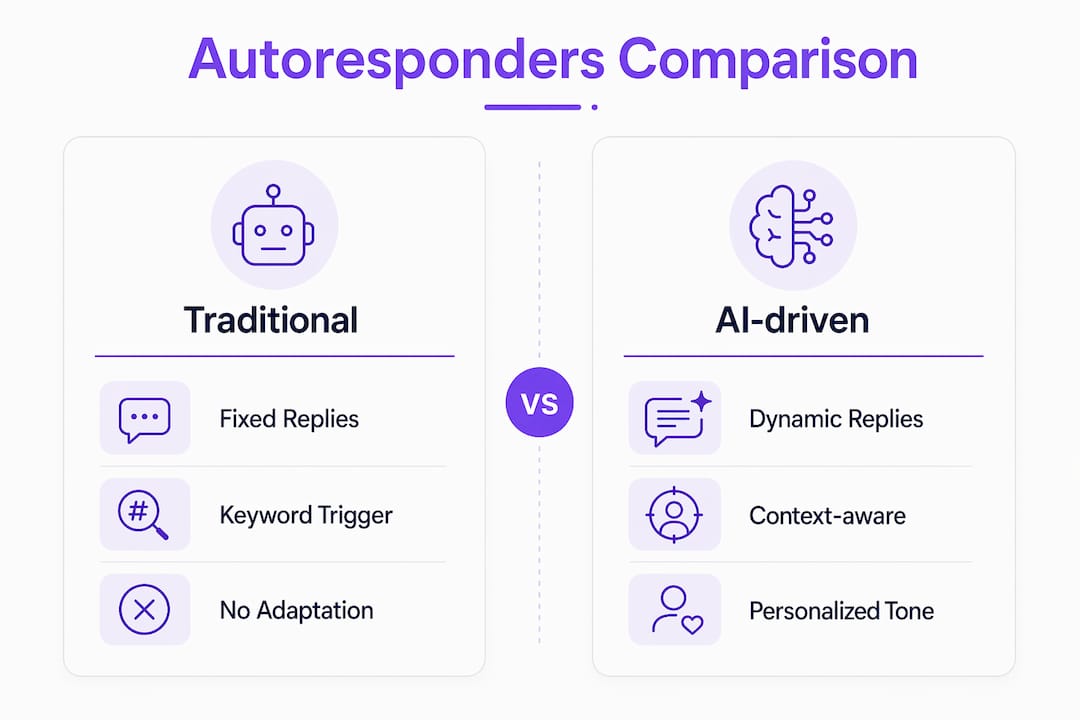
A legacy autoresponder fires a fixed template when triggered by a keyword or time condition. It cannot adapt to the content of the incoming message. An AI-driven system reads the full message, infers intent, and drafts a reply that matches the specific context. This is the difference between a "We received your email" acknowledgment and a substantive first response.
| Feature | Traditional autoresponder | AI-driven response system |
|---|---|---|
| Reply type | Fixed template | Dynamically drafted |
| Personalization | None or rule-based | Context and tone adaptive |
| Conversation memory | None | Stateful (up to 30 days) |
| Human review needed | Rarely | Recommended before sending |
| Setup complexity | Low | Moderate to high |
The personalization gap is the most significant practical difference. AI systems can match the sender's tone, reference specific details from the incoming message, and adjust formality based on context. A cloud-hosted AI assistant can do this across thousands of simultaneous threads without degradation in quality.
The critical caveat is human review. Treating AI as a drafting layer that requires human sign-off before sending reduces the risk of hallucinations and inappropriate tone in business communications. Organizations that skip this step expose themselves to reputational and legal risk. The efficiency gain from AI drafting is real. The risk from unsupervised sending is also real.
Where are AI models for automated replies used in practice?
AI models for automated replies are deployed across email, chat platforms, customer support queues, and no-code workflow tools. Meta-analytical research confirms that AI-based communication interventions are moderately to strongly effective in language tasks and organizational email automation. That finding holds across industries from e-commerce to healthcare administration.
Automation platforms like n8n and Pabbly Connect let teams build AI-powered reply workflows without writing code. Both platforms offer free tiers, with n8n supporting up to 100 tasks per month at no cost. These tools connect AI models to email inboxes, CRMs, and ticketing systems through API integrations. The benefits for business workflows are measurable: faster first-response times and reduced manual triage load.
Mobile-first tools extend AI responses into messaging apps. Replyfy generates contextual responses directly inside messaging apps and uses regex filtering to block credential leaks before any reply is sent. This security layer is often absent in enterprise tools that prioritize speed over safety. WhatsApp and Telegram integrations are now standard in most AI agent platforms, including those built on OpenClaw.
Key application areas by category:
- Customer support: AI drafts first-response emails and chat replies, reducing average handle time.
- Internal communication: AI summarizes long threads and drafts status updates for project management tools.
- Sales outreach: AI personalizes follow-up messages based on prior conversation history.
- Feedback processing: AI models in user feedback workflows categorize and route responses to the right team automatically.
Pro Tip: *When integrating AI replies into a customer support workflow, always log the AI-generated draft alongside the final human-edited version. Over time, that delta shows you exactly where the model needs fine-tuning.*
What are the risks and ethical limits of AI-generated responses?
AI-generated responses carry risks that go beyond technical failure. Ultra-personalized AI communication can mute user identity and breach privacy. When an AI learns to write in your voice, it also encodes your patterns, preferences, and potentially sensitive information into a system you may not fully control. Design that preserves user voice and explicit consent is not optional. It is the minimum standard.
The accountability problem is equally serious. AI's authoritative language can obscure accountability, and communicative norms get shaped algorithmically without clear user deliberation. When an AI sends a reply that damages a business relationship, the question of who is responsible is genuinely unresolved in most organizations. The model does not bear responsibility. The person or team that deployed it does.
> "Current rapid deployment of ultra-personalized AI often compromises privacy and fails to preserve user voice, recommending more cautious design." — Cornell Tech doctoral researcher
The Tri-Layer Communication Model describes how AI reshapes linguistic form and interaction dynamics beyond mere assistance. AI does not just help you communicate. It changes the structure of how communication happens. Organizations that deploy AI response systems at scale are, whether they intend to or not, reshaping their communicative culture.
Human feedback improves AI model accuracy, mitigates biases, and ensures ethical compliance by providing corrective input. This is the human-in-the-loop principle. It is not a workaround for a flawed system. It is a design requirement for any responsible deployment. Teams that treat human review as optional will eventually encounter a failure that makes it mandatory.
Key Takeaways
AI models generate context-aware responses through statistical pattern matching on conversation history, and responsible deployment requires human review, stateful architecture, and clear ethical boundaries.
| Point | Details |
|---|---|
| AI models are pattern matchers | They predict plausible responses from context, not from true understanding or memory. |
| Stateful architecture matters | Systems that store conversation history up to 30 days produce more coherent, adaptive replies. |
| Human review is non-negotiable | Using AI as a drafting layer with human sign-off prevents hallucinations and tone failures. |
| Privacy risks are real | Ultra-personalized AI can encode sensitive user data and mute individual voice without careful design. |
| No-code tools lower the barrier | Platforms like n8n and Pabbly Connect let teams deploy AI reply workflows without engineering resources. |
Why I think most organizations are deploying AI responses backwards
Most teams I have seen deploy AI response systems start with the automation and add the guardrails later. That is the wrong order. The model is not the hard part. The hard part is defining what a good response looks like for your specific context, your tone, your risk tolerance, and your users.
The thing that surprises people is how much the context window matters in practice. A model with a short context window will produce replies that feel coherent in isolation but miss the thread of a longer conversation. I have tested this directly with several AI agent setups, and the difference between a 4,000-token and a 32,000-token context window is not subtle. It shows up immediately in multi-turn conversations.
The ethical dimension also gets underweighted. Teams focus on accuracy and speed, which are measurable. Privacy preservation and voice authenticity are harder to quantify, so they get deferred. That is a mistake. The significance of AI models in communication is not just operational. It is cultural. You are changing how your organization sounds and how it relates to the people it communicates with.
My practical advice: treat the AI as a very fast junior writer. Review everything before it goes out. Build the feedback loop from day one. The organizations that do this well end up with a system that gets better over time. The ones that skip it end up with a system that confidently sends the wrong thing.
> *— Iosif Peterfi*
Clawbase makes AI response deployment practical
Getting an AI response system running in a real environment is harder than the demos suggest. Configuration, uptime, model selection, and integration with tools like Telegram and Discord all require time and technical knowledge that most teams do not have on standby.
Clawbase solves this by hosting OpenClaw on a dedicated server with one-click deployment, 99.9% uptime, and access to over 50 AI models. No sysadmin work. No maintenance overhead. The platform includes persistent memory management and native integrations with the communication tools your team already uses. For teams that want to put AI-driven response workflows into production without building infrastructure from scratch, the OpenClaw use cases page shows exactly what the agent can do across real communication scenarios. Managed AI agent hosting starts at $16 per month.
FAQ
What is the role of AI models in responses?
AI models generate context-aware replies by applying statistical pattern matching to conversation history. They function as adaptive drafting systems, not autonomous communicators, and work best when paired with human review.
How do stateful and stateless AI response systems differ?
Stateful systems store conversation history for up to 30 days and produce more coherent multi-turn replies. Stateless systems treat each message as a new input, which limits their ability to maintain context across a conversation.
What are the main risks of AI-generated responses?
The primary risks are hallucination, privacy breaches from over-personalization, and accountability gaps when AI sends replies without human review. Deploying AI as a drafting layer with mandatory sign-off addresses most of these risks.
Can non-technical teams deploy AI reply workflows?
Yes. No-code platforms like n8n and Pabbly Connect connect AI models to email and chat tools without requiring engineering work. Free tiers with up to 100 tasks per month make entry-level deployment accessible.
How does human feedback improve AI response quality?
Human feedback corrects model errors, reduces bias, and aligns output with organizational tone and ethical standards. This human-in-the-loop process is a design requirement for responsible AI communication deployment, not an optional add-on.