What Is AI Agent Architecture? A 2026 Guide
2026-06-14

AI agent architecture is the structural design that transforms a large language model into an autonomous system capable of dynamic decision-making, tool use, and iterative task execution. Where a standard LLM answers a single prompt and stops, an agent architecture keeps the model running inside a control loop, calling tools, observing results, and deciding what to do next. Microsoft describes agents as systems that interpret data, make decisions, and automate tasks, built on pillars of trust, traceability, and transparency. Understanding this design concept is the foundation for anyone building or evaluating AI-driven automation in 2026.
What is AI agent architecture, really?
The industry term for this design concept is *agentic system architecture*, though "AI agent architecture" is the phrase most practitioners use day to day. At its core, the architecture of AI agents answers one question: how does an LLM go from answering questions to completing multi-step tasks without constant human input?
The answer is a loop. The model receives a goal, selects a tool to call, observes the result, updates its working memory, and decides whether to continue or stop. That cycle repeats until the task is done or a termination condition is met. This is fundamentally different from a chatbot, which has no persistent state and no ability to act on the world.

The design also carries real responsibility. Agent architectures are not just about model prompts. They include secure, auditable patterns that emphasize trust and transparency at every layer. Getting the architecture right determines whether your agent is a reliable worker or an unpredictable black box.
What are the core components of AI agents?
A minimum viable agent architecture includes four interlocking parts: an LLM as the reasoning engine, a tool set with explicit schemas, a scratchpad as working memory, and a control loop that governs execution. Each component has a specific job, and removing any one of them breaks the system.
Here is what each component does:
- Large language model (LLM). The central reasoning engine. It reads the current state, decides which tool to call, and generates structured output. Models like GPT-4o or Claude 3.5 Sonnet are common choices for production agents.
- Tool interfaces. External functions the LLM can call, each defined with a JSON-schema. The schema acts as a contract, specifying inputs, outputs, and expected behavior. Treating tool calls as contractual interfaces with explicit schemas limits uncontrolled tool use and supports operational measurability.
- Memory systems. Agents use at least three memory layers. The scratchpad holds the current reasoning trace and is re-read every iteration to ground the model in actual observed results. Working memory holds context for the active task. Long-term memory, often backed by a vector store, persists knowledge across sessions. Think of these as layers in a human brain: short-term recall, active focus, and deep storage.
- Control loop. The loop decides the next action, executes it, observes the outcome, and checks whether the termination condition is satisfied. Scratchpad memory re-ingested each iteration reduces hallucinations and error propagation in multi-step tasks.
- Guardrails and human-in-the-loop (HITL) gates. Safety controls are not optional add-ons. Guardrails and tool-use behavior configurations, including HITL gating, are core architectural controls for safe automation. The OpenAI Agents SDK, for example, lets you pause execution and request manual approval before a tool with side effects runs.
Pro Tip: *Start with the narrowest possible tool set. Every tool you add expands the agent's action space and increases the chance of unexpected behavior. Add tools one at a time and test each loop iteration before moving on.*
How do AI agent frameworks and design patterns compare?
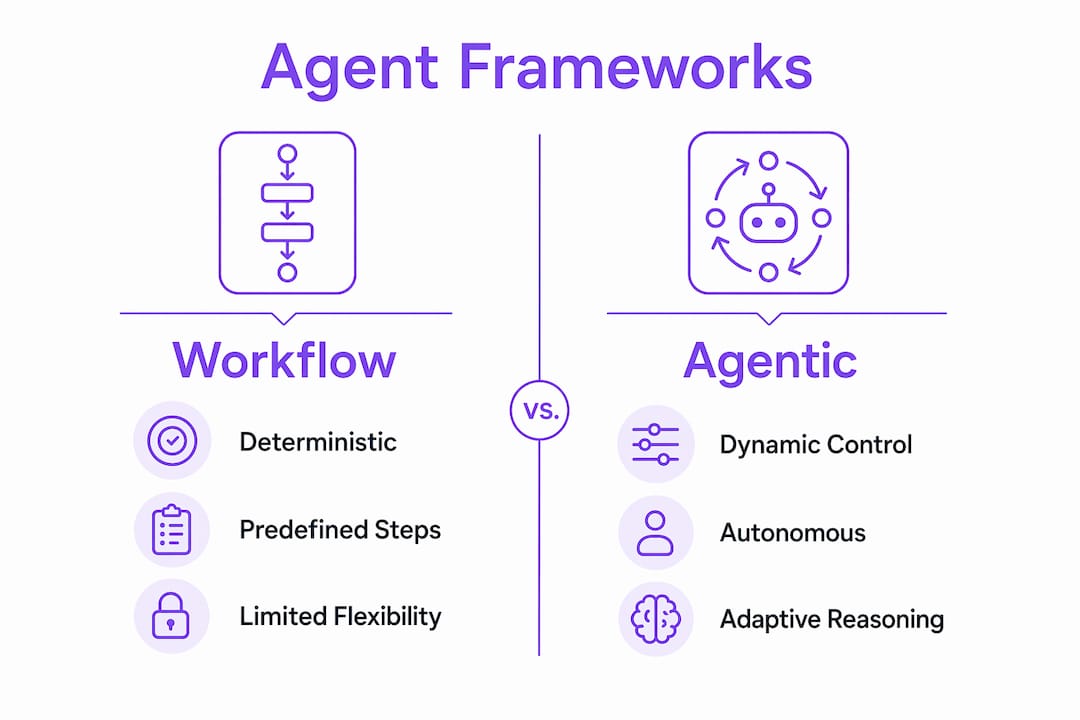
Not every AI agent system looks the same. A two-dimensional framework categorizes agent designs by cognitive function (7 categories) and execution topology (6 archetypes), producing 27 distinct design patterns. That taxonomy helps you pick the right pattern based on constraints like time pressure, failure cost, and required autonomy.
The three most important distinctions in practice are between workflows, agentic workflows, and full agents:
| Design Type | Control | Flexibility | Best For |
|---|---|---|---|
| Workflow | Fully deterministic, predefined steps | Low | Repetitive, predictable tasks |
| Agentic Workflow | Workflow shell with one or more LLM decision nodes | Medium | Tasks needing occasional dynamic judgment |
| Full Agent | LLM drives all decisions in an open loop | High | Complex, unpredictable multi-step tasks |
Most production AI agent systems are hybrid: a workflow shell with one or more agentic nodes where dynamic control is required. This hybrid model reduces unpredictability while preserving flexibility. It also addresses cost and auditability concerns, since open-ended autonomous steps are expensive and hard to debug.
The practical takeaway is that "agent" is not a binary label. You can dial autonomy up or down by choosing how many nodes in your pipeline hand control to the LLM. A document processing pipeline might be 90% deterministic workflow with a single agentic node that handles edge cases. That design is cheaper, faster to audit, and easier to maintain than a fully autonomous agent.
Real-world applications of AI agent architectures
Understanding agent architecture in theory is useful. Seeing it in production is where the design concept clicks.
- Enterprise task automation with Microsoft 365 Copilot. Microsoft embeds agent architecture directly into productivity tools. Copilot agents can read emails, draft responses, query databases, and update records, all within a controlled loop that respects organizational permissions and data governance policies.
- Multi-agent coordination with the OpenAI Agents SDK. The OpenAI Agents SDK configures agents with instructions, model settings, tool interfaces, guardrails, and multi-agent handoffs. One agent can hand off a subtask to a specialized sub-agent, which treats the sub-agent as a tool with explicit orchestration. This keeps context clean and synthesis controlled.
- Workflow automation with HITL gates. For tasks with irreversible side effects, such as sending emails or modifying databases, human-in-the-loop approval gates pause execution, serialize state, and wait for a human decision before resuming. This pattern is standard in financial and healthcare automation.
- Audit-ready agent pipelines with NIST evaluation probes. NIST evaluation probes integrate into agent workflows to produce structured audit trails with rationale, improving traceability and debugging in non-deterministic systems. These probes act as adversarial verifiers, providing objective assessments against rubric criteria.
- Personal AI agents for file and workflow management. Platforms like Clawbase deploy always-on agents that automate file management, schedule tasks, and integrate with communication tools like Telegram and Discord. You can explore AI agent use cases that cover everything from document processing to multi-step research workflows.
Pro Tip: *Before deploying any agent in production, map every tool call to a specific permission scope. An agent that can read files should not automatically have write access. Explicit capability boundaries prevent accidental data modification and make audits far simpler.*
What are the best practices for building AI agent architectures?
Building a reliable agent architecture requires discipline at every layer. Here are the practices that separate production-grade systems from fragile prototypes:
- Start simple, then add autonomy. Most production agents should start from simpler workflows, adding agentic loops only when dynamic decisions are genuinely required. Every autonomous step adds failure surface. Add it only when the task demands it.
- Make traceability non-negotiable. Microsoft's responsible AI pillars list trust, traceability, and transparency as foundational, not optional. Log every tool call, every LLM output, and every state transition. Without this, debugging a failed agent run is guesswork.
- Use evaluation probes for ongoing monitoring. Architecture-level observability and standardized evaluation probes enable reliable, structured audits and debugging. These probes transform agent debugging from intuition-based to evidence-based iteration.
- Define explicit agent identity and authorization scopes. Agent architectures require explicit agent identity, authorization scopes, and capability boundaries for secure operation. NIST's AI Agent Standards Initiative recommends standardized interfaces and delegation chains to enhance auditability and prevent vendor lock-in.
- Treat guardrails as architecture, not afterthought. Input and output guardrails should be defined at design time, not bolted on after a failure. The OpenAI Agents SDK builds guardrails directly into the agent configuration object, which is the right mental model.
- Manage context window costs deliberately. Long scratchpads are expensive. Summarize completed reasoning steps and archive them to long-term memory rather than feeding the full trace into every iteration. This keeps token costs predictable and reasoning focused.
For a deeper look at how managed AI services handle agent identity and governance at scale, the patterns translate directly to self-hosted architectures as well.
Key takeaways
Effective AI agent architecture requires a control loop, explicit tool contracts, layered memory, and built-in safety controls working together from the start.
| Point | Details |
|---|---|
| Architecture defines autonomy | The design of the control loop and tool interfaces determines how much the agent can do without human input. |
| Hybrid models dominate production | Most real systems combine deterministic workflows with selective agentic nodes to balance flexibility and auditability. |
| Memory layers reduce errors | Scratchpad, working memory, and long-term memory each serve distinct roles; skipping any one layer increases hallucination risk. |
| Guardrails are structural | HITL gates and tool-use configurations must be defined at design time, not added after deployment. |
| Traceability enables trust | NIST evaluation probes and structured audit trails are the difference between a debuggable agent and a black box. |
Why i think most teams get agent architecture backwards
Most teams I have seen approach agent architecture by starting with the model and working outward. They pick GPT-4o, write a system prompt, add a few tools, and call it an agent. Then they wonder why it hallucinates mid-task or calls the wrong tool in sequence.
The real design work happens before you write a single line of code. You need to define the termination condition first. What does "done" look like? Without a clear answer, the control loop has no exit, and the agent will either loop forever or stop arbitrarily. I have watched teams spend weeks debugging agent behavior that was actually a missing termination criterion.
The second thing teams get wrong is treating memory as a single concept. Scratchpad memory, working memory, and long-term memory are architecturally distinct. Conflating them produces agents that either forget context mid-task or carry irrelevant context forward and confuse the model. The memory architecture in OpenClaw is a good reference for how these layers interact in a real system.
My honest recommendation: resist the pull toward full autonomy. A hybrid workflow with two or three agentic nodes will outperform a fully autonomous agent on 80% of enterprise tasks. It is cheaper to run, easier to audit, and far less likely to surprise you in production. Add autonomy incrementally, and only where the task genuinely requires dynamic judgment. The 2026 NIST standards are moving in exactly this direction, and the teams building to those standards now will have a significant advantage when compliance becomes mandatory.
> *— Iosif Peterfi*
Deploy your own AI agent with Clawbase
Building an AI agent from scratch requires managing servers, configuring models, and wiring together memory and tool interfaces. Clawbase removes all of that friction. With one-click deployment on a dedicated server, you get a private, always-on OpenClaw agent with 99.9% uptime, persistent memory management, and access to over 50 AI models. No sysadmin skills required. Whether you want to automate file workflows, integrate with Telegram or Discord, or run multi-step research tasks, Clawbase handles the infrastructure so you can focus on the agent logic. Browse the full range of AI agent capabilities or get started with managed OpenClaw hosting from $16 per month.
FAQ
What is AI agent architecture in simple terms?
AI agent architecture is the design that lets a large language model act autonomously by combining a reasoning engine, tool interfaces, memory, and a control loop. Instead of answering one prompt, the agent cycles through observe, decide, and act steps until a task is complete.
What are the main components of AI agents?
The core components are an LLM as the reasoning engine, a tool set with JSON-schema definitions, a scratchpad and long-term memory system, a control loop with termination criteria, and guardrails including human-in-the-loop gates.
How do AI agent frameworks like the OpenAI agents SDK work?
The OpenAI Agents SDK configures agents with instructions, model settings, tool interfaces, guardrails, and multi-agent handoff rules. It supports tool-use behavior configuration and HITL approval gates that pause execution for human review before resuming.
What is the difference between a workflow and an AI agent?
A workflow follows predefined, deterministic steps. An AI agent uses an LLM to make dynamic decisions at runtime. Most production systems are hybrid, using a workflow shell with selective agentic nodes where flexibility is genuinely needed.
Why does agent architecture need explicit security controls?
Agents that can call tools and modify external systems require defined identity, authorization scopes, and capability boundaries. NIST's AI Agent Standards Initiative recommends standardized delegation chains to prevent unauthorized actions and support auditability across multi-agent systems.