Engineers: Reduce Prompt Injection Risk in Web Automation
2026-10-08

Yes, we can automate web tasks with AI safely when we combine strict context isolation, least-privilege tool scopes, action gating, and continuous adversarial testing. No single technique closes the gap on its own. The priority order matters: isolate first, restrict permissions second, validate every action third, and keep a human in the loop for anything irreversible. Residual risk never disappears entirely, so ongoing testing stays part of the job.
***
> TL;DR:
>
> - Isolating each browser session and injecting credentials at runtime minimize cross-session leaks and reduce attack surface during automation tasks.
> - Up to 86% of realistic prompt injections succeed in sandboxed environments, emphasizing the need for continuous adversarial testing and strict controls.
> - Separating privileged and content parsing models, routing tool calls through validation, and capturing logs significantly decrease the risk of instruction hijacking.
> - Public LLMs handling sensitive data should rely on private, encrypted processing with strict data retention and access controls to ensure privacy and compliance.
> - Ongoing monitoring, structured action logging, human approvals, and incident response plans are essential for maintaining safety in production AI agents.
***
Table of Contents
- Quick controls checklist for safer agent deployments
- Why web content is an untrusted instruction channel
- Engineering patterns that reduce agent risk
- Data governance for sensitive automation tasks
- Testing strategy: benchmarks and adversarial red-teaming
- Deployment monitoring and incident response
- Where managed hosting fits into a safety-first setup
- What "safe" really means for AI web agents
- Try a managed, privately hosted OpenClaw deployment
- FAQ
- Sources
Quick controls checklist for safer agent deployments
Before an agent touches a live browser session, a handful of controls should already be in place. These aren't theoretical best practices, they're the minimum bar for anything that acts on your behalf across the open web.
- Spin up a fresh, isolated browser context per task instead of reusing sessions or cookies across runs.
- Vault credentials and inject them at runtime rather than placing them anywhere in the model's context window.
- Require human confirmation or step-up authentication before payments, deletions, or account changes execute.
- Screen inputs and outputs against a structured schema instead of trusting free-text tool responses.
- Enable traces, network logs, and screenshots so every action is replayable after the fact.
Pro Tip: *Treat every page your agent visits as a potential instruction source, not just data, and design controls accordingly.*
Why web content is an untrusted instruction channel
Prompt injection comes in two flavors. Direct injection happens when someone types malicious instructions straight into a chat box. Indirect injection is sneakier: it hides inside a web page, a PDF, an API response, or a tool's output, and the agent reads it as though it were a legitimate instruction from its operator. The OWASP AI Agent Security Cheat Sheet treats every retrieved document, email, and API response as untrusted by default, which is the correct starting assumption for any agent that browses on your behalf.
The threat is not theoretical. The WASP benchmark found that realistic prompt injections partially succeed in up to 86% of tested scenarios, meaning attackers don't need full control to extract value. A partial hijack is enough to capture a credential, trigger an unauthorized transaction, or leak sensitive data to an external endpoint.
Concrete abuse vectors include:
- Hidden instructions in a web page that redirect the agent to submit a form with attacker-controlled data.
- A manipulated search result that convinces the agent to paste credentials into a lookalike login page.
- A tool response that smuggles exfiltration instructions disguised as formatting metadata.
Simple task-completion demos obscure this risk because they measure whether the agent finished the job, not whether it stayed within policy while doing so.
Engineering patterns that reduce agent risk
Reducing risk means building structural separation into the agent's design, not hoping a better system prompt will hold the line. A dual-LLM pattern, where a privileged execution model never sees raw untrusted content and a quarantined content model handles parsing, keeps attacker-controlled text away from the component that can actually act.
For the browser layer itself, Playwright's documentation describes deterministic interaction patterns: accessibility-tree locators, auto-waiting, and assertions that outperform vision-based clicking for both reliability and auditability, and you can use the BabyLoveGrowth AI crawlability audit tool to test how AI bots access your website content. Pairing that with traces, DOM snapshots, and network logs turns every automation run into evidence you can replay later.
- Separate the privileged execution LLM from the quarantined content-parsing LLM.
- Address elements through the DOM or accessibility tree instead of pixel coordinates.
- Keep credentials out of the model's context window entirely; inject them at the execution layer.
- Route every proposed tool call through an action-validation policy service before it runs.
- Capture traces, network requests, and screenshots for every session, successful or not.
Permission scoping deserves its own layer of discipline, and our piece on pre-action file access controls walks through gating patterns that apply just as well to browser tool calls.
| Control | What it prevents | Where it lives |
|---|---|---|
| Context isolation | Cross-session credential leakage | Browser session layer |
| Dual-LLM separation | Instruction hijacking from page content | Model architecture |
| Action validation service | Unauthorized high-risk calls | Policy/execution boundary |
| Traces and network logs | Undetected exfiltration attempts | Observability layer |
Data governance for sensitive automation tasks
Public third-party LLMs should be treated as untrusted destinations for sensitive inputs unless a private-processing architecture sits in front of them. OpenAI's private safety processing documentation describes one such approach: customer-controlled encrypted storage, retention windows, and enterprise key-management authorization that together limit how long sensitive content persists and who can access it.
Architecture alone doesn't satisfy a compliance team, so an operational checklist matters just as much:
- Validate where encrypted data physically lives and who holds the decryption keys.
- Set retention time-to-live values that match your actual legal and business requirements.
- Confirm key-management service (KMS) authorization controls before granting any processing access.
- Put operational service-level agreements in writing, not just in a sales deck.
Our walkthrough of AI assistant data privacy controls covers how these pieces map onto an actual deployment, including who on your team should own each governance decision.
Testing strategy: benchmarks and adversarial red-teaming
Knowing whether an agent is safe requires measuring it against adversarial conditions, not just checking whether tasks complete. The WASP benchmark evaluates end-to-end attacks inside sandboxed web environments rather than isolated text classification, which is why its partial-success rate of up to 86% carries more weight than a narrower lab test.
ST-WEBAGENTBENCH adds a different lens: Completion Under Policy, which scores whether an agent finished a task while staying inside defined safety policies. Across the open agents it evaluated, using 375 tasks and 3,057 policies spanning six trustworthiness dimensions, average Completion Under Policy came in below two-thirds, a reminder that raw task success and policy-compliant success are two different numbers.
- Run multi-step adversarial scenarios that emulate realistic attacker goals, not single-prompt injection tests.
- Score completion under policy, not just task completion, to catch silent constraint violations.
- Re-run the full adversarial suite after any prompt, tool, memory, or model change.
- Treat benchmark scores as a floor to clear, not a ceiling to celebrate.
Deployment monitoring and incident response
Safety work doesn't stop at launch. Once an agent is running in production, the signals worth watching are structured action logs, anomalies in tool usage patterns, and unexpected network calls that don't match the task at hand.
- Log structured metadata for every action alongside replayable traces.
- Watch for reasoning drift or tool-call patterns that deviate from baseline behavior.
- Require step-up authentication and human approval before irreversible operations execute.
- Keep incident runbooks and kill switches ready, with post-incident red-team follow-ups built into the process.
Pro Tip: *A kill switch that nobody has tested in the last quarter isn't a kill switch, it's a hope.*
Where managed hosting fits into a safety-first setup
Running OpenClaw on your own infrastructure demands real sysadmin work: isolated tenancy, encrypted storage, backup schedules, and patch management, all maintained continuously. We built ClawBase to handle that layer: one-click deployment on dedicated encrypted servers, persistent memory controls, 99.9% uptime, and access to over 50 AI models, so the operational burden of safe hosting doesn't fall entirely on your team.
Before trusting any managed vendor, including us, confirm these points directly: dedicated versus shared tenancy, backup frequency and encryption at rest, KMS and access-control documentation, and written uptime SLAs. Our guide on single-tenant hosting checks walks through exactly what to ask for.

What "safe" really means for AI web agents
Safety here is continuous and contextual, not a certificate you earn once. The right question isn't whether an agent can be hijacked, it's how small the blast radius stays when it is. We'd rather see a team over-invest in approval gates for payment flows and account changes than apply uniform caution everywhere and under-protect the actions that actually matter.
Budget for adversarial testing the same way you budget for monitoring infrastructure: as an ongoing line item, not a one-time audit before launch.
> *— Iosif Peterfi*
Try a managed, privately hosted OpenClaw deployment
If you want the architectural controls in this article without building and maintaining the hosting layer yourself, a managed OpenClaw instance gets you there faster. We offer dedicated encrypted servers, persistent memory, and broad model access starting on the LITE plan at $16 per month, with PRO and MAX tiers available for teams running heavier automation workloads.
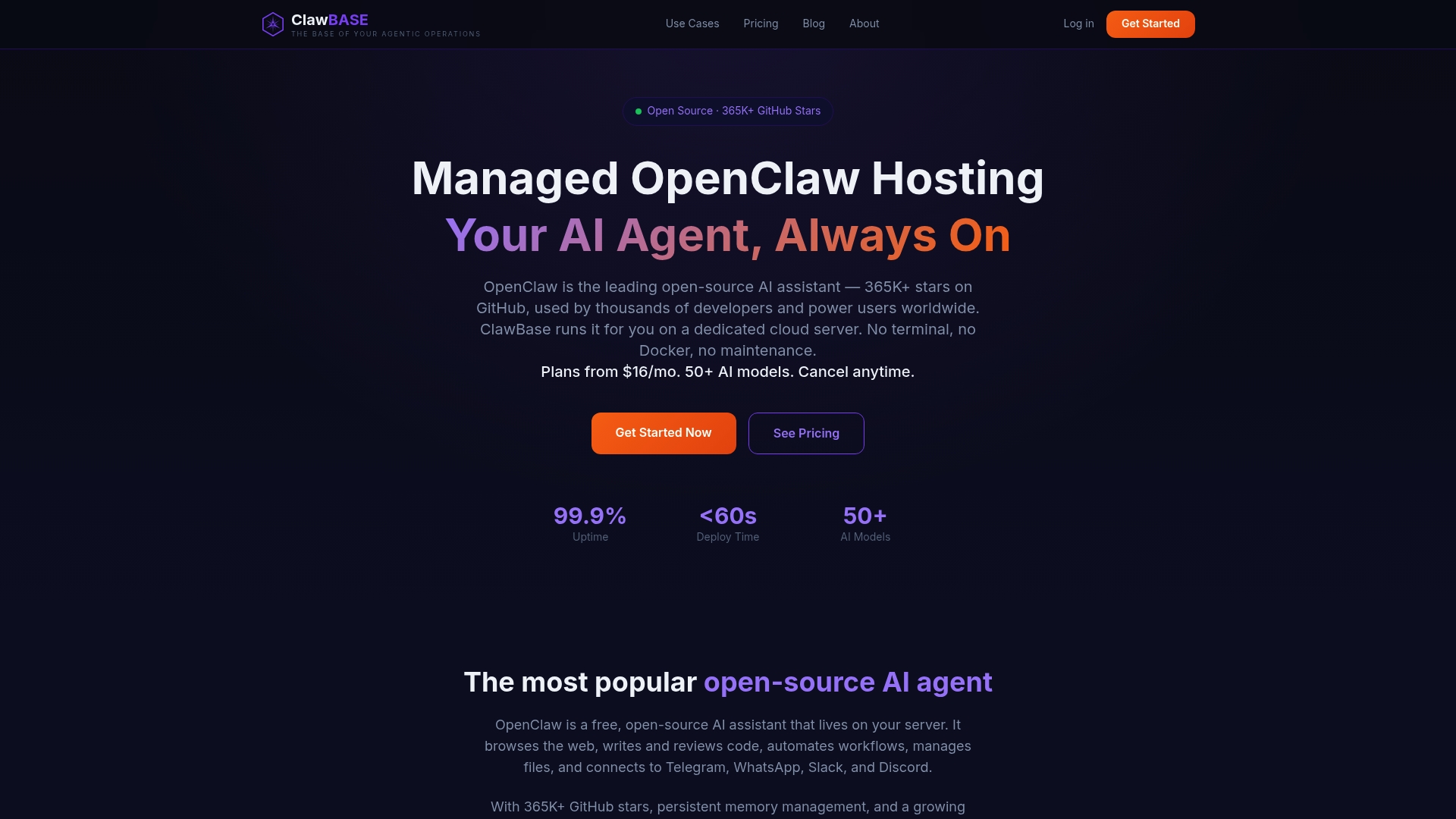
Our tutorial for setting up and mastering an OpenClaw agent walks through deployment end to end, and the pricing page lists every plan if you want to compare before you commit.
FAQ
What makes web content an untrusted instruction channel for AI agents?
Any page, document, or API response an agent retrieves can contain hidden instructions that look like legitimate data but are actually attacker-crafted commands. The OWASP AI Agent Security Cheat Sheet recommends treating all retrieved content this way by default rather than trusting it selectively.
How effective are prompt injection attacks against browser agents?
Realistic end-to-end prompt injections partially succeed in up to eighty-six percent of tested cases according to the WASP benchmark, which evaluates attacks inside sandboxed web environments rather than isolated text tests. That figure means no browser agent should be assumed safe without dedicated adversarial testing.
What is Completion Under Policy and why does it matter?
Completion Under Policy, introduced by ST-WEBAGENTBENCH, scores whether an agent finishes a task while staying inside defined safety constraints, not just whether the task got done. It matters because an agent can complete a task successfully while silently violating a policy along the way.
Can I use a public LLM for automation involving sensitive data?
Public third-party LLMs should be treated as untrusted destinations for sensitive inputs unless a private-processing architecture is explicitly in place. Approaches like OpenAI's private safety processing describe customer-controlled storage and retention limits as one way to narrow that gap, but eligibility and configuration still need verification.
Does ClawBase provide a safe environment for AI web automation?
ClawBase provides managed, dedicated encrypted servers for running OpenClaw with persistent memory controls and 99.9% uptime, which addresses infrastructure-level isolation and operational maintenance. Application-level controls like action validation, context isolation, and human approval gates still need to be configured for the specific automation tasks you run.
Sources
- AI Agent Security - OWASP Cheat Sheet Series
- WASP: Benchmarking Web Agent Security Against Prompt Injection Attacks (arXiv)
- ST-WEBAGENTBENCH (OpenReview)
- Playwright documentation
- OpenAI Private Safety Processing documentation