Permission Aware AI: Pre Action File Access Controls for Practitioners
2026-10-02

Treat AI file access as an authorization boundary, not a convenience feature: preserve source permissions, enforce policy before content ever reaches the model, and require provenance for anything an AI system uses to generate an answer. The core controls are sensitivity labels paired with DLP (Microsoft Purview is the common example), attribute-based access decisions, and isolated AI instances for the data that cannot tolerate mistakes. Managed private hosting, ClawBase among them, removes several of these risk vectors by design rather than by configuration.
***
> TL;DR:
>
> - Ingested permissions must include entitlement mapping and tagging of each content chunk to prevent leakage during retrieval or summarization.
> - Common missteps involve dropping access metadata during ingestion or allowing unrestricted agents that can traverse sensitive files, increasing leakage risks.
> - Enforcing pre-access policies and segmenting data through isolated instances provide the strongest control, especially for highly sensitive information.
> - Provenance logging at each stage and regular entitlement reconciliation are critical for auditability and maintaining compliance over time.
> - Managed private hosting can reduce risks by isolating AI agents on dedicated servers, with pilot programs advising starting small and verifying transparency before scaling up.
***
Table of Contents
- What File Access Controls Mean for AI Systems
- Where AI Systems Go Wrong: Failure Modes and Attack Patterns
- Principles for Preserving Source Access Controls in AI Workflows
- Technical Controls and Architecture Patterns
- Deployment Patterns: Segmentation, Isolation, and Ingestion
- Governance, Monitoring, and Vendor Due Diligence
- How ClawBase Helps: Reducing Risk Through Private Managed Hosting
- Incident Response for AI-Related File Access Breaches
- User Training for Safe AI File Interactions
- Legal and Compliance Considerations for AI File Access
- What Actually Matters When You Roll This Out
- Start a Secure AI File Access Pilot with ClawBase
- Sources
- FAQ
What File Access Controls Mean for AI Systems
File access controls for AI cover a different problem than traditional file security. A POSIX permission bit or an ACL entry answers one question: can this user open this file. An AI system introduces a second question that legacy controls were never built to answer: once a file is readable, what is the agent allowed to *do* with it, and does reading it count as viewing it or extracting it.
That distinction matters because a read operation performed by an agent is not just access, it is admission into the model's reasoning state. Once a chunk of a contract or a customer record enters a prompt or a retrieval context, it can be summarized, quoted, or blended with other sources the requesting user was never authorized to see. Microsoft Purview's own model separates these operations explicitly, distinguishing EXTRACT from VIEW rights so a sensitivity label can permit a person to view a document without permitting an AI process to pull data out of it.
Useful primitives to map before building anything:
- File-level permissions: POSIX bits, ACLs, and sensitivity labels that govern the underlying object.
- AI service access: the identity and scope an agent or connector uses to reach that object.
- Operation type: view, extract, summarize, or write, each with different risk.
- Enforcement touchpoint: ingest-time, query-time, pre-action, or post-response, each catching different failures.
Getting these primitives straight early saves a lot of rework once ingestion pipelines and retrieval layers are already running.
Where AI Systems Go Wrong: Failure Modes and Attack Patterns
Most AI file access incidents trace back to a small set of repeatable mistakes, and almost none of them involve a sophisticated adversary. They involve a pipeline that quietly dropped the access control metadata somewhere between the source system and the vector store.
- ACL loss during ingestion: connectors that index content into a shared knowledge base often strip the original entitlements, so a document that was restricted to one team becomes searchable by everyone.
- Aggregated inference: even when individual files stay within policy, an agent that queries across many sources can infer restricted information by combining fragments none of which was individually sensitive.
- Agent overreach: coding and file-management agents left unrestricted can traverse into
.envfiles, SSH keys, or configuration directories that were never meant to be part of any knowledge base. - Chunk mixing in synthesis: when a retrieval step returns both permitted and forbidden chunks, the model has no innate concept of which parts it should ignore, so a summary can leak restricted content by accident.
- Shadow AI and unmanaged connectors: teams standing up their own bots or plugins outside IT's inventory, with no entitlement reconciliation ever run against them.
One documented mitigation path: the FINOS AI Governance Framework recommends mapping entitlements and tagging chunks with their original permissions at ingestion, precisely because these failures cluster at the ingest and retrieval stages rather than at the model itself. Getting that mapping right early prevents most of the downstream leakage patterns above.
Principles for Preserving Source Access Controls in AI Workflows
Before choosing tools, a team needs agreement on the rules those tools will enforce. Four principles cover most of the ground.
- Preserve fidelity. Map source entitlements into the AI pipeline rather than recreating a parallel permission scheme; tag content and filter at query time whenever the underlying system allows it.
- Enforce pre-access. Policy decisions belong before content enters the agent's reasoning state, not after a response is generated. A denial issued after the fact cannot un-leak anything.
- Segment when mapping is infeasible. For data too sensitive or too irregular to tag reliably, the FINOS framework recommends isolated AI instances with their own stricter access controls rather than trying to filter everything inline within a general-purpose assistant.
- Require provenance. Every AI response touching governed data should trace back to specific source chunks and the policy that permitted their use, so an audit can reconstruct exactly what the model saw.
These four principles map directly onto the operational touchpoints from the previous section: fidelity and segmentation happen at ingest, pre-access enforcement happens at query and retrieval time, and provenance happens at response time.
Pro Tip: *Start provenance logging before you need it. Reconstructing what an agent saw six weeks ago, after the fact, is far harder than logging it as it happens.*
Technical Controls and Architecture Patterns
Once the principles are set, the implementation choices narrow to a handful of well-documented patterns.
Attribute-based access control and the Policy Machine. NIST's ABAC and Policy Machine guidance describes attribute-driven authorization as a way to express fine-grained, dynamic policies that evaluate the subject's role, the file's sensitivity label, the operation requested, and the environment, all at decision time rather than baked into a static role table. For AI systems, this means a policy decision point can grant an agent read access to a folder for summarization while denying extraction of specific fields, without a separate role for every combination.
Purview-style enforcement. Microsoft's pattern uses compute protection scopes and the processContent API: an application computes the applicable protection scope, caches the resulting ETag, and calls processContent before an upload, download, or file operation completes. A restrictAccess response must block the activity before it proceeds, not after. When sensitivity label indexing is enabled, Azure AI Search checks that metadata at query time so only authorized users see the AI-generated results tied to that label.
Pre-action enforcement. APort-style policy packs implement path allowlists and blocked-pattern rules (.env, private keys, path traversal attempts) plus size and extension limits, returning a deterministic ALLOW or DENY before the agent's filesystem call executes. This is the cheapest control to deploy and it catches the crudest overreach cases from the previous section.
Filesystem-level governance. CaFS-style architectures intercept file operations through a FUSE interposition layer, classifying each read and choosing to allow, redact, summarize, deny, or require approval before the content ever reaches the model's context window, producing a session-level audit record as it goes.
Query-time filtering for RAG. Tag chunks with their source entitlements at ingestion and filter the retrieval set before it reaches the model, rather than relying on a system prompt instructing the model to "ignore restricted content." Prompts are not access controls.
- Attribute sets worth standardizing: subject role, file sensitivity label, operation type, and environment (production, sandbox, agent identity).
- Enforcement mode matters: inline blocking stops the leak; offline auditing only documents it after the fact.
Pro Tip: *If you can only build one control this quarter, build pre-action enforcement on write and delete operations. Read leaks are damaging; unauthorized writes and deletes are often irreversible.*
Deployment Patterns: Segmentation, Isolation, and Ingestion
Three deployment patterns cover most real-world AI knowledge stores, and the right choice depends on how sensitive the data is and how much search breadth the organization needs.
- Enrich-on-ingest with query-time filtering. Tag every chunk with its source entitlements during ingestion and keep a single RAG store, filtering at query time before retrieval reaches the model. This suits moderate sensitivity data where centralized search matters more than airtight isolation.
- Logical or physical segmentation. Maintain separate indexes or vector database instances per access domain (finance, legal, HR). Enforcement is simpler because each store only ever serves one entitlement class, at the cost of narrower search across domains.
- Isolated AI instances. For data too sensitive to risk any cross-contamination, run a dedicated AI instance against that dataset alone, following the FINOS recommendation to segregate rather than filter when fine-grained mapping is impractical. This is operationally heavier but gives the strongest guarantee.
Whichever pattern a team chooses, the ingestion checklist stays constant: extract entitlements at the source rather than guessing at them, preserve stable document and chunk identifiers so provenance links survive re-indexing, attach chunk-level metadata for the filter to act on, and version content so entitlement updates propagate rather than leaving stale permissions cached in the index. Our guide to managing files with an AI assistant walks through several of these ingestion decisions in more detail.
Governance, Monitoring, and Vendor Due Diligence
Controls only hold if someone is watching them continuously, not just at deployment.
- Inventory first. Catalog every connector, agent identity, and plugin touching enterprise files, including the shadow AI tools individual teams stood up without IT's knowledge.
- Reconcile entitlements on a schedule. FINOS guidance recommends regular configuration audits and red-team exercises aimed specifically at bypassing preserved access controls in RAG pipelines, not just generic penetration tests.
- Log for provenance, not just security. Cognition observability records, query logs, and retrieval logs need retention policies long enough to support an audit months after the fact, since chunk-level traceability is what proves which document version informed a given answer.
- Ask vendors the direct questions. Does the API honor sensitivity labels natively? Can it export audit trails on request? Does the contract grant your team the right to run its own security tests against the deployment?
None of this replaces the technical controls from earlier sections. It is what confirms they are still working six months after launch.
How ClawBase Helps: Reducing Risk Through Private Managed Hosting
For teams that want an agent touching files without inheriting every risk vector above, private managed hosting removes several of them structurally rather than through configuration. ClawBase deploys OpenClaw, the open-source AI assistant, on a dedicated encrypted server with no public third-party connectors sitting between the agent and its files.
- One-click deployment on a dedicated server, with no sysadmin work to configure isolation boundaries.
- Persistent memory kept server-side rather than scattered across client sessions.
- 99.9% uptime with server-side policy enforcement rather than relying on client configuration.
- Controlled integrations with Telegram, Discord, and other channels, and a curated skillset marketplace instead of arbitrary plugin installs.
A sensible pilot: deploy an isolated instance against a limited, low-risk dataset with audit mode on, then measure provenance completeness and check for any unintended exposure before expanding scope.
Incident Response for AI-Related File Access Breaches
An AI file access incident needs a different first move than a standard breach: before anything else, determine what the agent's reasoning state actually contained, not just what it was theoretically permitted to see. Pull the retrieval logs for the session in question and identify every chunk that entered context, because permission and exposure are not the same fact once content has passed through a model.

Containment means revoking the agent's session or API credentials immediately and, where the architecture supports it, disabling the specific connector or ingestion path that surfaced the exposed content rather than shutting down the entire system. Scope assessment comes next: search downstream logs and any cached responses for whether the exposed content was quoted, summarized, or referenced in outputs delivered to other users, since a single ingestion failure can propagate into multiple responses before anyone notices.
Root cause analysis should check the ingestion pipeline first, since ACL loss during indexing is the most common source of these incidents, followed by a check of whether pre-action enforcement was actually active on the affected path or had silently failed open. Document the specific policy that should have blocked the exposure and did not, because that gap is what the remediation actually needs to close.
Recovery includes re-indexing with corrected entitlement tags, patching the enforcement gap, and, where the exposure involved regulated data, notifying the compliance and legal teams promptly enough to meet applicable breach notification timelines. Post-incident, feed the failure back into the reconciliation schedule from the governance section so the same gap gets checked for on a recurring basis, not just once.
User Training for Safe AI File Interactions
Most AI file exposure incidents involve no malicious intent at all: someone uploads a file to a chat interface or points an agent at a shared drive without realizing what that action actually authorizes. Training needs to address that gap directly rather than repeating generic security awareness content.
Employees interacting with AI assistants should understand that pointing an agent at a folder is not the same as opening a file themselves. An agent that indexes a shared drive can surface content in a summary to a colleague who never had direct access to the original file, especially if entitlement tagging on that drive was ever incomplete. Framing this clearly, rather than assuming it is obvious, closes one of the most common gaps identified in the failure modes discussed earlier.
Practical training points that hold up in most environments:
- Never upload files containing credentials, keys, or personal data to a general-purpose AI chat interface that is not covered by an organizational DLP policy.
- Treat an AI agent's file access request the same way you would treat a new coworker's access request, and question it if the scope looks broader than the task requires.
- Report any AI tool or plugin connected to company files that was not provisioned through the approved inventory process, since that is exactly how shadow AI accumulates.
Refresher training tied to actual incident patterns, rather than an annual slide deck, tends to stick better because it maps directly onto behavior people recognize in their own workflow.
Legal and Compliance Considerations for AI File Access
Regulatory exposure from AI file access follows the same logic as any other data processing activity, but the audit trail requirements are stricter because regulators increasingly expect organizations to show not just that a control existed, but that it fired correctly on the specific record in question.
Under GDPR, an AI system that processes personal data through retrieval or summarization is a processing activity subject to the same lawful basis, purpose limitation, and data minimization requirements as any other system, and a data subject access request now has to account for whatever an AI pipeline retained or generated from that person's data. Organizations should treat AI access to personal data as a boundary that needs the same documentation as any other automated decision path.
For healthcare organizations, HIPAA's requirements around access limited to the minimum necessary for a given purpose apply directly to AI agents processing protected health information, meaning an assistant that can query broadly across a clinical records store needs the same entitlement boundaries a human user would have, not a broader scope granted for convenience. This is precisely where isolated instances or strict query-time filtering, discussed in the deployment patterns section, earn their operational cost.
None of the above substitutes for a review by qualified legal counsel familiar with the organization's specific regulatory obligations and jurisdiction. What the technical controls in this article provide is the evidentiary trail: provenance records, entitlement mappings, and audit logs are what let an organization demonstrate compliance rather than simply assert it after the fact.

What Actually Matters When You Roll This Out
Most organizations overbuild the model layer and underbuild the entitlement layer, then wonder why an agent surfaced something it should not have. If I had to prioritize three moves for a team starting this month: inventory every connector and agent identity first, pilot pre-action policies against your single highest-risk dataset rather than everything at once, and instrument provenance logging before you need it for an investigation.
Get identity, platform, data governance, and legal involved early, not after the pilot proves the concept. Measure success by audit trail completeness, the drop in misclassified exposures, and how quickly you detect anomalous agent access, not by how fast the rollout finished.
> *— Iosif Peterfi*
Start a Secure AI File Access Pilot with ClawBase
If your team wants to test permission-aware AI without standing up your own hosting and enforcement stack from scratch, ClawBase runs OpenClaw on a private, encrypted, dedicated server with no public connectors between the agent and your files.
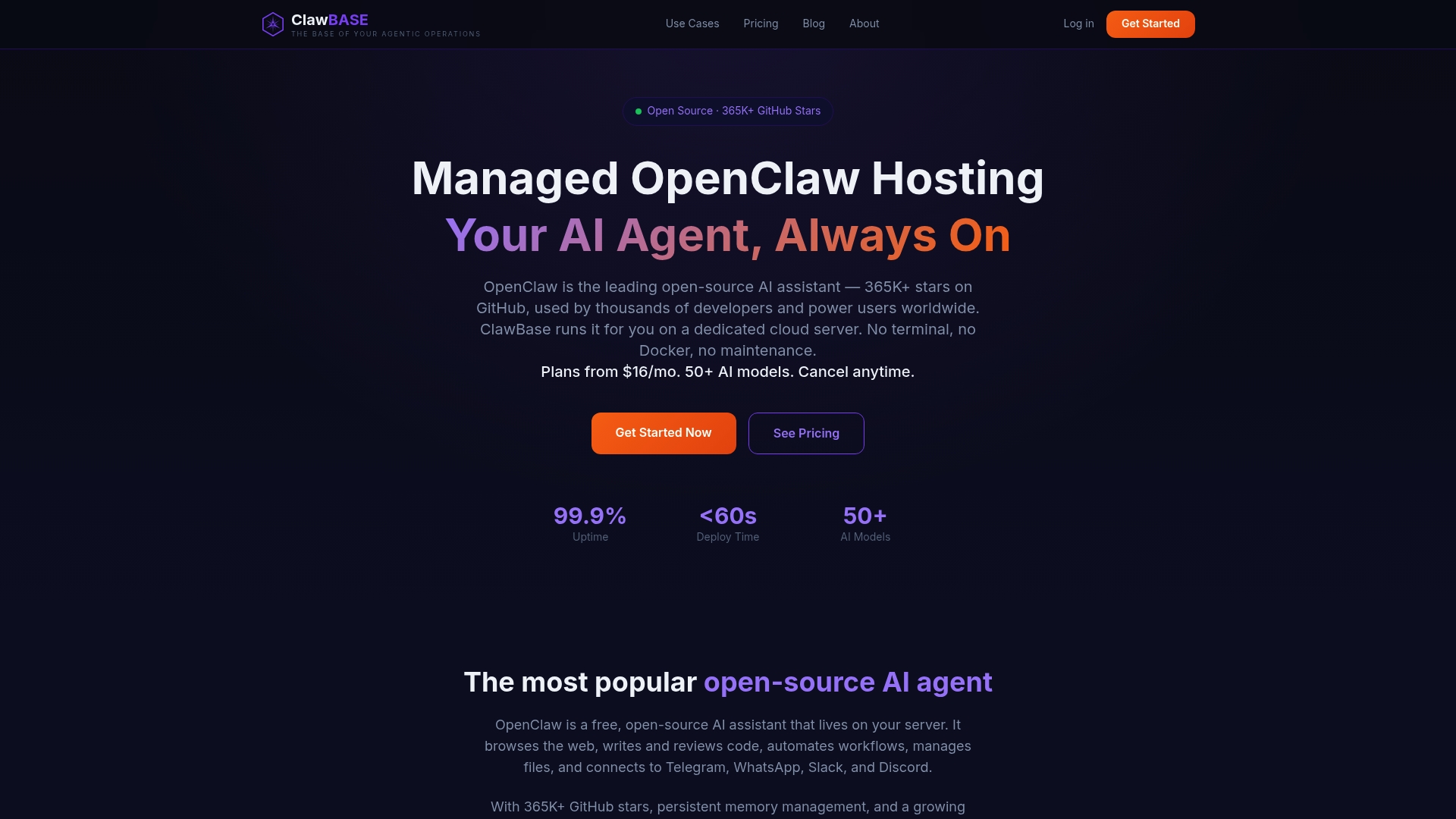
A sensible pilot mirrors the pattern from earlier: pick an isolated, low-risk dataset, turn on audit mode, and run entitlement reconciliation checks weekly for the first month. Managed hosting like this fits best when a team wants controlled agent file access without operating its own Purview integration and policy decision points; enterprise-scale Purview plus custom vendor controls fits better when you already have that platform team in place. Plans start at $16 per month on the LITE tier, with PRO and MAX tiers available for larger deployments, and a 7-day free trial to test the pattern before committing.
Sources
- Secure AI with Microsoft Purview (Microsoft docs)
- FINOS AI Governance Framework (preserving source access controls)
- NIST Special Publication on ABAC / Policy Machine
FAQ
How is AI being used in access control?
AI systems are increasingly the subject of access control decisions rather than just a tool for making them: attribute-based systems evaluate a requesting agent's role, the file's sensitivity label, and the operation requested before granting access. Platforms like Microsoft Purview apply this at query time so AI-generated results respect the same sensitivity boundaries as direct human access.
What are the four types of access control?
Common models include discretionary access control, mandatory access control, role-based access control, and attribute-based access control. For AI systems, ABAC and the NIST Policy Machine model tend to fit best because they can evaluate dynamic attributes like operation type and environment rather than relying on static roles alone.
Who can control the permissions for a file?
File owners and system administrators typically set the underlying permissions through ACLs or sensitivity labels, but in AI pipelines a policy decision point, often built on ABAC rules, determines whether an agent's specific operation on that file is allowed at query time. This separates the static permission from the dynamic, context-aware decision an AI system requires.
What are the three types of file permissions?
Traditional file systems define read, write, and execute permissions for a given user or group. AI systems introduce a further distinction on top of these, separating VIEW rights from EXTRACT rights, since Microsoft Purview's sensitivity label model treats an AI process pulling data out of a document differently from a person simply viewing it.