What Is Open-Source AI Software? A 2026 Guide
2026-06-24

Open-source AI software is defined as an AI system whose source code, model weights, training data information, and documentation are all freely available to use, study, modify, and share. The Open Source Initiative's OSAID 1.0 sets the current industry standard: a system qualifies as open-source AI only when it provides enough artifacts for anyone to fully understand, reproduce, and rebuild it. Releasing model weights alone does not meet that bar. This distinction matters enormously for businesses and developers who want real control over the AI they deploy, not just the ability to run someone else's black box.
What is open-source AI software, and how does it differ from other AI types?
The most common misconception in AI today is treating open-weight models as fully open-source. Open-weight AI means the model's parameters are downloadable, but the training data and full source code needed for reproducibility are not provided. Meta's Llama is the most cited example: its weights are public, yet the training pipeline and dataset details remain proprietary. Full open-source AI, by contrast, requires all four components: source code, model weights, training data information, and documentation.
This distinction has real consequences. Without training code and data documentation, you cannot audit how a model learned its behavior, reproduce its outputs independently, or verify claims about its safety properties. Reproducibility is the foundation of scientific trust, and it applies equally to AI systems.
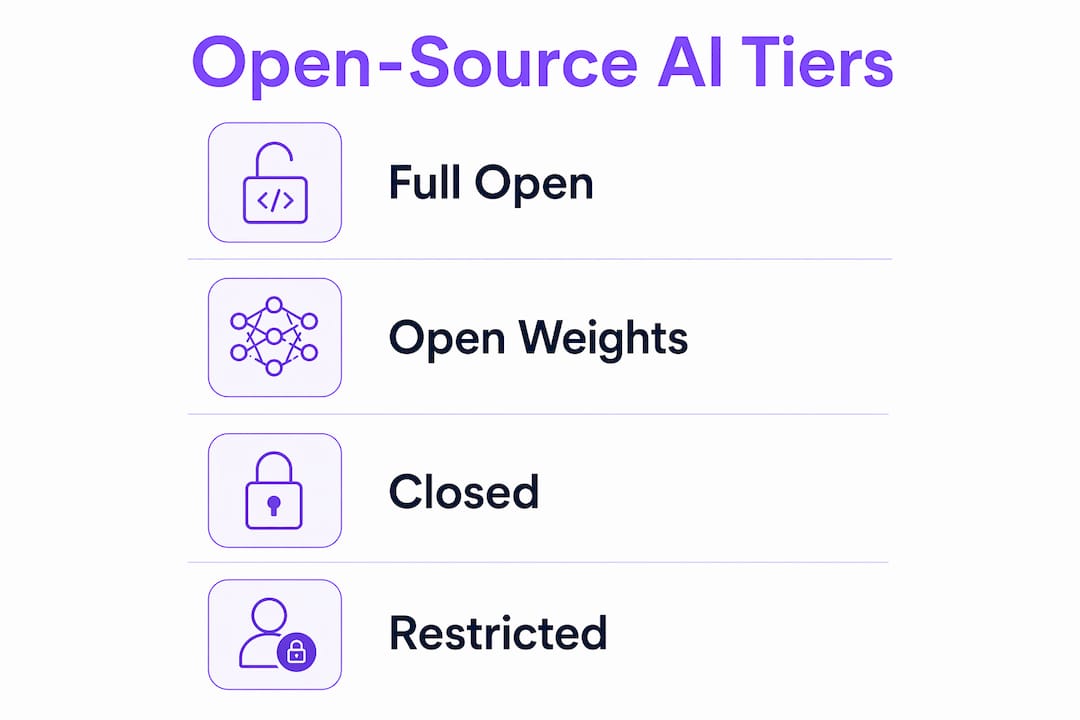
The G7 and OSI formalized these degrees of openness in 2026 with a three-tier labeling standard:
- Weights Available: A proprietary model that shares weights but retains closed licensing.
- Open Weights: Weights released under an open-source license, but training data and code are not fully disclosed.
- Open Source AI with Open Data: All assets, including training data, are openly licensed and available.
Understanding which tier a given model occupies tells you exactly what freedoms you actually have. A model labeled "open" that sits in the first tier gives you far less control than one in the third tier.
Pro Tip: *Before adopting any AI model, check its license file directly. Licenses like Apache 2.0 and MIT grant broad freedoms, while custom "community licenses" often restrict commercial use or redistribution in ways that matter for business deployments.*
What components make up an open-source AI ecosystem?
Open-source AI is not a single file or model. It is a stack of components, each of which can be open or closed independently. Practitioners treat each layer separately when auditing true openness: training code, model weights, training data information, inference code, and deployment tooling all require individual evaluation.
The four core layers are:
- Source code: The training and inference scripts that define how the model learns and runs.
- Model parameters: The weights that encode learned knowledge, typically stored as large binary files.
- Data documentation: Descriptions of training datasets, their sources, and preprocessing steps. Full raw data release is sometimes legally impossible due to privacy constraints, so OSI's OSAID accepts detailed documentation as a substitute.
- Deployment components: Inference servers, APIs, and configuration files needed to run the model in production.
Above these model layers sits the orchestration layer. Frameworks like OpenHarness provide open-source agent infrastructure that wraps lower-level AI models with tool use, memory management, and safety boundaries. OpenHarness is a Python-based agent harness that separates model intelligence from workflow logic. That separation means you can swap the underlying language model without rewriting your entire application. For teams building production AI agents, this modularity is the difference between a maintainable system and a brittle one.
Pro Tip: *Treat your AI stack like a layered architecture. Audit each component independently. A system with open weights but closed training code is not reproducible, regardless of how it is marketed.*

Why is open-source AI software powerful? Key benefits and opportunities
Open-source AI's core advantage is control. When you have access to the full stack, you decide how the model runs, where it runs, and what data it touches. That independence is not available with closed API-based services, where the vendor controls every layer.
The main benefits break down as follows:
- Full auditability. Transparency in open-source AI lets organizations inspect AI behavior directly. This matters most in healthcare, finance, and criminal justice, where unexplained decisions carry serious consequences.
- No vendor lock-in. Open-source AI lets you deploy without mandatory commercial licenses, on your own infrastructure or any cloud provider you choose.
- Community-driven improvement. Thousands of contributors can identify bugs, propose fixes, and add capabilities faster than any single vendor team.
- Cost control. Avoiding per-call API fees compounds into significant savings at scale, especially for high-volume applications.
- Composability. Modular open-source systems let you combine the best model for each task rather than accepting a single vendor's all-in-one solution.
> Openness does not automatically guarantee safety, quality, or privacy. An open model can still produce biased outputs, leak sensitive information, or behave unpredictably. Evaluating behavior and testing for compliance remain your responsibility, regardless of how open the license is.
That caveat is not a reason to avoid open-source AI. It is a reason to approach it with the same rigor you would apply to any production system. The transparency open-source provides actually makes that evaluation easier, not harder.
How do you evaluate and use open-source AI software effectively?
Choosing the right open-source AI tool starts with a component-by-component audit. Many models marketed as open are actually open-weight only, which creates real risks if you assume full reproducibility. A structured checklist prevents that mistake.
Openness audit checklist:
- Is the full training source code publicly available in a version-controlled repository?
- Are model weights downloadable under an OSI-approved license?
- Does the project provide training data documentation or dataset cards?
- Are inference and deployment scripts included and maintained?
- Does the license permit your intended use, including commercial deployment?
Beyond openness, evaluate quality and security before committing to a model. Run the model against your actual use cases, not just benchmark scores. Check the project's issue tracker for unresolved security reports. Verify that the maintainers respond to vulnerabilities promptly.
The table below maps common use cases to the level of openness they typically require:
| Use case | Minimum openness level | Why it matters |
|---|---|---|
| Internal productivity tool | Open Weights | Reproducibility is less critical; cost and control matter most |
| Regulated industry deployment | Open Source AI with Open Data | Auditability and reproducibility are legally required |
| Research and benchmarking | Open Source AI with Open Data | Full rebuild capability is needed to validate results |
| Customer-facing product | Open Weights or higher | License must permit commercial use explicitly |
For businesses without deep sysadmin capacity, open-source AI scalability is a real operational challenge. Managed hosting platforms simplify deployment by handling infrastructure, uptime, and model updates. This is where the gap between "technically open" and "practically usable" closes for most organizations. You can also explore AI agent architecture guides to understand how orchestration layers like OpenHarness fit into production deployments.
Key Takeaways
Open-source AI software requires all four components, including code, weights, data information, and documentation, to be openly available, and anything less is open-weight, not truly open-source.
| Point | Details |
|---|---|
| OSAID 1.0 sets the standard | Full open-source AI requires code, weights, data info, and docs, not just weights. |
| Open-weight is not open-source | Models like Meta's Llama share weights but lack training data and full code for reproducibility. |
| G7 labeling clarifies tiers | Three labels, Weights Available, Open Weights, and Open Source AI with Open Data, define actual openness. |
| Openness does not equal safety | Auditing behavior, licenses, and compliance remains your responsibility after adoption. |
| Orchestration layers add flexibility | Frameworks like OpenHarness separate model intelligence from workflow logic for maintainable systems. |
Why I think most teams misread "open-source AI" and pay for it later
The phrase "open-source AI" has become a marketing label more than a technical specification. I have watched teams adopt models described as open, build production pipelines around them, and then discover six months later that the training data documentation was a two-paragraph README with no real substance. That is an open-weight model wearing an open-source label, and it creates a reproducibility debt that compounds over time.
The component-by-component audit I described is not optional for serious deployments. It is the minimum due diligence. The G7 and OSI labeling framework from 2026 is genuinely useful here because it gives you a shared vocabulary to push back on vague vendor claims. When a vendor says "open," you can now ask: "Open Weights, or Open Source AI with Open Data?" That question alone filters out a lot of noise.
The other thing I keep coming back to is the orchestration layer. Most discussions of open-source AI focus entirely on the model, but the harness around the model is where most of the real engineering work happens. OpenHarness's design philosophy, separating model intelligence from workflow orchestration, is the right mental model for any team building agents. It keeps your infrastructure from becoming hostage to any single model's quirks or licensing changes.
For enterprises, the composability argument is the strongest one. Open-source AI composability gives you the ability to mix the best components for each task, run them on your own infrastructure, and avoid the compounding cost of per-call API fees. That independence is worth the upfront investment in proper evaluation and setup.
> *— Iosif Peterfi*
Clawbase makes open-source AI deployment practical
Getting from "technically open" to "running in production" is where most teams stall. Clawbase removes that barrier by offering one-click managed hosting for OpenClaw, a powerful open-source AI assistant, on a dedicated server with 99.9% uptime and no maintenance overhead required.
Clawbase gives you access to over 50 AI models, persistent memory management, and native integrations with Telegram and Discord, without requiring sysadmin expertise. Whether you are a developer building custom agents or a business team automating workflows, the platform handles the infrastructure so you can focus on the application. See what is possible with real AI agent use cases, or go straight to Clawbase managed hosting to get started from $16 per month.
FAQ
What is the Open Source AI Definition (OSAID)?
The Open Source AI Definition 1.0, published by the Open Source Initiative, requires that an AI system's code, model weights, training data information, and documentation all be freely available to use, study, modify, and share. Releasing only model weights does not satisfy this definition.
What is the difference between open-weight and open-source AI?
Open-weight AI provides downloadable model parameters but withholds training code and data details needed for full reproducibility. Open-source AI, per OSAID 1.0, requires all components to be openly available.
Is open-source AI software safe to use in production?
Openness does not guarantee safety or quality. You must audit model behavior, check the license for your use case, and test for security vulnerabilities before any production deployment.
What are the best open-source AI software examples?
Well-known open-source AI projects include models and frameworks across the full stack. OpenHarness is a notable open-source agent harness for building production AI agents with modular, swappable model backends.
How do I know if an AI model is truly open-source?
Check whether the project provides training source code, model weights under an OSI-approved license, training data documentation, and deployment scripts. If any of those four components are missing, the model is open-weight at best, not fully open-source.