Encrypted AI Hosting: 3–7% Overhead to Verify Privacy for Tech Teams
2026-09-20

Encrypted AI hosting combines hardware-backed trusted execution environments with client-side encryption so model inputs and outputs stay unreadable outside a verified enclave, even to the host operator. It's the right call for regulated data, proprietary model weights, or any workload where a breach means more than embarrassment. If that's your situation, the next step is mapping your threat model against the deployment options below, not shopping on marketing copy.
***
> TL;DR:
>
> - Encrypted AI hosting relies on confidential computing with trusted execution environments and end-to-end encryption, which together protect data "in use" and during model requests.
> - Cloud TEE solutions offer scalability and verifiable hardware attestation but impose overhead and require management of attestation and memory extensions for advanced features.
> - Managed dedicated encrypted servers provide a quick setup for enterprise-grade encryption and persistent memory, suitable for teams lacking in-house security expertise.
> - Attestation proves hardware and software integrity but does not eliminate risks from side-channel attacks, firmware flaws, or misconfiguration, requiring layered security controls.
> - For regulated or highly sensitive data, verified hardware attestations, strict key management, and compliance artifacts are essential to ensure real security beyond marketing claims.
***
Table of Contents
- What Is Encrypted AI Hosting and How Does It Work?
- Which Deployment Model Fits Your AI Workload?
- What Does Attestation Actually Prove, and What Are the Residual Risks?
- Which Compliance and Operational Controls Should You Require?
- How Should Teams Choose an Encrypted Hosting Provider?
- How Managed Encrypted Hosting Removes Common Deployment Barriers
- When Is Encrypted AI Hosting Actually Worth It?
- Get Started With Managed Encrypted AI Hosting
- Primary Sources for Verifying Encrypted AI Hosting Claims
- Sources
- FAQ
What Is Encrypted AI Hosting and How Does It Work?
Encrypted AI hosting rests on two technologies that solve different problems, and mixing them up is the most common mistake I see teams make during vendor evaluation.
The first is confidential computing, delivered through trusted execution environments (TEEs). Intel TDX creates a hardware-isolated region of memory that even a compromised hypervisor can't read, encrypting RAM contents so the underlying cloud provider never sees plaintext data or model weights. NVIDIA's confidential GPU modes extend that same protection to accelerator memory and the PCIe bus connecting CPU and GPU, which matters because most inference workloads live on the GPU, not the CPU. Together, these form what the Intel TDX white paper describes as encryption of data "in use," the missing piece that traditional encryption at rest and in transit never covered.
The second technology is end-to-end encryption (E2EE) applied to the model request itself. Here's how a well-built flow works in practice: the client fetches the model's public key, which is cryptographically bound to a specific TEE attestation report. The client generates an ephemeral key pair, encrypts the request payload, and sends it to the model running inside the enclave. Only that enclave, verified by its attestation, can decrypt the input, run inference, and encrypt the response before it ever leaves protected memory. The NEAR AI Cloud E2EE guide documents this pattern using Ed25519 and X25519 key exchange with XChaCha20-Poly1305 for the symmetric encryption layer, an authenticated cipher that's become a de facto standard for this kind of session encryption.

Pro Tip: *Ask any vendor claiming "end-to-end encryption" which specific cipher suite and key exchange protocol they use. If they can't name it, they're likely describing transport encryption (TLS) and calling it something bigger.*
Here's the catch nobody advertises upfront: strict E2EE breaks features users expect. Tool-calling, persistent memory, and external connectors to services like Slack or a CRM all require the model to retain or act on context across sessions, and that's hard to reconcile with a system where the server never sees plaintext beyond a single request. Vendors typically choose one of two paths:
- Disable or limit these features when E2EE mode is active, trading functionality for confidentiality guarantees.
- Extend the protocol so memory and tool state also live inside the attested enclave, encrypted at rest between calls, which adds engineering complexity but preserves the assistant's usefulness.
A concrete walkthrough helps here. Say a healthcare analytics team sends patient-note summaries to a hosted model. The client library encrypts the note client-side using a session key derived from the model's attested public key. The request travels over TLS as an outer layer, arrives at the enclave, gets decrypted only inside the TDX-protected memory region, processed, and the response is encrypted again before leaving the enclave. Nobody, including the hosting provider's own engineers, has access to a plaintext copy at any hop. That's the guarantee confidential computing exists to deliver, and it's a meaningfully different promise than "we encrypt your data" on a typical SaaS privacy page.
Which Deployment Model Fits Your AI Workload?
Three architectures dominate private AI hosting right now, and each makes a different trade between control, capability, and operational burden.
Endpoint-local inference runs the model directly on the user's device or an on-premises server the organization physically controls. Nothing leaves the building, which eliminates cloud exposure entirely and satisfies the strictest data residency requirements. The limit is capability: consumer and even high-end workstation hardware can't run the largest, most capable models at usable speeds, and every device needs enough memory and compute to justify the deployment. This suits narrow, well-defined tasks more than open-ended assistant work.
Cloud TEE hosting runs your workload inside an attested enclave on shared cloud infrastructure. You get scalability and access to larger models than most endpoints can handle, plus a verifiable hardware attestation report proving the enclave configuration matches what was promised. The trade-off shows up in overhead: NVIDIA's confidential computing solution brief cites theoretical overhead in the range of 3 to 7% for TDX and protected PCIe, manageable with warm enclaves but real enough to factor into latency-sensitive applications.
Managed dedicated encrypted servers sit between those two options. A vendor provisions a dedicated, encrypted server for your organization, handles the enclave configuration and attestation plumbing, and layers persistent memory management and integrations on top. You give up some of the granular control a DIY cloud TEE setup offers, but you gain a working system in hours instead of weeks, without needing in-house confidential computing expertise. Our own comparison of cloud-hosted versus self-hosted assistants digs into this trade-off in more depth.
Picking among the three comes down to answering a short sequence of questions in order:
- Can the workload run entirely on hardware you control? If yes and model capability requirements are modest, endpoint-local wins on simplicity and cost.
- Do you need attested, verifiable isolation with cloud-scale model access, and do you have the engineering capacity to manage attestation verification yourself? If yes, cloud TEE is worth the operational investment.
- Do you need enterprise-grade encryption and persistent memory without hiring for it? Managed dedicated hosting closes that gap, particularly for teams without a dedicated security engineering function.
Latency, model support, and required integrations should all factor into that third question. A private AI assistant used for professional workflows has different SLA needs than a batch-processing pipeline that tolerates a few extra seconds per request.
What Does Attestation Actually Prove, and What Are the Residual Risks?
A hardware attestation report is a cryptographic statement, signed by the chip manufacturer, that a specific enclave is running a specific, measured piece of software on genuine, unmodified hardware. It binds a public key to that measurement, so when your client encrypts a request against the model's public key, you have mathematical assurance the request can only be decrypted by that exact verified enclave image, not a lookalike or a modified version an attacker swapped in.
What attestation does not prove is equally important. It doesn't guarantee the software inside the enclave is free of bugs, that the hardware itself has no undiscovered flaws, or that side-channel attacks are impossible. Confidential compute providers are candid about this limit.
> Confidential compute raises the cost of unauthorized access substantially, but it does not eliminate residual risk. Side-channel attacks, firmware vulnerabilities, and misconfiguration remain real concerns that layered defenses, not hardware alone, need to address.
That framing, drawn from VoltageGPU's confidential compute documentation, should shape how you read any vendor's security claims. TEEs are a strong layer, not a complete answer.
The practical residual risks worth naming:
- Side-channel attacks that infer data through timing, power consumption, or cache behavior rather than direct memory access.
- Firmware and microcode vulnerabilities in the chip itself, which occasionally surface and require patching across the fleet.
- Misconfiguration on the provider's side, such as enclaves left in debug mode or attestation checks that get silently skipped.
- Secret leakage through logging, error messages, or crash dumps that inadvertently capture plaintext before it enters the enclave.
Mitigating these risks in practice means demanding dedicated tenancy rather than shared enclave pools where noisy neighbors increase side-channel exposure, requesting integrity monitoring that alerts on unexpected enclave restarts or measurement changes, enforcing strict key separation between environments, and minimizing logging of anything that touches plaintext, even temporarily.
Before signing with any vendor, ask for a live attestation report you can verify programmatically, not a marketing PDF. Request evidence of periodic re-attestation, a documented incident response process, and third-party audit results covering the specific enclave configuration you'd be using, not a generic corporate SOC 2. If a vendor can't produce a real attestation example on request, treat that as a disqualifying gap, not a minor inconvenience.
Which Compliance and Operational Controls Should You Require?
Security engineers evaluating encrypted AI hosting need to look past uptime numbers and dig into the specific artifacts a vendor can produce on request. Anyone can claim "HIPAA-ready." Fewer can hand you a signed Business Associate Agreement (BAA) alongside third-party penetration test reports scoped to the actual enclave configuration you'd run in.
Here's the checklist worth working through during procurement:
- Compliance artifacts: a signed BAA for HIPAA-relevant workloads, recent third-party penetration test reports, and documentation of data residency guarantees if your regulatory scope requires data to stay within specific borders.
- Key management model: does the vendor support customer-managed keys (CMK), hardware security modules (HSMs), or is encryption entirely vendor-controlled? Customer control over key material is the difference between "trust us" and "verify it yourself." Our breakdown of encryption-at-rest key management steps walks through what a proper CMK setup looks like.
- Data retention and logging policy: how long is data kept, what gets logged, and does logging ever capture plaintext outside the enclave boundary?
- SLA specifics: documented uptime commitment, backup frequency and encryption status, incident response timelines, and whether the vendor allows you to test recovery procedures rather than take them on faith.
| Control area | What to request | Why it matters |
|---|---|---|
| Compliance | Signed BAA, penetration test report | Confirms legal and technical review, not just a claim |
| Key management | CMK or HSM support | Determines who can technically access decrypted data |
| Retention | Written data retention and deletion policy | Limits exposure window if a breach occurs |
| SLA | Uptime guarantee, backup cadence | Confirms operational reliability under load |
Data residency deserves its own line item beyond HIPAA. GDPR imposes restrictions on transferring EU personal data outside the European Economic Area without adequate safeguards, and California's CCPA gives residents specific rights over how their data is processed and retained, rights that don't automatically disappear because an AI vendor sits between the business and the end user. If your organization operates across these jurisdictions, retention and residency policy needs to satisfy the strictest applicable regime, not the most convenient one.
Our HIPAA-compliant AI assistant deployment guide covers the specific protections a healthcare-adjacent deployment needs beyond this general checklist.
How Should Teams Choose an Encrypted Hosting Provider?
Choosing among encrypted hosting options gets easier once you sequence the questions correctly instead of evaluating features in a random order.
- Map your plaintext exposure tolerance first. Does regulatory or contractual obligation forbid any third party from ever accessing raw data, even transiently? That answer alone often eliminates entire categories of hosting.
- Confirm compliance scope. If HIPAA, GDPR, or CCPA applies, filter for vendors that produce the specific artifacts covered above before you evaluate anything else.
- Test latency under realistic load. A confidential compute stack with 3 to 7% overhead behaves very differently under a cold enclave than a pre-warmed one, so benchmark with production-like request patterns, not a single test call.
- Check model and feature support against your actual use case. If you need persistent memory or tool-calling integrations, confirm the vendor supports those inside the attested boundary rather than disabling them for E2EE mode.
- Run a structured pilot before committing. A solid pilot includes an attestation verification step, a functional test of the encrypted request and response cycle, a performance benchmark under warm enclave conditions, and a simulated incident to confirm log handling and recovery actually work as documented.
The decision flow, boiled down: workloads with zero tolerance for third-party exposure and modest model needs go endpoint-local. Workloads needing large models plus verifiable attestation and in-house security capacity go cloud TEE. Workloads needing enterprise-grade encryption without a dedicated security team go managed dedicated hosting. Most business teams and technical professionals land in that third category, which is exactly where operational simplicity starts to outweigh the appeal of building it yourself.
How Managed Encrypted Hosting Removes Common Deployment Barriers
Most of the friction in encrypted AI hosting isn't cryptographic. It's operational: someone has to provision the enclave, verify attestation on an ongoing basis, keep firmware patched, and maintain the integrations a real team actually uses day to day.
That operational load is exactly what pushes many technology leaders toward managed encrypted hosting rather than a self-built cloud TEE stack. A one-click deployment on a dedicated, encrypted server removes the provisioning step entirely. Persistent memory management means the assistant retains useful context across sessions without your team building that infrastructure from scratch. Broad model support, including multi-model routing, means you're not locked into a single provider's roadmap. Integrations with tools like Telegram and Discord mean the assistant actually gets used inside the channels teams already work in, rather than sitting unused behind a clunky internal dashboard.
A 99.9% uptime commitment matters here too, because encrypted infrastructure only protects data that's actually available when your team needs it. An enclave that's technically secure but frequently down doesn't help anyone.
During a pilot, these features map directly to the checklist items covered earlier:
- One-click deployment shortens the time from "let's try this" to a working test environment from weeks to hours.
- Automated updates reduce the ongoing maintenance burden that otherwise falls on internal sysadmin resources.
- Managed encryption on dedicated servers means the attestation and key-handling work has already been done, leaving your team to verify rather than build.
Validating any managed vendor still requires the same diligence: ask for a real attestation example, confirm the encryption model applies to memory and integrations, not just the initial request, and run a small-scale integration test before scaling up. Managed doesn't mean unverified. It means someone else did the infrastructure work, and your job shifts to confirming they did it correctly.
When Is Encrypted AI Hosting Actually Worth It?
Encrypted hosting earns its cost in specific situations, not universally. Regulated industries handling health records, financial data, or legal documents need it because the compliance exposure alone justifies the overhead. Teams building on proprietary datasets or model fine-tunes that represent real competitive advantage need it because a leak isn't just a privacy incident, it's a business one. High-stakes competitive environments, where even the fact that you're using AI on a particular dataset is sensitive, belong here too.
Where I'd push back on the current enthusiasm: plenty of teams reach for confidential computing for workloads that never justified it. If your data is already public, low-sensitivity, or aggregated beyond individual identification, the latency overhead and operational complexity of a TEE stack is friction without payoff. Match the tool to the actual risk, not to what sounds impressive in a security review deck.
The deeper point is this: cryptographic proof beats vendor promises every time. A signed attestation report you verified yourself is worth more than any amount of marketing language about "military-grade encryption." Ask for the report. Check it. Then decide.
> *— Iosif Peterfi*
Get Started With Managed Encrypted AI Hosting
If you've read this far, you already know the trade-offs: self-hosting a confidential AI stack gives you full control but demands real infrastructure expertise, while unmanaged cloud services often skip the hardware-level guarantees entirely. Clawbase sits in the gap between those two, giving you a dedicated, encrypted server for your OpenClaw assistant without requiring a single line of sysadmin work.
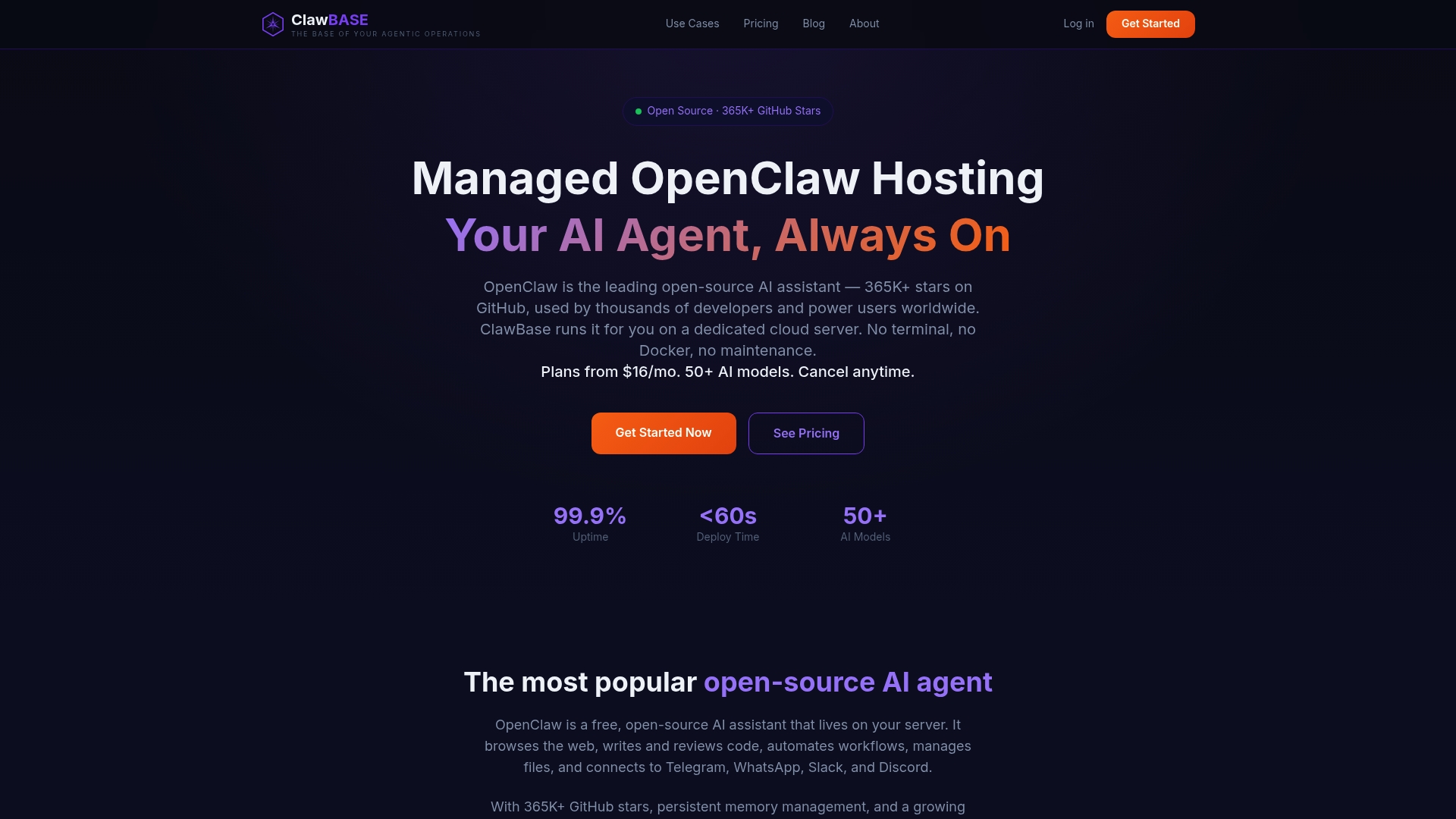
Deployment is one click. For teams that need to validate encrypted hosting before committing budget, that's a lower-risk starting point than building enclave infrastructure from scratch.
Start with the LITE plan at $16 a month, which includes a 7-day free trial, and run the pilot checklist from this guide against it: verify the encryption setup, test your actual integrations, and confirm memory persistence works the way your workflow needs. If your use case involves specific automation patterns, the use-case library is worth a look before you scope the trial. For agencies weighing the productivity math on AI adoption more broadly, this research on AI-driven ROI for agencies is a useful reference point.
Primary Sources for Verifying Encrypted AI Hosting Claims
Vendor claims about "military-grade encryption" or "fully private AI" are worth checking against the primary technical documentation, not taking at face value.
- The Intel TDX white paper documents exactly how memory encryption and CPU-level isolation work at the hardware level.
- The NEAR AI Cloud E2EE chat completions guide lays out the full cryptographic flow, including key exchange and cipher choices, for anyone who wants to see the protocol rather than take a summary on faith.
- The ArXiv security analysis of AI and E2EE integration is the clearest published treatment of why AI features and strict E2EE create real tension, and what mitigations actually help.
- VoltageGPU's confidential compute documentation is a solid reference for understanding residual risk framing beyond the hardware marketing.
Sources
- ArXiv: Security analysis of AI integration with E2EE systems
- VoltageGPU — confidential compute documentation
FAQ
Is There a Confidential AI Platform Available Today?
Yes. Platforms built on confidential computing, using TEEs like Intel TDX combined with attested E2EE protocols, exist and are in production use today. The technology described in the NEAR AI Cloud documentation reflects a working, deployable pattern, not a theoretical one.
How Do You Host Your Own Private AI?
You can self-host on hardware you control for maximum data control, though that path demands real systems administration expertise to configure encryption, memory management, and updates correctly. Managed alternatives like Clawbase handle that infrastructure on a dedicated encrypted server, letting you deploy a private assistant without building it from scratch.
Is There an AI That Is Completely Private?
No AI hosting model offers absolute, zero-risk privacy. Confidential computing and E2EE substantially reduce exposure by keeping data encrypted in use, but residual risks like side-channel attacks and misconfiguration remain, which is why layered mitigations matter alongside the hardware guarantees.
What Is the Most Secure AI Platform?
There's no single universally "most secure" platform. Security depends on your specific threat model, and the strongest approach for most sensitive workloads combines hardware attestation, E2EE for requests, and verified key management rather than relying on any one vendor's marketing claim. Request a live attestation report from any provider before trusting a security claim.
Does Clawbase Support HIPAA-Relevant Deployments?
Clawbase runs on dedicated, encrypted servers designed to reduce the operational barriers that come with HIPAA-relevant AI assistant deployments, detailed further in the HIPAA-compliant AI assistant guide. Specific compliance artifacts and current plan details are available directly on the pricing page.