SRE First 30/60/90 Plan to Prevent AI Agent Downtime
2026-10-05

The controls that stop AI agent downtime, in order of impact, are failure isolation through bulkheads, runtime policies with circuit breakers, observability built on SLIs and error budgets, and transactional undo for anything that mutates state. Each one closes a different failure path: isolation stops one bad job from starving the rest, circuit breakers stop a degraded dependency from cascading, and undo mechanisms mean a bad mitigation can be reversed instead of compounded. Start this week by measuring your SLIs, wiring a circuit breaker into your riskiest tool call, requiring dry-run on every mutation, and running one small fault-injection test.
***
> TL;DR:
>
> - Rate limiting has been identified as the largest single cause of AI agent reliability degradation, with a 2.5 percentage point impact below baseline.
> - Building bulkheads, fallback models, and sandboxed APIs can contain failures and preserve system availability during degraded conditions.
> - Implementing runtime policies, circuit breakers, and mandatory dry-runs before irreversible actions significantly reduces the risk of cascading failures.
> - Conducting controlled chaos testing focused on rate limits and schema drift reveals an average 8.8% drop in reliability, emphasizing the importance of backoff strategies.
> - Transactional undo and robust logging can dramatically improve recovery success rates, enabling agents to explore more aggressively without risking permanent damage.
***
Table of Contents
- What Breaks in Production: Common Failure Modes for AI Agents
- Architectural Controls That Prevent Agent Downtime
- Runtime Harness: Policies, Circuit Breakers, and Safe Actuation
- Observability, SLIs, SLOs, and Operational Runbooks
- Testing Reliability: Chaos Engineering and Benchmarks for Agents
- Recovery and Compensation: Transactional Undo, RAC, and TNR
- Our Take: A 30/60/90 Plan for Agent Reliability
- A Managed Path to Fewer Operational Headaches
- FAQ
- Sources
What Breaks in Production: Common Failure Modes for AI Agents
Agent reliability fails in a handful of recurring ways, and recognizing the signature early is most of the job. Model drift shows up as gradually degrading output quality that nobody notices until a downstream process breaks. Context exhaustion produces truncated reasoning or repeated tool calls as the agent loses track of what it already tried. API and tool fragility surfaces as timeouts, malformed responses, or silent schema changes from a vendor that never announced them. Prompt injection and rate limiting round out the list, often invisibly, until usage spikes.
The operational symptoms overlap enough to confuse on-call engineers: rising P95 latency, partial outputs that look plausible but are incomplete, runs that cannot be reproduced twice in a row, and corrupted downstream state once a half-finished action writes to a database.
- Model drift: quality erodes slowly, often invisible until output is audited downstream.
- Context exhaustion: the agent loses working memory and loops or stalls.
- API and tool fragility: a dependency times out, throttles, or changes its response shape.
- Prompt injection: untrusted input redirects the agent toward unintended actions.
- Cascading resource exhaustion: one stuck job consumes shared compute and starves everything else.
Fault injection work from ReliabilityBench found a reliability degradation of 8.8% under realistic perturbations, with rate limiting alone causing the largest single drop, 2.5 percentage points below baseline. That ranks rate limiting above most of the failure modes operators instinctively worry about first.
Architectural Controls That Prevent Agent Downtime
Architecture decides how far a single failure travels. The goal is containment: when something breaks, it should break small.
- Bulkhead your workloads. Separate heavy batch or research jobs from the inference path serving live requests, and reserve capacity so a runaway job can never starve a user-facing endpoint. The CACM piece on failure isolation argues that AI pipelines need this bulkhead pattern paired with graceful degradation, not just more compute.
- Build model fallbacks. When a primary remote endpoint degrades, fall back to a smaller local model or a cached response rather than returning an error. Lazy-loading a lightweight local model only when the primary is unhealthy keeps costs down while preserving availability.
- Reserve capacity and throttle defensively. Prioritized queues for critical tool calls, combined with throttling on lower-priority agent tasks, keep the system responsive when demand spikes. Our guide to open-source AI scalability walks through resource partitioning patterns in more depth.
- Sandbox every mutation. Design mutating APIs with a
dry_run=trueparameter as a first-class feature, and route all actuation through a control plane that can enforce sandboxing before anything touches production state.
Pro Tip: *Treat dry-run support as a launch requirement for any new tool integration, not a feature to retrofit after the first incident.*
These four patterns work together: isolation limits blast radius, fallbacks preserve the user experience during degradation, and sandboxed actuation means even a confused agent cannot do lasting damage.
Runtime Harness: Policies, Circuit Breakers, and Safe Actuation
The runtime harness is what turns a capable model into a dependable operator. This is the layer between the agent's reasoning and the real world, and it matters more for reliability than model quality does. The Agent Governance Toolkit frames this directly: treat reliability as a system property, enforced through runtime layers, not as something a bigger model eventually solves.
- Runtime policies evaluate eligibility and lifecycle predicates before a tool call executes, denying anything that violates an invariant regardless of what the agent "wants" to do.
- Per-agent circuit breakers trip automatically when error budgets run out, triggering throttling or a full exhaustion action without waiting for a human to notice.
- Progressive authorization escalates permission levels as risk increases, often centralized through an Actuation and Verification Agent pattern that checks every high-risk action before it runs.
- Mandatory dry-run and justification checks force the agent to show its reasoning and a simulated result before any irreversible step, with a human-in-the-loop gate for the riskiest category.
SRE guidance for agentic operations describes exactly this combination: agent-specific circuit breakers, dry-run support built into actuation APIs, and a post-actuation guardian, sometimes called a Red Button, that can halt an action already in flight.
Pro Tip: *Build the circuit breaker before you build the autonomy. A tool call with no off switch is a liability no matter how well the model reasons.*
Observability, SLIs, SLOs, and Operational Runbooks
You cannot fix what you cannot see, and agent systems hide failure more easily than traditional services because outputs can look correct while being wrong. The right signals to track: repeated-success rate (sometimes called pass@k), tool-call failure rate, actuation success rate, and latency at P95 and P99 for both inference and tool calls. Our logging practices guide covers the telemetry layer this depends on.
Error budgets, not ad-hoc thresholds, should trigger action. When a budget burns down, the response is automatic: throttle traffic, trip a circuit breaker, or freeze deploys until the team investigates, a pattern the Agent Governance Toolkit specifies directly through CIRCUIT_BREAK and THROTTLE actions tied to error-budget consumption.
A usable incident runbook follows four steps:
- Verify the incident against the SLI dashboard rather than a single alert.
- Simulate the mitigation in dry-run mode before applying it live.
- Roll back through the compensation path if the mitigation does not resolve the issue.
- Escalate with a trace replay attached, so the next responder can reproduce the failure deterministically.
Append-only audit logs make that trace replay possible; without one, every incident review starts from guesswork.
Testing Reliability: Chaos Engineering and Benchmarks for Agents
You find out how an agent fails under real conditions by failing it on purpose, in a controlled way, before production does it for you. Start by defining fault profiles: transient timeouts, hard rate limits, partial or truncated responses, and schema drift on tool outputs.
- Inject one fault type at a time so you can attribute the reliability drop to its actual cause.
- Run pass@k-style evaluations across varying consistency (k), error tolerance (ε), and load (λ) to map where robustness breaks down.
- Prioritize rate-limit and schema-drift experiments first, since they cause outsized damage relative to other fault types.
- Bound the blast radius with abort conditions and deterministic replay, so a chaos experiment cannot itself cause an outage.
The ReliabilityBench benchmark quantified an 8.8% reliability degradation under fault injection, identifying rate limiting as the fault type causing the single largest drop. That result alone justifies putting backoff and retry logic ahead of almost any other reliability investment.
An open-source implementation like the Agentic Reliability Framework demonstrates how adaptive anomaly detection and policy-driven self-healing can be wired into this kind of testing loop without building the harness from scratch.
Recovery and Compensation: Transactional Undo, RAC, and TNR
Every mitigation you apply can itself go wrong, which is why recovery needs to be as deliberate as prevention. The foundation is a transaction log: a tool interceptor records every mutating action as it happens, enabling LIFO rollback when something needs to be undone in reverse order.

Robust Agent Compensation, or RAC, formalizes this by pairing each mutating tool call with a reversible compensation action, recorded in a persistent transaction log. Evaluation of RAC shows a 1.5 to 8x improvement in token economy and latency for complex tasks, because recovery no longer depends on the model replanning from scratch.
Stratus introduces Transactional Non-Regression, or TNR, which requires an undo operator for every risky action and serialized writer exclusivity so retries cannot collide with each other. Stratus evaluation shows TNR improves mitigation success rates precisely because an agent can explore more aggressively when it knows any wrong move can be reversed.
- Define a compensation pair for every mutating action before it ships.
- Require dry-run simulation ahead of any irreversible call.
- Cap retries to prevent an undo loop from becoming its own incident.
- Maintain a dedicated Undo Agent or rollback policy that owns this logic centrally.
Pro Tip: *An agent that can undo its own mistakes is worth more than one that simply avoids making them, because mistakes happen regardless.*
Our Take: A 30/60/90 Plan for Agent Reliability
Most teams try to solve agent reliability by making the model smarter. That is backwards. The governance research is consistent on this point: reliability is a harness and runtime property, and a better model bolted onto a fragile runtime is still fragile.
A realistic sequence: in the first 30 days, measure your SLIs and add basic circuit breakers to your highest-risk tool calls. In 60 days, layer in runtime policies, mandatory dry-run, and at least one model fallback path. By 90 days, run your first bounded chaos experiment and implement transactional undo for anything that writes state.
Small teams should resist the urge to grant agents full autonomy before this sequence is done. An SLO-driven exhaustion action and a working fallback path prevent more outages than any amount of prompt engineering.
> *— Iosif Peterfi*
A Managed Path to Fewer Operational Headaches
Everything in this guide takes real engineering time to build: isolation, circuit breakers, observability, undo logic. We built ClawBase as a managed hosting layer for OpenClaw that handles a meaningful slice of that operational burden for you, so your team can spend its time on policies and testing instead of server maintenance.
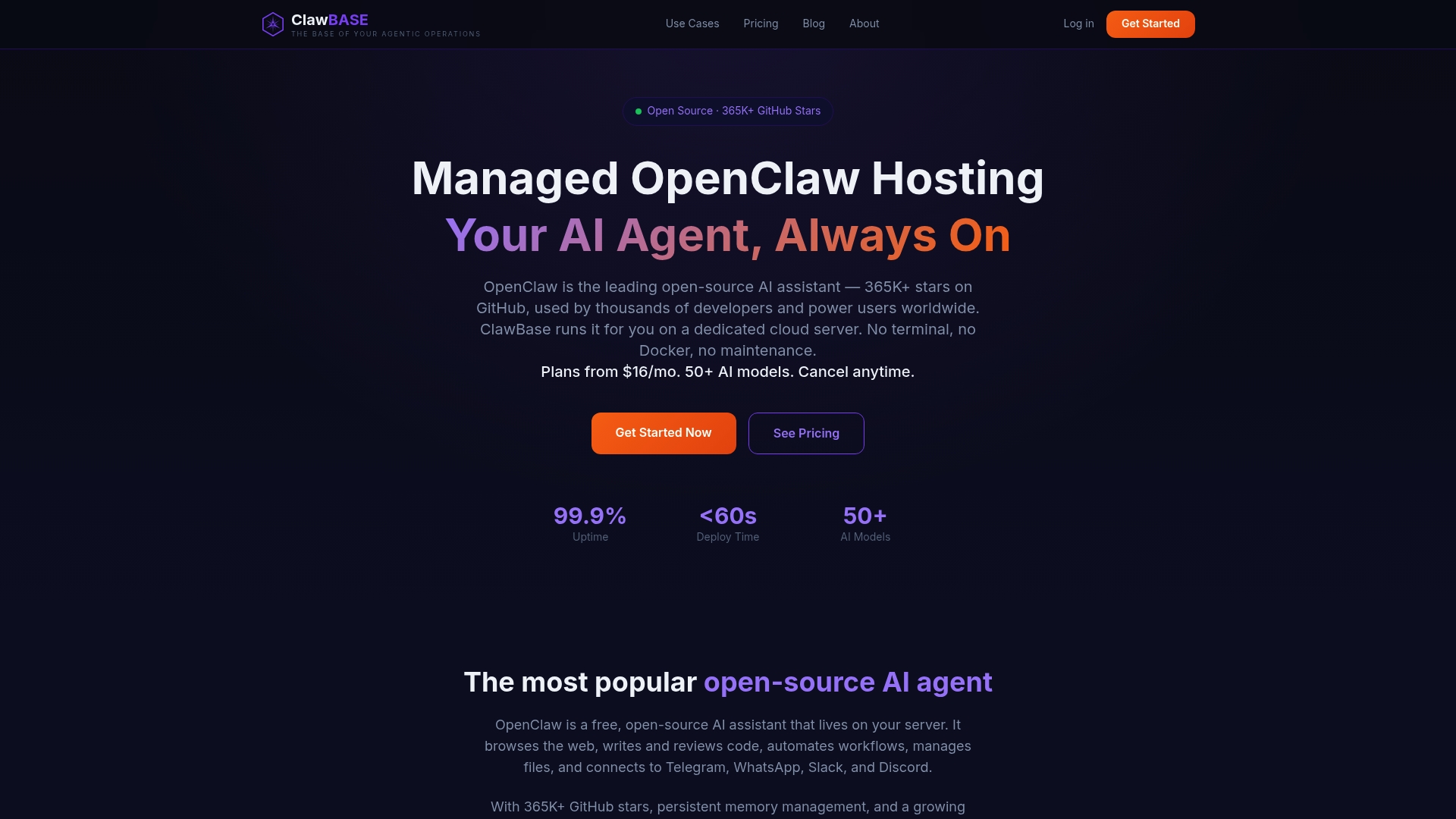
One-click deployment on a dedicated, encrypted server removes much of the manual setup and maintenance work typically required. Persistent memory management helps keep agent context intact across sessions to reduce context-exhaustion issues.
- One-click deployment removes manual setup and sysadmin overhead.
- Persistent memory management reduces context-exhaustion failures.
- Daily encrypted backups and automated updates contribute to your overall recovery strategy.
If you want to see how this holds up for real workloads, check our use cases or start with the 7-day free trial on our pricing page, where current prices are listed.
FAQ
What is the single biggest cause of AI agent downtime?
Across controlled fault injection testing, rate limiting caused the largest single drop in agent reliability, more than other failure modes like partial responses or schema drift, according to ReliabilityBench. Prioritizing backoff and retry logic around rate limits is the highest-leverage single fix most teams can make.
How do circuit breakers help prevent AI agent downtime?
A circuit breaker automatically stops sending traffic to a degraded dependency or tool call once error rates cross a defined threshold, preventing one failing component from cascading into a full outage. Governance specifications recommend tying circuit breakers directly to error-budget consumption rather than manual thresholds, as described in the Agent Governance Toolkit.
What is transactional undo and why does it matter for agents?
Transactional undo means every mutating action an agent takes has a paired compensation step that can reverse it if the action turns out to be wrong. Frameworks like RAC and Stratus's TNR approach show this lets agents explore more aggressively because mistakes become reversible instead of permanent.
How often should AI agents be retrained or have their environment updated?
There is no universal schedule; it depends on how fast your underlying data and tool integrations change, and teams typically tie retraining and environment updates to drift detected through their SLI dashboards rather than a fixed calendar. Monitoring actuation success rate and repeated-success metrics over time is a more reliable trigger than a preset interval.
Can managed hosting reduce AI agent downtime on its own?
It does not replace the runtime policies, circuit breakers, and testing covered in this guide, which still need to be built around the agent's own logic.
Sources
- Agent SRE Governance -- Version 1.0 - Agent Governance Toolkit
- ReliabilityBench (agent reliability benchmark)
- AI engineering: reliable operations (Google SRE resources)