7 Signs You Need Managed AI for Your Team
2026-06-13

Managed AI is defined as a structured hosting and governance layer that runs AI agents on your behalf, handling uptime, security, credential rotation, and observability so your team focuses on outcomes rather than infrastructure. The signs you need managed AI are not subtle over time. They show up as missed deadlines, runaway error rates, compliance gaps, and engineers spending their days babysitting servers instead of building. Most teams recognize the need between their second failed deployment and their first compliance challenge. That is a costly place to learn the lesson. This article gives you the indicators before that point.
***
1. Signs you need managed AI: repetitive tasks consuming 20+ hours per week
The clearest operational signal is time. When your team logs more than 20 hours weekly on repetitive manual work like data entry, follow-up emails, report generation, or file routing, you have crossed the threshold where managed AI pays for itself.

Businesses generating between $1M and $10M in annual revenue can recover $5,000 to $15,000 monthly by moving these tasks to a managed AI layer. That figure represents real labor hours redirected to higher-value work, not theoretical efficiency gains.
The problem with piecemeal AI tools is that they require constant human supervision. A managed AI platform runs these workflows continuously, with built-in retry logic, error handling, and logging. You are not just automating a task. You are removing yourself from the maintenance loop entirely.
- Data entry and CRM updates triggered by incoming emails
- Weekly report compilation from multiple data sources
- Customer follow-up sequences based on behavioral triggers
- File organization and routing across cloud storage systems
Pro Tip: *Log every task your team performs for one week using a tool like Toggl or Clockify, then tag each entry as "repeatable by AI" or "requires human judgment." If more than 30% of logged hours fall into the first category, you have a quantified case for managed AI adoption.*
***
2. Your AI performance metrics are outside acceptable ranges
AI agents that operate without governance infrastructure produce unreliable results at scale. Two metrics reveal this faster than any other: escalation rate and task success rate.
An escalation rate above 15% means your AI is routing more than one in seven tasks back to a human for review. A task success rate below 85% means your automation is failing on more than one in six attempts. Neither figure is acceptable in a production environment.
| Metric | Unmanaged AI | Managed AI |
|---|---|---|
| Task success rate | Below 85% | 85–95% |
| Escalation to human review | Above 15% | Below 15% |
| Observability | Manual logging or none | Built-in dashboards |
| Error recovery | Manual retry | Automated retry with alerts |
Managed AI platforms stabilize these numbers by providing monitoring and guardrails out of the box. Without them, teams often mistake initial speed for success and only discover the failure rate weeks later when downstream systems are corrupted.
Pro Tip: *Set a weekly review of your escalation rate and task success rate before any other AI metric. These two numbers tell you whether your AI is production-ready or still an experiment.*
***
3. AI projects are stuck in pilot purgatory
A project that has not reached production after one full quarter is not a technical problem. It is an infrastructure problem. AI projects stuck in pilot longer than 90 days almost always suffer from the same root causes: no standard deployment environment, no shared credential management, and no agreed monitoring baseline.
Managed AI environments solve all three by providing a pre-built operational scaffold. Instead of your engineers assembling reliability features from scratch, those features ship with the platform. The result is deployment timelines measured in days rather than months.
Consider what pilot purgatory actually costs. Every week a working AI agent sits in staging is a week of labor savings, customer experience improvements, or competitive advantage that never materializes. The hidden engineering cost of DIY reliability, including retries, observability, and credential management, routinely consumes months of effort that managed platforms condense into days.
- No shared staging environment that mirrors production
- Credentials and API keys managed informally across team members
- No agreed definition of "done" for agent reliability
- Deployment blocked on infrastructure reviews that repeat each sprint
If your team checks two or more of these boxes, the pilot is not the problem. The absence of managed infrastructure is.
***
4. Security, governance, and compliance risks are accumulating
Unmanaged AI creates shadow IT at scale. When individual contributors adopt AI tools without central oversight, leadership loses visibility over which data is being processed, by which models, and under what retention policies. In regulated industries, that is not a theoretical risk. It is a compliance failure waiting for an audit.
> "Managed AI functions as enterprise guardrails, securing identity and enforcing policies, preventing shadow AI proliferation in organizations." — Managed AI for SMBs
The governance features that managed AI platforms provide are not optional add-ons. They are the difference between an AI deployment you can defend to a regulator and one you cannot. A platform like Clawbase, for example, provides persistent memory management and dedicated server isolation, which means your data never shares infrastructure with other tenants.
Managed AI governance features that address these risks directly include:
- Identity management: Every agent action is tied to an authenticated user or service account
- Policy enforcement: Rules governing which data sources agents can access and which actions they can take
- Audit logs: Immutable records of every agent decision, useful for both debugging and compliance review
- Usage monitoring: Real-time visibility into which models are being called and at what frequency
If your team cannot answer "who accessed what data, using which AI model, on which date," you are operating without the controls that managed AI provides by default. Explore AI function calling to understand how managed platforms enforce these boundaries at the API level.
***
5. Your engineers are maintaining infrastructure instead of building capabilities
The most expensive sign of all is invisible on a balance sheet. When your best engineers spend their time on credential rotation, uptime monitoring, retry logic, and deployment pipelines for AI agents, they are not building the product capabilities that differentiate your business.
DIY AI hides significant engineering costs for reliability features that managed platforms include by default. Observability, rate limit handling, model fallbacks, and persistent memory are table stakes for production AI. Building them yourself is a choice to compete with infrastructure vendors rather than focus on your core product.
The strategic question is not "can we build this?" Most teams can. The question is "should we?" For AI workflows that support operations rather than define your product, the answer is almost always no. A practical decision framework for this choice comes down to one test: if the AI capability went down tomorrow, would customers notice directly, or would your internal team? If the answer is internal team, you are looking at a supportive workflow. Managed AI is the right fit.
***
6. When to choose managed AI over in-house builds
The managed versus DIY decision is not binary. A hybrid approach often delivers the best outcome: use managed infrastructure for rapid initial delivery while your team builds internal expertise for long-term customization.
| Scenario | Recommended approach |
|---|---|
| Small team, fast delivery needed | Managed AI from day one |
| AI is a core product differentiator | In-house build with managed scaffolding |
| Regulated industry with compliance requirements | Managed AI with audit log access |
| Limited internal AI/ML expertise | Managed AI to avoid reliability gaps |
| Existing DevOps team with AI experience | Hybrid: managed hosting, custom logic |
The managed route is commercially sensible when AI is supportive rather than a core product capability. Small teams that lack internal AI depth get to production faster and with fewer reliability incidents. Larger teams benefit from offloading operational overhead while retaining control over workflow logic.
Ask yourself these four questions before committing to a build:
- Do we have an engineer who can own AI infrastructure full-time?
- Can we meet our compliance requirements with self-managed tooling?
- Is this AI capability a product differentiator or an internal efficiency tool?
- What is the cost of a two-week outage in this workflow?
If questions one and two produce uncertain answers, managed AI is the lower-risk path.
***
7. Your team has no visibility into what AI is actually doing
The final indicator is the most operationally dangerous. If you cannot tell, at any moment, what your AI agents are doing, which models they are calling, and what decisions they have made in the last 24 hours, you are running a black box in production.
Visibility is not just a debugging convenience. It is the foundation of accountability. Monitoring escalation rates, policy violations, and error counts is critical to maintaining safe AI operations. Without these signals, teams discover failures through downstream consequences rather than proactive alerts. A customer complaint, a corrupted dataset, or a missed SLA is a much more expensive way to learn that your agent failed three days ago.
Managed AI platforms provide this visibility as a core feature, not an afterthought. Developers using managed services report that workflow reliability improvements are among the top reasons they choose managed over self-hosted deployments. When every agent action is logged and every anomaly triggers an alert, you shift from reactive firefighting to proactive governance.
***
Key takeaways
Managed AI is the right infrastructure choice when operational inefficiencies, performance gaps, and governance risks exceed what unmanaged or DIY AI can reliably address.
| Point | Details |
|---|---|
| Repetitive task threshold | More than 20 hours per week on manual tasks signals a clear case for managed AI. |
| Performance benchmarks | Task success below 85% and escalation above 15% indicate unmanaged AI instability. |
| Pilot delays as a signal | Projects stuck in staging beyond one quarter need managed infrastructure, not more iteration. |
| Governance by default | Managed AI provides audit logs, identity controls, and policy enforcement that DIY builds lack. |
| Visibility is non-negotiable | If you cannot monitor agent decisions in real time, you are running production AI blind. |
***
Why I think most teams wait too long to go managed
The pattern I have seen repeatedly is this: a team builds a promising AI prototype, it works well enough in testing, and then they spend the next three months trying to make it production-grade on their own. By the time they adopt managed infrastructure, they have accumulated what I call scar tissue. Workarounds, undocumented credential files, monitoring gaps, and a general distrust of the AI system because it has failed them twice already.
The teams that move to managed AI early, before the second failure, avoid all of that. They get to spend their engineering cycles on the logic that actually matters: what the agent does, not how it stays alive. I have found that the engineers who resist managed AI the longest are usually the ones who most want to own the full stack. That instinct is admirable in a product context. In an infrastructure context, it is expensive.
My practical advice: treat managed AI the way you treat cloud hosting. You would not build your own data center to run a web app. You should not build your own reliability layer to run an AI agent. The indicators for managed AI adoption are measurable and specific. When you see two or more of the signs in this article, the decision has already been made for you by your operational reality. Act on it before the scar tissue forms.
> *— Iosif Peterfi*
***
Ready to move from pilot to production with Clawbase
If you recognized two or more of these signs in your current setup, Clawbase is built for exactly this transition. Clawbase provides managed OpenClaw hosting starting at $16/month, with one-click deployment on a dedicated server, 99.9% uptime, persistent memory management, and access to over 50 AI models. No sysadmin expertise required.
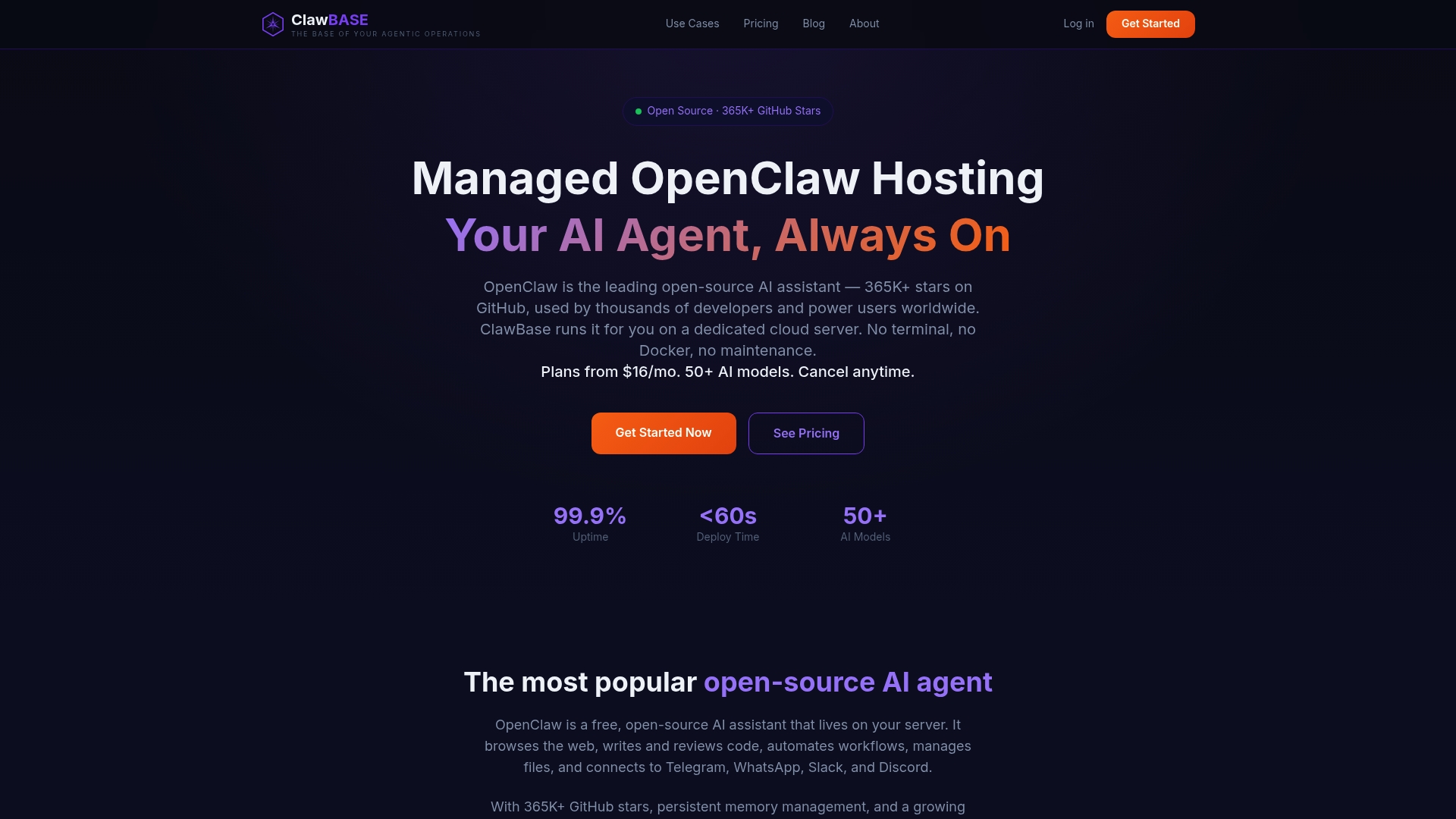
You get built-in monitoring, Telegram and Discord integration, and the governance controls that regulated teams need from day one. Whether you are a solo developer tired of maintaining your own stack or a team ready to move a workflow into production, Clawbase removes the operational overhead entirely. Browse the OpenClaw use cases to see which workflows map to your situation, then check current pricing to find the plan that fits your scale.
***
FAQ
What are the main signs you need managed AI?
The clearest signs are spending more than 20 hours per week on repetitive tasks, AI task success rates below 85%, projects stuck in pilot for more than a quarter, and no visibility into agent decisions. Any two of these together indicate that unmanaged AI is no longer sufficient.
How do I know if my AI performance metrics are a problem?
An escalation rate above 15% or a task success rate below 85% to 95% signals instability in your AI operations. These benchmarks apply to mature agentic systems and indicate that governance infrastructure is missing.
Is managed AI worth it for small teams?
Managed AI is especially valuable for small teams because it eliminates the need for a dedicated infrastructure engineer. The managed route is commercially sensible when AI supports operations rather than defines the core product, and small teams benefit most from the speed and reliability it provides.
What is the difference between managed AI and DIY AI?
DIY AI requires your team to build and maintain reliability features like retry logic, observability, and credential management. Managed AI platforms include these features by default, condensing months of engineering effort into a deployment that takes days.
How does managed AI address security and compliance?
Managed AI platforms provide identity management, policy enforcement, and immutable audit logs that track every agent action. These controls prevent shadow IT risks and give regulated industries the documentation they need for compliance reviews.