Best Agntable.com Alternatives for AI Agent Hosting 2026
2026-08-06

For most teams migrating from Agntable, Clawbase is the clearest replacement: one-click OpenClaw deployment on a dedicated encrypted server, no sysadmin work, and a 7-day free trial to validate the setup before committing. The shortlist below covers the three categories worth evaluating.
- Fully managed OpenClaw hosting (Clawbase): dedicated servers, automated updates, daily encrypted backups, 99.9% uptime, and integrations with Telegram, Discord, Slack, and WhatsApp out of the box. Best for teams that want zero operational overhead.
- Cloud-managed PaaS for agents (platforms like Elestio, Kinsta, Cloudways, Latenode): flexible compute, broader app catalogs, and pay-as-you-scale pricing. Best for engineering teams that want infrastructure control without full self-hosting.
- Self-hosted open-source stacks: maximum control, lowest per-unit cost at scale, but significant maintenance burden. Best for teams with dedicated DevOps capacity.
If you are migrating from Agntable and want a production-ready agent running within the hour, start a trial deployment with Clawbase. The other categories require meaningful setup time before you can validate performance.
***
Table of Contents
- What criteria actually separate agntable.com alternatives?
- What each alternative category actually delivers
- Why Clawbase is the recommended pick for most Agntable users
- How to choose an Agntable alternative: decision criteria and red flags
- How pricing structures differ across alternatives
- Which open-source agents and integrations should you verify before buying?
- How does customer support quality compare across alternatives?
- What are the scalability options and performance limits per alternative?
- What contract terms and cancellation policies should you expect?
- Key Takeaways
- Clawbase: managed OpenClaw hosting with a 7-day free trial
What criteria actually separate agntable.com alternatives?
SaaSHub's actively maintained alternatives listing groups options by hosting model, community votes, and feature coverage rather than a single vendor ranking — which is the right frame. The table below maps the dimensions that matter most when you are replacing a managed agent host.
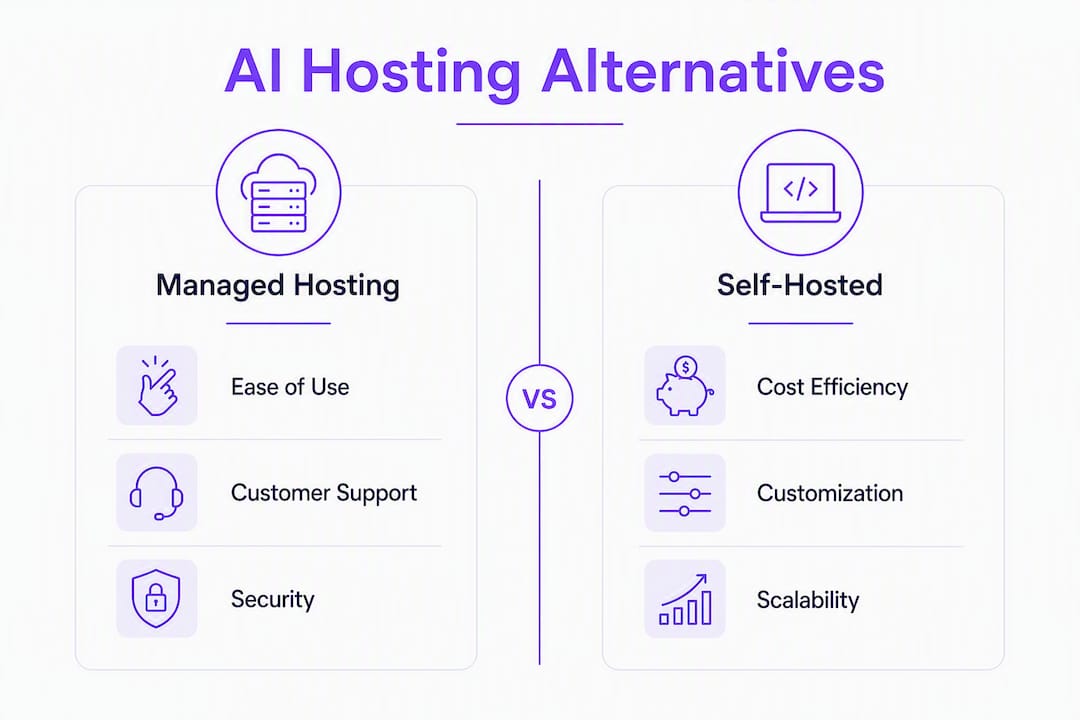
| Dimension | Fully managed OpenClaw host | Cloud-managed PaaS | Self-hosted stack |
|---|---|---|---|
| **Best for** | Low-ops teams, non-technical users, developers | Engineering teams wanting infra control | DevOps-heavy teams, cost-at-scale |
| **Pricing shape** | Flat monthly subscription, predictable | Per-resource or per-app metering | Infrastructure cost only |
| **Supported agents / templates** | OpenClaw + skillset marketplace | Varies by platform; often broad app catalog | Any open-source framework |
| **Ease of deployment** | One-click, no sysadmin required | Moderate; some CLI or dashboard config | Manual; Docker/Kubernetes expertise needed |
| **Managed services** | Updates, backups, monitoring included | Partial; depends on tier | None by default |
| **Integrations** | Telegram, Discord, Slack, WhatsApp, webhooks | Webhooks, APIs; messaging varies | Custom-built |
| **Data privacy / isolation** | Dedicated encrypted servers per user | Shared or dedicated depending on tier | Full control, self-managed encryption |
| **Scalability** | Vertical scaling within plan tiers | Horizontal and vertical; compute metering | Unlimited, constrained by your hardware budget |
| **Support SLA** | Published uptime SLA; managed support | Tier-dependent; enterprise SLAs available | Community forums, no SLA |
The columns on data privacy and SLA are not table stakes you can defer. Software directories consistently flag automated backups, monitoring, custom domains, and integrations as the primary differentiators buyers use to separate production-ready hosts from experimentation platforms.
Pro Tip: *Data isolation is the column most buyers skip during evaluation. A cheaper multitenant option can expose persistent agent memory to co-tenants. Always ask for explicit documentation of encryption-at-rest and per-tenant isolation before signing up.*
***
What each alternative category actually delivers
Fully managed OpenClaw hosting
This category handles every operational layer: server provisioning, OS updates, agent updates, backups, monitoring, and uptime. You log in, deploy, and use the agent. The tradeoff is that the platform controls the underlying infrastructure, so you cannot tune kernel parameters or install arbitrary system packages.

Typical feature set: one-click deployment, persistent memory management, multi-model routing, messaging platform integrations, daily backups, and a published uptime commitment.
Pros:
- Zero sysadmin overhead; no SSH access required
- Predictable flat monthly pricing with no surprise compute bills
- Managed security patching and encrypted storage included
Cons:
- Less infrastructure flexibility than a raw PaaS
- Agent framework support limited to what the platform officially supports
- Scaling ceiling defined by the plan tier, not raw compute
Pricing shape: entry plans typically start at a low monthly rate for a single dedicated agent instance, with higher tiers unlocking more compute, additional model access, and priority support.
Cloud-managed PaaS for agents
Platforms in this category give you a managed cloud environment where you deploy containerized agent workloads. You get more infrastructure control than a fully managed host, but you are still responsible for configuring the agent stack, setting up backups, and monitoring agent health. Elestio, Kinsta, Cloudways, and Latenode each represent different points on this spectrum.
Pros:
- Broad app and framework support beyond a single agent type
- Horizontal scaling and compute metering for variable workloads
- More control over networking, storage, and environment variables
Cons:
- Meaningful setup time before a production agent is running
- Costs can spike with compute-based metering under heavy load
- Backup and monitoring configuration is often manual or add-on
Pricing shape: free tiers exist for experimentation; paid entry levels typically start at a modest monthly rate per app instance, with production workloads metered by CPU, RAM, or concurrent agent sessions.
Self-hosted open-source stacks

Local-first toolchains give you full control and low latency, but they add maintenance overhead and offer no uptime guarantees. Running Dify, Langflow, or OpenWebUI on your own infrastructure means you own every layer: container orchestration, SSL certificates, model routing, and disaster recovery.
Pros:
- No vendor lock-in; full data sovereignty
- Lowest cost at scale if you have existing infrastructure
- Any open-source agent framework is fair game
Cons:
- Requires dedicated DevOps capacity for ongoing maintenance
- No published SLA; uptime depends entirely on your infrastructure
- Security patching, backups, and monitoring are your responsibility
Pricing shape: infrastructure cost only. A minimal VPS setup might run $5–$20/month, but production-grade redundancy with GPU compute for local model inference can reach several hundred dollars monthly.
***
Why Clawbase is the recommended pick for most Agntable users
Agntable positions itself as a cloud-based platform for launching autonomous AI agents without manual server setup, handling deployment, scaling, browser automation, and isolated environments. Clawbase covers the same core job-to-be-done for OpenClaw specifically, and does it with a tighter operational model.
The use cases where Clawbase adds the most value:
- Developers who want low-ops production agents: deploy OpenClaw, connect it to your messaging stack, and skip the infrastructure work entirely. The platform handles updates and backups automatically.
- Business teams needing private agents: dedicated servers mean your agent's persistent memory and conversation history are not shared with other tenants. That matters for teams handling sensitive workflows.
- Non-technical users running automation workflows: the one-click deployment model means no Docker knowledge, no CLI, and no server configuration. You get a private, always-on agent with access to over 50 AI models.
- Students and researchers: the 7-day free trial on the entry plan lets you run a real workload before spending anything.
Clawbase's managed OpenClaw hosting starts at a competitive monthly rate, with a 7-day free trial on the entry plan. Payment accepts both credit card and cryptocurrency. The 99.9% uptime commitment is published, and the dedicated server model means your agent's data stays isolated by design.
Pro Tip: *Use the 7-day trial to run your actual agent workload, not a toy example. Test the specific integrations you need (Telegram bot, Discord webhook, or Slack connector) and verify that persistent memory behaves correctly across sessions before you commit to a plan.*
***
How to choose an Agntable alternative: decision criteria and red flags
Decision criteria checklist
- Deployment model: does the platform offer one-click deployment, or does it require CLI setup and container configuration?
- Managed services scope: are updates, backups, and monitoring included, or are they manual add-ons?
- Data isolation: does each user get a dedicated server, or is the environment multitenant?
- Scaling options: can you upgrade compute without migrating to a new instance?
- Model access: how many AI models are available, and does the platform support multi-model routing?
- Integrations: which messaging platforms and webhook endpoints are supported natively?
- Published SLA: is there a documented uptime commitment with defined remedies?
- Pricing predictability: is the billing flat-rate or compute-metered, and what triggers overage charges?
Ten questions to ask any vendor during evaluation
- What is the exact uptime SLA, and what remedies apply when it is missed?
- How frequently are backups taken, and how long is backup retention?
- Can I export my agent's data, memory, and skillsets in a portable format?
- Which open-source agent frameworks and templates are officially supported?
- Is my agent running on a dedicated server, or is compute shared with other tenants?
- How are security patches applied, and how much downtime do updates require?
- What happens to my agent if I cancel: is there a grace period for data export?
- Are messaging integrations (Telegram, Discord, Slack) native or third-party middleware?
- What support tier is included in the entry plan, and what is the typical response time?
- Is there a free trial, and does it require a credit card to start?
Red flags to watch for
- No published uptime SLA or vague "best effort" language
- No documentation of per-tenant data isolation or encryption-at-rest
- Compute-metered pricing with no cap or spend alert mechanism
- No data export option or agent portability documentation
- Support limited to community forums on paid plans
Pro Tip: *Before migrating a production agent, run a parallel deployment on the new platform for at least 48 hours. Verify that persistent memory, scheduled tasks, and all integrations behave identically before cutting over DNS or webhook endpoints.*
***
How pricing structures differ across alternatives
Pricing in the managed agent hosting category follows three distinct shapes, and the one you choose has a bigger impact on your monthly bill than the headline entry price.
Flat subscription: one price per month covers a dedicated instance, all managed services, and a defined compute allocation. Predictable, easy to budget, and the right model for teams running a consistent agent workload.
Per-resource metering: you pay for CPU hours, RAM-hours, or concurrent agent sessions consumed. Cheap for sporadic workloads, expensive for always-on agents that run continuous tasks.
Hybrid: a base subscription covers the instance, with metered add-ons for model API calls, storage overages, or additional integrations.
| Pricing line item | Flat subscription | PaaS metered | Self-hosted |
|---|---|---|---|
| Base instance cost | Fixed monthly fee | Per-hour or per-app | Infrastructure only |
| Model compute | Included (multi-model routing) | Per-call or per-token | Model hosting cost |
| Concurrent agents | Defined by plan tier | Metered per session | Unlimited (hardware-bound) |
| Storage / backups | Included, daily encrypted | Add-on or manual | Self-managed |
| Integrations | Native (Telegram, Discord, etc.) | Webhook/API, varies | Custom-built |
| Support | Managed, SLA-backed | Tier-dependent | Community only |
Review directories confirm that free tiers exist primarily for experimentation, while entry paid tiers cover managed hosting for light production workloads. Compute- or concurrency-driven metering activates at production scale.
Before signing up, verify three things: whether the free trial requires a credit card, what the cancellation policy is (month-to-month vs. annual lock-in), and whether there is a data export window after cancellation. The SaaSHub alternatives listing was last updated in April 2026; this signals that pricing and feature sets in this category are still shifting quickly — always check the vendor's current pricing page directly.
***
Which open-source agents and integrations should you verify before buying?
The agent framework and integration coverage are where many buyers get surprised post-purchase. Verify compatibility with your specific stack before committing.
Open-source agent frameworks and templates to check
- OpenClaw: the core agent framework Clawbase hosts natively; verify skillset marketplace access and persistent memory behavior
- n8n-style workflow agents: event-driven automation workflows with node-based logic; check whether the platform supports custom workflow imports
- Dify-style stacks: LLM application frameworks with RAG pipelines and prompt orchestration; confirm container support and model routing compatibility
- Langflow: visual agent builder; verify whether the platform supports custom Python environments
- OpenWebUI: browser-based chat interface for local and hosted models; check integration with the platform's model routing layer
Research-focused tools differ meaningfully from production-ready managed hosts in model access depth and workflow integration maturity. A platform optimized for exploratory agent work may not offer the SLA or persistent memory guarantees a production workload requires.
Integration compatibility matrix
| Integration type | What to verify |
|---|---|
| Telegram | Native bot token support vs. third-party middleware |
| Discord | Webhook or bot API; persistent connection vs. polling |
| Slack | OAuth app support; event subscriptions |
| Business API access; message template restrictions | |
| Webhooks | Inbound and outbound; authentication options |
| Model APIs | Which providers are natively routed; bring-your-own-key support |
| Custom skillsets | Marketplace access; ability to upload private skillsets |
Compatibility checklist before purchase
- Container support (Docker, Kubernetes, or managed runtime)
- Persistent memory availability across sessions
- Custom domain support with SSL termination
- Browser relay or automation integration
- Private skillset upload and marketplace access
- Multi-model routing with bring-your-own-key option
***
How we selected and compared these alternatives
The shortlist here focuses on platforms that offer managed hosting for open-source AI agents, have publicly documented features and pricing, and provide a trial or free tier for hands-on evaluation. Sources used include Capterra's Agntable listing, G2's competitor alternatives page, SaaSHub's community-maintained alternatives index, SoftwareAdvice's feature comparison entries, and vendor product documentation.
Limitations: this comparison does not cover small self-hosted forks with no public documentation, regional-only hosts with limited English-language support, or platforms that were in private beta as of early 2026. Feature sets and pricing change frequently in this category.
Pro Tip: *Use review roundups to form your category shortlist, then go directly to vendor docs and run a trial deployment. That two-step process gives you the reliable signal that no comparison article can fully replicate.*
***
How does customer support quality compare across alternatives?
Support quality is one of the sharpest practical differences between the three categories, and it often determines whether a production incident becomes a minor blip or a multi-hour outage.
Fully managed OpenClaw hosts typically include managed support as part of the subscription. That means a human-reviewed ticket system, documented response times, and a team that understands the specific agent stack you are running. Clawbase's model falls here: the managed service includes support for the platform, the agent runtime, and the integrations.
Cloud-managed PaaS platforms vary significantly by tier. Entry plans on most PaaS providers offer community forums or email support with no guaranteed response time. Enterprise tiers unlock SLA-backed support with defined response windows, but those tiers carry meaningfully higher price points. If you need sub-four-hour response times on a paid plan, verify that explicitly before signing up.
Self-hosted stacks offer community support only. GitHub issues, Discord servers, and documentation are your primary resources. For teams with strong internal DevOps capacity, that is workable. For teams migrating from a managed host specifically because they want less operational burden, it is a step backward.
The practical test: submit a pre-sales support question before you sign up. Response time and answer quality on a pre-sales question are a reliable proxy for what you will get post-purchase.
***
What are the scalability options and performance limits per alternative?
Scalability in managed agent hosting is not just about raw compute. It is about whether you can scale without migrating, whether persistent memory survives a scale event, and whether your integrations stay live during a resize.
Fully managed OpenClaw hosts scale vertically within plan tiers. Upgrading a plan typically provisions more CPU and RAM on the same dedicated server, preserving agent state and integrations. The ceiling is the platform's highest tier, which suits most single-team or small-business workloads. For teams running dozens of concurrent agents, this model has limits.
Cloud-managed PaaS platforms support both vertical and horizontal scaling. You can add compute resources or spin up additional agent instances, and metered billing means you only pay for what you use. The tradeoff is that scaling events require configuration work, and persistent memory across horizontally scaled instances requires a shared memory backend that not all platforms configure automatically.
Self-hosted stacks are theoretically unlimited, constrained only by your infrastructure budget and engineering capacity. Kubernetes-based deployments can scale to hundreds of concurrent agents, but the operational complexity scales proportionally. Open-source AI scalability at production volume requires careful attention to memory management, model routing, and stateful session handling.
For most teams migrating from Agntable, the vertical scaling model of a fully managed host covers the workload. Evaluate horizontal scaling only if you are running more than a handful of concurrent production agents.
***
What contract terms and cancellation policies should you expect?
Contract terms in this category range from fully flexible month-to-month subscriptions to annual commitments with meaningful discounts and early-termination clauses.
Fully managed OpenClaw hosts like Clawbase operate on monthly or annual subscription models. Month-to-month plans give you full flexibility: cancel anytime, and your agent runs until the end of the billing period. Annual plans typically offer a cost reduction. Verify whether there is a data export window after cancellation and how long the platform retains your agent data post-cancellation.
Cloud-managed PaaS platforms vary. Entry plans are almost always month-to-month. Enterprise agreements often require annual commitments with negotiated SLAs and dedicated support. Read the termination clause carefully: some platforms delete data immediately on cancellation, while others offer a 30-day grace period.
Self-hosted stacks have no vendor contract. Your commitment is to your own infrastructure provider (a VPS or cloud provider), which typically operates on monthly billing with no minimum term.
Three things to confirm with any vendor before signing up: the data retention policy after cancellation, whether agent memory and skillsets are exportable in a portable format, and whether the trial period converts automatically to a paid plan or requires explicit opt-in.
***
Key Takeaways
Clawbase is the most direct replacement for Agntable users who want managed OpenClaw hosting with zero operational overhead, dedicated encrypted servers, and predictable flat-rate pricing.
| Point | Details |
|---|---|
| Verify data isolation first | Demand written documentation of per-tenant encryption and dedicated server allocation before signing up. |
| Match pricing model to workload | Flat subscriptions suit always-on agents; metered PaaS suits variable or experimental workloads. |
| Test integrations during the trial | Run your actual Telegram, Discord, or Slack integration during the trial period, not after committing. |
| Confirm data export before canceling | Check that agent memory, skillsets, and conversation history are exportable in a portable format. |
| Clawbase for low-ops teams | Clawbase's one-click OpenClaw deployment, 99.9% uptime, and 7-day free trial make it the recommended starting point for most migrating users. |
***
The case for managed hosting over DIY agent stacks
The managed vs. self-hosted debate in AI agent hosting tends to get framed as a cost question, but that framing misses the real variable: time. Self-hosting a Dify or Langflow stack on a VPS is not expensive in dollars. It is expensive in engineering hours — initial setup, ongoing patching, backup verification, and incident response. For a team whose core work is building products or running workflows, those hours have a high opportunity cost.
What I find most underappreciated in this category is the persistent memory problem. A self-hosted agent that loses its memory state during a server restart or a botched update is not just inconvenient; it breaks the continuity that makes an agent genuinely useful over time. Managed hosts that guarantee persistent memory across updates and restarts are solving a harder problem than they advertise.
For a developer team migrating production agents from Agntable, the practical path is a parallel deployment: run the new platform alongside the existing setup for 48 hours, verify memory persistence, integration behavior, and model routing, then cut over. For a non-technical team that wants private agents for internal workflows, the one-click model removes the parallel deployment complexity entirely — deploy, connect your messaging platform, and the agent is live.
***
Clawbase: managed OpenClaw hosting with a 7-day free trial
Most teams evaluating Agntable alternatives spend more time on comparison research than on actual deployment. Clawbase is built to flip that ratio: one-click OpenClaw deployment on a dedicated encrypted server, with no server configuration, no manual update cycles, and no backup scripts to maintain.
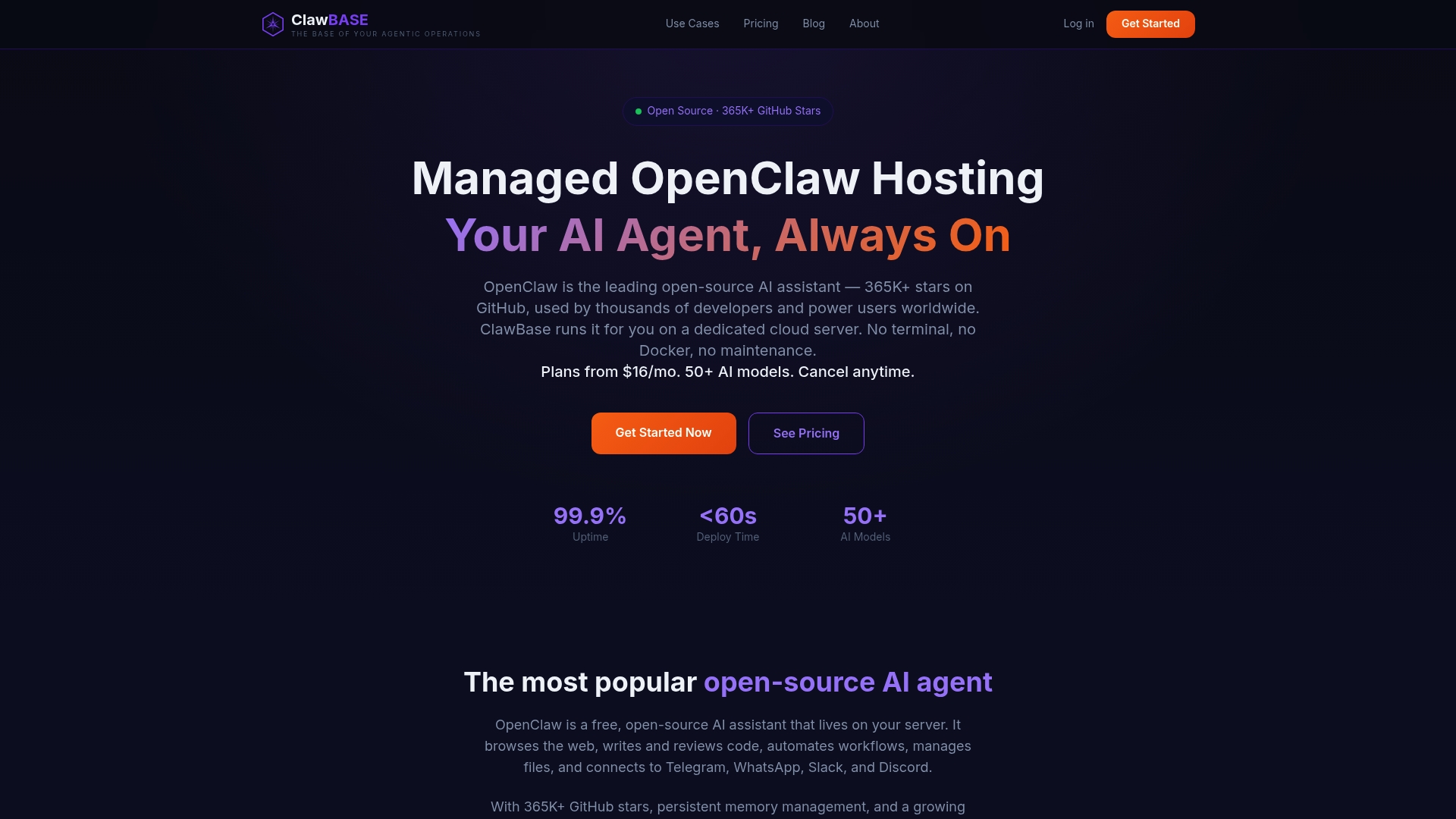
The entry plan starts at $16/month and includes daily encrypted backups, automated updates, persistent memory management, access to over 50 AI models with multi-model routing, and native integrations with Telegram, Discord, Slack, and WhatsApp. Every instance runs on a dedicated server — your agent's memory and data are not shared with other tenants. The 99.9% uptime commitment is published, not implied.
The 7-day free trial on the entry plan requires no long-term commitment. Run your real workload, test your integrations, and verify persistent memory behavior before you pay anything. Explore the OpenClaw use cases to map Clawbase's capabilities to your specific workflows, then start your trial at clawbase.to.
***
Useful sources and documentation
Verify current pricing, SLA terms, and feature availability directly with each vendor before purchasing. The sources below were used to build this comparison.
- Agntable on Capterra — user reviews, pricing signals, and feature listings
- Agntable competitors on G2 — community-rated alternatives and feature comparisons
- SaaSHub Agntable alternatives — community-maintained alternatives index, last updated April 2026
- SoftwareAdvice Agntable entry — feature comparisons and popular pairing suggestions
- Agntable review on AIChief — independent cost, use-case, and alternatives coverage
- Clawbase product documentation — managed OpenClaw hosting features, pricing, and trial details
Pricing and SLA terms in this category change frequently. Always confirm the current published pricing page and SLA documentation directly with the vendor before making a purchase decision.