What Is Multi-Model AI Support? A 2026 Guide
2026-06-08

Multi-model AI support is defined as an AI platform's ability to interact with multiple distinct models and dynamically select the best model per request based on criteria like cost, performance, and availability. The industry term for the broader concept is *multi-modal machine learning*, though "multi-model AI support" specifically describes the orchestration layer that routes tasks across a portfolio of models. Platforms like MuleSoft's AI Gateway and Broadcom VMware Tanzu AI Services have made this architecture production-ready, and the results speak for themselves: 40% cost reductions and 99.95%+ uptime are achievable when failover mechanisms replace single-provider reliance. If you are building AI into your workflows or automating tasks at scale, understanding this architecture is not optional. It is the foundation of every resilient AI system built in 2026.
What is multi-model AI support and how does it work?
Multi-model AI support means a platform maintains a pool of integrated models and a routing component that selects the right model for each incoming request. The selection is not random. It follows defined criteria: task complexity, cost ceiling, latency requirements, and model availability at the moment of the request.
The three core components are the *router*, the *model pool*, and the *fallback chain*. The router evaluates each request against a policy. The model pool holds all available models, from budget options like smaller open-source LLMs to premium models like GPT-4o or Claude 3.5 Sonnet. The fallback chain defines what happens when the primary model is unavailable or returns an error.
Here is how a typical routing sequence works in practice:
- A request arrives at the unified API endpoint.
- The router reads the request metadata: task type, token count, priority flag.
- The policy layer matches the request to the most appropriate model in the pool.
- The selected model processes the request and returns a response.
- If the model fails or exceeds latency thresholds, the fallback chain activates the next model automatically.
- The response is returned to the application with no change to the calling code.
MuleSoft's AI Gateway implements this with semantic routing, a single authentication point, and the ability to onboard new models without changing application code. That last detail matters enormously for teams managing production systems.
Pro Tip: *Design your routing policy around three tiers: a budget model for high-volume, low-complexity tasks; a mid-tier model for standard reasoning; and a premium model reserved for tasks where accuracy is non-negotiable. This alone can cut inference costs by 30 to 50 percent without degrading output quality.*

Benefits and challenges of multi-model AI support
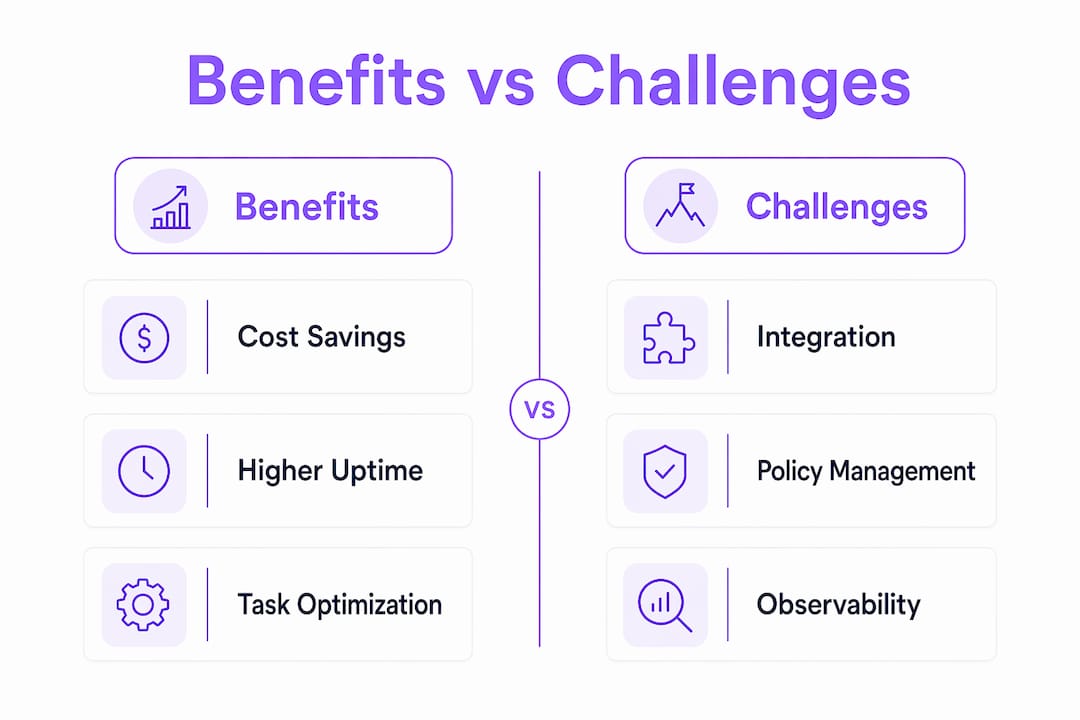
Multi-model architectures decouple business logic from providers, which means your application does not break when a provider changes pricing, deprecates a model, or experiences an outage. That decoupling is the single most underappreciated benefit of this approach.
The strategic advantages are concrete:
- Flexibility: Swap or add models without rebinding your application.
- Cost control: Route simple tasks to cheaper models and reserve expensive calls for complex ones.
- Higher uptime: Automatic failover means a provider outage does not become your outage.
- Task-specific optimization: A code-generation model outperforms a general-purpose model on coding tasks, even if the general model scores higher on benchmarks.
The challenges are equally real. Integration complexity increases when you manage five models instead of one. Dynamic model management requires applications to treat model lists as changing inputs rather than fixed configurations. Policy enforcement across a live model pool requires a governance layer that most teams underestimate.
> "Managing model portfolios instead of single models enables enterprises to balance capabilities, cost, and operational risks dynamically." — IDC, Beyond LLMs: Why AI Strategy Requires Multi-model Architectures
Unified APIs simplify this considerably. Instead of writing provider-specific integration code for each model, your application calls one endpoint and the gateway handles the rest.
| Dimension | Single-model approach | Multi-model approach |
|---|---|---|
| Provider dependency | High: one provider failure breaks the system | Low: failover routes to alternate models |
| Cost efficiency | Fixed: one pricing tier regardless of task | Variable: tasks matched to cost-appropriate models |
| Flexibility | Low: model changes require code updates | High: models added or removed at the gateway layer |
| Reliability | Limited by single provider SLA | Compounded across multiple providers |
| Governance complexity | Simple: one model to monitor | Higher: requires policy layer and routing oversight |
Multi-model AI examples and real-world use cases
A production model pool at a mid-size enterprise typically looks like this: a budget tier using a smaller open-source model for classification and summarization tasks, a mid-tier model like Mistral or Llama 3 for standard reasoning and drafting, and a premium tier using GPT-4o or Claude 3.5 Sonnet for complex analysis, legal review, or customer-facing generation. Routing based on task complexity across these tiers is what drives the cost and reliability gains.
Practical applications where multi-model support delivers measurable results include:
- Customer support automation: Route simple FAQ responses to a fast, cheap model. Escalate nuanced complaints to a premium model with better reasoning.
- Code review pipelines: Use a specialized code model for syntax and logic checks, then pass flagged sections to a general reasoning model for explanation.
- Document processing: A lightweight model extracts structured data from forms. A premium model handles ambiguous or complex documents.
- Cross-verified output workflows: Running tasks across multiple models and comparing outputs increases confidence in results, particularly for knowledge work where a single wrong answer has downstream consequences.
- AI agent task scheduling: When an agent needs to schedule and execute tasks, routing each subtask to the most capable model for that specific operation improves end-to-end accuracy.
Cross-verified output deserves more attention than it typically gets. The pattern runs the same prompt through two or three models, then compares the responses. Agreement signals high confidence. Divergence triggers a human review or a third model tiebreaker. For structured outputs like financial summaries or medical data extraction, this pattern can catch errors that a single model would pass silently.
Pro Tip: *When building your model portfolio, do not optimize for the highest benchmark score. Test each model on your actual task distribution. A model that scores lower on MMLU but excels at your specific document format will outperform a general leader in production.*
How to implement multi-model AI support in your workflows
The architectural foundation is a Unified API or AI Gateway that abstracts provider-specific endpoints behind a single interface. Your application code calls one URL. The gateway handles authentication, routing, and failover internally. MuleSoft's AI Gateway and open-source implementations like the model-router pattern on GitHub both follow this design.
Implementation steps for teams starting from scratch:
- Choose your gateway layer. Managed gateways like MuleSoft handle policy enforcement and observability. Open-source routers give you full control but require more operational investment.
- Define your model pool. Start with three tiers: budget, mid-tier, and premium. Add specialized models (code, vision, embeddings) as your use cases expand.
- Write your routing policy. Rule-based policies are the simplest starting point: route by token count, task type, or priority flag. Complexity-based routing requires a classifier step but delivers better cost optimization.
- Configure your fallback chain. Every model in your pool needs a defined fallback. A chain of three models covers most outage scenarios without over-engineering.
- Design for dynamic model discovery. Broadcom VMware Tanzu recommends using a config URL binding so applications discover available models at runtime rather than hardcoding model names. This prevents breaking changes when models are updated or retired.
- Add a policy and observability layer. Track routing decisions, latency per model, error rates, and cost per request. Without this data, routing drift goes undetected until it becomes a budget or quality problem.
Common pitfalls include treating the routing policy as a one-time configuration and skipping the observability layer entirely. Both mistakes surface as unexplained cost spikes or silent quality degradation weeks after deployment. If you run into setup errors during integration, the most frequent cause is misconfigured fallback chains rather than model-level failures.
Key takeaways
Multi-model AI support requires a router, a tiered model pool, and a fallback chain governed by a live policy layer to deliver cost savings and reliability at production scale.
| Point | Details |
|---|---|
| Core architecture | A router, model pool, and fallback chain are the three non-negotiable components. |
| Cost and uptime gains | Tiered routing can cut inference costs by 40% and push uptime above 99.95% through failover. |
| Unified API advantage | A gateway abstraction layer lets you add or swap models without changing application code. |
| Cross-verified output | Running tasks across multiple models and comparing results catches errors single-model systems miss. |
| Dynamic model management | Design applications to discover models at runtime via config URLs, not hardcoded model names. |
Why I think single-model AI is an operational liability in 2026
I have watched teams spend months building tightly coupled integrations around a single model, only to scramble when that provider changes pricing or deprecates an endpoint. The pattern repeats. The fix is always the same: add an abstraction layer that should have been there from the start.
What strikes me most about multi-model architectures is not the cost savings, though those are real. It is the reduction in operational anxiety. When your system can route around a failing provider in milliseconds, you stop treating model availability as a risk factor and start treating it as a solved problem.
The emerging challenge I see is routing drift. Teams configure a policy at launch and never revisit it. Six months later, a new model in the pool is cheaper and faster for 60% of their tasks, but the router still sends those requests to the original model out of inertia. Observability is the answer, and most teams underinvest in it.
IDC's framing of multi-model as a strategic imperative is accurate, but the real driver is simpler: single-model reliance is a single point of failure. Any architecture that tolerates a single point of failure in a production system is not a finished architecture. Multi-model support is how you finish it.
> *— Iosif Peterfi*
How Clawbase makes multi-model AI support accessible
Clawbase gives you access to over 50 AI models through a single managed platform, removing the infrastructure work that typically blocks multi-model adoption. One-click deployment on a dedicated server means you get a private, always-on AI agent with 99.9% uptime without writing a line of DevOps configuration.
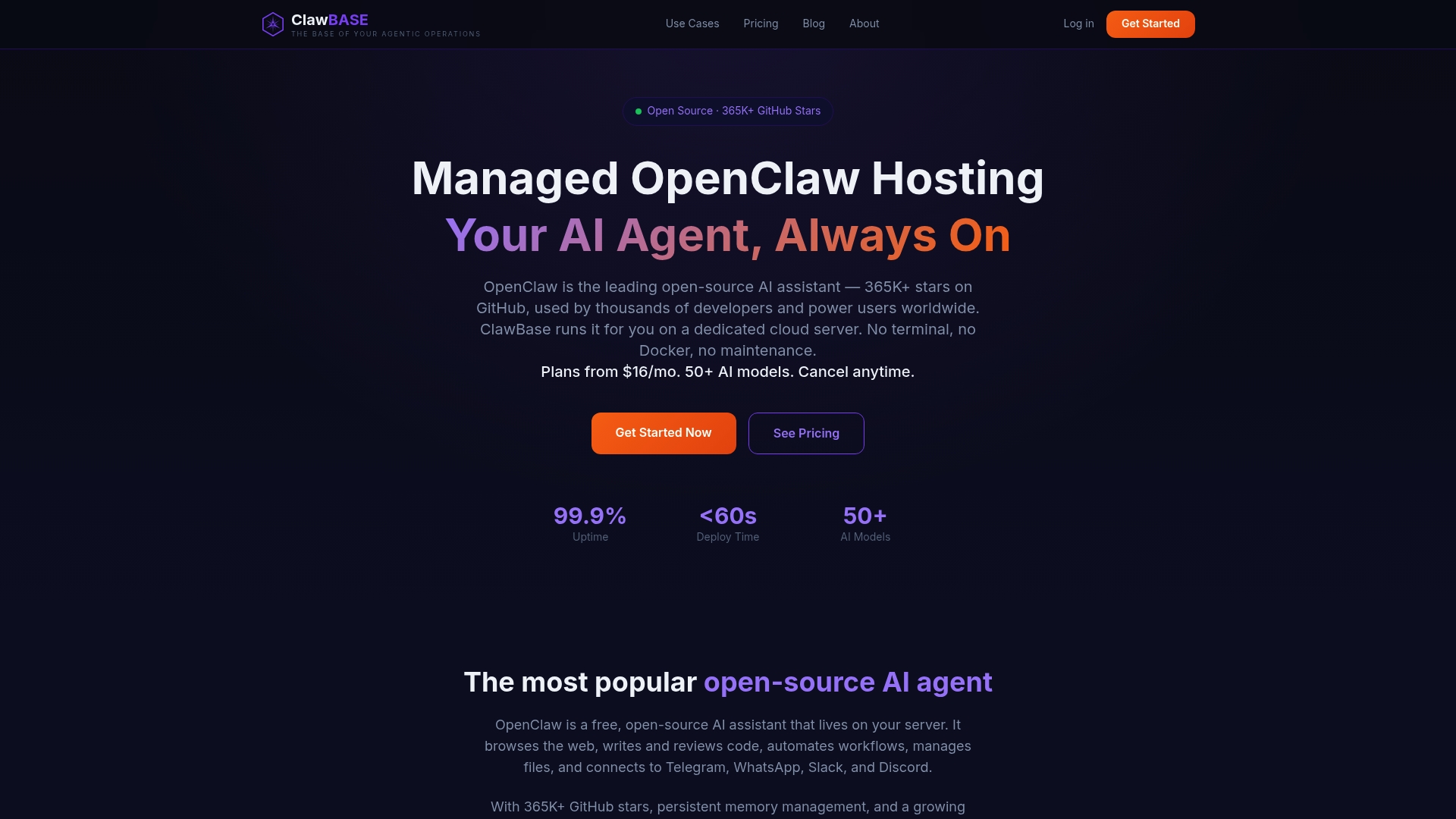
For professionals who want to put multi-model AI to work immediately, the OpenClaw use cases page shows exactly what AI agents can do across automation, file management, and communication integrations with Telegram and Discord. If you are evaluating options, Clawbase's managed hosting plans start at $16 per month, making enterprise-grade multi-model orchestration accessible without enterprise-grade overhead.
FAQ
What is multi-model AI support in simple terms?
Multi-model AI support is a system that connects to multiple AI models and automatically selects the best one for each task based on cost, speed, and accuracy. It uses a router and fallback chain to keep your application running even when one model is unavailable.
How does multi-model AI differ from single-model AI?
Single-model AI sends every request to one fixed model regardless of task complexity or cost. Multi-model AI routes each request to the most appropriate model in a pool, reducing costs and improving reliability through automatic failover.
What are the main benefits of multi-model AI?
The primary benefits are cost reduction through tiered routing, higher uptime through failover, and task-specific optimization by matching each request to the model best suited for that task type.
What tools support multi-model AI implementation?
MuleSoft's AI Gateway, Broadcom VMware Tanzu AI Services, and open-source model-router implementations on GitHub all provide the gateway abstraction and routing logic needed for multi-model deployments.
Is multi-model AI support hard to implement?
The core architecture is straightforward with a managed gateway, but operational complexity increases without a policy layer and observability tooling. Starting with three model tiers and a rule-based routing policy keeps the initial implementation manageable.