What Is AI Critical Thinking Support? A 2026 Guide
2026-07-17

AI critical thinking support is defined as the use of AI tools designed to actively enhance human reasoning by promoting reflective thinking, argument evaluation, and informed decision-making. This is distinct from standard AI chatbot use, where the goal is simply getting an answer. The industry term for the most effective form is "process-oriented AI interaction," where the AI functions as a cognitive coach rather than a shortcut. Research confirms that AI-supported Socratic dialogue agents significantly improve critical thinking and argumentation skills compared to generic AI chatbots. Understanding how this works, and where it can go wrong, is the difference between using AI to think better and using it to stop thinking altogether.
What is AI critical thinking support and how does it work?
AI critical thinking support works by keeping you in the reasoning process rather than removing you from it. A standard chatbot gives you an answer. A process-oriented AI gives you a question back, or asks you to defend your position, or generates a counterargument you have to address. That friction is the point.
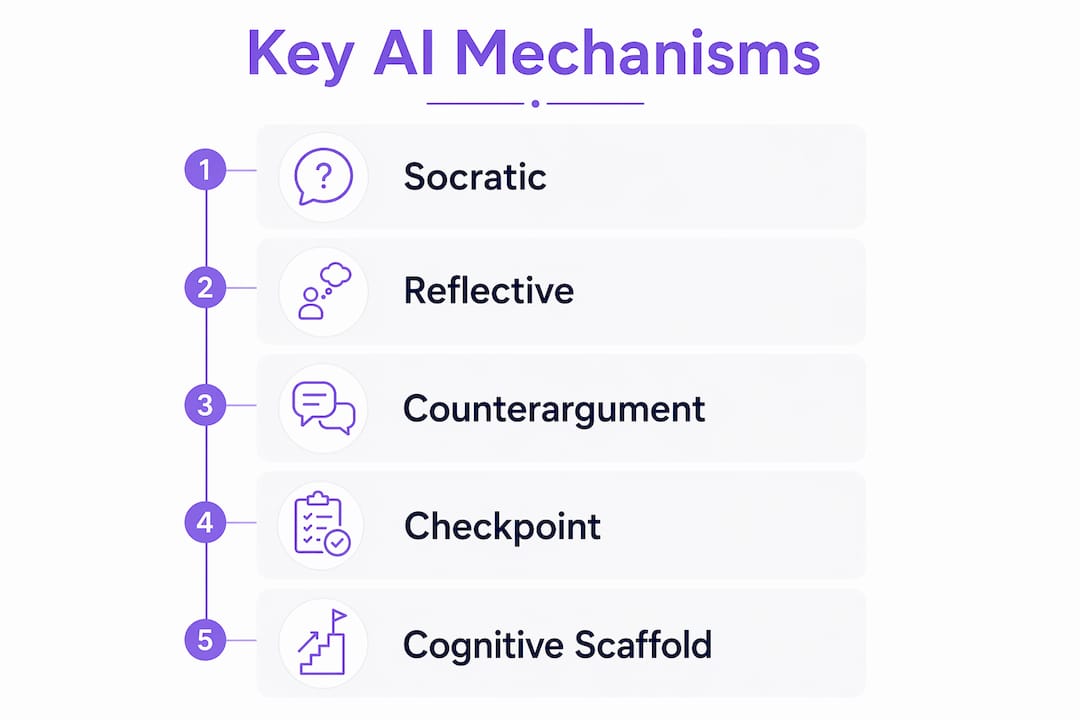
The foundational mechanism is Socratic questioning. AI-supported Socratic dialogue agents use iterative cycles of questioning, counterargument, and user reflection rather than delivering final answers. This forces the user to build and test their own reasoning, which is how critical thinking actually develops.

A second mechanism is reflective checkpointing. Process-oriented AI designs with reflective checkpoints and verification prompts produce stronger epistemic vigilance and better reasoning quality. Epistemic vigilance means you actively question whether a source or claim is reliable. AI that builds this habit into its workflow trains you to do the same independently.
The third mechanism is counterargument generation. When an AI presents the strongest case against your position, you are forced to either refine your argument or abandon a weak one. This mirrors the kind of structured debate training used in law schools and policy programs, applied at scale through AI.
Pro Tip: *When using any AI tool for analysis or decision-making, ask it to argue the opposite of your conclusion before you finalize your thinking. This single habit activates the counterargument mechanism even in tools not specifically designed for it.*
These mechanisms work together as a form of cognitive scaffolding. Think of scaffolding the way a construction crew uses it: temporary support that lets you build something you could not build alone, then gets removed once the structure can stand on its own. AI scaffolding for critical thinking follows the same logic. You can read more about how different AI learning tools apply these principles across educational and professional contexts.
What are common risks when using AI for critical thinking?
The biggest risk is cognitive offloading. This happens when you hand your reasoning to the AI entirely and accept its output without scrutiny. Unreflective AI use impairs independent reasoning and reduces job-specific critical skills over time. The result is what researchers call "metacognitive laziness," where you stop monitoring your own thinking because the AI appears to be doing it for you.
A second risk is automation bias. This is the tendency to trust AI outputs simply because they come from a machine. Automation bias is well-documented in aviation, medicine, and finance, and it applies equally to AI-assisted reasoning. If you accept an AI's framing of a problem without questioning it, you have not thought critically. You have outsourced the thinking and signed off on the result.
Timing also matters more than most people realize. The risks compound when you bring AI in too early:
- Early AI access before individual reasoning: Reduces the cognitive effort you invest, which weakens argument quality and limits perspective diversity.
- Late AI access after initial reasoning: Boosts essay scores and perspective incorporation compared to early or no AI access. You bring your own thinking first, then use AI to stress-test it.
- No AI access under time pressure: Can limit the range of sources and counterarguments you consider, especially for complex topics.
- AI access without structured reflection: Produces the worst outcomes. You get AI-generated content you have not interrogated, which you then treat as your own reasoning.
The pattern is clear: AI used after independent thought strengthens reasoning. AI used as a replacement for it weakens reasoning.
Pro Tip: *Before opening any AI tool for a decision or analysis task, write down your initial position and your top two reasons for it. This creates a baseline that protects you from automation bias and gives you something concrete to test against the AI's response.*
AI literacy is the practical solution to these risks. Users who understand AI's influence on argument framing and their own cognitive habits are far better positioned to use these tools without being shaped by them. AI literacy is not just knowing how to prompt an AI. It is knowing when not to use one.
How can you implement AI critical thinking support effectively?
Effective implementation comes down to interaction design, whether you are a student, a professional, or an organization deploying AI tools at scale. The goal is to build AI use into workflows in ways that demand reasoning from the user, not just retrieval.
An integrated AI-supported framework grounded in constructivism and cognitive load theory improves students' self-regulation and inference-making skills. Constructivism means learners build knowledge through active engagement, not passive reception. Cognitive load theory means you structure tasks so the mental effort goes toward reasoning, not just managing information.
The table below compares two broad approaches to AI integration based on their design principles and outcomes:
| Approach | Design focus | Reasoning demand | Outcome |
|---|---|---|---|
| Product-oriented AI use | Final answer delivery | Low | Cognitive offloading, reduced critical skill |
| Process-oriented AI use | Iterative questioning and reflection | High | Improved reasoning, epistemic vigilance |
For individuals, the most practical implementation steps are:
- Use AI to generate counterarguments, not conclusions.
- Set a rule: write your own analysis first, then bring in AI to challenge it.
- Ask AI to identify the weakest point in your argument, not just confirm it.
- Use AI-generated summaries as a starting point for your own research, not an endpoint.
For organizations and educators, the design principles that matter most are explicit verification steps built into AI workflows, reflection prompts that require users to articulate their reasoning, and time structures that protect independent thinking before AI access. Educational AI tools built on constructivist and epistemic scaffolding principles produce sustained cognitive engagement, which is the measurable goal.
What cognitive skills does AI support in critical thinking?
AI cognitive support maps onto three core functions: perception, decision-making, and learning. Each connects directly to the skills that define critical thinking.
Perception in AI terms means processing and interpreting information. For critical thinking, this translates to analysis and inference-making. An AI that surfaces contradictory evidence or highlights gaps in a data set trains you to look for those things yourself.
Decision-making support covers evaluation and judgment. When AI presents weighted options with explicit trade-offs, it models the kind of structured evaluation that good decision-making requires. The key is that the user must make the final call and articulate why.
Learning support covers self-regulation and metacognition. Mixed-methods research with high school students showed improved communication and information evaluation when AI-supported tasks required students to reflect on their own reasoning process.
The specific critical thinking skills that AI interaction can develop include:
- Inference-making: Drawing conclusions from incomplete information, supported by AI that asks "what else would you need to know?"
- Argument evaluation: Assessing the strength of claims and evidence, supported by AI counterargument generation.
- Epistemic belief development: Building calibrated confidence in what you know and don't know, supported by AI verification prompts.
- Motivation and engagement: Deep engagement with Socratic dialogue fosters motivation and advanced argumentation strategies in learners. Motivation is not a soft outcome. It determines whether critical thinking habits persist outside the AI interaction.
The distinction between AI as a cognitive crutch and AI as a cognitive coach is fundamental. Maintaining user control during iterative verification is the critical variable. When the user controls the reasoning and the AI challenges it, skills develop. When the AI controls the reasoning and the user approves it, skills atrophy.
Key Takeaways
AI critical thinking support works only when the AI challenges your reasoning rather than replacing it, making interaction design the single most important factor in whether these tools build or erode critical skills.
| Point | Details |
|---|---|
| Process over product | Use AI that asks questions and generates counterarguments, not one that just delivers answers. |
| Timing determines outcome | Engage AI after your initial reasoning to boost argument quality and reduce bias. |
| Cognitive offloading is the core risk | Unreflective AI use reduces independent reasoning and job-specific critical skills over time. |
| Scaffolding builds lasting skills | Constructivist AI frameworks improve self-regulation, inference-making, and information evaluation. |
| AI literacy is non-negotiable | Understanding how AI frames arguments protects you from automation bias and epistemic drift. |
Why interaction design is the real variable here
I have spent a lot of time testing AI tools across different reasoning tasks, and the pattern that keeps showing up is this: the tool matters far less than how you use it. I have seen people use a basic AI assistant in ways that genuinely sharpened their thinking, and I have seen people use purpose-built reasoning tools in ways that made them intellectually lazier within a week.
The cognitive crutch versus cognitive coach distinction is not really about the AI. It is about the interaction pattern the user brings to it. If you go to an AI looking for confirmation, you will get confirmation. If you go to it looking for the strongest objection to your position, you will get that instead. The AI reflects the quality of the question you ask.
What I find genuinely promising is the research on Socratic dialogue agents. The idea that you can build an AI that structurally refuses to give you a final answer, that keeps redirecting you back to your own reasoning, is a real design breakthrough. Most AI tools are not built this way, but the ones that are produce measurably better outcomes. That gap between what is possible and what is deployed is where the interesting work is happening right now.
My honest recommendation: treat AI as a sparring partner, not a search engine. The role of AI models in shaping how you think is already significant. The question is whether you are directing that influence or just absorbing it.
> *— Iosif Peterfi*
Clawbase and AI agents built for real cognitive work
Clawbase gives you access to OpenClaw, a powerful open-source AI agent, without the technical setup that normally blocks most people from using it. One-click deployment on a dedicated server means you get a private, always-on AI agent with persistent memory and access to over 50 AI models. That persistent memory is what makes it genuinely useful for critical thinking workflows: the agent remembers your previous reasoning, your stated positions, and the counterarguments you have already worked through. You can explore practical AI agent use cases that align directly with analysis, decision support, and structured reasoning tasks. Clawbase is available from $16/month with 99.9% uptime and no maintenance required.
FAQ
What is AI critical thinking support?
AI critical thinking support is the use of process-oriented AI tools that enhance reasoning by prompting reflection, counterargument, and verification rather than delivering final answers. The goal is to develop the user's own analytical skills, not replace them.
How does AI enhance critical thinking in education?
AI-supported Socratic dialogue agents improve critical thinking and argumentation skills by sustaining cognitive challenge and advanced questioning strategies. Research with intermediate learners shows these agents outperform generic AI chatbots on reasoning outcomes.
When should you use AI during a critical thinking task?
Engaging AI after completing your initial independent reasoning produces the best results. Studies show late AI access boosts argument quality and perspective diversity compared to early or no AI access.
What is the difference between a cognitive crutch and a cognitive coach in AI?
A cognitive crutch delivers answers and reduces the user's reasoning effort, leading to cognitive offloading. A cognitive coach uses iterative questioning and reflection to build the user's independent reasoning capacity over time.
What risks come with using AI for critical analysis?
The main risks are automation bias, metacognitive laziness, and reduced epistemic vigilance. These occur when users accept AI outputs without scrutiny, particularly when AI is introduced before independent reasoning has taken place.