What Is a Personal AI Tutor? Your 2026 Guide
2026-06-17

A personal AI tutor is an intelligent tutoring system that adapts in real time to your individual pace, knowledge gaps, and learning style, delivering one-on-one instruction without the cost or scheduling limits of a human teacher. The industry term for this technology is Intelligent Tutoring System, or ITS, though "personal AI tutor" captures how modern platforms like Khanmigo and LearnAI have made these systems accessible to everyday learners. Research shows that personalized tutoring can move a student from the 50th to the 98th percentile in performance. That is not a marginal gain. It is the kind of result that used to require years of expensive, one-on-one human instruction. AI tutors now deliver a version of that outcome at a fraction of the cost and at any hour of the day.
How does a personal AI tutor work?
The core of any AI tutoring system is its ITS architecture. This architecture does more than check whether your answer is right or wrong. It assesses why you struggle and then shifts its teaching strategy to address the root cause. That distinction separates a genuine AI tutor from a simple quiz app.
Here is what happens under the hood during a typical session:
- Diagnostic intake: The system asks you questions or reviews your past responses to map your current knowledge state. Think of this as the AI building a mental model of what you know and where the gaps are.
- Real-time adaptation: As you answer, the tutor adjusts difficulty, pacing, and explanation style. If you nail three problems in a row, it moves on. If you stumble, it zooms in with a different approach.
- Socratic questioning: Platforms like Khan Academy's Khanmigo use guided questions and step-by-step feedback to push you toward the answer rather than handing it to you. This builds critical thinking, not just recall.
- Analogies and examples: Large language models allow AI tutors to generate fresh analogies tailored to your background. A student who loves basketball gets a physics explanation framed around projectile motion on a court.
- Misconception flagging: After a session, the system can identify specific wrong beliefs you hold, not just topics you missed.
Pro Tip: *Ask your AI tutor to explain a concept three different ways. If one explanation does not click, the next one often will. Large language models have the range to do this instantly, which no single human tutor can match on demand.*
The effectiveness of AI tutors depends entirely on this diagnostic layer. Without it, you just have a chatbot that answers questions. With it, you have a system that builds understanding progressively, the same way a skilled human teacher would.

AI tutors vs. human tutors: benefits and limits
The cost difference alone makes AI tutors worth serious attention. Human tutors typically cost $40–$100 per hour. That price point puts consistent, high-quality tutoring out of reach for most families. AI tutoring platforms are often free or available through low-cost subscriptions, and they are available at 3 a.m. before an exam just as readily as at noon on a Tuesday.
The comparison goes deeper than price, though. Here is how the two approaches stack up across the dimensions that matter most:
| Feature | AI Tutor | Human Tutor |
|---|---|---|
| Availability | 24/7, no scheduling required | Limited to agreed hours |
| Cost | Free to low-cost subscription | $40–$100 per hour |
| Personalization | Real-time adaptation to every response | Adapts over multiple sessions |
| Emotional support | Minimal, no genuine empathy | Strong, reads mood and motivation |
| Cultural nuance | Limited without specific training | Natural, context-aware |
| Repetition tolerance | Unlimited, never frustrated | Varies by tutor |
| Accountability | Self-directed only | External motivation provided |
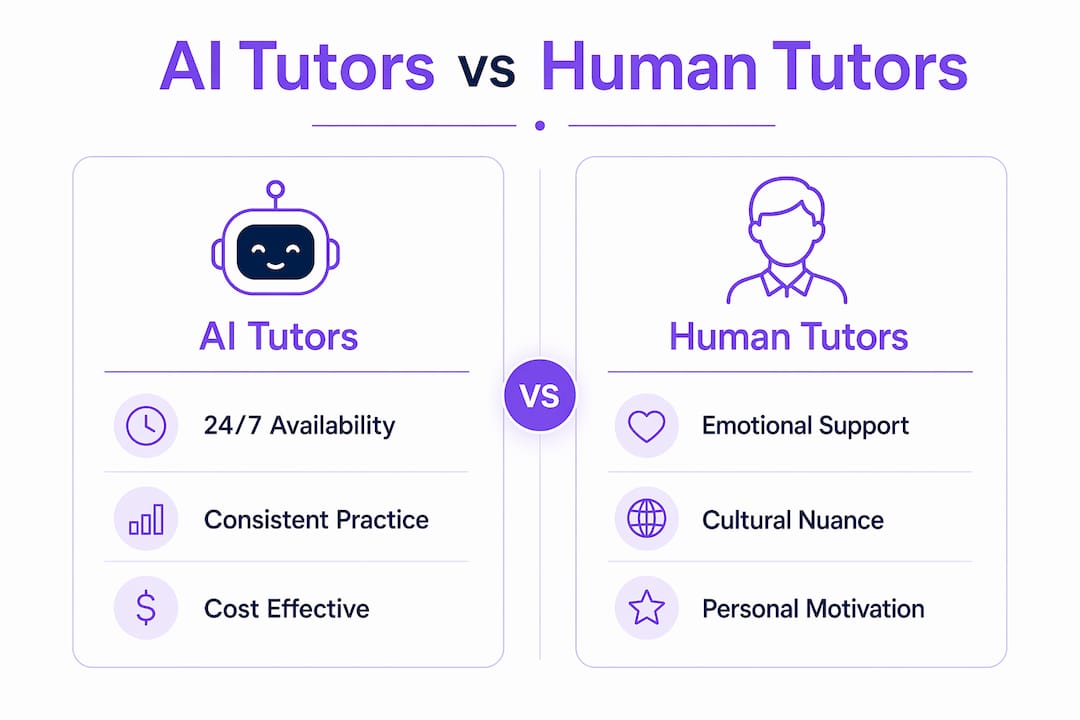
AI tutors excel at repetitive teaching tasks like concept explanation and practice problem generation. They do not get tired, impatient, or distracted. That consistency is genuinely valuable for building foundational skills.
The ceiling, however, is real. AI tutors cannot replace human mentors for emotional support or cultural nuance. A student going through a difficult period at home needs a person who can read the room, not an algorithm. The AI learning companion model tries to address this by adding peer-like social support and motivational scaffolding, but it remains a work in progress compared to a trusted human teacher.
The practical answer is to treat AI tutors as a complement to human instruction, not a replacement. Use the AI for drilling concepts, generating practice problems, and getting instant feedback. Reserve human mentorship for motivation, accountability, and the kind of nuanced guidance that requires genuine relationship.
How to set up a personal AI tutor for your goals
A well-configured AI tutor outperforms a generic one by a wide margin. Setup takes roughly 15–30 minutes and pays dividends across every session that follows. Here is a structured process to get it right.
- Define your learning objective clearly. Write one sentence that states exactly what you want to master. "I want to pass the AP Chemistry exam in May" is useful. "I want to learn chemistry" is not. Specificity gives the AI a target to calibrate against.
- Set the curriculum scope. Tell the AI which topics are in bounds and which are not. If you are studying for a specific exam, paste in the official syllabus or topic list. This prevents the AI from wandering into adjacent material you do not need yet.
- Upload grading rubrics and past exams. Providing past exams and rubrics calibrates the AI to the exact standards you will be judged against. This is one of the most underused setup steps, and it makes a measurable difference in session quality.
- Instruct the AI to use Socratic questioning. Explicitly tell it: "Do not give me direct answers. Guide me with questions and hints until I arrive at the answer myself." This one instruction shifts the entire dynamic from passive consumption to active learning.
- Apply Bloom's Taxonomy as a framework. Ask the AI to start at the knowledge and comprehension levels, then progressively move toward application, analysis, and synthesis as you demonstrate mastery. This mirrors how skilled human teachers structure a curriculum.
- Schedule a diagnostic summary at the end of each session. Ask the AI to flag your misconceptions and summarize the knowledge gaps it detected. This turns each session into a feedback loop, not just a study block.
Pro Tip: *If you are using AI without technical skills, start with a single subject and a single objective. Trying to configure a tutor for five subjects at once produces mediocre results across all of them. Depth beats breadth in the setup phase.*
What advanced strategies actually improve AI tutoring results?
Most people use AI tutors the wrong way. They ask a question, read the answer, and move on. That is closer to reading a textbook than genuine tutoring. The learners who get the most out of these systems treat the AI as a thinking partner, not a search engine.
Here are the strategies that separate effective users from average ones:
- Refuse direct answers on purpose. Instructing the AI to use guiding questions rather than direct answers forces you to construct knowledge rather than receive it. This is the single highest-leverage change you can make to your sessions.
- Feed it your actual exam materials. Generic AI responses come from generic prompts. When you provide curriculum scope and official rubrics, the AI stops teaching to a general audience and starts teaching to your specific test.
- Use follow-up prompts to surface blind spots. After any explanation, ask: "What misconception might a student have about this topic?" Then check whether you hold that misconception. This is a fast way to find gaps you did not know existed.
- Request a session debrief. At the end of a study block, ask the AI to summarize your knowledge gaps and list the three concepts you are most likely to get wrong on an exam. This turns passive review into targeted preparation.
- Balance AI sessions with human mentorship. The AI learning companion model provides social scaffolding, but it does not replace the motivational pull of a real person who knows your name and cares about your progress. Schedule regular check-ins with a teacher, tutor, or study partner to maintain accountability.
- Avoid the "explain everything" trap. If you ask the AI to explain a full chapter, you will get a wall of text and retain very little. Break requests into single concepts and test your understanding before moving forward.
The learners who treat AI as a thinking partner in professional development contexts report the same pattern: specificity and active engagement produce results, while passive consumption does not.
Key takeaways
A personal AI tutor delivers measurable learning gains when configured with clear objectives, Socratic questioning, and regular diagnostic feedback.
| Point | Details |
|---|---|
| Define objectives first | Specific learning goals let the AI calibrate instruction to your exact needs. |
| Cost advantage is real | AI tutors cost a fraction of the $40–$100/hour rate for human tutors. |
| Socratic method matters | Instructing the AI to ask guiding questions builds critical thinking, not just recall. |
| Diagnostics close gaps | Requesting misconception summaries after each session surfaces blind spots you would otherwise miss. |
| AI complements humans | Use AI for concept drilling and practice; rely on human mentors for motivation and accountability. |
Where i land on AI tutors after testing them seriously
I have spent a lot of time configuring and testing AI tutoring setups across different subjects and skill levels. My honest observation is that most people dramatically underestimate the setup cost and overestimate the out-of-the-box quality.
A generic AI tutor with no configuration is a mediocre study tool. A well-configured one, with a defined scope, Socratic instructions, and real exam materials loaded in, is genuinely impressive. The gap between those two experiences is larger than most articles acknowledge.
What I find most interesting is the autonomy effect. Learners who use AI tutors consistently report feeling more in control of their education. They can revisit concepts without embarrassment, ask "dumb" questions without judgment, and move at their own pace. That psychological safety is underrated as a learning accelerator.
My caution is about critical thinking. If you always let the AI explain things to you, you stop building the mental muscle of working through confusion independently. The Socratic method instruction is not just a nice-to-have. It is a safeguard against intellectual passivity.
My advice: pick one subject, spend 20 minutes on setup, and run five sessions before you evaluate whether it is working. Most people quit after one session that felt generic, which is almost always a configuration problem, not a technology problem.
> *— Iosif Peterfi*
How Clawbase supports your AI tutoring setup
Building a personal AI tutor that actually performs requires more than a good prompt. It requires a reliable, always-on AI agent with persistent memory and access to capable models. Clawbase makes that possible without any server configuration or technical overhead. With one-click deployment of OpenClaw on a dedicated server, you get 99.9% uptime, persistent memory management, and access to over 50 AI models. Explore the full range of AI agent use cases to see how Clawbase supports personalized learning assistants, workflow automation, and more. If you want a private AI tutor that remembers your progress across every session, Clawbase managed hosting starts at $16 per month.
FAQ
What is a personal AI tutor in simple terms?
A personal AI tutor is an AI-powered system that adapts its teaching in real time to your pace, learning style, and knowledge gaps. It functions like a one-on-one instructor available at any hour, without the cost of a human tutor.
Can AI tutors replace human teachers?
AI tutors excel at repetitive instructional tasks like concept explanation and practice generation, but they cannot replicate the emotional support and cultural nuance of a human teacher. The two work best in combination.
How long does it take to set up an effective AI tutor?
Setup takes approximately 15–30 minutes when you define your learning objectives, restrict the curriculum scope, and configure the AI to use Socratic questioning rather than direct answers.
What is the best way to use an AI tutor for exam prep?
Upload past exam papers and official grading rubrics to calibrate the AI to your specific test standards. Then instruct it to ask guiding questions rather than provide answers, and end each session by requesting a summary of your knowledge gaps.
Are AI tutors suitable for all ages?
Yes. AI tutoring systems adapt to the learner's current level regardless of age, making them useful for elementary students building foundational skills, adults pursuing professional certifications, and everyone in between.