SOC 2 for AI: What It Covers and What It Doesn't
2026-10-29

SOC 2 has no separate AI category. Auditors examine AI services against the same Trust Services Criteria they use for any other service, and the scope of the examination decides which AI risks, controls and evidence matter. That makes a SOC 2 report a useful signal about how a vendor secures its AI systems and customer data. It is not a certificate that the AI itself is safe, accurate or well governed.
This guide is for buyers vetting an AI vendor and for teams preparing for their own examination. We walk through what applies, what auditors look at, how scope changes with third-party models, and where a report stops being evidence.
TL;DR
- There is no AI-specific SOC 2 criterion. The five existing criteria (Security, Availability, Processing Integrity, Confidentiality, Privacy) are applied to systems that include AI.
- Security is mandatory in every report. The other four are chosen based on commitments to customers, and Processing Integrity is the one most worth considering for AI outputs.
- Scope is the whole story: a model provider that is carved out, or added after the examination period, sits outside the auditor's opinion.
- A report shows that controls existed or operated for a defined scope. It does not prove protection against prompt injection, model extraction or hallucination.
- Pair SOC 2 with AI-specific frameworks such as ISO/IEC 42001 or the NIST AI RMF when governance is the question.
Table of Contents
- Does SOC 2 cover AI?
- How the five criteria map to an AI service
- What auditors actually look at in an AI system
- How scope changes with models, data and third parties
- Type I or Type II for an AI service
- What a SOC 2 report does not prove
- A buyer's checklist for AI vendors
- Preparing for your own SOC 2 with AI in scope
- Our perspective
- Where managed hosting fits
- FAQ
- Sources
Does SOC 2 cover AI?
Indirectly, yes. SOC 2 does not certify AI systems or their outputs, but it is applied to AI services by using the existing five criteria to assess the risks of systems that include AI. The same source stresses there is no formal "AI certification" or checkbox, and that a standard report shouldn't be read as comprehensive AI governance or safety assurance.
The AICPA, which maintains the framework, describes SOC reports as a way for CPAs to help users assess risks tied to outsourced services, with the SOC 2 guide covering controls relevant to security, availability, processing integrity, confidentiality or privacy.
The newest official signal is AICPA's TQA Section 9561, published in September 2026. It gives nonauthoritative guidance on how a service organization's use of AI affects SOC 1 and SOC 2 examinations: scope, system description, risk assessment and control design. It also says the engagement team must have the competence to evaluate the specific AI technologies involved. If your auditor can't talk about your retrieval pipeline or model routing in concrete terms, that is worth noticing.
So the honest answer to "does SOC 2 cover AI" is this: it covers the environment, access, change management, availability and data handling around your AI. It was not designed to cover AI-specific risks, controls and considerations in their entirety.

How the five criteria map to an AI service
The criteria have distinct objectives, summarized by RSM: availability concerns operation and use of systems; confidentiality concerns protecting information designated confidential; processing integrity concerns complete, valid, accurate, timely and authorized processing; privacy concerns the appropriate collection, use, retention, disclosure and disposal of personal information.
Security is required in every SOC 2 report. Its objective is protecting information and systems against unauthorized access, unauthorized disclosure and damage. The other four are optional and selected according to the service, its commitments and customer needs.
Here is how that translates for an AI product:
| Criterion | Required? | What it means for AI |
|---|---|---|
| Security | Always | Who can reach models, prompts, tools, customer data and logs; how changes are approved |
| Availability | Optional | Inference or agent uptime, capacity, backup and recovery |
| Processing Integrity | Optional | Outputs and actions that are complete, valid, accurate and authorized; handling of invalid results |
| Confidentiality | Optional | Protection of data customers have marked confidential, including what lands in datasets and logs |
| Privacy | Optional | Personal information collected, used, retained and disposed of by the AI workflow |
One view from the AICPA-oriented side is that AI risks are mapped to existing, technology-neutral criteria rather than treated as a new category, with Security carrying most of the AI control work and other criteria added when service commitments justify them. That matches how we read it.
Where Processing Integrity earns its place
Processing Integrity is pertinent to AI because organizations may want to verify that processing is complete, valid, accurate, timely and authorized, and to monitor and remediate invalid outputs or unexpected results. Baker Tilly makes a related point: including it is a strategic move to show accountability for AI-generated outputs, because applying SOC principles to AI brings in dimensions such as model development and validation.
If your product takes actions on a user's behalf (sending messages, editing files, calling tools), that is where Processing Integrity moves from nice-to-have to the criterion your customers will ask about.
What auditors actually look at in an AI system
Most AI controls land in criteria you already know. Schellman lists access controls under CC6, monitoring under CC4, system development lifecycle controls under CC8.1 and vendor or supplier controls under CC9.2 as places AI-related controls may sit.
The risks that can fall inside scope, per SOC2Auditors.org, include:
- Unauthorized access to models or customer data.
- Unapproved changes to models, prompts, retrieval indexes or tools.
- Prompt injection that causes unauthorized retrieval or tool actions.
- Inference or service outages.
- Dependence on a hosted-model provider.
- Processing failures.
- Sensitive data retained in datasets or logs.
The same source gives examples of the evidence that answers them:
- Security: least-privilege access reviews.
- Change management: testing and approval records plus version history for model or prompt changes.
- Monitoring: anomaly monitoring and incident records.
- Vendors: assessments and contracts for hosted models.
- Availability: capacity, backup and recovery testing.
- Processing Integrity: validation and error-handling records.
- Confidentiality and Privacy: retention and disposal evidence.
Auditors also expect evidence aimed at AI behavior, such as drift monitoring. Treat prompts and retrieval indexes as code: version them, review them, and keep the trail.
For AI and machine-learning platforms, an examination can look at security over the AI environment and data, including segregation and access to client data. That is the part buyers should care about most when a vendor hosts their data next to other customers' data. We cover the architecture side of that question in our piece on single-tenant AI hosting.
How scope changes with models, data and third parties
Two AI companies can both say "we have SOC 2" and mean very different things. The difference is the system description and the boundary.
The description of the system must follow the AICPA description criteria, which require clear disclosure of system boundaries and the role of technologies, AI included, used to deliver the service. TQA 9561 points the same way: scope, description and risk assessment all have to reflect AI use.
Three patterns come up repeatedly:
- You build and host your own models. More of the stack is yours: training data handling, model change control, access to weights. More controls, more evidence.
- You call a third-party model API. Third-party AI APIs inside an in-scope product are treated as subprocessors under the carve-out method. You remain responsible for API credentials, API-call logging, contractual data-handling and retention terms, training-use restrictions and monitoring of customer-facing outputs.
- You switch or add providers. A model provider added after the examination period, or carved out of the system description, remains outside the auditor's opinion.
That last one matters for products that route between many models. If a vendor supports dozens of models, ask which ones were in the described system during the period, and how new ones are onboarded and assessed.
Type I or Type II for an AI service
A Type I report assesses the design of controls at a specific date. A Type II report evaluates operating effectiveness over a period, which gives a historical look at the control environment. Type II periods commonly run three to twelve months.
For AI, the gap is wider than usual. Models, prompts and tools change often, so a snapshot of design says little about whether change management held up over a quarter. If you are buying, ask for Type II. If you are preparing, a Type I can be a reasonable first milestone, as long as you are clear with customers about what it is. For a deeper walk through report structure, this guide to SOC 2 Type II reports is a good companion.
What a SOC 2 report does not prove
A report covers a specific audit period and the controls in its scope. It does not establish security for your use case or cover AI-specific risks such as training-data security, model extraction or prompt injection.
In practice, a clean SOC 2 report does not tell you:
- Whether the model's answers are accurate or free of bias.
- Whether an agent can be tricked by hostile content in a web page or document.
- Whether a provider added after the period meets the same bar.
- Whether the vendor's AI governance, impact assessment and responsible-use practices are mature.
For the last point, frameworks built for AI help. ISO 42001 can be added to a SOC 2+ report to test AI-specific controls, such as impact assessments and responsible AI use. The NIST AI RMF is intended for voluntary use, and its Generative AI Profile helps organizations manage AI risks in line with their goals, risk tolerance and resources.
PwC argues that trust in AI needs a lifecycle approach, with evaluation, testing and monitoring built in from design, since point-in-time reviews are increasingly insufficient for dynamic systems. Independent assurance is one part of that confidence, not all of it.
A buyer's checklist for AI vendors
When a vendor hands you a report, read it in this order:
- Report type and period. Type II, and does the period overlap with now?
- Criteria included. Security only, or also Availability, Confidentiality, Processing Integrity and Privacy?
- System description. Does it name the AI components and describe where your data flows?
- Subservice organizations. Which model providers and hosts are carved out, and what complementary controls does the vendor expect you to run?
- Exceptions. Were any noted in change management, access or monitoring?
- Gaps the report can't fill. Ask separately about prompt injection defenses, data retention for logs, and whether your data is used for training.
Some of these questions go beyond SOC 2. Our guides on what to check before committing to secure AI assistant hosting, file access controls for AI and verifying server encryption attestation cover the technical side. If your concern is European data protection rather than US assurance, see our note on GDPR-compliant AI hosting.
Preparing for your own SOC 2 with AI in scope
If you are the one being examined, a workable sequence looks like this:
- Inventory the AI. List models, providers, prompts, retrieval indexes, tools and where each touches customer data.
- Decide what is in the system description. Be explicit about components you rely on and ones you carve out. The relevance test auditors apply is practical: does the AI mitigate or introduce covered risks, or enable the service?
- Pick criteria from your commitments. Start with Security. Add Processing Integrity if the system acts or produces outputs customers rely on.
- Put AI changes under change control. Prompt and model changes need approval records and version history.
- Log and monitor. Keep API-call logs, anomaly alerts and incident records.
- Assess your AI vendors. Keep contracts, retention terms and training-use restrictions on file.
- Choose Type I or Type II deliberately. Then let the observation period run with evidence collected as you go.
For teams running AI inside the business rather than selling it, our overview of AI compliance assistance for business shows where assistants fit into compliance work.
Our perspective
We host OpenClaw, an open-source personal AI assistant, on dedicated, encrypted cloud servers for customers who don't want to run the infrastructure themselves. That puts us close to the questions SOC 2 is trying to answer: who can reach the server, where the data lives, what happens when something fails, and which model provider sees what.
Here is what we'd tell any buyer, including buyers evaluating us. Don't ask "is it SOC 2?" and stop. Ask what the architecture makes impossible. A dedicated server per customer removes a whole class of cross-tenant questions before an auditor ever arrives. Encrypted storage and daily encrypted backups make the recovery and confidentiality conversations shorter. Persistent memory is useful, and it is also a retention question you should be able to answer.
The point most reports miss is the agent itself. An assistant that connects to Telegram, Slack or a browser can be handed hostile text. A report on the hosting environment won't tell you how it behaves then, so test that yourself and keep permissions narrow. We wrote about the principle in why private deployment beats a ban. We don't claim an attestation we haven't published here, and we'd rather you verify every claim, ours included, against documents you can read.
> *— Iosif Peterfi*
Where managed hosting fits
If your team wants an assistant that runs on infrastructure you don't have to patch, ClawBase deploys OpenClaw in one click on a dedicated, encrypted server, with 99.9% uptime, persistent memory, daily encrypted backups, automated updates and more than 50 supported AI models. It connects to Telegram, Discord, Slack and WhatsApp.
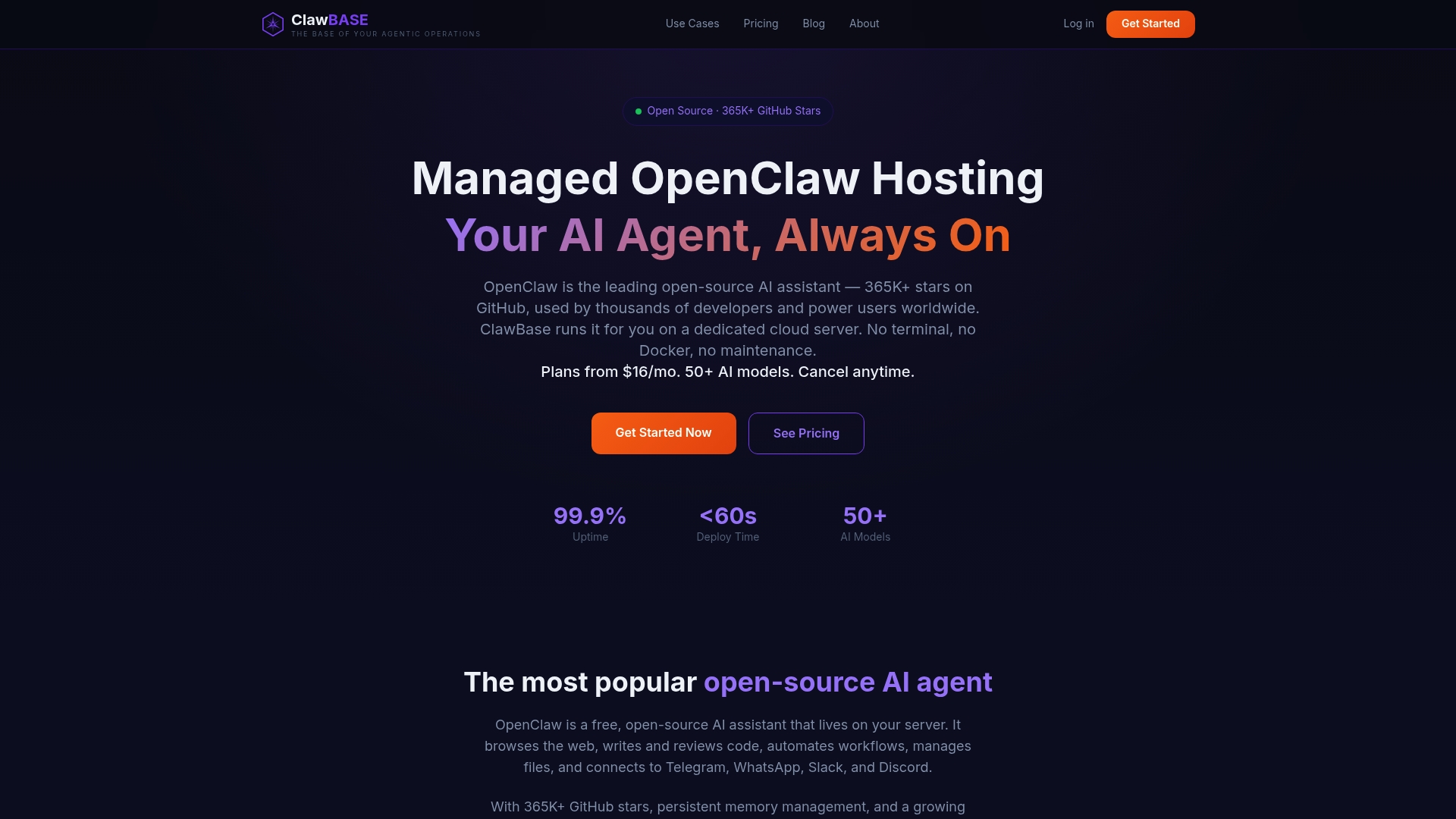
Plans on the pricing page are LITE at $16 per month or $199 per year, PRO at $33 per month or $399 per year, and MAX at $66 per month or $799 per year. The entry plan has a 7-day free trial, so you can review the setup against your own vendor checklist before you commit. For ideas on what to automate first, see our OpenClaw use cases.
FAQ
Is SOC 2 still relevant for AI?
Yes, as a baseline. Auditors apply the same criteria to AI services, so a report still tells you about access control, change management, monitoring, availability and data handling around the system. It does not replace AI-specific governance, so buyers increasingly pair it with ISO/IEC 42001 or the NIST AI RMF.
Do I need Processing Integrity in a SOC 2 for an AI product?
It is optional, but it is the criterion that speaks to whether outputs and actions are complete, valid, accurate, timely and authorized. If customers rely on what your AI produces or does, adding it shows accountability for outputs. If your AI is only a minor internal feature, Security alone may match your commitments.
What happens to SOC 2 scope if I use a third-party model API?
The provider is typically treated as a subservice organization. You stay responsible for credentials, logging, contractual retention and training-use terms, and monitoring of outputs. If the provider is carved out or added after the examination period, it falls outside the auditor's opinion.
Does a SOC 2 report mean an AI vendor is safe to use?
Not by itself. It shows that defined controls were designed, or operated over a period, within a stated scope. It does not cover model accuracy, prompt injection resilience or training-data security, so ask about those directly.
Sources
- Does SOC 2 Cover AI? What Auditors Actually Look At
- AICPA: System and Organization Controls SOC Suite of Services
- AICPA TQA Section 9561: Effect of the Service Organization's Use of AI on SOC 1 and SOC 2 Examinations
- Schellman: How to Incorporate AI Controls into Your SOC 2 Examination
- RSM: Effective SOC reporting
- Cloud Security Alliance: The 5 SOC 2 Trust Services Criteria Explained
- SOC 2 for AI Companies (2026)
- Baker Tilly: Evolving SOC 2 reports for AI controls
- Linford & Co: Auditing AI Platforms
- AICPA: 2018 SOC 2 Description Criteria
- Databrackets: AI Systems in the SOC 2 Examination
- AI Security Wiki: SOC 2 Crosswalk
- Pulumi: What is SOC 2?
- Pertama Partners: AI Vendor Certifications Guide
- NIST: AI RMF Generative AI Profile (NIST AI 600-1)
- PwC: Building trust as part of the AI lifecycle