GDPR Compliant AI Hosting: 4 Priorities for IT Teams in 90 Days
2026-10-11

Yes, we can confirm that hosting AI in a GDPR compliant way is achievable, but only when controller accountability (a DPIA plus a documented lawful basis), appropriate transfer safeguards, a binding DPA, and concrete technical controls like encryption, access logs, and key control are all in place together. Before signing with any provider, verify whether a DPIA is triggered, whether the DPA covers processor assistance obligations under Article 28, and whether encryption keys stay under your control.
***
> TL;DR:
>
> - A DPIA is required when an AI deployment is likely to create high risk, and teams should revisit it as models, datasets, or uses change.
> - Remote support access from outside the European Economic Area can trigger transfer rules even when servers remain in Europe; SCCs also require a transfer impact assessment.
> - Match the lawful basis to each data flow: consent must be withdrawable, legitimate interest needs a balancing test, and contractual necessity covers only essential processing.
> - Require a DPA that specifies assistance with rights requests and breach response, names current subprocessors, and sets deletion terms for backups when service ends.
> - Before procurement, request a sample audit log, immutable records of prompts and administrative actions, and evidence on subprocessors, audits, and government access requests.
***
Table of Contents
- What GDPR Requires for AI Hosting: Roles, Lawful Basis, and DPIA
- Data Residency and Cross-Border Transfers for AI: What Counts and Which Safeguards Work
- Technical Safeguards: Encryption, Keys, Isolation, Access Controls, Logging, and Retention for AI Hosting
- Contracts and Processor Obligations: What to Demand in a DPA and Why It Matters
- Operational Controls and How to Demonstrate Compliance: DPIA Steps, Audits, and Vendor Due Diligence
- How Managed, Encrypted Hosting Reduces Compliance Burden
- Four Priorities for the Next 90 Days
- A Practical Path to GDPR-Aligned AI Hosting
- FAQ
- Sources
What GDPR Requires for AI Hosting: Roles, Lawful Basis, and DPIA
Every AI hosting arrangement starts with a question that sounds simple but trips up a lot of technical teams: who is the controller, and who is the processor? When your organization decides why personal data flows into a model, you're the controller. The hosting provider that stores, processes, or trains on that data at your direction is the processor, bound by a contract that spells out the processing's scope and purpose. That distinction matters because accountability under Article 24 never transfers away from the controller, even when the processor handles the infrastructure.
EDPB guidance on controller and processor roles makes clear that controllers must select processors offering "sufficient guarantees" and formalize that relationship through a Data Processing Agreement. The processor, in turn, has to assist with implementing security measures and provide visibility into any sub-processors it relies on. For AI workloads, this becomes a layered chain: your hosting provider might depend on a cloud infrastructure vendor, which depends on a regional data center operator, and each link needs documentation.
A Data Protection Impact Assessment becomes mandatory the moment your AI deployment is likely to create high risk for people's rights, something that applies to most generative AI systems processing personal data at scale. EDPS orientations on generative AI treat the DPIA as an ongoing obligation rather than a one-time checkbox, which means your review cycle needs to repeat as the model, dataset, or use case evolves.
Lawful basis gets more complicated once an AI system touches model training, telemetry, or live user interactions. A few patterns show up repeatedly:
- Consent works for optional features like personalization, but it has to be specific and withdrawable.
- Legitimate interest can cover operational telemetry, provided a balancing test documents why your interest doesn't override user rights.
- Contractual necessity applies narrowly, usually to processing that a service literally cannot function without.
Mixing these bases without documenting which applies to which data flow is one of the fastest ways to fail an audit.
Data Residency and Cross-Border Transfers for AI: What Counts and Which Safeguards Work
Storing or processing personal data outside the European Economic Area counts as a transfer, and so does something easy to overlook: remote administrative access. If a support engineer in a third country can log into a server holding EU personal data, that access itself can trigger Chapter V obligations, regardless of where the physical server sits. EDPB guidelines on the interplay between Article 3 and Chapter V confirm that the transfer rules apply based on where processing actually happens, not just where data is nominally stored.

Three transfer mechanisms do the heavy lifting in practice: Standard Contractual Clauses, Binding Corporate Rules, and certification mechanisms. Each has real limits. SCCs require a transfer impact assessment that weighs the destination country's surveillance laws. Certification under Guidelines 07/2022 needs enforceable commitments and a redress path for data subjects, not just a badge on a vendor's website.
When evaluating a hosting provider, ask for specific evidence rather than general assurances:
- Signed SCCs covering the exact data flows in your deployment, not a generic template.
- Documentation of certification mechanisms or code-of-conduct adherence, where claimed.
- A current, named list of sub-processors, since an outdated list is a common audit finding.
- Contract clauses addressing how the provider responds to government access requests in third countries.
Technical Safeguards: Encryption, Keys, Isolation, Access Controls, Logging, and Retention for AI Hosting
Legal paperwork only protects you as much as the infrastructure behind it. Article 32 requires "appropriate technical and organizational measures," and for AI hosting, that phrase translates into a fairly specific stack. Our own look at encrypted hosting trade-offs found that properly implemented encryption adds manageable overhead relative to the risk it removes.
- Encrypt data in transit and at rest, and where possible, hold your own encryption keys rather than letting the provider manage them by default.
- Rotate keys on a schedule and consider split-key arrangements so no single party can unilaterally decrypt stored data.
- Choose isolation that matches your risk profile: single-tenant hosting with hardware security modules for sensitive workloads, container or VM separation as a baseline everywhere else. Our single-tenant hosting checklist walks through how to evaluate this for enterprise deployments.
- Enforce least privilege through role-based access control and privileged access management, including controls on who can view raw prompts or model outputs. Our breakdown of permission-aware access controls covers how this applies specifically to AI agents handling files and external actions.
- Log every prompt, model version change, and administrative action, and make those logs immutable so they hold up during an incident investigation.
- Set retention limits and avoid training on personal data by default, since purpose limitation applies to model improvement the same way it applies to any other processing.
Pro Tip: *Ask your hosting provider for a sample audit log before you sign, not after. If they can't produce one on request, assume they won't be able to produce one during an incident either.*
Minimization deserves special attention in AI contexts because models can retain traces of training data in ways that are hard to fully erase later. Building retention and minimization into deployment from day one, rather than retrofitting it, saves considerable pain when a data subject exercises their erasure rights.
Contracts and Processor Obligations: What to Demand in a DPA and Why It Matters
A Data Processing Agreement isn't boilerplate you skim before signing. Article 28 spells out minimum contract content, and AI hosting contracts need to hit every point with specificity rather than vague language.
- Scope, purpose, and duration of processing, stated precisely enough to cover model inference, logging, and any training use separately.
- Security measures matching what you verified technically, referenced in the contract rather than left to a separate, unenforceable policy document.
- A named, current sub-processor list with a mechanism for you to object to additions.
- Clear deletion and data return terms once the contract ends, including confirmation that backups are purged on the same schedule.
Processors also carry assistance obligations that often get overlooked during procurement. They need to help you respond to data subject requests and support breach notification within the tight timelines GDPR imposes. EDPB Opinion 22/2024 on reliance on sub-processors raises the bar further for high-risk processing, calling for increased verification and, where warranted, audit rights rather than taking a vendor's word on paper.
During procurement, ask for an evidence package upfront: third-party audit reports, a current sub-processor list, and a description of how the provider would support you through a DPIA or a regulator inquiry. A vendor that can produce this quickly is usually a vendor whose compliance posture is more than marketing copy. Our overview of AI compliance assistance covers what this support typically looks like in practice.
Operational Controls and How to Demonstrate Compliance: DPIA Steps, Audits, and Vendor Due Diligence
Demonstrating compliance means having evidence ready before a regulator asks for it, not scrambling to assemble it afterward.
- Identify the processing: map exactly what personal data flows into the AI system and for what purpose.
- Map the data flows end to end, including any sub-processors and cross-border hops.
- Assess risk to individuals, weighing likelihood and severity rather than treating every flow as equally sensitive.
- Document mitigations: encryption, access controls, retention limits, and transfer safeguards addressed earlier.
- Set a review cycle, since EDPS generative AI orientations treat the DPIA as living documentation, not a one-time filing.
Vendor due diligence should check certifications, sub-processor transparency, and incident response commitments against what the provider actually discloses rather than what a sales deck implies. The EU Cloud Code of Conduct gives a useful benchmark here, since adherence signals that a provider has mapped its controls to recognized standards like ISO 27001 or SOC 2. For teams weighing comparable frameworks in adjacent regulated sectors, guidance on SOC 2 for AI systems walks through how model lineage and drift get documented for audit purposes.
Keep log retention periods, sampling audit results, and attestation letters in one place so they're ready the moment a supervisory authority asks.
How Managed, Encrypted Hosting Reduces Compliance Burden
A managed hosting approach can take a meaningful chunk of this checklist off your plate without weakening any single control. We built ClawBase around one-click deployment for OpenClaw on dedicated, encrypted servers, which directly supports the Article 32 technical measures discussed above. Persistent memory management gives teams a defined place to apply retention and minimization policies rather than scattering state across ad hoc storage.
Because the hosting is managed end to end, the sub-processor chain stays centralized and documented in one place, which simplifies the audit evidence a DPIA or a supervisory review eventually asks for. Teams managing sensitive health or financial data under parallel frameworks can find similar structure in guidance on HIPAA compliant AI deployment, which covers logging and risk management patterns that overlap closely with GDPR expectations.
Four Priorities for the Next 90 Days
If I had to compress this entire framework into what actually gets done first, it would be four items: run the DPIA before deployment, not after a regulator asks why one doesn't exist. Sign a DPA that names processor assistance obligations explicitly rather than in passing. Insist on customer-managed encryption keys, or an equivalent arrangement, before any personal data touches the system. Demand audit evidence, not assurances, during procurement.
When time-to-compliance is tight, a managed hosting arrangement that already bakes in encryption and centralized sub-processor documentation can close the gap faster than building the equivalent internally.
> *— Iosif Peterfi*
A Practical Path to GDPR-Aligned AI Hosting
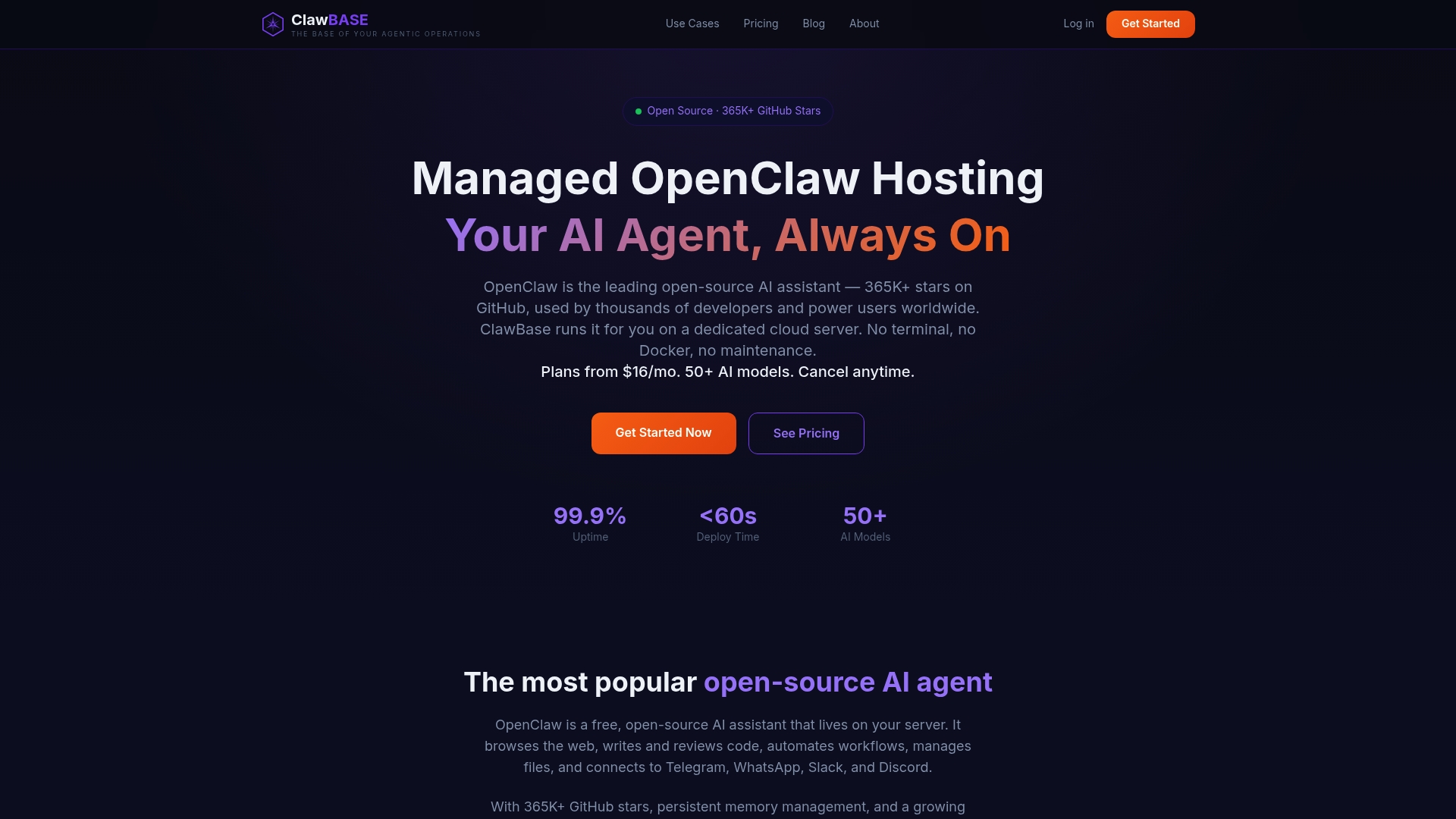
We offer managed OpenClaw hosting designed to balance deployment speed with necessary compliance controls, running on dedicated, encrypted servers with persistent memory management and supporting audit evidence requests encountered during DPIA reviews and vendor due diligence.
- Encrypted dedicated servers managed without requiring sysadmin work on your end.
- Persistent memory controls designed to assist with retention and minimization planning.
- Support for a broad range of AI models without requiring separate compliance reviews for each integration.
Check current plans and pricing to see which tier fits your deployment, or visit ClawBase to review the technical documentation before you talk to your compliance team.
This article is general information, not a substitute for advice from a qualified lawyer. Consult a qualified legal professional about your own circumstances before acting on anything here.
FAQ
Who counts as a GDPR controller in an AI hosting setup?
The controller is whoever decides why personal data is processed, typically your organization when you choose to deploy an AI system. The hosting provider acting on your instructions is the processor, and EDPB guidance confirms that controller accountability never transfers away even when infrastructure is outsourced.
Is GDPR stricter than HIPAA for AI systems?
GDPR and HIPAA address different scopes: GDPR covers all personal data across sectors, while HIPAA applies specifically to protected health information in the United States. Comparing strictness directly is misleading since each sets its own baseline for consent, breach notification, and processor obligations within its own legal framework.
Can GDPR-covered data be stored outside the EU?
Yes, but only with appropriate safeguards under Chapter V, such as Standard Contractual Clauses, Binding Corporate Rules, or an approved certification mechanism. EDPB guidelines on international transfers also note that remote access from outside the EEA can itself qualify as a transfer, even when the stored data stays put.
What is a third-party processor under GDPR?
A third-party processor is any organization that processes personal data on behalf of a controller and under the controller's instructions, bound by a Data Processing Agreement as required by Article 28. This includes hosting providers, cloud infrastructure vendors, and any sub-processors those vendors rely on further down the chain.