AI in Competitive Analysis: A Developer's 2026 Guide
2026-07-27

AI now plays a continuous, agentic role in competitive analysis: it monitors signals around the clock, synthesizes them into structured intelligence, simulates competitive scenarios, and delivers deal-ready recommendations directly into team workflows. That is a meaningful shift from the old model of quarterly reports assembled by hand. Three functions define what teams can expect immediately:
- Always-on signal collection — crawlers, webhooks, and stream processors ingest pricing pages, changelogs, job postings, and social data without manual scheduling.
- Synthesis and scenario simulation — agentic workflows powered by LLMs and retrieval-augmented generation (RAG) turn raw signals into structured competitor profiles and test strategic responses in real time.
- Action-driving recommendations — outputs route into Slack, Discord, Salesforce, or CRM records so sellers and product teams act on intelligence, not just read it.
Start by wiring one production data source (a competitor pricing page or a Gong call feed) into an OpenClaw agent on Clawbase and running a golden-set validation before expanding scope.
Table of Contents
- What does AI actually do in competitive analysis?
- Core AI techniques powering competitive intelligence
- What data governance and antitrust risks should you plan for?
- How do you build a developer-forward agent workflow?
- How do you measure whether your CI agent is working?
- Which deployment option fits your team?
- What does a 4–12 week pilot actually look like?
- How does Clawbase speed up an OpenClaw pilot?
- Key Takeaways
- What practitioners usually get wrong in CI pilots
- Skip the setup friction and start your CI pilot today
- Authoritative sources and further reading
What does AI actually do in competitive analysis?
The role of AI in competitive analysis spans five practical use-case groups, each replacing or accelerating a specific manual step.
Continuous monitoring replaces scheduled scraping jobs with event-driven pipelines. A webhook fires when a competitor's pricing page changes; an agent classifies the change and decides whether it warrants an alert. Always-on assistants handle this without human scheduling.
Automated synthesis uses RAG plus LLM summarization to convert raw web content, call transcripts, and review data into structured competitor profiles. Columbia Business School research shows many firms already use gen AI to synthesize transcripts (62%), analyze data (58%), and write reports (54%).
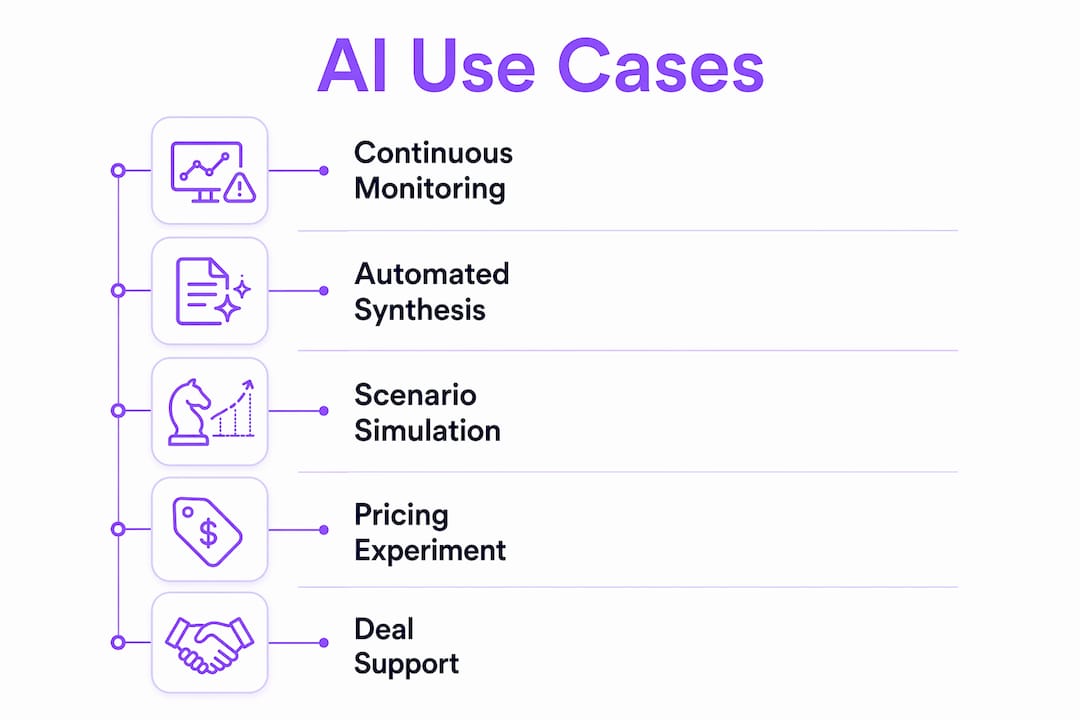
Agentic scenario simulation lets product and GTM teams test pricing moves or positioning changes against simulated market responses before committing. According to a16z, this turns market research into an always-on feedback loop rather than a one-off project.
Pricing and offer experimentation applies reinforcement learning to test price points against observed competitor moves, with human approval gates before any live change.
In-context deal support surfaces competitor objection-handling tips inside a CRM record or a Slack thread at the moment a seller needs them. Human judgment remains essential for interpreting ambiguous signals, approving pricing changes, and validating any claim before it reaches a customer.
Core AI techniques powering competitive intelligence
The building blocks of a production competitive-intelligence (CI) system are well-defined. Here is what each layer does:
- LLMs (GPT-style, Llama 2, Hugging Face models) — generate structured summaries, classify competitor moves, and draft positioning responses.
- Retrieval-augmented generation (RAG) — grounds LLM outputs in source documents, reducing hallucination by anchoring every claim to a retrieved passage.
- Vector search and embedding-based semantic search — indexes competitor content so agents can retrieve the most relevant context for a given query.
- Knowledge graphs — map relationships between competitors, products, pricing tiers, and market segments for richer reasoning.
- Multi-model orchestration — routes tasks to specialized models (a small classifier for change detection, a large LLM for synthesis) to balance cost and latency.
- Stream processors — handle real-time feeds (RSS, social APIs, webhook events) for sub-minute signal ingestion.
- Reinforcement learning for pricing — optimizes price-point recommendations against observed competitor behavior, always with a human approval gate.
The architectural flow looks like this: ingestion → storage/indexing → enrichment → agent/synthesis layer → delivery/integration. LangChain and similar orchestration frameworks connect these layers. OpenAI's GPT APIs or open-weight models via Hugging Face sit at the synthesis layer; vector stores handle retrieval. Integration touchpoints for CRM (Salesforce), call recordings (Gong), and messaging platforms (Slack, Discord) ensure insights land where teams already work. For API-focused integration patterns, native API workbench tooling can simplify connector development across these layers.
Pro Tip: *Standardize every agent output with a fixed-structure prompt that requires a competitor name, a source URL, a one-sentence finding, and a recommended action. This format makes human audits fast and keeps outputs consistent across pipeline runs.*

What data governance and antitrust risks should you plan for?
Data inputs for CI agents span public web (pricing pages, changelogs, product docs), social and review platforms, job postings, third-party telemetry, CRM records, call transcripts, and synthetic data. Each source carries its own governance burden.
Governance controls to implement before going to production:
- Access logs with user and agent attribution for every query
- Retention policies that specify how long raw competitor data is stored
- Data lineage tags so every AI claim traces back to a source document
- Provenance tagging on synthetic data to prevent it from being treated as observed fact
- Source citation required in every structured output (see prompt template above)
The regulatory picture is serious. The OECD warns that agentic and pricing algorithms can stabilize coordination and raise attribution challenges for enforcement — meaning automated pricing agents that respond to competitor moves in near-real-time may attract antitrust scrutiny even without explicit collusion.
> "AI adoption increases market transparency and speeds competitor response times, creating both efficiency gains and emerging competition risks such as algorithmic pricing that may facilitate exclusionary conduct." — OECD, *Artificial Intelligence and Competitive Dynamics in Downstream Markets*
For AI compliance guidance specific to data governance, a short pre-launch checklist covers the essentials: confirm data source terms of service, implement rate limits on public scraping, log all agent actions, and require human sign-off before any pricing recommendation reaches production.
How do you build a developer-forward agent workflow?
A production CI agent follows a four-stage loop:
- Ingestion — a crawler or webhook pulls competitor pricing pages, changelogs, or social posts on a schedule or event trigger.
- Event detection — a classifier (small LLM or fine-tuned ML model) flags meaningful changes (price drop, new feature, executive hire) and filters noise.
- Context assembly via RAG — the agent retrieves relevant historical context from the vector index and assembles a prompt with source passages attached.
- Recommendation delivery — the agent posts a structured summary to Slack or Discord, updates a CRM field, or triggers a Salesforce task with a recommended next action.
Example fixed-structure prompt for a competitor pricing alert:
You are a competitive intelligence analyst.
Competitor: {competitor_name}
Change detected: {change_description}
Source URL: {source_url}
Retrieved context: {rag_passages}

Output format:
- Finding (1 sentence, cite source)
- Impact on our positioning (1 sentence)
- Recommended action for sales (1 sentence)
Integration bullets for production readiness:
- Connect Gong or call-recording APIs to feed transcript summaries into the RAG index weekly.
- Push deal-specific competitor tips to Salesforce opportunity records via a webhook on stage change.
- Route high-priority alerts to a dedicated Slack channel; low-priority digests to a weekly email.
- Implement deduplication by hashing source URLs and change fingerprints before indexing.
- Set rate limits on public crawlers to stay within terms of service and avoid IP blocks.
Reducing manual work with AI agents at each of these stages is where most of the productivity gain actually shows up.
How do you measure whether your CI agent is working?
| Metric | Definition | Target |
|---|---|---|
| Source-verified claim rate | % of agent outputs with a cited, retrievable source | — |
| Time-to-insight | Minutes from signal ingestion to delivered recommendation | — |
| Win-rate delta | Change in deal win rate for opportunities with CI touchpoints | Positive trend over time |
| Seller adoption rate | % of target sellers who act on at least one CI recommendation per week | 62% |
| False-positive rate | % of alerts classified as meaningful but rated irrelevant by reviewers | <10% |
Testing steps: build a golden dataset of 50–100 known competitor events with correct classifications; run blind human review on a 10% sample of weekly outputs; resample monthly and recalibrate the classifier when false-positive rate exceeds threshold. Chicago Booth research shows AI models can explain market signals in human-readable form, which makes golden-set construction more tractable than it sounds.
Pro Tip: *Run human-in-the-loop audits specifically on pricing and positioning claims before any output auto-triggers an outbound action. A single bad recommendation reaching a customer erodes more trust than a week of accurate ones builds.*
Which deployment option fits your team?
Three paths exist, each with real trade-offs:
- Self-hosted OpenClaw — maximum control, full data locality, and auditability. Requires sysadmin capacity, ongoing model updates, and infrastructure management. Right for teams with strict data-residency requirements and dedicated DevOps.
- Managed OpenClaw hosting via Clawbase — one-click deployment on a dedicated server, 99.9% uptime SLA, persistent memory, and connectors to Slack, Discord, Telegram, and over 50 AI models. No maintenance burden. Right for teams that want to pilot in hours, not weeks.
- Third-party cloud APIs (OpenAI GPT APIs, Hugging Face Inference) — fastest to prototype, but data leaves your environment and costs scale with inference volume. Right for early-stage experiments before committing to a production architecture.
Decision checklist: security and data-residency requirements → dataset locality needs → inference latency tolerance → budget for hosting vs. inference → integration needs (CRM connectors, messaging platforms). Why developers choose managed AI services covers this trade-off in detail for teams weighing ops burden against control.
What does a 4–12 week pilot actually look like?
Must-do list before week one: define scope (one competitor set, one data source), assemble a golden dataset, wire one ingestion connector, build the RAG index, implement the fixed-structure prompt template, and set governance controls (access logs, retention policy).
| Phase | Weeks | Milestones |
|---|---|---|
| Discovery | — | Scope defined, data sources confirmed, golden dataset built |
| Build | 2–5 | Ingestion wired, RAG index live, prompt templates tested |
| Pilot | — | Delivery channel integrated, golden-set validation passed, first human audit |
| Scale | — | Additional connectors added, KPI baseline established, governance review |
Rough cost buckets: developer time dominates early phases (architecture and integration); hosting and inference costs scale with query volume and model size; storage and indexing costs grow with corpus size. The biggest cost driver is inference on large models — using a smaller classifier for event detection and reserving large LLMs for synthesis cuts inference spend significantly.
How does Clawbase speed up an OpenClaw pilot?
Clawbase removes the setup friction that typically consumes the first two weeks of a self-hosted pilot. One-click deployment puts OpenClaw on a dedicated server with persistent memory management, pre-built connectors to Slack, Discord, and Telegram, and access to over 50 AI models including Llama 2 and GPT-style APIs. The 99.9% uptime SLA means the agent is always available to process ingestion events, not just when a server is healthy.
For a CI pilot, the practical starting point is connecting one data source (a competitor pricing page or a Gong feed) through the Clawbase interface, configuring the fixed-structure prompt template, and routing outputs to a Slack channel. That loop can be live within a day. Managed hosting is the right first step for teams without dedicated DevOps capacity or for those who want to validate the workflow before investing in self-hosted infrastructure.
Key Takeaways
AI's role in competitive analysis is most valuable when it is continuous, source-anchored, and integrated directly into the workflows where teams make decisions.
| Point | Details |
|---|---|
| Always-on monitoring beats periodic reports | Event-driven pipelines detect competitor changes in minutes, not days. |
| RAG reduces hallucination risk | Anchoring every LLM output to retrieved source passages keeps claims verifiable. |
| Integration drives adoption | Insights pushed to Slack, CRM, or Discord get acted on; standalone dashboards do not. |
| Governance is non-negotiable | Access logs, retention policies, and source citation are required before production. |
| Clawbase accelerates pilots | One-click OpenClaw deployment with 99.9% uptime and pre-built connectors cuts setup from weeks to hours. |
What practitioners usually get wrong in CI pilots
The most common failure is weak data provenance. Teams wire an ingestion pipeline, get outputs, and never verify that each claim traces back to a real, retrievable source. When a seller uses a bad competitive claim in a deal and loses, trust in the whole system collapses.
The second failure is skipping golden-set validation. Running the agent against known events before going live takes a day and catches the majority of classification errors. Skipping it to save time is a false economy.
A short do-not-do list: never auto-trigger pricing changes from agent recommendations without human review; do not rely on a generic chat interface as your primary CI delivery mechanism (sellers will not use it consistently); do not treat AI outputs as final analysis rather than first drafts requiring human-in-the-loop review.
The practical rule: treat the AI as a managed analyst. Ask it specific, decision-driving questions. Require source citations. Audit a sample of outputs weekly. The teams that get value from CI agents are the ones managing them actively, not the ones who set them up and walk away.
Skip the setup friction and start your CI pilot today
The hardest part of a competitive-analysis pilot is not the AI. It is the two weeks of infrastructure work before the first useful output appears. Clawbase eliminates that entirely: one-click OpenClaw deployment on a dedicated server, 99.9% uptime, persistent memory, and connectors to Slack, Discord, and Telegram ready out of the box.
Teams without dedicated DevOps capacity should start with managed hosting. Teams with strict data-residency requirements or existing infrastructure can self-host OpenClaw and use Clawbase as a reference architecture. Either way, the fastest path to a validated CI workflow is a four-week pilot with one production connector and a golden-set validation run before week five. See what OpenClaw agents can do for your specific use case, or go directly to Clawbase to review plans starting at $16/month and deploy today.
Authoritative sources and further reading
- OECD: AI and Competitive Dynamics in Downstream Markets — the primary policy reference for antitrust risks from algorithmic pricing and agentic AI; essential for governance planning.
- OECD: The Impact of AI Adoption on Market Dynamics — covers how AI lowers entry barriers and reshapes market structure; useful for framing competitive-advantage arguments.
- a16z: How AI Is Changing Market Research — investment-thesis-level analysis of agentic simulations and continuous market research; strong framing for product and GTM teams.
- Columbia Business School: How Gen AI Is Transforming Market Research — survey data on enterprise adoption of gen AI for synthesis, analysis, and synthetic data; useful for benchmarking your pilot scope.
- Chicago Booth Review: How AI Is Helping Explain Stock-Price Moves — illustrates explainability value and hypothesis-generation from AI outputs; relevant to golden-set design and validation methodology.
- Martech: The Marketer's New Playbook for AI-Powered Competitive Intelligence — practitioner guidance on prompt design and treating AI as a managed analyst; directly applicable to workflow and prompt-template sections.
- Competely: Competitive Analysis with AI — practitioner how-to covering fixed-structure prompts, source citation requirements, and hallucination mitigation; best reference for prompt engineering and audit design.
- Klue: How AI Helps with Competitive Intelligence — covers CRM integration, Gong connectors, and in-workflow delivery patterns; useful for integration architecture decisions.