30–90 Day Model Selection for Agents: Cut Cost Per Successful Task
2026-09-24

For production agents, the right pattern is a short candidate list, not a leaderboard pick: a cheap baseline for routine steps, a balanced model for typical tasks, and a high-capability model reserved for hard cases. There is an independent fallback behind all three. Optimize the whole setup for cost per completed task, not per-call price. Route at the task level when work is long-horizon, and wrap the rollout in canaries, fallback chains, and audit logs before it touches real traffic.
***
> TL;DR:
>
> - Building a model shortlist with three roles—cheap baseline, balanced, and high-capability—helps optimize for cost per successful task rather than per call.
> - Testing capability should focus on reasoning depth, tool-call accuracy, and resistance to prompt injection, with latency and cost evaluated under real serving conditions.
> - When routing, pin models at the task level to improve success in long-horizon tasks and use canaries, fallback chains, and logging for safe deployment.
> - Evaluation metrics must include task success rate, critical errors, latency percentiles, and cost per run, analyzed by task class and routing path.
> - Managed hosting services like OpenClaw simplify infrastructure setup for offline testing, canary deployments, and iterative model refinement at affordable monthly rates.
***
Table of Contents
- How to Build a Model Shortlist for Agents
- What Criteria Should You Test Before Choosing a Model?
- Should You Route Per Call or by Task?
- What Should a Model Evaluation Scorecard Include?
- How Do You Roll Out a New Model Safely?
- A 30 to 90 Day Plan for Testing Model Choices
- Why Model Selection for Agents Breaks Down in Practice
- Run Your Model Experiments Without the Setup Overhead
- Sources
- FAQ
How to Build a Model Shortlist for Agents
Model selection for agents starts with a shortlist, not a single winner. Most teams overspend by defaulting every call to the biggest model available, or underspend by locking in a cheap model that quietly fails on edge cases. The fix is a small portfolio built around three roles.
- Cheap baseline: handles routine, low-risk steps like formatting, retrieval summarization, or simple classification.
- Balanced candidate: your workhorse for typical agent tasks that need real reasoning but not maximum capability.
- High-capability candidate: reserved for genuinely hard sub-tasks, multi-step planning, or ambiguous inputs.
- Independent fallback: a model from a different provider or family, so a single outage or rate limit doesn't take down the whole agent.
Which pattern fits depends on your traffic shape. High-volume workloads with tight latency budgets do better with a fixed combination selected offline, since routing overhead adds latency you can't afford. Long-horizon tasks with delayed rewards, like multi-step research or coding agents, benefit more from task-level routing that can learn which backend actually finishes the job. As a rule of thumb: choose fixed selection for predictable, high-throughput workflows, and routing for heterogeneous task mixes where task difficulty varies call to call.
What Criteria Should You Test Before Choosing a Model?
A shortlist means nothing if you test it against the wrong bar. Capability alone doesn't predict production performance, because agents fail in ways that benchmarks don't measure.
Start with capability checks that map directly to what your agent does: reasoning depth, tool-call fidelity, schema adherence, multimodal input handling, and resistance to prompt injection. A model that answers well but emits malformed tool arguments is not usable, regardless of its benchmark score.
- Test latency and context-window behavior in your actual serving configuration, including retrieval and tool schemas, since suitability changes with tenancy and endpoint constraints.
- Account for full cost, not token price: retries, downstream tool calls, and human review all add to the real bill.
- Check governance basics: admin controls, model lifecycle and deprecation policy, and region or tenancy restrictions that might block a model later.
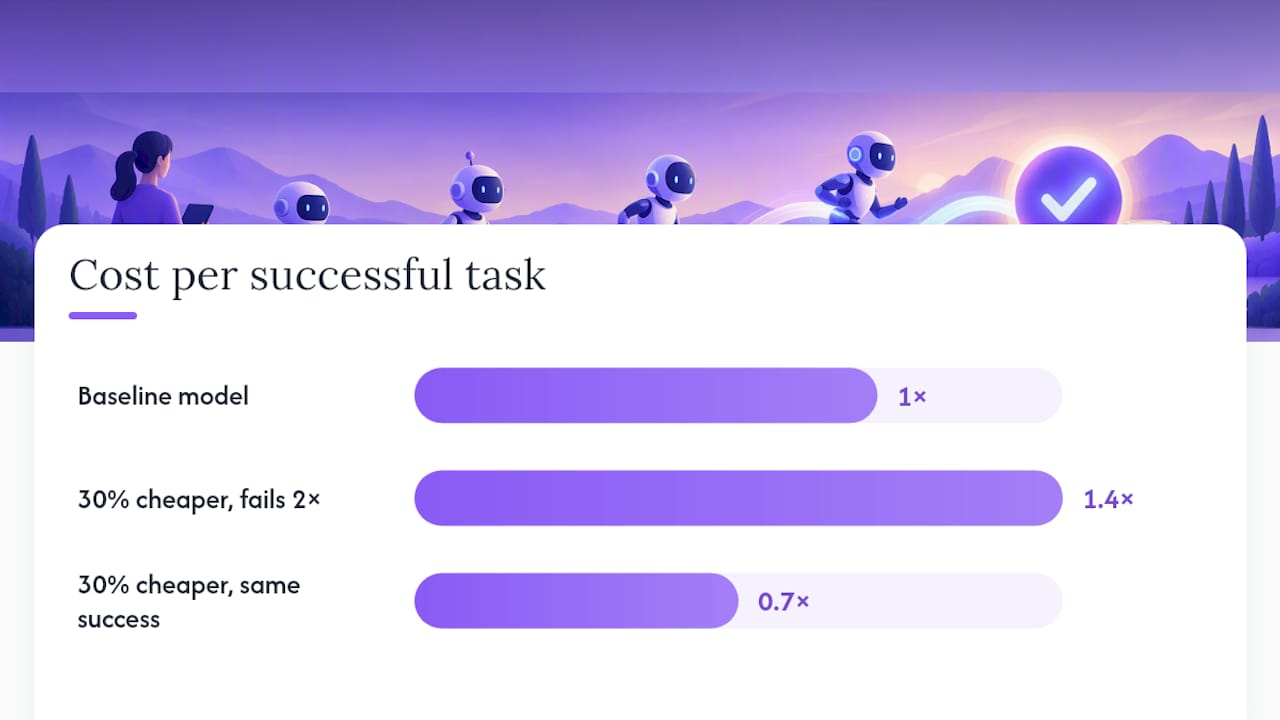
The number that matters most is cost per successful task, not cost per token. A model that's 30% cheaper per call but fails twice as often on complex steps is more expensive once you count retries and escalations. GitHub's guidance on Copilot's model selection makes a related point: reserve higher-cost reasoning models for genuinely difficult problems, because switching models mid-session often adds cost without a matching quality gain.
Should You Route Per Call or by Task?
Per-call routing looks appealing because it's simple: score each request, send it to whichever model looks cheapest or fastest for that single step. The problem shows up on long-horizon tasks, where a model swapped mid-task breaks continuity and makes it nearly impossible to attribute success or failure to any one decision. If step 4 fails after three model switches, which model do you blame? Per-call routing can't tell you.
TRACE-Router addresses this by assigning a backend at task admission and pinning every subsequent call to that same model, then updating its routing policy using the task's terminal reward rather than per-call signals. That single change lets the router learn from outcomes an agent actually cares about, and it measurably improves the accuracy-latency trade-off on agentic workloads.
Common routing policies worth knowing:
- First-call-big: send the opening call to a strong model to gauge task complexity, then downshift if the task looks simple.
- Length or complexity-based: route by prompt length, tool count, or a complexity classifier.
- Bandit or learned routers: adapt routing weights over time based on observed success rates per task class.
Pro Tip: *Hybrid setups work well in practice: run fixed selection as your default, and layer in task-level routing only for the task classes where difficulty varies unpredictably.*
What Should a Model Evaluation Scorecard Include?
An evaluation scorecard turns "this model feels better" into something you can actually compare across releases. Databricks' practitioner guidance outlines the core metrics worth tracking for any agent serving real traffic.
- Task success rate and critical-error rate
- Valid tool-call rate and completion within step budget
- p50/p95 latency
- Tokens in and out, and cost per run
- Retry and fallback rate
- User correction rate
| Metric | What it catches |
|---|---|
| Task success rate | Whether the agent actually finishes the job |
| Critical-error rate | Failures serious enough to need human intervention |
| Valid tool-call rate | Schema and argument correctness |
| p95 latency | Worst-case user experience, not just average |
| Cost per run | True operating cost including retries |
Split every one of these by task class and routing path, not just as a global average, since a model can look great overall while quietly underperforming on your hardest task category. Freeze the full evaluation harness, prompt templates, tool schemas, retry logic, before comparing models, because those factors affect results more than raw model capability. Pair a trace-aware judge that checks factual grounding and tool correctness with a separate judge for presentation quality, and align both against human ratings before trusting the automated scores. For expensive combinatorial search spaces, selection algorithms like arm-elimination and epsilon-LUCB cut down the brute-force cost of testing every model combination.
How Do You Roll Out a New Model Safely?
Even a model that aced your scorecard can behave differently under real production load. Treat every model swap like a deployment, not a config change.
- Route a small slice of traffic, or mirror it silently as shadow traffic, before sending real users through a new model.
- Define an explicit fallback chain so a failure or timeout drops to a known-good model automatically.
- Log every routing decision and retain execution traces, since debug visibility is essential when a routing policy misbehaves.
- Set circuit breakers tied to SLA thresholds that revert a route automatically when error rates spike.
- Watch for early warning signs: rising retries, tool-call errors, p95 latency drift, and a jump in user corrections.
Pro Tip: *Routing decisions based only on the latest user message can miss context from earlier in the conversation, which is a common source of silent quality regressions after a rollout.*
A 30 to 90 Day Plan for Testing Model Choices
You don't need a quarter-long research project to validate a model strategy. A tight, disciplined cycle gets you there faster than an open-ended benchmark hunt.
- Build an evaluation dataset that includes edge cases and deliberately malformed tool calls, not just clean happy-path examples.
- Pick two judges: one trace-aware judge for grounding and tool correctness, one for presentation quality, and calibrate both against human review.
- Run offline selection using a bandit method to narrow your shortlist, then validate the winner with shadow traffic and a small canary.
- Track cost per successful task throughout, and keep refining routing policy with contextual bandits as new task classes appear.
Why Model Selection for Agents Breaks Down in Practice
Most model selection mistakes trace back to one thing: comparing models outside the harness they'll actually run in. Swap the prompt template, the retry policy, or the tool schema between test runs and you're no longer measuring the model at all. Freeze the harness first, then let the models compete.

The other trap is adding models for the sake of variety. A bigger model pool sounds safer, but research on multi-agent systems shows unjustified diversity can actually reduce performance. Every model in your stack should earn its place through a complementary strength, not a vague sense that more options is better.
If there's one durable habit worth building, it's this: prioritize traceability, judge alignment with human feedback, and cost-per-success over any single benchmark score. Leaderboards change monthly. A well-instrumented scorecard doesn't.
> *— Iosif Peterfi*
Run Your Model Experiments Without the Setup Overhead
Everything in this playbook, offline selection, task-level routing, canaries, fallback chains, assumes you can actually stand up the infrastructure to test it. That's the part most teams underestimate. Configuring OpenClaw manually for multi-model experiments takes real sysadmin time most engineering teams don't have to spare.
Managed hosting services remove that setup step entirely. One-click deployment gets you a dedicated, encrypted server running OpenClaw with access to a wide range of AI models, so you can test your baseline, balanced, and high-capability candidates against the same harness without provisioning anything yourself. If your agent connects to popular messaging platforms, integration is often included.
Start on the LITE plan at $16 per month to run your first selection experiment, or check the PRO and MAX tiers if you need more model throughput. Teams building out agent skillsets from scratch may also want applied training on agent design before scaling their model pool. For a look at what teams actually build once the model layer is solved, see real OpenClaw use cases.
Sources
- About Copilot auto model selection — GitHub Docs
- Which AI model should power your customer service agent? — Databricks community
FAQ
How Do You Perform Model Selection for Agents?
Build a shortlist of two to three models by role (cheap baseline, balanced, high-capability), test each in your real serving harness, and score them on task success rate, latency, and cost per successful task rather than raw benchmark scores. Validate the winner with shadow traffic before a full rollout.
What Is an Agent-Based Model Example?
A customer-support agent that classifies a request with a cheap model, escalates ambiguous cases to a balanced model, and hands unresolved multi-step issues to a high-capability model is a common example. Databricks documents a version of this pattern for customer service agents specifically.
What Are the Main Criteria for Model Selection?
The core criteria are capability (reasoning, tool-call accuracy, schema adherence), latency under real load, cost per completed task, and governance factors like admin controls and region restrictions. Testing must happen in the actual serving configuration, since context window and retrieval setup change which model performs best.
Should I Use Per-Call Routing or Task-Level Routing?
Task-level routing generally performs better for long-horizon agent work because it pins one model per task and learns from the task's final outcome rather than isolated calls. TRACE-Router's approach shows this improves the accuracy-latency trade-off specifically for agentic workloads with delayed rewards.
How Much Does Clawbase Cost for Testing Multiple Models?
Clawbase's LITE plan starts at $16 per month or $199 per year, with PRO and MAX tiers available for teams running more model traffic. All plans include access to over 50 AI models for running selection experiments on the same managed server.