Best ElixirClaw.ai Alternatives for 2026: Ranked
2026-07-28

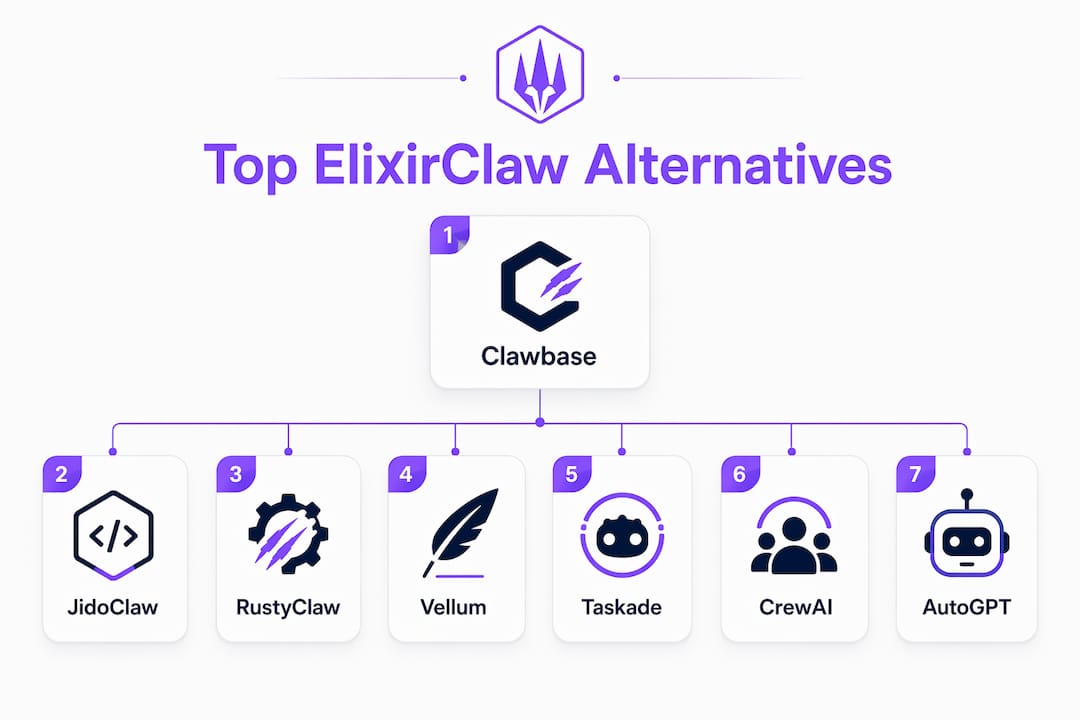
For most teams, the fastest path to a production-ready AI agent in 2026 is either Clawbase (managed OpenClaw hosting, zero ops) or JidoClaw (self-hosted, Elixir/OTP-native, full governance stack). If you need deterministic, auditable automation with pre-reasoning and pre-execution gates, ElixirClaw's Dual-Gate Governance model sets the bar — but it is not the only way to get there.
Here is the shortlist, with one-line verdicts:
- Clawbase — Best managed option: one-click OpenClaw deployment, 99.9% uptime SLA, Telegram/Discord integrations, no sysadmin required.
- JidoClaw — Best self-hosted for governance: Elixir/OTP-native, sandboxed execution, AES-256-GCM secrets, persistent workflow state machines with approval gates.
- RustyClaw — Best for low-latency workloads: Rust core plus Elixir orchestration, broad model support (Anthropic, OpenAI, Gemini, Ollama, Bedrock, OpenRouter), multiple memory backends.
- Vellum — Best for LLM workflow orchestration with a visual editor and version-controlled prompt management.
- Taskade Agents — Best for collaborative teams that want AI agents embedded inside project management without any infrastructure lift.
- CrewAI — Best for multi-agent pipelines where developers want Python-native role-based orchestration and a large open-source community.
For regulated environments, JidoClaw's native approval gates and AES-256-GCM encryption at rest make it the most enterprise-ready self-hosted option. Clawbase is the fastest path to production for teams that cannot afford the operational overhead of a self-managed stack.
***
Table of Contents
- How do the top ElixirClaw.ai alternatives compare side by side?
- Quick profiles: what each alternative actually does well
- Why teams look for ElixirClaw alternatives
- How we evaluated these alternatives
- How do you pick the right ElixirClaw alternative for your team?
- Developer and enterprise notes: observability, governance, and migration
- Key Takeaways
- The governance gap most teams discover too late
- Skip the ops burden: Clawbase runs OpenClaw for you
- Useful sources and vendor docs
How do the top ElixirClaw.ai alternatives compare side by side?
The table below covers the dimensions that actually move buying decisions: hosting model, privacy posture, memory control, integrations, setup friction, pricing shape, and governance depth.

| Tool | Best for | Hosting model | Privacy & credential isolation | Persistent memory | Integrations | Ease of setup | Pricing shape | Governance / auditability | Dev friendliness | Scalability |
|---|---|---|---|---|---|---|---|---|---|---|
| **Clawbase** | Low-ops managed OpenClaw | Managed cloud | Dedicated server per user | Yes, managed | Telegram, Discord, 50+ AI models | One-click | From $16/mo (managed) | SLA-backed uptime; integration-level controls | Moderate | Cloud-scaled |
| **JidoClaw** | Governed self-hosted agents | Self-hosted (Elixir/OTP) | Full local control, AES-256-GCM secrets | Yes, persistent state machines | GitHub, CLI, LiveView dashboard | Developer-first | Infra cost + ops | Approval gates, sandboxed execution, audit-ready | High | BEAM distribution |
| **RustyClaw** | Low-latency, multi-model | Self-hosted (Rust + Elixir) | Local-first, pluggable backends | SQLite, Postgres, Qdrant | Anthropic, OpenAI, Gemini, Ollama, Bedrock, OpenRouter | Developer-first | Infra cost + ops | Plugin-level; no native dual-gate | Very high | Rust core + BEAM |
| **Vellum** | LLM workflow orchestration | Managed cloud | Tenant isolation | Version-controlled | REST API, webhooks | Low-code / visual | Subscription (tiered) | Prompt versioning, evaluation logs | Moderate | Cloud-scaled |
| **Taskade Agents** | Team collaboration + agents | Managed cloud | Workspace isolation | Session + project memory | Native PM, Taskade Firefox add-on, Zapier | No-code | Freemium + paid tiers | Task-level audit trail | Low | Cloud-scaled |
| **CrewAI** | Multi-agent Python pipelines | Self-hosted or cloud | Configurable | Role-scoped memory | Python SDK, REST, LangChain | Developer-first | Open-source + enterprise tier | Role-based traces; no native dual-gate | Very high | Horizontal |
| **AutoGPT** | Experimental autonomous agents | Self-hosted | Local-first | File-based | Plugin ecosystem | Developer-first | Open-source (infra cost) | Minimal native governance | High | Manual scaling |
| **Perplexity (agents)** | Research and web-grounded tasks | Managed cloud | Account-level | Session-scoped | Web search, API | No-code | Subscription | Minimal | Low | Cloud-scaled |
| **Claude (Anthropic)** | Safe, instruction-following agents | Managed API | Anthropic data policy | Context window only | REST API, Claude.ai | Low-code | Token-based / subscription | Constitutional AI guardrails | Moderate | Cloud-scaled |
| **Hermes Agent** | Lightweight local inference | Self-hosted | Full local | Configurable | Local model backends | Developer-first | Open-source | Minimal | High | Manual |
| **Manus** | General-purpose agentic tasks | Managed cloud | Account-level | Session-scoped | Web, code execution | No-code | Subscription / waitlist | Moderate | Low-moderate | Cloud-scaled |
A note on pricing: "Infra cost + ops" for self-hosted tools means you pay for compute, storage, and engineering time — which typically runs higher than a managed subscription once you factor in monitoring and policy enforcement. Managed options trade that flexibility for a predictable monthly line item.
Open-source alternatives trade licensing costs for operational complexity. Teams must plan for observability, policy enforcement, and decision-trace storage if they want enterprise-grade auditability.
***
Quick profiles: what each alternative actually does well
1. Clawbase
Clawbase removes the single biggest barrier to running OpenClaw in production: the ops burden. Instead of provisioning servers, configuring memory backends, and wiring up integrations manually, you get a dedicated server with one-click deployment. Persistent memory, Telegram and Discord integrations, and access to over 50 AI models are included out of the box. The 99.9% uptime SLA means you are not babysitting infrastructure at 2 AM.
The trade-off is customization depth. If your team needs to modify the agent's core decision infrastructure or run fully air-gapped, a self-hosted stack is the better fit. But for most business automation workflows — file management, messaging integrations, scheduled tasks — Clawbase gets you to production faster than any self-hosted alternative.
Pricing: From $16/month (managed). No infrastructure overhead.
Migration from ElixirClaw: Straightforward for teams already using OpenClaw; memory and integration configs transfer cleanly to the managed environment.
***
2. JidoClaw
JidoClaw is the most governance-complete self-hosted option in this list. Built natively on Elixir/OTP, it ships with a CLI, a LiveView dashboard, sandboxed code execution via its Forge runner, and persistent workflow state machines that support approval gates. Secrets are encrypted at rest with AES-256-GCM. For teams in regulated industries — finance, healthcare, legal — that combination of sandboxed execution and native approval gates is not a nice extra; it is the baseline requirement.
Setup is developer-first. You will need Elixir tooling, infrastructure provisioning, and someone who understands OTP supervision trees. The payoff is BEAM distribution: fault-tolerant, hot-reloadable agent processes that can survive node failures without losing workflow state.
Pros: Native governance, sandboxed execution, AES-256-GCM secrets, BEAM fault tolerance.
Cons: Significant ops overhead; not suitable for non-technical teams.
Pricing: Open-source; you pay for compute and engineering time.
Migration from ElixirClaw: API surface differs from ElixirClaw's Agentic OS. Map your approval gate policies to JidoClaw's state machine definitions and validate memory export formats before cutover.
***
3. RustyClaw
RustyClaw pairs a high-performance Rust core with an Elixir/OTP orchestration layer. The result is low-latency I/O handling that most pure-Elixir or pure-Python stacks cannot match, combined with the supervised process model that makes Elixir reliable for long-running agents. It supports a broad provider matrix — Anthropic, OpenAI, Gemini, Ollama, Bedrock, OpenRouter — and multiple memory backends including SQLite, Postgres, and Qdrant.
The cross-process bridge between the Rust core and the Elixir layer (via UDS/IPC) introduces operational complexity that you must stress-test under realistic load before going to production. Plugin support is strong, but native dual-gate governance is absent; teams that need deterministic decision traces will need to build that layer themselves.
Pros: Exceptional throughput, multi-model flexibility, pluggable memory backends.
Cons: No native governance; cross-process bridge adds ops complexity.
Pricing: Open-source; infra + ops cost.
Migration from ElixirClaw: Validate memory backend migration paths (export formats, encryption-at-rest key handling) and confirm provider API parity before switching.
***
4. Vellum
Vellum targets ML engineers and product teams building LLM-powered workflows. Its visual editor lets you design, test, and version-control prompt chains without writing infrastructure code. Evaluation logs and prompt versioning give teams a lightweight audit trail, though it stops well short of the deterministic decision traces that ElixirClaw or JidoClaw produce. If your primary need is prompt management and workflow orchestration rather than autonomous agent execution, Vellum fits cleanly.
Pros: Visual workflow editor, prompt versioning, low-code onboarding.
Cons: Not a full agentic runtime; governance depth is limited.
Pricing: Tiered subscription; free tier available.
***
5. Taskade Agents (Genesis / Agents v2)
Taskade embeds AI agents directly into its project management layer. Agents v2 (also called Taskade Genesis) can run tasks, generate content, and coordinate across workspaces without any infrastructure setup. The Firefox add-on extends agent access to the browser. For teams that live inside Taskade for project work, the zero-infrastructure lift is genuinely useful. For teams that need custom agent logic, deep API integrations, or governance controls, the platform's constraints become apparent quickly.
Pros: No setup, native PM integration, freemium entry point.
Cons: Limited extensibility; governance is task-level only.
Pricing: Freemium; paid tiers for advanced agent features.
***
6. CrewAI
CrewAI gives Python developers a role-based multi-agent framework with a large and active open-source community. You define agents with specific roles, goals, and tools, then orchestrate them into crews that collaborate on complex tasks. Role-based memory scoping and execution traces make debugging multi-agent pipelines manageable. An enterprise tier adds managed hosting and support. The absence of native dual-gate governance means regulated teams will need to layer their own policy enforcement on top.
Pros: Mature Python SDK, active community, role-based orchestration, enterprise tier available.
Cons: No native pre-execution governance gates; Python dependency management adds friction.
Pricing: Open-source core; enterprise tier pricing on request.
***
7. AutoGPT, Perplexity agents, Claude, Hermes Agent, and Manus
AutoGPT remains the canonical experimental autonomous agent framework. It is best for R&D and prototyping, not production governance. Perplexity's agentic features are purpose-built for web-grounded research tasks; session-scoped memory and minimal governance make it unsuitable for regulated workflows. Claude (Anthropic) excels at instruction-following and safe reasoning via Constitutional AI guardrails, but its memory is context-window-scoped and it is an API-first tool rather than a full agent runtime. Hermes Agent is a lightweight local inference option for teams that need fully air-gapped deployment. Manus handles general-purpose agentic tasks in a managed cloud environment, though its governance depth is moderate and availability has been waitlist-gated.
Pro Tip: *If you are evaluating Perplexity or Claude as ElixirClaw replacements, be precise about what you are replacing. They are model-layer tools, not full agentic operating systems. You will still need an orchestration layer on top.*
***
Why teams look for ElixirClaw alternatives
The most common driver is not dissatisfaction with ElixirClaw's governance model — it is the operational and commercial constraints around it. Here is what we hear most often:
- Ops cost: Self-hosting an enterprise Agentic OS requires sysadmin expertise, monitoring infrastructure, and ongoing policy maintenance. Many teams underestimate this until they are three weeks into a pilot.
- Vendor lock-in: Proprietary decision-trace formats and approval gate schemas can make migration painful. Developers often choose open-source frameworks specifically to avoid this dependency.
- Local-first privacy: Teams handling sensitive data — PII, financial records, protected health information — frequently need credential isolation that a shared SaaS control plane cannot guarantee.
- Integration gaps: ElixirClaw's integration surface may not cover every messaging platform, CRM, or ticketing system a team relies on. Alternatives like RustyClaw's multi-provider matrix or Clawbase's Telegram/Discord support address specific gaps.
- Performance constraints: High-throughput automation scenarios (thousands of agent actions per hour) can expose latency ceilings in managed platforms. RustyClaw's Rust core is specifically designed for this ceiling.
- Experimental vs. production needs: R&D teams evaluating agent architectures often want a lighter framework (AutoGPT, CrewAI) before committing to a governed production stack.
Each driver maps to a different alternative category. Teams prioritizing low ops overhead should look at managed options. Teams prioritizing governance and local-first privacy should evaluate JidoClaw. Teams prioritizing throughput should benchmark RustyClaw. For a broader look at why developers use managed AI services, the operational calculus has shifted significantly in 2026 as agent complexity has grown.
***
How we evaluated these alternatives
Testing focused on the dimensions that separate production-ready agent platforms from demos. Here is what we examined for each tool:
- Memory behavior: Does the platform support persistent memory across sessions? What are the TTL controls? Can memory be exported or migrated?
- Integration depth: Native connectors vs. webhook-only vs. REST API. We tested CRM update flows, ticket creation, and messaging integrations.
- Governance and approval gates: Does the platform enforce pre-reasoning and pre-execution checks natively, or does governance require custom middleware?
- Audit logs and decision traces: Are traces structured and queryable? Are they immutable? Can they satisfy a SOC 2 or internal compliance review?
- Persistence and backup: What happens to workflow state during a node failure? Is state recoverable?
- Scaling behavior: How does the platform perform under concurrent agent load? We noted BEAM distribution benefits for Elixir-based stacks and Rust core throughput for RustyClaw.
Self-hosted tools (JidoClaw, RustyClaw, AutoGPT, Hermes Agent) were evaluated in local instances. Managed tools (Clawbase, Vellum, Taskade, Perplexity, Claude, Manus) were tested against their cloud environments. Automation scenarios included CRM record updates, approval workflow routing, and multi-step ticket creation.
> Snapshot notice: Agent platform features and pricing move fast in 2026. Every comparison in this article reflects the state of each platform at time of writing. Verify governance docs, audit log capabilities, and pricing tiers directly with each vendor before committing to a pilot.
Limitations worth naming: governance depth for some tools (Hermes Agent, Manus) is harder to verify from public documentation alone. Where vendor docs were sparse, we note that explicitly rather than inferring capability.
***
How do you pick the right ElixirClaw alternative for your team?
Work through these steps in order. Skipping compliance before integrations is the most common mistake teams make.
- Assess your compliance posture first. If your industry requires deterministic audit trails, pre-execution approval gates, or data residency guarantees, filter your list to tools that provide these natively (JidoClaw, or ElixirClaw itself). Bolted-on governance rarely satisfies a SOC 2 auditor.
- Map your integration requirements. List every system the agent must read from or write to. Check each candidate's native connector list, not just its API surface. An API exists for everything; a native connector saves weeks.
- Honestly assess your ops capacity. Self-hosted stacks like JidoClaw and RustyClaw require infrastructure provisioning, monitoring, and policy enforcement. If your team does not have an engineer who can own that, a managed option is the right call. The ops overhead of open-source stacks is consistently underestimated.
- Run a scoped pilot before committing. An 8–12 week pilot on a single automation workflow (one CRM integration, one approval routing scenario) is enough to surface the real friction points. Avoid piloting on your most complex workflow first.
- Get cost clarity before signing. Managed subscriptions have predictable costs; self-hosted stacks have variable costs (compute, storage, engineering hours). For a rough comparison: a managed plan at $16–$50/month is often cheaper than one engineer-week of ops work per month on a self-hosted stack.
Questions to ask vendors during demos:
- Are audit logs immutable and queryable, or append-only flat files?
- Do approval gates operate pre-reasoning, pre-execution, or both?
- How is IAM/credential isolation implemented at the infrastructure level?
- What is the memory TTL control model, and can memory be exported?
- Is rollback/versioning supported for agent policy artifacts?
Red flags to watch:
- Governance described as "configurable" with no documentation of what that means in practice.
- Decision traces that are human-readable logs but not machine-queryable.
- A single-point-of-failure control plane with no failover documentation.
- Pricing that changes significantly between the demo environment and production scale.
Pro Tip: *Ask specifically whether governance is native to the agent runtime or implemented as a middleware wrapper. Native decision infrastructure produces structured Decision Traces at the execution layer; middleware wrappers can be bypassed or fail silently under load.*
***
Developer and enterprise notes: observability, governance, and migration
Verify governance depth before you commit
The most important technical question for any regulated team is whether a platform's governance is integrated into its decision infrastructure or added on top. Native governance produces structured Decision Traces at the execution layer, enforces policy deterministically, and gives auditors a queryable record. Bolted-on governance forces your team to build custom observability and policy enforcement layers — which means more engineering time and more surface area for compliance gaps.

JidoClaw's approval gates are native to its workflow state machine, which is why it holds up well in regulated environments. RustyClaw's governance, by contrast, is plugin-level; teams that need dual-gate enforcement will need to build that layer themselves.
Observability checklist
Before signing off on any platform for production use, verify these specifically:
- Decision traces: are they structured (JSON/queryable) or unstructured (log lines)?
- Pre-reasoning gates: does the platform check intent before generating a plan?
- Pre-execution gates: does the platform require approval before taking an action?
- Immutable logs: are audit records write-once, or can they be modified?
- Real-time monitoring: does the platform expose AgentOps-compatible telemetry or a native dashboard?
> Key insight: Deterministic execution and dual-gate governance are becoming mandatory requirements for agentic automation in regulated industries. A platform that cannot demonstrate both in its architecture documentation is not production-ready for compliance-sensitive workflows.
Migration notes
Moving from ElixirClaw to a self-hosted stack requires more than copying configuration files. Validate these specifically:
- Memory backend migration: Export formats differ across platforms. Confirm your target platform can ingest your existing memory store, and verify encryption-at-rest key handling during the transfer.
- API parity: ElixirClaw's Agentic OS API surface does not map 1:1 to JidoClaw or RustyClaw. Budget time for adapter development.
- Approval gate policy artifacts: Map your existing gate definitions to the target platform's policy schema. Backwards-compatible rollback strategies are worth building before you cut over.
- Hot-reload and BEAM distribution: For Elixir-based targets (JidoClaw), confirm hot-reload behavior for your agent modules and test BEAM cluster formation under your expected node count.
Scaling notes for developers
RustyClaw's Rust core delivers low-latency I/O that matters at high agent concurrency. The cross-process bridge between the Rust core and the Elixir orchestration layer uses UDS/IPC, which introduces measurable latency under load. Test this bridge under realistic concurrency before assuming linear scaling. JidoClaw's pure BEAM stack avoids this bridge complexity and benefits from OTP's supervision tree for fault isolation — a meaningful advantage for mission-critical workflows where a crashed agent process must not take down its neighbors. For a deeper look at self-hosted AI software trade-offs, the ops calculus depends heavily on your team's existing Elixir or Rust expertise.
***
Key Takeaways
For most teams in 2026, the choice between ElixirClaw alternatives comes down to one question: how much ops complexity can your team absorb in exchange for control?
| Point | Details |
|---|---|
| Managed vs. self-hosted | Clawbase is the fastest path to production; JidoClaw and RustyClaw suit teams with dedicated infrastructure capacity. |
| Governance is the filter | For regulated workflows, only platforms with native approval gates and structured Decision Traces (JidoClaw, ElixirClaw) clear the compliance bar. |
| Migration takes planning | API parity, memory export formats, and approval gate policy mapping all require dedicated engineering time before cutover. |
| Pilot scope matters | An 8–12 week scoped pilot on one workflow surfaces real friction faster than a broad evaluation across multiple use cases. |
| Clawbase for low-ops teams | Clawbase delivers managed OpenClaw hosting from $16/month with a 99.9% uptime SLA, no infrastructure overhead required. |
***
The governance gap most teams discover too late
There is a pattern worth naming directly. Teams evaluate ElixirClaw alternatives by comparing feature lists, then discover six weeks into a pilot that the governance model they assumed was present is actually a logging wrapper with no enforcement at the execution layer. This is not a vendor deception problem; it is a due-diligence gap.
The distinction between native decision infrastructure and bolted-on observability is not always visible in marketing copy. A platform can truthfully claim "audit logs" while those logs are append-only flat files that no compliance tool can query. It can claim "approval gates" while those gates are optional middleware that agents can route around under certain error conditions.
My recommendation: before you commit to any platform in this list, ask for a live demonstration of a failed approval gate. Watch what happens to the agent's execution path when a gate rejects an action. If the platform cannot show you a clean, traceable rejection with a structured Decision Trace, that is your answer about governance depth.
For teams that genuinely need governed automation, the shortlist is short: JidoClaw for self-hosted, Clawbase for managed. Everything else in this comparison is either a research tool, a workflow orchestrator, or an experimental framework. Those are all legitimate choices for the right use case. They are not ElixirClaw replacements for compliance-sensitive production workflows.
***
Skip the ops burden: Clawbase runs OpenClaw for you
Running OpenClaw in production without a dedicated ops engineer is genuinely difficult. Provisioning servers, configuring memory backends, maintaining uptime, and wiring integrations manually can consume weeks of engineering time before a single business workflow runs.
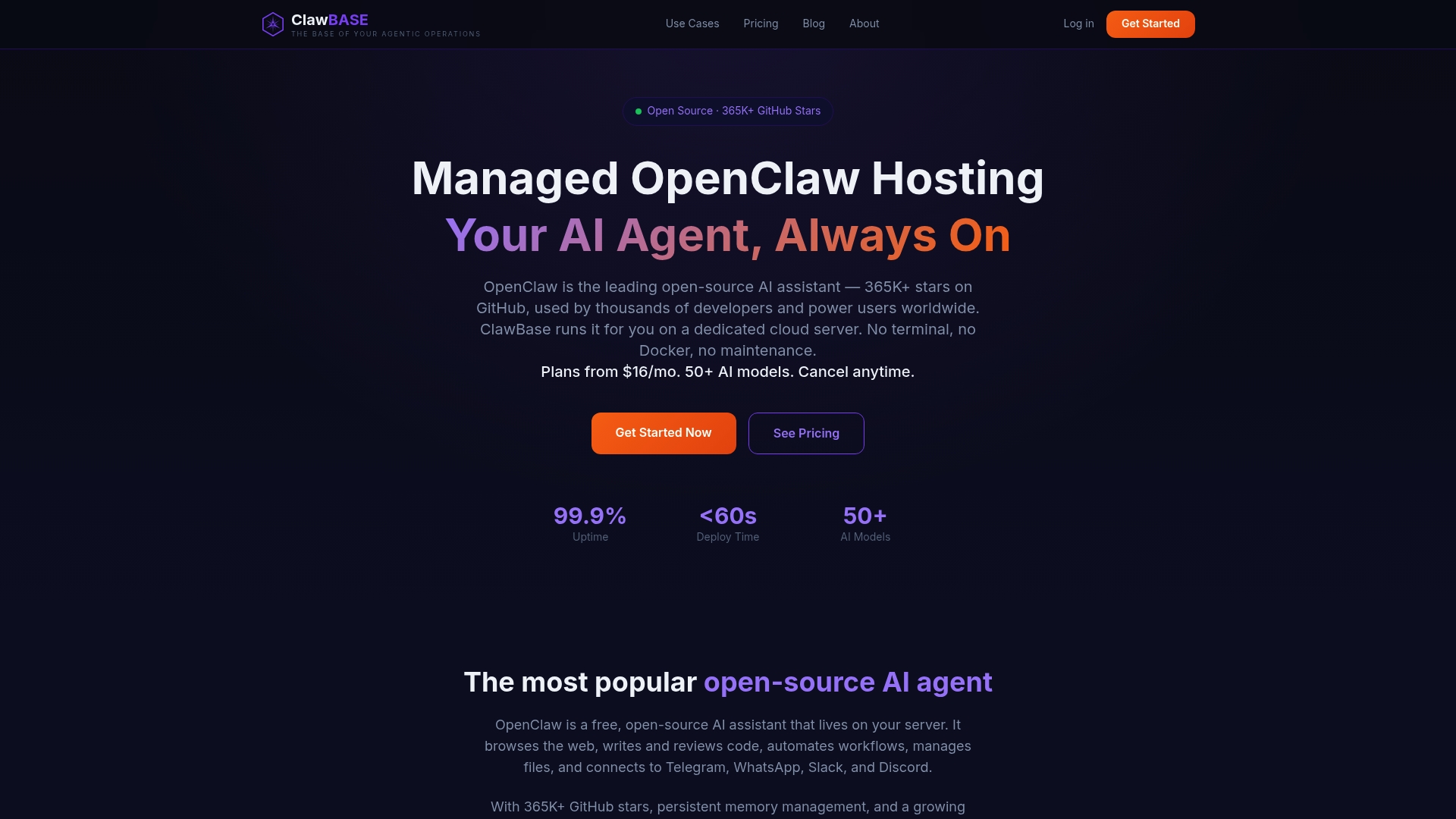
Clawbase eliminates that overhead entirely. You get a dedicated server with one-click deployment, persistent memory management, Telegram and Discord integrations, and access to over 50 AI models — all backed by a 99.9% uptime SLA. No maintenance, no infrastructure monitoring, no sysadmin expertise required. For teams that evaluated JidoClaw or RustyClaw and concluded the ops cost was too high, Clawbase is the direct alternative: the same OpenClaw capabilities, delivered as a managed service from $16/month.
If you want to see what that looks like in practice, the OpenClaw use cases page maps specific automation workflows to the platform's capabilities. When you are ready to move from evaluation to pilot, start your Clawbase instance and have a production-ready agent running the same day.
***
Useful sources and vendor docs
Features and pricing across agent platforms change frequently. Verify the following directly before committing to a pilot.
- ElixirClaw Agentic OS — Microsoft Marketplace: Primary listing for ElixirClaw's governance model, Dual-Gate Governance documentation, and Decision Trace specifications. Verify audit log formats and approval gate schema here.
- JidoClaw — GitHub (robertohluna/jido_claw): Source repo for JidoClaw. Check the README for current installation instructions, Forge runner documentation, and AES-256-GCM secrets implementation details. Migration guides and state machine schema are in the repo wiki.
- RustyClaw — GitHub (tezra-io/rustyclaw): Source repo for RustyClaw. Verify current provider support, memory backend compatibility, and UDS/IPC bridge documentation. Plugin API reference is in
/docs. - Clawbase — Landing page: Managed OpenClaw hosting. Verify current pricing tiers, SLA terms, and integration list here.
- ElixirClaw 2026 company profile — PitchBook: Market context for the broader enterprise agent landscape, including governance and automation approaches from firms like DataRobot and OPAQUE.
- Stanford HAI — 2025 AI Index Report: Authoritative annual benchmark for AI adoption trends, enterprise deployment patterns, and governance research. Use to contextualize market claims about agentic AI growth.
- Taskade Firefox Add-on: Verify current Taskade Agents feature set and browser integration scope.
- Toolsplorer — Agent platform reviews: Independent third-party reviews of agent tools; useful for cross-checking vendor feature claims and pricing.
| Source | What to verify |
|---|---|
| ElixirClaw Marketplace listing | Dual-Gate Governance schema, Decision Trace format, SOC/ISO statements |
| JidoClaw GitHub repo | AES-256-GCM implementation, approval gate state machine, migration guides |
| RustyClaw GitHub repo | Provider matrix, memory backend compatibility, UDS/IPC bridge load behavior |
| Clawbase landing page | Current pricing, SLA terms, integration list, model count |
| PitchBook profile | Enterprise landscape context, governance approach comparisons |
| Stanford HAI AI Index | Agentic AI adoption benchmarks, governance research |
Reminder: Agent platform READMEs and vendor docs are the ground truth for compatibility and installation instructions. Marketing pages lag behind actual feature releases. Always check the repo or vendor docs portal directly, not third-party summaries, for the latest governance and migration specifications.