CISA Hardened AI Server Backups for Operators: Protect Models and Keys
2026-10-04

AI server workloads require AI-aware backup strategies that treat models, registries, vector indexes, and configs as first-class assets, not just file snapshots. The immediate priority list is short: verify checkpoint integrity before you trust any backup, move backup credentials into a vault separate from production, and put a restore test on the calendar before the quarter ends.
***
> TL;DR:
>
> - Ensure checkpoint integrity through minimal validation runs, as passing checksums do not guarantee usability after incomplete shard writes.
> - Back up weight deltas for large models to reduce storage costs, with occasional full checkpoints for reliable recovery.
> - Export vector indexes and feature stores on a scheduled basis, understanding that rebuild times can extend into days if exports are missing.
> - Separate backup credentials into a vault outside production to prevent credential theft from compromising recovery options.
> - Test restore procedures regularly with defined RTO and RPO targets, including integrity checks and actual inference runs to verify performance.
***
Table of Contents
- Why AI workloads break conventional backup assumptions
- Core AI backup strategies you can implement this quarter
- Protecting model artifacts, registries, and derived data
- Recovery targets and testing discipline
- Security and ransomware resilience for AI servers
- Implementation checklist and sample architecture patterns
- ClawBase operator resources for OpenClaw backup complexity
- Why this can't wait another quarter
- A managed path to lower backup overhead
- FAQ
- Sources
Why AI workloads break conventional backup assumptions
Traditional backup thinking assumes a file system snapshot can be rehydrated into a working state. AI infrastructure violates that assumption in a few specific ways.
Model checkpoints are not single files, they are a bundle of weights, optimizer state, RNG seeds, and dataloader position, and if any shard writes incompletely, you get a torn checkpoint that looks fine until you try to resume training or run inference and get silent divergence instead of an error. A checksum passing is not proof of usability. The only real proof is a minimal validation run against the restored state.
Derived assets compound the problem. Embeddings, feature stores, and vector indexes can take hours or sometimes days to regenerate from source data, according to the COMPEL Framework, so treating them as "just rebuild it" is a plan that works on paper and fails under incident pressure.
There is also a dependency layer that classic backup plans ignore entirely: external model providers. If your pipeline depends on a hosted LLM API and that vendor has an outage or deprecates an endpoint, no local restore fixes that. Your recovery plan needs a documented fallback path for vendor failure, not just for disk failure. We cover common versions of this gap in our notes on AI automation mistakes.
Core AI backup strategies you can implement this quarter
Once you accept that AI assets need their own backup logic, the question becomes which patterns actually move the needle. These are the ones worth prioritizing, roughly in the order we'd tackle them.
- Run autonomous discovery first. Inventory every ephemeral AI resource, training clusters, notebook instances, feature pipelines, before you decide what to protect, because you cannot back up what you do not know exists.
- Make checkpoints atomic. Weights, optimizer state, RNG seed, and metadata need to land together, and a checkpoint should not be promoted to "restorable" until shard writes are verified complete.
- Back up weight deltas, not full copies, for large models. The COMPEL Framework notes that for models in the 10+ gigabyte range, incremental backups of weight deltas between fine-tunes paired with occasional full checkpoints cut storage costs substantially.
- Export vector databases and feature stores on a schedule. Treat full regeneration as your fallback plan, not your primary recovery method, since rebuild times can stretch into days.
- Version configs, prompts, and deployment artifacts in Git. This enables restore-by-redeploy: instead of restoring files, you redeploy from source control through your CI/CD pipeline.
- Keep backup credentials out of production's reach. A separate vault and separate account means a compromised production agent cannot touch your backup copies.
Each pattern earns its place because it targets a specific AI failure mode, large model size, slow rebuild times, or credential compromise, rather than generic disk loss.
Protecting model artifacts, registries, and derived data
Different AI asset classes need different protection levels. Treating all backups the same way is how teams end up with a restorable database and an unusable model registry sitting next to each other.
- Model weights and registries: use immutable, content-addressed object storage with cross-region replication and strict access control, since a model that cannot be tampered with after write is a model you can trust during an incident.
- Feature stores: snapshot materialized features and back up the raw sources behind them, recording metadata and data lineage so you know which pipeline version produced which feature set.
- Vector indexes: export snapshots during low-activity windows and plan for rebuild times measured in hours to days if an export is missing, per the COMPEL Framework.
- Prompts, guardrails, and configs: version everything in Git and wire it into your CI/CD pipeline so a restore is really a redeploy.
Operator playbooks make this concrete rather than theoretical. The FrootAI backup-restore-ai skill documentation walks through enabling point-in-time recovery for conversation stores, turning on blob versioning and soft delete, and exporting search indexes as NDJSON with scripted restore commands you can time and verify.
Pro Tip: *Store your model registry's access policy as code alongside the registry itself, so a restore also restores who is allowed to touch it.*
If you are managing model switching across providers, our guide on switching AI models without coding covers registry structure in more depth.
Recovery targets and testing discipline
A backup you have never restored is a hypothesis, not a plan. Set RTO and RPO targets by tier, then test against them on a fixed cadence.
- Configs and prompts: RTO in minutes, RPO near zero since Git gives you continuous versioning.
- Vector indexes and feature stores: RTO from tens of minutes to a few hours, RPO around one day depending on export frequency.
- Full environment rebuild: RTO in hours, RPO around one day for most teams running standard snapshot schedules.
The COMPEL Framework recommends semi-annual partial restores and annual full failovers for critical AI workloads, a cadence that catches silent degradation before it becomes an incident.
Verification needs three layers: integrity checks on the raw data, an end-to-end functional test that actually runs inference or a short training step against the restored state, and a comparison of pre- and post-restore performance metrics. That last step matters most, because a model can restore successfully and still perform worse than before if something subtle, a wrong tokenizer version, a mismatched embedding dimension, slipped through.

Security and ransomware resilience for AI servers
Ransomware actors specifically hunt for backup credentials so they can delete your recovery path before encrypting production. CISA's StopRansomware guidance addresses this directly, and AI infrastructure needs the same discipline applied to model-specific assets.
- Implement the 3-2-1 rule: three copies, two different media, one offsite, with at least one copy offline and encrypted, and use object-lock immutability for critical model snapshots.
- Separate backup credentials and vaults from production service accounts, since CISA notes that attackers who compromise a production account often go hunting for backup access specifically to delete recovery copies.
- Keep golden images and infrastructure-as-code templates offline, and retain some offline hardware copies for rebuilds, a practice detailed in the CISA Ransomware Guide.
- If you use managed service providers, require backup hygiene compliance contractually and verify it, rather than assuming it.
Teams running agents that interact with public AI tools should also review guidance on preventing private data leakage through public AI tools, since a leaked credential often starts the chain that ends in a deleted backup.
Implementation checklist and sample architecture patterns
Turning all of this into action does not require a six-month project. Start with the checklist, then pick an architecture pattern that matches your risk tolerance.
- Inventory every AI asset and assign a tier (model, feature store, vector index, config).
- Stand up isolated backup vaults, separate from production credentials.
- Enable immutable storage for model snapshots specifically.
- Schedule vector index and feature store exports.
- Add a restore test to your CI pipeline, even a minimal one.
Three architecture patterns cover most teams: a cold restore built on infrastructure-as-code for lowest cost, a warm standby replicated cross-region for faster recovery, and active-active for workloads that genuinely cannot tolerate downtime. If you are planning data movement between any of these, migration-focused resources like DBLScanner's migration solutions are worth reviewing before you commit to a pattern.
Pro Tip: *Treat embeddings as a rebuildable tier-two asset when storage budget is tight, incremental checkpointing and lifecycle policies for archival data will do more for your cost line than over-protecting things you can regenerate.*
ClawBase operator resources for OpenClaw backup complexity
Running the checklist above against a self-managed OpenClaw deployment is real sysadmin work: vault setup, immutable storage configuration, restore scripting. Our OpenClaw backup playbook for operators walks through automating, encrypting, or outsourcing that work, and our notes on encryption at rest cover the encryption side specifically.
Daily encrypted backups and automated updates on managed OpenClaw servers remove most of the restore-testing burden from your team's plate without removing your ability to verify it yourself.
Why this can't wait another quarter
Model loss is not like losing a spreadsheet. A corrupted checkpoint can erase weeks of fine-tuning, and a missing vector export can mean days of silent rebuild while your product sits degraded. Restore discipline has to be a leadership priority, not a backlog item. Pick one workload and schedule its first partial restore test within 30 days.
> *— Iosif Peterfi*
A managed path to lower backup overhead
If the checklist above feels like more infrastructure work than your team wants to own, A managed alternative built specifically for OpenClaw offers one-click deployment on a dedicated server, with daily encrypted backups and automated updates handled for you.
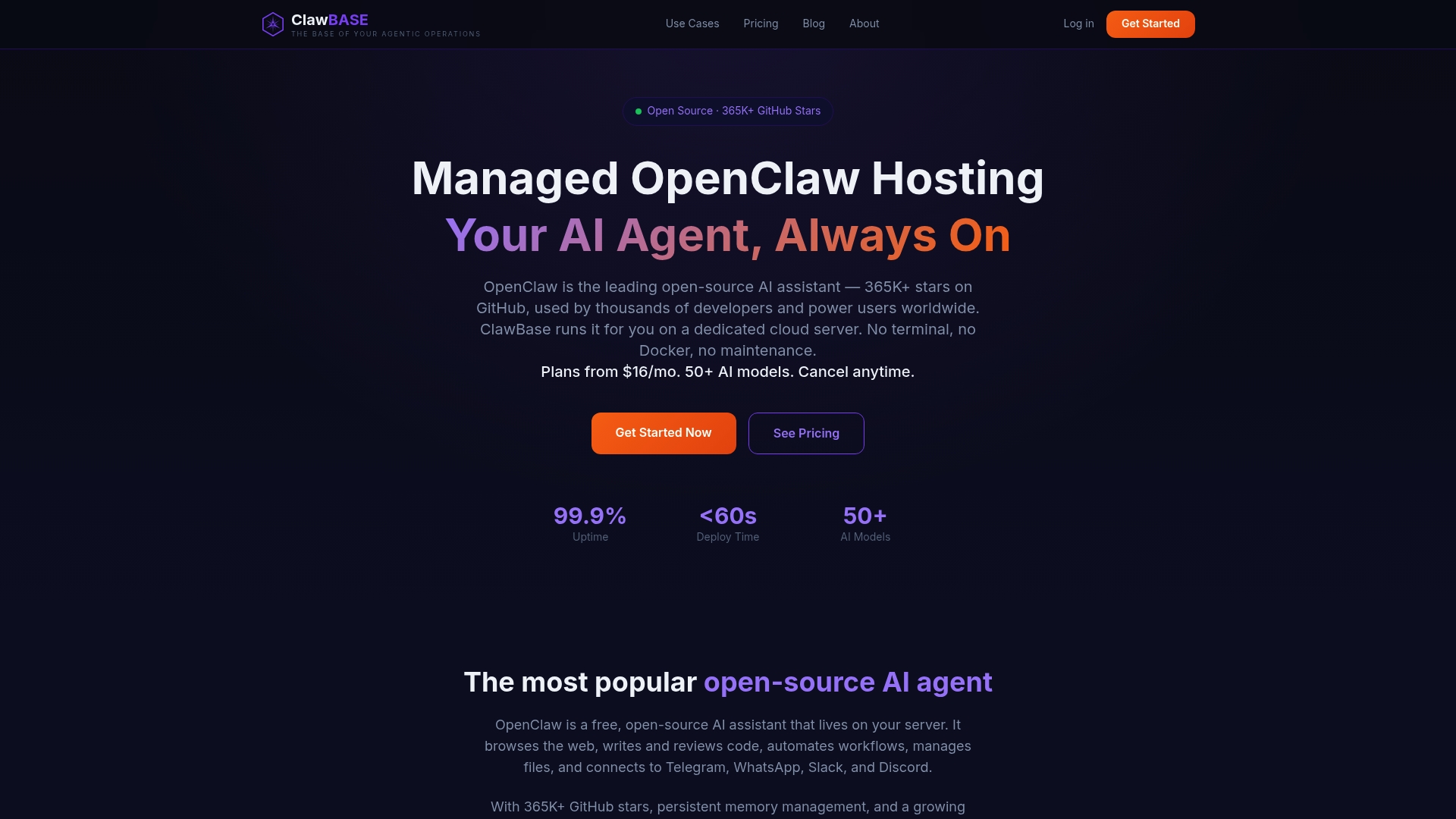
What this removes from your plate:
- No sysadmin time spent configuring vaults, immutable storage, or restore scripts.
- Persistent memory management and support for over 50 AI models on a private, always-on server.
- 99.9% uptime backed by infrastructure you don't have to patch yourself.
Plans start at $16 per month on the LITE tier, with PRO and MAX tiers available for heavier workloads. Browse OpenClaw use cases to see where a managed server fits your team.
FAQ
What is the 3/2/1 rule for backing up data?
The 3-2-1 rule means keeping three copies of your data across two different media types, with one copy stored offsite. CISA's backup options guidance treats this as the baseline, and for AI workloads at least one of those copies should be offline and encrypted to resist ransomware deletion.
What are the four types of backup?
The common categories are full, incremental, differential, and mirror backups, each trading storage cost against restore speed differently. For large AI models, incremental backups of weight deltas are generally the most practical choice, since full backups of multi-gigabyte checkpoints get expensive fast.
What can I do with my own AI server?
A dedicated AI server lets you run a private assistant that automates workflows, manages files, and connects to communication platforms like Telegram and Discord without routing your data through shared infrastructure. Managed options like ClawBase handle the deployment and backup side so the server stays usable without ongoing sysadmin work.
How often should I test my AI backup restores?
For critical model and vector index workloads, the COMPEL Framework recommends semi-annual partial restores and an annual full failover test. Config and prompt restores, since they are version-controlled, can be smoke-tested far more frequently with little overhead.
Sources
- CISA StopRansomware guidance
- COMPEL Framework — AI disaster recovery: backup and restore patterns
- FrootAI backup-restore-ai playbook (GitHub)