AI Note Organization Best Practices: A System That Scales
2026-08-21

Use one hub, one capture tool, automated AI tagging and summarization, and a ten-minute daily review. That combination turns scattered notes into a searchable second brain faster than any app-switching strategy you have probably tried.
Here's the action plan in one line: pick a single hub, connect one quick-capture tool, turn on automatic summaries and semantic search, then run a short daily pass to process what came in. The PARA method (Projects, Areas, Resources, Archives) gives you the folder skeleton. AI handles the summarizing and linking work that used to eat your evenings. If privacy or persistent memory matters to you, a managed option like ClawBase removes the setup friction entirely.
Before you build anything, get these three things running:
- One inbox where every note, screenshot, and voice memo lands first, no exceptions.
- One AI layer that auto-tags and summarizes on ingestion (built into your note app or bolted on).
- One recurring calendar block, ten minutes, same time daily, to process what landed.
Pro Tip: *Resist the urge to build a perfect folder structure before you've captured a single week of real notes. Structure should follow behavior, not precede it.*
Key Takeaways
Organizing notes with AI works when a single hub, automated tagging and summarization, and a short daily review replace scattered apps and manual filing.
| Point | Details |
|---|---|
| Start with one hub | Pick a single note app and one quick-capture tool before building any folder structure. |
| Automate the boring layer | Turn on AI summarization and auto-tagging so retrieval, not filing, becomes your daily habit. |
| Protect the originals | Keep an untouched sources folder for OCR and transcripts so summaries stay auditable. |
| Match structure to goal | Use PARA for active projects and Zettelkasten-style linking for long-term research. |
| Consider a private agent | Clawbase's managed OpenClaw hosting fits readers who need persistent memory and full data control without server setup. |
Table of Contents
- Building a Step-by-Step AI Workflow for Note Organization
- What Should You Look for in an AI Note Tool?
- How Should You Structure Notes for AI to Search Them?
- Note-Taking Workflows for Students and Professionals
- How Do You Clean Up Legacy Notes and Old Recordings?
- What Privacy and Security Questions Should You Ask AI Note Tools?
- Prompt Templates You Can Copy for Note Organization
- Which Integrations Actually Save You Time?
- Recommended Tool Profiles by Use Case
- What Changes When You Add Persistent Memory to Notes?
- When Does a Private Managed Agent Beat a Cloud Note App?
- Frequently Asked Questions
- Sources
Building a Step-by-Step AI Workflow for Note Organization
You can build a working system in a weekend. The order matters more than the tools you pick.
- Choose one hub and one capture tool. Pair a note app with a phone widget or browser clipper so friction between "thought" and "captured" drops to seconds. Done looks like: you can add a note from your phone in under five seconds.
- Ingest legacy notes into an untouched sources inbox. Run OCR on scanned pages, transcribe old voice memos, and drop everything into a folder you never edit directly. Done looks like: every old note has a digital, searchable copy somewhere, even if it's messy.
- Run AI summarization and auto-tagging, then build a light PARA skeleton. Let the AI generate a title and three-bullet summary for each dumped note, then sort by Project, Area, Resource, or Archive. Done looks like: you can find any note from the last month in under 30 seconds.
- Set up a ten-minute daily processing block. Clear the inbox, confirm or correct AI tags, and add one link between today's note and something older. Consistency here is what actually keeps a second brain useful over the capture-and-organize layers alone. Done looks like: your inbox count hits zero most days.
- Enable retrieval: semantic search, Q&A, and a weekly digest. This is where AI earns its keep, surfacing notes by meaning instead of exact keyword. Done looks like: you can ask "what did I decide about the Henderson project in March?" and get an answer, not a keyword miss.
Pro Tip: *Schedule the weekly digest for Friday afternoon. Reviewing the week's notes right before you close out gives your AI tool fresh context to catch patterns you'd otherwise forget by Monday.*
What Should You Look for in an AI Note Tool?
Four criteria separate tools that actually save time from ones that just add another app to check.
Summarization quality comes first. A tool that reduces a 40-minute lecture recording to three accurate bullets and a takeaway line saves real study or review time. One that hallucinates details or misses the actual thesis is worse than no summary at all.
Semantic search and retrieval matter more than most buyers realize going in. Semantic retrieval methods outperform keyword-only search on indexability and topical recall, according to 2025 academic analysis, which means you can search by meaning ("that thing about client churn") instead of remembering the exact phrase you typed six weeks ago.
Auto-tagging and linking determine whether your archive stays navigable at 500 notes or turns into a junk drawer. Transcript ingestion for audio and PDF support decides whether meetings and lecture recordings actually make it into your system at all.
Score any candidate tool on a quick 1 to 5 scale across:
- Ease of capture (how many taps or clicks from thought to saved note)
- Summarization accuracy (does it get the point right, not just shorter)
- Integration depth (calendar, task manager, cloud storage)
- Privacy controls (local export, encryption, data retention terms)
Anything scoring below 3 on two or more axes probably isn't worth a longer trial.
How Should You Structure Notes for AI to Search Them?
Structure decides whether AI retrieval actually works or just returns noise. A practical second brain needs three layers: capture, organize, and retrieve, with AI delivering most of its value in that last layer by surfacing connections you'd never find manually.
Think of it as three zones:
- Inbox (capture): everything lands here first, unsorted, unedited.
- Workspace (organize): PARA-style folders where you actively work.
- Retrieval layer (AI-maintained): the index, tags, and semantic search that let you find anything regardless of where it physically lives.
Pick your organizing system based on your actual goal. PARA fits people managing active projects with deadlines. A Zettelkasten-style linking approach, where every note connects to related ideas rather than sitting in a folder, fits long-term research or writing work better. Cornell-style cue columns still work well for lecture notes, and AI can auto-generate the cue questions from your notes after the fact.
Tagging rules matter more than most people admit. Use descriptive titles ("2026-03-Client-Churn-Root-Causes") instead of vague ones ("Meeting Notes 3"), and keep your tag vocabulary short and consistent, five to ten recurring tags beats fifty one-off ones. Semantic search reduces the need for deep folder trees altogether. You ask in plain language, the system finds the meaning.

Pro Tip: *Rename files the moment AI generates a summary, not later. A backlog of fifty untitled "AI Summary" files is almost as unsearchable as the raw mess you started with.*
Note-Taking Workflows for Students and Professionals
Students and professionals need different templates, even though the underlying AI mechanics are identical.
Student workflow, built for lectures and exam prep:
- Record the lecture on your phone or laptop, one file per class session.
- Auto-transcribe immediately after class, while context is fresh enough to catch transcription errors.
- Generate a three-bullet study summary plus a one-sentence takeaway for each session.
- Convert key facts into flashcards for spaced repetition review.
- Run a weekly review pass across the week's flashcards and summaries before they fade.
ClawBase has documented this exact pattern in an exam preparation workflow that pairs a persistent private agent with spaced-repetition review for recall.
Professional workflow, built for meetings and research:
- Capture the meeting (recording or live notes).
- Extract action items automatically, tagged with owner and due date.
- Sync tasks into your task manager the same day.
- File the cleaned notes into the relevant project folder.
- Generate a weekly digest that surfaces patterns across multiple meetings.
Name files with a date, topic, and short descriptor: "2026-03-14-Vendor-Call-Pricing" beats "Notes" every time you search for it later.
Pro Tip: *Students should archive aggressively after each exam, keep only the flashcards that stump you. Professionals should archive by project closure date instead of by time, so a stalled project doesn't clutter active search results.*
How Do You Clean Up Legacy Notes and Old Recordings?
Every messy archive needs the same four moves, in order.
- Build an immutable sources folder first. Run OCR on scanned pages, transcribe old audio files, and drop everything in without editing the originals. This keeps an audit trail if an AI summary later gets something wrong.
- Deduplicate and cluster. Run rough automated clustering to group similar notes, then apply a manual rule: if two notes cover the same topic within a week of each other, merge them.
- Generate summaries and titles with AI, but keep the original untouched in sources. You always want to trace a summary back to its source text.
- Verify with a before/after check. A raw meeting transcript running fifteen minutes becomes a three-bullet summary plus two action items, with a link back to the original transcript file.
- Keep the sources folder read-only where your tool allows it.
- Never delete an original until its AI-generated summary has been reviewed at least once.
This cleanup pass is exactly where Microsoft's guidance on AI summarizer tools points to real productivity gains: the summarization step, not the storage, is what saves hours.
What Privacy and Security Questions Should You Ask AI Note Tools?
Ask any vendor these questions before you feed them sensitive notes: What's your data retention policy? Can I export in a standard format, not a proprietary lock-in one? Is data encrypted at rest and in transit? Who has access controls, and are third-party models involved in processing my notes?
Practical settings worth checking on day one:
- Local storage or local export options, so you are not fully dependent on one vendor's cloud.
- Scheduled automatic exports, weekly at minimum, stored somewhere you control.
- The ability to exclude specific folders from cloud-model processing entirely.
Minimize personally identifiable information in raw notes where you can. Use ephemeral shares for sensitive meeting notes rather than permanent links, and default to least-privilege sharing, give access to a folder, not the whole workspace.
The convenience-versus-control tradeoff comes down to one question: does this data ever need to leave a system you fully own? If the answer is no, a private managed agent that keeps memory and files on a dedicated server beats a general cloud app on privacy grounds alone.
Pro Tip: *Run a quick audit before you migrate anything: list which of your existing notes contain client names, financial figures, or health details. That list tells you exactly which folders need the strictest access controls.*
Prompt Templates You Can Copy for Note Organization
A few prompt patterns handle almost every organization task you'll run into.
Summarize: "Summarize this text into 3 bullet points, a 1-sentence takeaway, and a suggested title under 8 words."
Tag: "Suggest 3 to 5 tags for this note from my existing tag vocabulary, and rate your confidence in each tag from 1 to 5."
Q&A / study: "Generate 5 exam-style questions from this note, with concise 1-sentence answers for each."
Flashcards: "Convert the key facts in this note into flashcard pairs, question on one side, short answer on the other."
Automation ideas worth setting up once and forgetting:
- On upload, trigger auto-summarize, then auto-tag, then file into the matching project folder.
- For voice memos specifically, trigger transcription first, then run the same summarize and tag chain.
- For meeting recordings, add a task-extraction step before filing, so action items sync to your task manager automatically.
Small variations in these prompts (asking for "confidence scores" on tags, or "exam-style" versus "casual" questions) noticeably change output quality, so test a few phrasings against your own notes before locking one in.
Which Integrations Actually Save You Time?
The integrations worth setting up connect your notes to the tools you already use daily, not to some new dashboard you'll abandon in a month.
- Calendar sync turns meeting invites into pre-built note templates with the right date and attendee names already filled in.
- Task manager sync pushes AI-extracted action items straight into your existing task list instead of leaving them buried in a note.
- Cloud storage connections pull PDFs and shared documents into your sources inbox automatically.
- Chat archivers capture your AI conversations and Slack or Discord threads into the same hub, so a good idea from a chat doesn't vanish.
The highest-value automation flow: meeting recording triggers an auto-transcript, which triggers a summary, which creates tasks in your task manager, all without you touching a keyboard between the meeting ending and your task list updating. Clawbase's guide on AI workflow automation covers building chains like this one in more depth, and the role of AI in team collaboration shows how this extends to shared team notebooks.
Recommended Tool Profiles by Use Case
Rather than ranking products against each other, match your actual need to a tool category.
AI-native note hubs (Notion AI, Mindgrasp): best for people who want summarization, tagging, and search built into one workspace rather than stitched together from separate apps. Feature checklist: strong summarize and tag features, moderate search, workspace-native memory. Pricing tends to run freemium with paid tiers for AI features specifically.
Semantic search and synthesis tools (NotebookLM): best for researchers and students working from a large pile of source documents who need to ask questions across everything at once rather than searching file by file. Feature checklist: strong Q&A over uploaded sources, weaker on ongoing daily capture.
Meeting transcription and summarizers (tl;dv, Krisp): best for professionals who live in back-to-back calls and need clean transcripts with action items extracted automatically. Feature checklist: strong transcript ingestion, action-item extraction, moderate long-term memory.
Quick summarization utilities (NoteGPT, Summary AI): best for fast one-off summarization of an article, PDF, or long document without committing to a full workspace. Feature checklist: strong single-document summarize, minimal cross-note linking or memory.
Private managed agents (ClawBase): best for anyone who wants persistent memory across every note and conversation, full data control, and no server maintenance. Feature checklist: strong on privacy, memory persistence, and multi-model access; setup complexity is the tradeoff for fully self-hosting the open-source alternative.
> The real test of any note tool isn't week one, it's week four. Does the system still surface a note you forgot you wrote, at the exact moment you need it? If yes, the tool earned its place. If you're back to scrolling folders manually, it didn't.
Trial any tool for one week against a real backlog of your own notes, not a demo dataset. Success after that week looks like: you found something old without remembering where you filed it.
What Changes When You Add Persistent Memory to Notes?
A private AI agent with persistent memory turns your note archive into something closer to a maintained wiki than a folder of documents. Instead of you re-explaining context every time you ask a question, the agent remembers what it already knows and builds on it.
Good fits: a private study assistant that remembers your entire semester, a team knowledge hub that onboards new hires by answering questions instead of pointing to a wiki page, or a research notebook the agent actively maintains and cross-links over time. This mirrors the approach in Karpathy's LLM wiki method, where the model owns synthesis and linking instead of just retrieving raw chunks, producing a compounding artifact rather than a static archive.
| Factor | Convenience-first (cloud app) | Control-first (private agent) |
|---|---|---|
| Memory persistence | Session or workspace-limited | Fully persistent across sessions |
| Data control | Vendor-managed, standard export | Full export, encrypted storage you control |
| Setup effort | Instant sign-up | One-click managed deployment (no sysadmin work) |
| Best fit | Casual, low-sensitivity notes | Sensitive work, long-term research, teams |
Pro Tip: *Start your pilot with a single notebook, not your entire archive. Enforce the immutable sources layer from day one so every AI-generated summary stays auditable against the original.*
What I actually run day to day
My own stack is boring on purpose: one capture app, automatic summaries on ingestion, and a ten-minute review most evenings. The habit compounds faster than any single feature does. One weekly digest surfaced a connection I'd missed entirely, two unrelated client projects both stalling on the same vendor delay, something I'd never have caught scanning folders manually. I moved from free tools to a private managed agent once note volume crossed the point where manual review started slipping most days.
When Does a Private Managed Agent Beat a Cloud Note App?
If your notes include client details, financial figures, or research you can't risk losing to a vendor's outage, a cloud note app asks you to trust someone else's uptime and someone else's data policy. Clawbase's approach is different: managed hosting for OpenClaw, an open-source personal AI assistant, deployed on a dedicated encrypted server with 99.9% uptime and no sysadmin work required on your end.
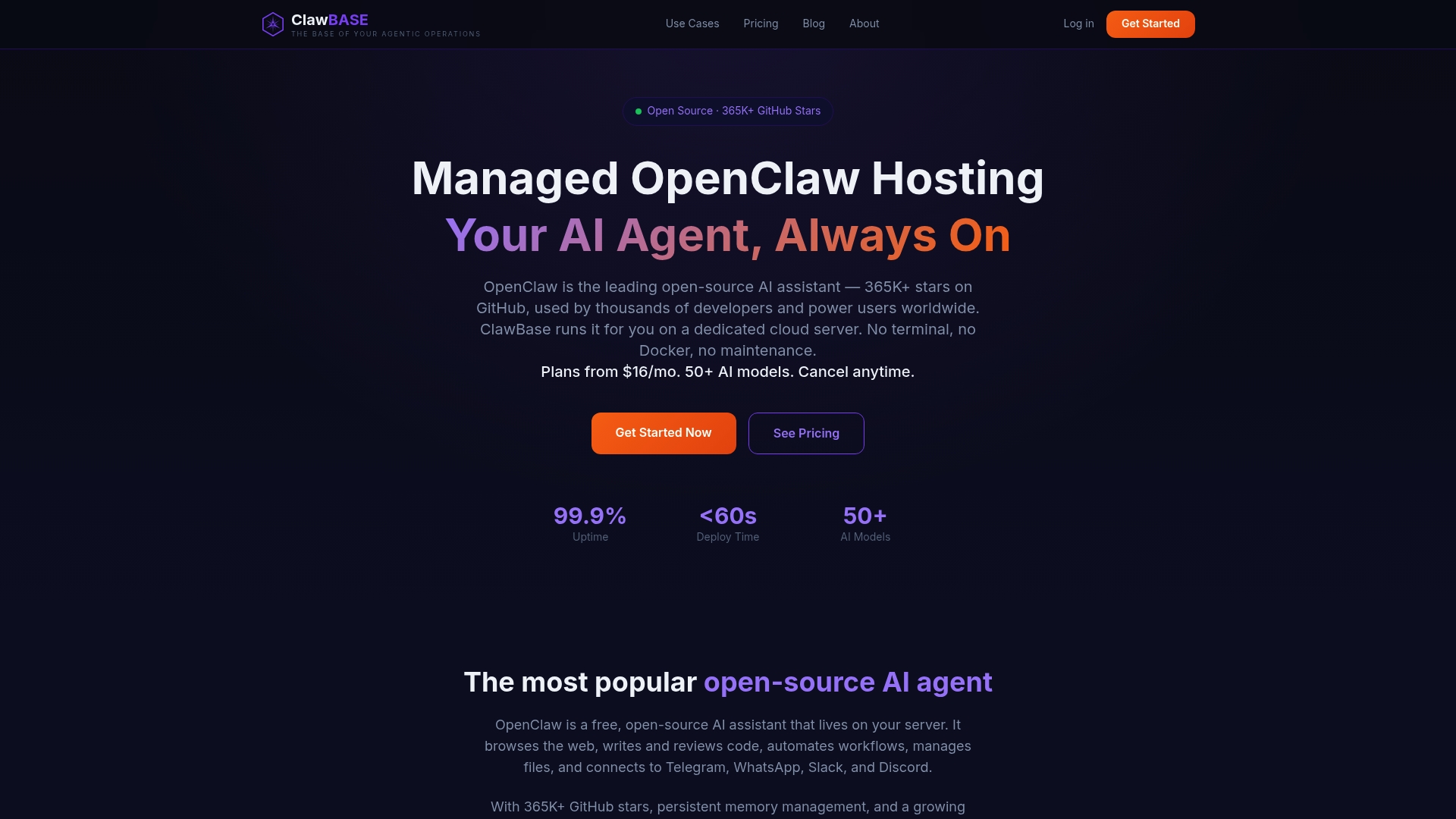
This fits three kinds of readers specifically: professionals whose notes contain client or financial data that shouldn't sit on a shared cloud model, teams that need one assistant with persistent memory across every project instead of a dozen disconnected chat threads, and anyone who wants the privacy of self-hosting without configuring a server themselves. You get full daily encrypted backups, connections to Telegram, Discord, Slack, and WhatsApp, and access to over 50 AI models from one dashboard. Clawbase also details why private AI assistants suit professionals who need uptime and export control that a free tier can't promise. If a persistent, private agent sounds closer to what your notes actually need, start a trial on the entry plan and see what a week of managed deployment looks like.
Frequently Asked Questions
What is the best AI note-taking method for beginners?
Start with one capture tool feeding one hub, then turn on automatic summarization before worrying about tags or folders. Complexity kills new systems faster than bad organization does.
Do AI note tools work offline?
Most cloud-based tools require a connection for AI processing, though many let you capture offline and sync later. A privately hosted agent can keep more of the workflow local depending on configuration.
How much does AI note-taking software cost?
Pricing ranges from free tiers with limited AI features to subscription plans for full summarization and memory tools. Managed private agents like Clawbase typically run as monthly subscriptions with a free trial period.
Can AI organize notes I already have?
Yes. Run OCR on scanned documents, transcribe old audio, then let AI generate summaries and tags for the whole backlog in one batch pass rather than one note at a time.
Is it safe to put sensitive notes into an AI tool?
Only after checking the vendor's encryption, data retention, and export policies. For genuinely sensitive material, a private managed agent with full data control is the safer default over a general cloud app.
Sources
- Scitepress
- How to Build a Second Brain With AI Tools: A Practical Guide for 2026 | TechSifted
- How to Use AI to Take Better Notes and Never Lose an Idea Again in 2026 | NexaSphere