AI Model Types Explained Simply for Professionals
2026-07-14

AI models are mathematical functions trained on data to classify, predict, or generate content. That single definition cuts through most of the confusion professionals face when reading about artificial intelligence. Understanding the core AI model categories matters more than ever: the average enterprise runs 4.2 AI models in production simultaneously. That number tells you these systems are not monolithic. They are specialized tools, each built for a different job. With ai models types explained simply, you can make better decisions about which model fits which problem.
1. What are AI models and how do they differ from AI apps?
An AI model is the engine. An AI application is the car. AI models are mathematical functions, while applications wrap those functions in a user interface and workflow. Most people interact with applications and never see the model underneath. Recognizing this distinction prevents a common mistake: evaluating an AI tool by its interface when the real question is which model powers it.
AI models are grouped by their learning method into four primary families: supervised, unsupervised, reinforcement, and deep learning. Generative models, foundation models, and multimodal models extend that framework into newer territory. Each family solves a different class of problem, which is why enterprises rarely rely on just one.

2. What are supervised learning AI models and where are they used?
Supervised learning is the most widely deployed AI model type in business today. These models train on labeled data, meaning every training example comes with a known correct answer. The model learns to map inputs to outputs by studying thousands or millions of labeled examples.
Common supervised learning model types include:
- Logistic regression: Predicts binary outcomes, such as spam or not spam
- Decision trees: Split data into branches based on feature values, easy to interpret
- Random forests: Combine many decision trees to reduce errors and overfitting
- Support vector machines (SVMs): Find the boundary that best separates two classes
Real-world applications span credit scoring, fraud detection, medical diagnosis, and email filtering. These models perform best when you have large volumes of labeled data and a clearly defined prediction target.
Pro Tip: *If your labeled dataset is small, start with a decision tree or logistic regression before reaching for a neural network. Simpler models often outperform complex ones when data is scarce.*
3. How do unsupervised learning AI models work and why are they important?
Unsupervised learning models find structure in data without any predefined labels or correct answers. The model receives raw input and discovers patterns on its own. This makes unsupervised learning especially useful when labeling data is expensive or impossible.
Key unsupervised techniques include:
- Clustering algorithms (K-means, DBSCAN): Group similar data points together without predefined categories
- Principal component analysis (PCA): Reduce the number of variables in a dataset while preserving key information
- Autoencoders: Compress data into a lower-dimensional representation and reconstruct it
Practical applications include customer segmentation, anomaly detection in network traffic, and exploratory data analysis. The main challenge is that results require human interpretation. There is no ground truth to validate against, so domain expertise matters more here than in supervised settings.
4. What is reinforcement learning and where is it applied?
Reinforcement learning (RL) is the most conceptually distinct of the basic AI model types. RL models learn through feedback loops and trial and error, optimizing for long-term rewards rather than matching labeled examples. Think of it as teaching a model the way you train a dog: reward good behavior, and the model learns to repeat it.
RL does not require a labeled dataset. Instead, it requires an environment where actions produce measurable outcomes. That makes it powerful for dynamic, sequential decision-making problems.
Applications include:
- Robotics: Teaching robotic arms to grasp objects through repeated attempts
- Game playing: Training agents to master complex strategy games
- Recommendation systems: Optimizing content suggestions based on user engagement signals
- Supply chain management: Adjusting inventory decisions in real time
Pro Tip: *RL is computationally expensive and requires careful reward design. A poorly defined reward signal produces models that game the metric rather than solve the real problem. Define your reward function before you write a single line of training code.*
5. Why are deep learning models pivotal in modern AI?
Deep learning uses multi-layered neural networks loosely inspired by the structure of the human brain. Each layer extracts increasingly abstract features from raw input. The first layer of an image model might detect edges. The next detects shapes. The final layers recognize objects. This layered abstraction is what makes deep learning so effective on unstructured data.
Deep learning excels at:
- Computer vision: Image classification, object detection, medical imaging
- Speech recognition: Transcribing audio to text in real time
- Natural language processing: Understanding and generating human language
- Video analysis: Detecting activity patterns across frames
Two architectures dominate the field. Convolutional neural networks (CNNs) process grid-like data such as images. Recurrent neural networks (RNNs) process sequential data such as text or time series. Transformers, a newer architecture, have largely replaced RNNs for language tasks and now power most large language models.
6. What are generative AI models and how do they differ from discriminative models?
Discriminative models classify or predict, and generative models create new content. That one sentence captures the most important distinction in modern AI. Discriminative models draw a boundary between categories. Generative models learn the underlying distribution of data and use it to produce new examples.
| Feature | Discriminative models | Generative models |
|---|---|---|
| Primary task | Classify or predict | Create new content |
| Output | Label or probability | Text, image, audio, video |
| Training signal | Labeled examples | Data distribution |
| Common examples | SVMs, logistic regression | Large language models, image generators |
Large Language Models (LLMs) are the most prominent generative AI subtype today. LLMs work by predicting the next token in a sequence, one step at a time, across massive training datasets. That mechanism produces fluent text, code, and structured data. The 2026 AI boom was enabled by LLMs accessible via natural language, which lowered the barrier to AI programming for anyone who can type.
Production AI systems rarely use one type alone. Discriminative and generative models combine in real deployments to maximize effectiveness. A content moderation system, for example, might use a generative model to paraphrase flagged content and a discriminative model to re-classify it.
Pro Tip: *Confusing LLMs with all of generative AI leads to misaligned infrastructure investment. LLMs handle text. Generative AI also covers image synthesis, audio generation, and video creation. Budget and infrastructure planning should reflect that broader scope.*
7. What are foundation models, multimodal models, and agentic AI?
Foundation models are large, pre-trained models built on diverse datasets and fine-tuned for specific downstream tasks. They represent a shift from training specialized models from scratch to adapting a single general-purpose model. This approach cuts development time and cost significantly for most enterprise use cases.
Multimodal models extend that idea across data types. A multimodal model processes text, images, and audio within a single architecture. This matters because real-world problems rarely arrive in one format. A customer complaint might include a photo, a voice message, and a typed description. A multimodal model handles all three at once.
Agentic AI models combine language models with autonomous task execution capabilities such as API calls, web browsing, and file management. They do not just answer questions. They plan sequences of actions, execute them, and adjust based on results. This is the category that makes multi-model AI support a practical necessity rather than a luxury.
Key characteristics of these newer model categories:
- Foundation models: Pre-trained once, adapted many times, reducing per-task training cost
- Multimodal models: Accept and produce multiple data types in a unified architecture
- Agentic AI: Autonomous planners that execute multi-step tasks without human intervention per step
Open-weight AI models such as Llama and Mistral can be downloaded and run privately, which matters for data compliance and avoiding vendor lock-in. That option is increasingly relevant as enterprises weigh control against convenience in their AI infrastructure decisions.
Key takeaways
Understanding AI model types by learning method and output capability is the fastest path to making sound AI investment decisions.
| Point | Details |
|---|---|
| Models vs. applications | AI models are mathematical functions; applications add the interface and workflow on top. |
| Four core learning families | Supervised, unsupervised, reinforcement, and deep learning cover the majority of production AI use cases. |
| Generative vs. discriminative | Generative models create content; discriminative models classify it. Most real systems use both. |
| Foundation and agentic models | Pre-trained foundation models and autonomous agentic AI define the 2026 enterprise AI frontier. |
| Open-weight models matter | Private deployment of open-weight models gives enterprises control over compliance and vendor relationships. |
Why I think most professionals overcomplicate this
I have spent years watching smart people freeze when someone mentions "AI models" in a strategy meeting. The freeze usually comes from conflating the category with a single product they read about. The most common mistake I see is treating large language models as synonymous with all of AI. LLMs are one subtype of generative AI, which is itself one branch of a much larger tree. Conflating them leads to real budget errors.
The second mistake is assuming you need one model to do everything. That instinct comes from how we think about software tools. AI does not work that way. Organizing AI into seven core categories helps CTOs manage budgets and strategy effectively because it forces the right question: what specific problem am I solving, and which model family is built for that problem?
My practical advice is to map your use cases before you evaluate any model. Write down what input you have, what output you need, and whether you have labeled data. That three-step exercise eliminates most of the confusion. You will quickly see that fraud detection calls for a supervised classifier, customer segmentation calls for clustering, and content generation calls for a generative model. The categories do the heavy lifting once you understand them.
The professionals who get the most out of AI are not the ones who know the most about neural network architecture. They are the ones who can match a business problem to the right model family without hesitation.
> *— Iosif Peterfi*
Clawbase makes working with multiple AI models practical
Running multiple AI model types in production is the norm, not the exception. The challenge is managing that complexity without a dedicated infrastructure team.
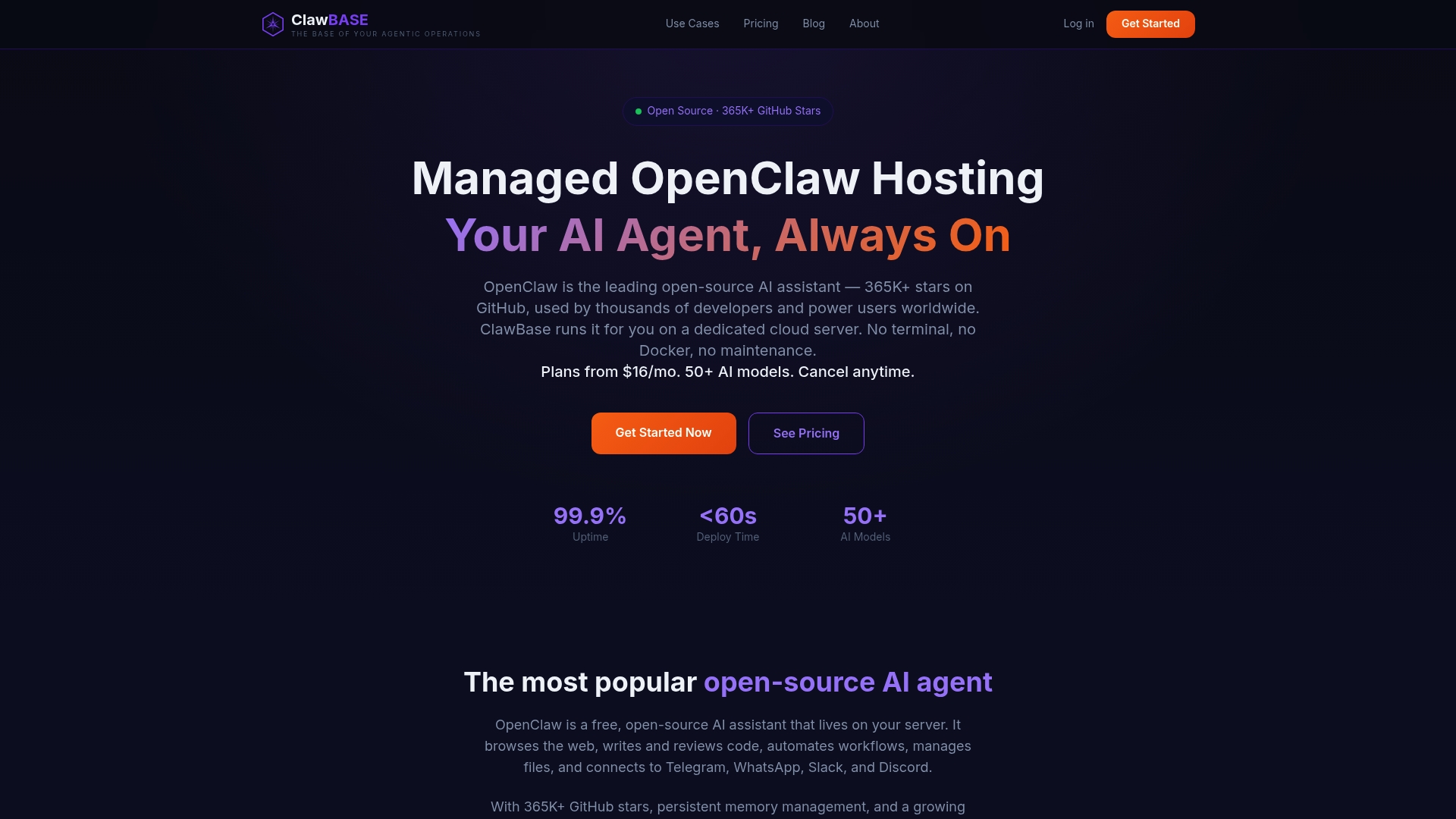
Clawbase gives you one-click access to OpenClaw, a powerful open-source AI agent, deployed on a dedicated server with 99.9% uptime and no maintenance required. You get access to over 50 AI models covering generative, agentic, and foundation model categories, all switchable without writing a single line of code. Persistent memory, Telegram and Discord integration, and private deployment make Clawbase a practical choice for teams that need the right model for each task without the infrastructure overhead. Start with managed hosting from $16 per month.
FAQ
What is the simplest definition of an AI model?
An AI model is a mathematical function trained on data to perform a specific task such as classification, prediction, or content generation. It is the engine inside an AI application, not the application itself.
What are the main types of AI models?
The four primary AI model families are supervised learning, unsupervised learning, reinforcement learning, and deep learning. Generative, foundation, and multimodal models extend these into newer application areas.
How do generative AI models differ from discriminative models?
Generative models create new content such as text, images, or audio. Discriminative models classify or predict categories from existing data. Most production AI systems use both types together.
What is an LLM and is it the same as generative AI?
An LLM is a large language model that generates text by predicting the next token in a sequence. It is a subtype of generative AI, not a synonym for it. Generative AI also includes image, audio, and video generation models.
What is agentic AI and how does it differ from a standard language model?
Agentic AI combines a language model with autonomous task execution, including API calls, web browsing, and file management. A standard language model responds to prompts. An agentic model plans and executes multi-step tasks on its own.