A Private, Managed OpenClaw Server for U.S. Teams
2026-08-26

There is no such thing as a "HIPAA compliant AI assistant" in the sense most searches assume, and if you are trying to automate Slack replies or manage files with a private AI agent, you almost certainly do not need one. What you need is a private, managed OpenClaw instance running on a dedicated, encrypted server, and that already exists. ClawBase deploys exactly this: one-click OpenClaw hosting on isolated infrastructure with a high uptime target.
This article is scoped to that use case, not to healthcare organizations building tools around protected health information (PHI). If your team touches electronic health records, needs a Business Associate Agreement (BAA), or routes patient data through an AI agent, this is the wrong guide. What follows applies to developers, non-technical operators, and business teams who want:
- A private AI agent that automates workflows without a sysadmin on payroll
- Persistent memory and integrations with Telegram, Discord, Slack, and WhatsApp
- Dedicated, encrypted hosting instead of a shared, multi-tenant instance
Key Takeaways
A private, managed OpenClaw deployment on dedicated encrypted infrastructure satisfies the operational security bar that "HIPAA compliant AI assistant" searchers actually want, provided PHI never enters the workflow.
| Point | Details |
|---|---|
| Scope matters first | This use case excludes PHI, EHR access, and BAA workflows entirely; verify your workflow before choosing a vendor. |
| Isolation is non-negotiable | Insist on single-tenant, dedicated hosting rather than shared infrastructure to eliminate cross-tenant risk. |
| Verify, don't assume | Request architecture diagrams, encryption details, backup policy, and audit log access in writing before signing. |
| Misconfiguration is the real risk | Publicly exposed Gateways and permission errors are documented failure modes for self-hosted OpenClaw setups. |
| ClawBase fits this checklist | Dedicated encrypted servers, high uptime reliability, and one-click deployment cover the controls this guide recommends, with affordable entry-tier plans starting at a low monthly cost. |
Table of Contents
- What "HIPAA Compliant AI Assistant" Means Here (And What It Doesn't)
- What Security Controls Should a Private Managed OpenClaw Assistant Have?
- Should You Self-Host, Use Managed Hosting, or Go Hybrid?
- How Do You Evaluate a Managed OpenClaw Provider?
- How ClawBase Maps to Every Control on This List
- Sources
What "HIPAA Compliant AI Assistant" Means Here (And What It Doesn't)
When people search "HIPAA compliant AI assistant," most land on articles about EHR integrations, BAAs, and PHI handling. That's a different subject with a different audience. This article uses the phrase the way a security-conscious business team actually means it in practice: a private, single-tenant OpenClaw deployment with the operational controls (encryption, isolation, audit logging) that HIPAA-grade thinking demands, applied to *non-regulated* business data.
Allowed uses under this scope look like:
- A Discord or Slack bot that drafts replies, summarizes threads, or triages support tickets
- File management and document search across a private company drive
- Scheduling, reminders, and browser automation for internal operations
Disallowed uses, explicitly outside what this article or ClawBase's product is built for:
- Storing, transmitting, or processing PHI as defined by HIPAA
- Any workflow requiring EHR access or a signed BAA
- Clinical decision support tied to individual patient records
If your workflow touches the second list, you need a healthcare-specific compliance vendor, not a general-purpose managed AI host.
What Security Controls Should a Private Managed OpenClaw Assistant Have?
OpenClaw is genuinely powerful precisely because it can read files, run shell commands, and automate a browser. That same flexibility is why its own GitHub documentation ships with a dedicated security guide and sandboxing recommendations. Left in default configuration, an OpenClaw Gateway can end up publicly reachable, which is how misconfigured instances end up exploited.
Here's the control stack worth requiring before you trust any provider with your agent:
- Single-tenant, dedicated instances. Research on agent deployment security consistently recommends dedicated hosting over shared multi-tenant environments because isolation eliminates cross-tenant risk entirely, rather than just reducing it.
- Encryption in transit and at rest. TLS should cover every API call and channel integration; the underlying disk should be encrypted so a compromised host doesn't expose stored memory or logs.
- Role-based access control (RBAC) and immutable audit logs. Every admin action and agent decision should be traceable and unable to be quietly edited after the fact.
- Sandboxing and network egress controls. The Gateway should bind to localhost, not the public internet, with firewall rules restricting outbound connections, per OpenClaw's own guidance.
- Secrets and key management. Look for bring-your-own-key (BYOK) support and documented key rotation policies.
- Automated updates, backups, and incident response. Patches should apply without manual intervention, and backups should be encrypted and scheduled daily.
Pro Tip: *Run openclaw security audit --deep immediately after any new deployment, whether self-hosted or managed. It's the single fastest way to catch a misconfigured Gateway before it becomes a public exposure.*
For the highest privacy bar, ask whether a provider supports confidential computing through Trusted Execution Environments (TEEs), where data stays encrypted even during active processing. It's not table stakes yet, but it's the direction serious private-AI infrastructure is heading.
Should You Self-Host, Use Managed Hosting, or Go Hybrid?
The right deployment model depends less on ideology and more on who's on your team and what happens at 2 a.m. when something breaks.
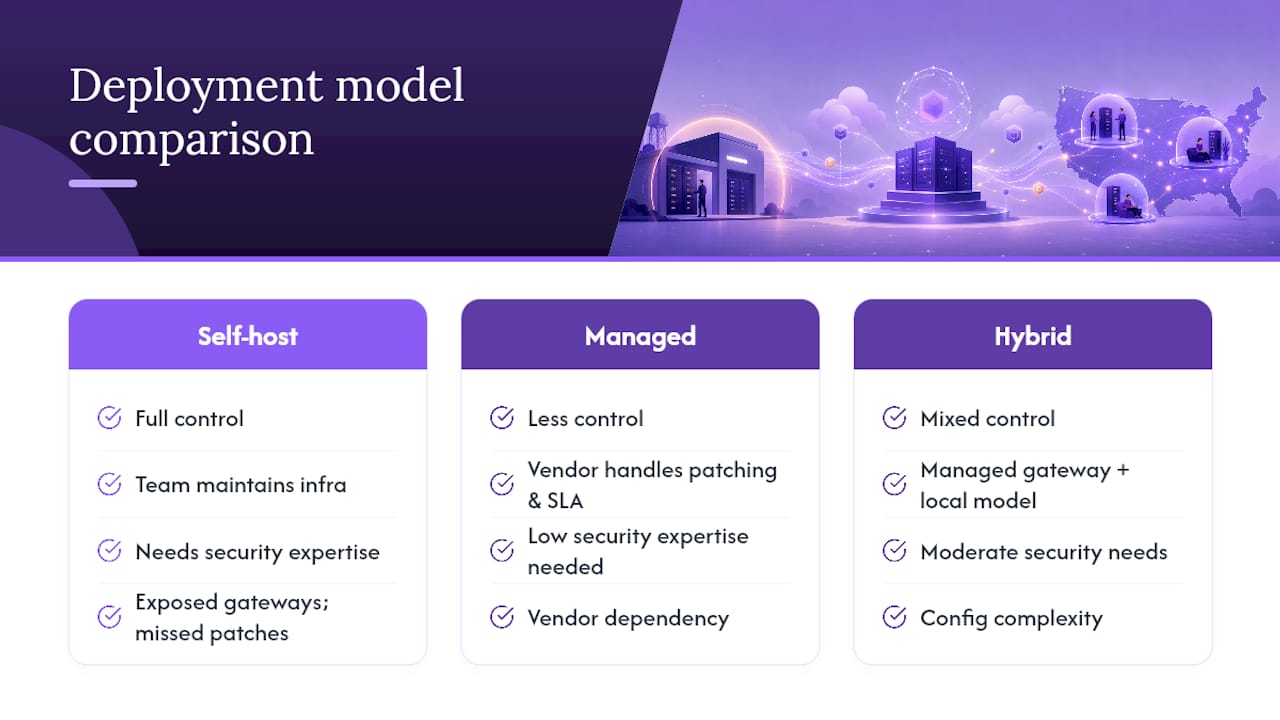
Managed hosting puts isolation, patching, and uptime SLAs on someone else's plate. You trade a monthly fee for not needing in-house security expertise. This is the right default for most non-technical teams and for developers who'd rather build workflows than babysit infrastructure.
Self-hosting makes sense when you already run production infrastructure and want full control over the stack. The common pitfalls are real, though: publicly exposed Gateways, permission misconfigurations, and forgetting to apply patches are documented failure modes, not hypotheticals, according to DataCamp's overview of OpenClaw's architecture.
Hybrid setups split the difference. A managed Gateway paired with a locally run model can work well for teams with specific data residency preferences.
If your team has no dedicated security engineer, start managed. If you already run a hardened cloud environment and enjoy the maintenance, self-hosting is viable. Most business teams underestimate the second option's time cost.
How Do You Evaluate a Managed OpenClaw Provider?
Before you sign anything, get answers to these in writing. Vague answers here are the red flag itself.
- Ask for the architecture diagram. You want to see the isolation model explicitly, not just hear "it's secure."
- Verify encryption specifics. Disk encryption standard, TLS version, and whether you can bring your own key.
- Confirm backup policy. Frequency, encryption status, and retention window for backups.
- Request audit log access. Ask whether logs are immutable and how long they're retained.
- Ask for SOC 2 or penetration test summaries. A provider undergoing SOC 2 Type II audits or third-party penetration testing should be able to share a summary report, even if the full document is under NDA.
- Interview their ops team directly. Ask how patches roll out and what their incident response timeline looks like.
Managed AI platforms built for enterprise OpenClaw deployments typically bundle sandboxed execution, RBAC, automatic updates, and availability SLAs as a package rather than as add-ons. That bundling is the actual value of paying for managed hosting instead of assembling the stack yourself.
Pro Tip: *If a provider can't explain in one paragraph how they isolate your instance from other customers, treat that as disqualifying, not just a yellow flag.*
How ClawBase Maps to Every Control on This List
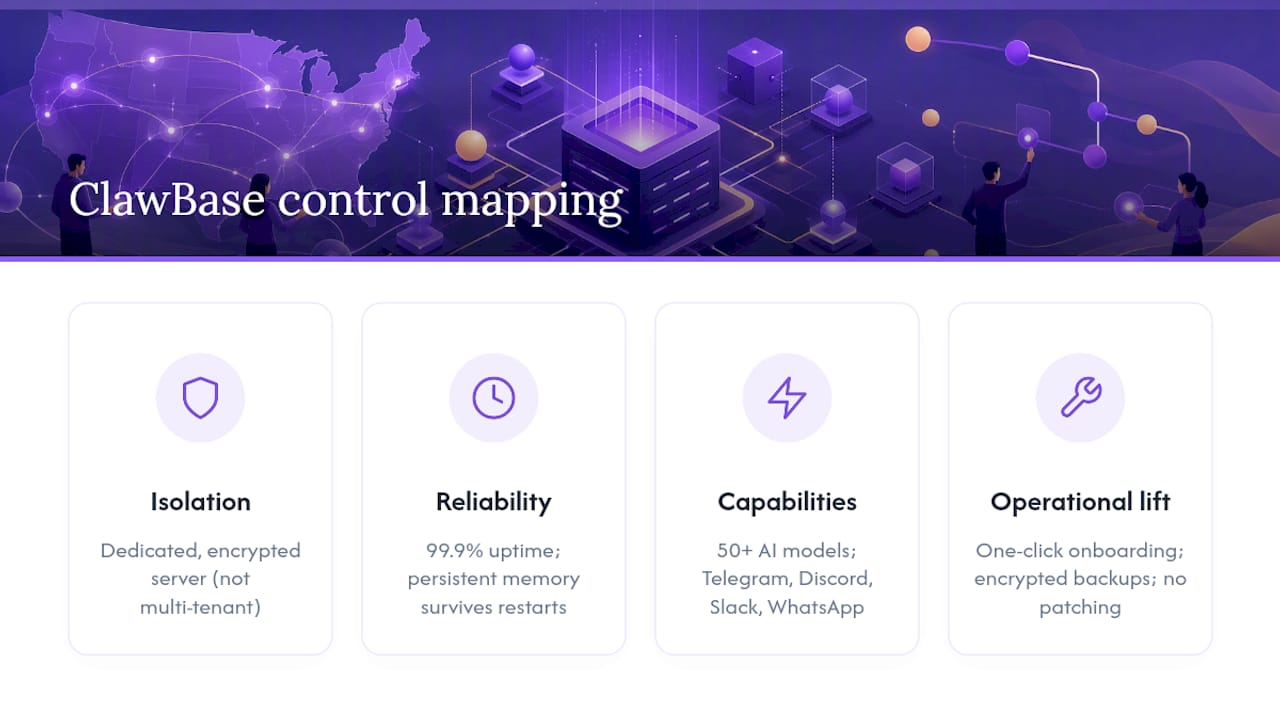
ClawBase was built around this exact checklist, not retrofitted to match it. Every deployment runs on a dedicated, encrypted server, not a shared multi-tenant environment, which satisfies the isolation requirement outright rather than approximating it. Onboarding is one-click, so you get the operational discipline of a managed platform without needing to hire the security engineer that self-hosting would require.
The proof points line up directly against the checklist above: 99.9% uptime, persistent memory that survives restarts, and access to over 50 AI models with multi-model routing, all running on infrastructure you don't have to patch yourself. Integrations with Telegram, Discord, Slack, and WhatsApp cover the automation use cases most teams actually want, and daily encrypted backups plus automated updates handle two of the operational items procurement checklists always flag.
If you want the deeper mechanics of how private hosting models reduce ops burden, this breakdown of private AI assistant advantages is worth reading before you commit. For teams weighing whether managed hosting or self-hosting fits better, why developers choose managed AI services covers the trade-off in more detail.
Plans start at $16 a month with a 7-day free trial on the entry tier, so you can run the exact checklist above against a live instance before paying for anything. Head to ClawBase to start the trial and get a dedicated server spun up in minutes, not weeks.
A short recommendation based on the trade-offs
Most U.S. teams overestimate their appetite for self-hosting and underestimate how quickly a misconfigured Gateway becomes a real problem. Unless you already run hardened infrastructure, start managed. Confidential computing through TEEs is getting more accessible fast. Worth asking about now, even if you don't need it yet.
> *— Iosif Peterfi*
Sources
- ArXiv paper on isolation and security for agent deployments
- openclaw/openclaw — GitHub
- OpenClaw — Personal AI Assistant
- Why we need private AI with TEEs — Bankless