Run One Restore This Quarter: Per Asset AI Server DR Checklist
2026-09-26

AI meaningfully improves disaster recovery for AI servers when it's paired with tested restores and human-approved execution, not left to run alone. It speeds triage, cuts mean time to recovery, and flags blast radius faster than manual runbooks. Start now: inventory your AI artifacts (models, embeddings, conversation history, credentials), set per-asset RTO/RPO, and run one real restore test this quarter.
***
> TL;DR:
>
> - AI disaster recovery relies on tested restores and human approval, with specific planning for different AI assets like models, embeddings, and conversation history.
> - Asset classification and per-asset RTO/RPO are essential, with derivable assets often rebuildable from source data and irreplaceable assets needing real backups.
> - Regular, real restore testing, including cross-region drills and rebuild outside emergencies, is crucial for validating recovery procedures and timing accuracy.
> - Architectural choices, such as active-active or cold restore, depend on outage costs, with a focus on explicitly mapping dependencies and integrating AI-specific storage systems.
> - Human-in-the-loop controls, audit logging, and compliance measures are vital to prevent unsupervised actions and meet regulatory requirements during recovery processes.
***
Table of Contents
- How AI Improves Disaster Recovery: Core Mechanisms
- Designing an AI-Ready Recovery Plan
- AI-Specific Assets: Setting RTO and RPO for Models, Embeddings, and Histories
- Testing and Restore Validation Discipline
- Implementation Patterns and Architectures for AI Server Recovery
- Operational Risks, Governance, and Security Controls
- Practitioner Checklist and How Managed Hosting Simplifies AI Server DR
- Integration Challenges Between AI Systems and Existing DR Infrastructure
- AI-Driven Monitoring and Real-Time Alerting for Disaster Recovery
- Cost Considerations for AI-Based Disaster Recovery
- Compliance and Regulatory Issues in AI Data Recovery
- Examples of Successful AI Server Disaster Recovery in Practice
- Where AI-Driven Disaster Recovery Is Headed
- Managed Hosting That Takes Backup Discipline Off Your Plate
- Sources
- FAQ
How AI Improves Disaster Recovery: Core Mechanisms
AI doesn't replace your recovery plan. It compresses the time between "something's wrong" and "here's what to do about it." The mechanisms are specific, not magic:
- Predictive analytics scans telemetry and logs for the drift patterns that precede failure, often flagging trouble before an alert fires.
- Anomaly detection with blast-radius estimation tells you whether a spike is a blip or a cascading failure worth waking someone up for.
- AI-assisted runbook generation keeps recovery documentation current as infrastructure changes, instead of going stale in a wiki nobody updates.
- Agentic loops propose an execution plan and wait for a human to approve it, rather than acting unilaterally.
Open-source patterns like CanaryAIAgent demonstrates this with a multi-agent setup, splitting triage, recovery, and compliance into separate roles with audit logs and approval gates baked in. That separation matters more than any single model's accuracy.
Designing an AI-Ready Recovery Plan
An AI-ready plan starts with knowing what you actually have, not with picking a fancier tool. Work through this in order:
- Inventory every AI workload component — model weights, vector stores, prompt templates, orchestration scripts, and their dependencies on each other.
- Classify assets by criticality and assign a per-asset RTO/RPO instead of one blanket number for the whole system.
- Version-control prompts, configs, and pipelines through CI/CD the same way you would application code, so a rollback is a git operation, not a scramble.
- Define how agent outputs become executable actions — which APIs they can call, which policy gates sit between a recommendation and a real change.
Skipping step four is the most common mistake. Teams build a smart triage agent, then have no clean path from "here's what I'd do" to an action that's actually authorized and logged.
AI-Specific Assets: Setting RTO and RPO for Models, Embeddings, and Histories
Not every AI asset deserves the same recovery treatment, and treating them identically wastes money or risks data you can't get back. Recovery planning for AI workloads has to treat model artifacts, embeddings, prompts, and conversation history as distinct assets, each with its own rebuild-versus-storage math.
- Derivable assets (embeddings, cached inference results) can often be recomputed from source data. Run the arithmetic: compute cost to rebuild versus storage cost to retain, and let that number set your RTO.
- Irreplaceable assets (conversation history, fine-tuned checkpoints, credentials) need real backups, because there's no source of truth to regenerate them from.
- Degraded-mode fallbacks deserve a formal recovery tier of their own, a documented "acceptable but limited" state rather than an improvised stopgap during an incident.
- Metadata discipline matters as much as the data itself: store the embedding model identifier alongside the vectors, because mixing embeddings from different model versions silently degrades retrieval without throwing an obvious error.
Treat RTO as a business decision, not an engineering guess. Converting rebuild time into a dollar figure lets you prioritize backup spend on the assets that actually cost the most to reproduce.
Testing and Restore Validation Discipline
A backup nobody has restored is a hope, not a plan. That's the blunt framing AWS's own restore-testing guidance uses, and it applies doubly to AI infrastructure where a "successful" restore can still leave you with mismatched embeddings.
- Run automated integrity checks continuously, hashing backup artifacts to catch silent corruption early.
- Perform weekly database restores to validate conversation history and metadata stores.
- Run monthly full application restores to catch dependency failures that a database-only test misses.
- Schedule quarterly cross-region failover drills to confirm the whole dependency graph survives a real regional outage.
- Test key rotation and credential recovery as part of every drill cycle, not as an afterthought.
Pro Tip: *Rebuild a vector index once, for real, outside of an emergency. It's the only way to learn your true rebuild time and expose embedding API rate limits before they surprise you during an actual outage.*
Measure actual restore times, not projected ones, and feed those numbers back into your RTO/RPO targets. Aspirational recovery times that have never been tested are just guesses with a deadline attached.
Implementation Patterns and Architectures for AI Server Recovery
The right architecture depends on how much an outage costs you per minute, not on which pattern sounds most advanced.
- Active-active suits AI services where downtime is unacceptable, typically customer-facing inference endpoints. It costs the most to run continuously but keeps RTO close to zero.
- Warm standby works well for internal tools and moderately critical agents, keeping a scaled-down replica ready so failover takes minutes rather than hours.
- Cold restore fits batch workloads and lower-priority agents where a few hours of downtime is tolerable, trading recovery speed for lower standing infrastructure cost.
- Vector database and feature store replication needs its own strategy separate from application failover, since these stores grow large and change at a different rate than code.
For the agentic layer itself, Intuit's EWOK Agent, built on Amazon Bedrock, offers a useful template: a thin reasoning layer decides intent, while a separate deterministic executor performs the actual authenticated, audited failover action. The model never touches infrastructure directly.
Operational Risks, Governance, and Security Controls
The biggest risk in AI-driven disaster recovery isn't a bad prediction. It's an unsupervised action taken on that prediction. CISA's joint guidance on integrating AI into operational environments is explicit that human-in-the-loop review belongs in front of any AI decision touching operational technology or critical infrastructure.
Build these controls in from the start:
- Audit logging for every AI recommendation, including its confidence score and a unique execution ID tied to whatever action followed.
- Backup integrity controls: hashing, encryption, immutable storage, and disciplined key management, following the framework NIST SP 1339 lays out for operational technology environments.
- Approval gates that are actually tested, not just documented, since an autonomous agent should never perform a destructive action without a verified human approval path.
- Multi-vendor fallback plans, pre-tested rather than assumed, so a single cloud provider's outage doesn't become your outage too.
Encryption and key management deserve particular attention for AI backups specifically, since a compromised key doesn't just expose data. It can expose the model weights and conversation logs that define your competitive position. Our encryption at rest guidance covers the customer-managed key rotation steps worth building into any AI backup strategy.
Practitioner Checklist and How Managed Hosting Simplifies AI Server DR
Run through this list before you touch a vendor comparison:
- Inventory every AI workload component and its dependencies.
- Classify assets and assign per-asset RTO/RPO.
- Version-control prompts, pipelines, and configs.
- Back up embeddings with their model identifier attached.
- Build a credential and key rotation path into every drill.
- Run tiered restore tests on a real schedule, not an aspirational one.
- Choose warm-standby or cold-restore per workload, not one pattern for everything.
- Deploy real-time monitoring with anomaly thresholds tuned to your traffic.
- Require human approval gates before any destructive recovery action executes.
- Log every AI recommendation with confidence scores and execution IDs.
Managed hosting reduces the operational weight of several of these steps without eliminating the need for testing discipline. Encrypted backups running automatically, persistent memory management, and automated updates cover a meaningful chunk of the checklist by default, which matters most for teams without a dedicated recovery engineer.
Integration Challenges Between AI Systems and Existing DR Infrastructure
Most enterprise disaster recovery infrastructure was built for stateless application servers and relational databases. AI workloads break several of those assumptions at once, and that mismatch is where most integration pain shows up.
Vector databases don't fit neatly into traditional backup tooling designed around row-based snapshots. A standard database backup tool might successfully snapshot a Postgres instance while missing the fact that your embedding pipeline and vector index are stored in a completely different system with its own consistency model. Conversation history, meanwhile, often lives in a hybrid of structured storage and object storage, which means a single "restore" action might need to coordinate across two or three different backup systems just to bring one agent back online.
Existing runbooks also tend to assume deterministic behavior. A traditional failover script checks a health endpoint and flips traffic. An AI service might report itself as healthy while returning degraded output because a model version mismatch corrupted retrieval quality, a failure mode legacy monitoring simply isn't built to catch.
The practical fix isn't a wholesale infrastructure replacement. It's mapping AI-specific dependencies explicitly into your existing DR documentation, rather than assuming your current runbooks already cover them. Treat the vector store, the model registry, and the conversation store as first-class citizens in your recovery graph, each with its own restore procedure and its own entry in the dependency map, instead of lumping them under a generic "database" line item that nobody actually tests.
AI-Driven Monitoring and Real-Time Alerting for Disaster Recovery
Traditional monitoring watches CPU, memory, and response codes. AI server monitoring has to watch those plus a second layer: output quality, retrieval accuracy, and drift in the embedding space, none of which show up in a standard uptime dashboard.
Real-time alerting for AI infrastructure typically layers three signal types. Infrastructure-level signals catch the obvious failures: a node down, a disk full, a network partition. Application-level signals catch latency spikes and error rate increases in the serving layer. The third layer, often missing from off-the-shelf monitoring stacks, watches for semantic drift: a sudden change in response length, confidence score distribution, or retrieval hit rate that suggests something's degraded even though every health check is green.
Anomaly detection tuned to these AI-specific signals catches problems earlier than threshold-based alerting alone. A model serving endpoint returning technically valid but increasingly generic responses, for instance, might never trip a latency alarm while quietly failing every user interacting with it. Detecting that requires baselining normal output characteristics and alerting on deviation, not just watching for outright errors.
The practical takeaway for alerting design: route infrastructure alerts to your existing on-call rotation, but route AI-quality alerts to whoever owns the model, since the fix for a drift alert is rarely a server restart. It's a rollback to a previous checkpoint or a retraining trigger. Building that routing distinction into your alerting rules from day one saves confusion during an actual incident, when nobody wants to debug which team owns which alert type.
Cost Considerations for AI-Based Disaster Recovery
AI disaster recovery costs break down differently than traditional DR, and treating them the same way leads to either overspending on redundant infrastructure or underspending on the assets that actually matter.
Storage costs for AI workloads scale with model size and vector store volume, which grow faster than typical application data. A large embedding store for a mature retrieval system can dwarf the size of the application database it supports, so replicating it across regions for an active-active setup gets expensive fast. That's exactly why the rebuild-versus-store arithmetic matters: for many derivable assets, recomputing embeddings from source data costs less than paying for continuous cross-region replication, especially for assets that change frequently anyway.
Compute costs shift the equation further. Warm-standby model serving capacity sitting idle, ready to take over traffic, costs real money every hour it's not serving requests. That's the trade-off worth quantifying before choosing an architecture: active-active buys near-zero RTO at continuous cost, while cold-restore defers that cost until an actual incident, at the price of a longer recovery window.
The most overlooked cost line item is testing itself. Running quarterly cross-region drills and monthly full-application restores consumes real compute and engineering time. Budget for it explicitly rather than treating it as free, because a drill that gets skipped due to "cost pressure" is exactly the drill that would have caught the failure mode that eventually causes a real outage. Our breakdown of realistic AI server cost ranges is a useful starting point for weighing standing infrastructure cost against recovery speed before committing to an architecture.

Compliance and Regulatory Issues in AI Data Recovery
Regulatory requirements for AI data recovery inherit the underlying data protection rules for whatever data the system touches, plus a layer of AI-specific scrutiny that's still catching up to the technology.
If an AI agent processes personal data, financial records, or health information, its backups inherit the same retention, access-control, and breach-notification obligations that apply to the source systems, regardless of whether the data currently sits in a conversation log or a vector embedding. That distinction matters because regulators are increasingly clear that an embedding derived from personal data doesn't automatically escape data protection scope just because it's been transformed into vectors.
Encryption and access logging aren't optional extras here, they're often the compliance requirement itself. NIST's operational technology guidance calls for integrity verification and controlled access to backup media as baseline practice, and that baseline tends to align closely with what auditors expect from any regulated data environment, AI or not.
The harder compliance question is auditability of the AI's own decisions during recovery. If an agent recommended a failover action, regulators and internal auditors alike may want to know what data informed that recommendation, what confidence score it carried, and who approved the execution. That's precisely why audit logging with execution IDs isn't just a security best practice. In regulated industries, it's becoming the evidence trail that demonstrates the recovery process itself was controlled, not improvised.
Cross-border data residency adds another wrinkle for cross-region failover specifically: replicating a vector store or conversation history to a standby region in a different jurisdiction can trigger data transfer obligations that a same-region backup never would. Map your failover regions against your data residency requirements before you build the architecture, not after a compliance review flags it.

Examples of Successful AI Server Disaster Recovery in Practice
The clearest public example of agentic disaster recovery done with real guardrails is Intuit's EWOK Agent, built on Amazon Bedrock to standardize failovers across its services. The architecture deliberately separates reasoning from action: a thin agentic layer interprets an incident and proposes a plan, while a completely separate deterministic executor carries out the actual authenticated action. The model itself stays stateless with respect to credentials, meaning it never holds the keys to execute anything directly. That single design decision is what makes the whole system auditable, since every action traces back to a typed, logged request rather than an opaque model decision.
On the open-source side, projects like CanaryAIAgent demonstrate the same principle at smaller scale: splitting orchestration, triage, recovery, and compliance into distinct agent roles, each logging its reasoning and requiring approval before destructive steps execute. It's not a production case study from a major enterprise, but it's a useful reference architecture for teams building this pattern internally rather than adopting it wholesale from a cloud vendor.
The common thread across both examples isn't the sophistication of the model. It's the boring part: a hard boundary between what the AI recommends and what actually executes, with a human or a deterministic policy gate sitting at that boundary every time. Teams that skip that boundary and let a model call infrastructure APIs directly are the ones most likely to end up as a cautionary example rather than a case study.
Where AI-Driven Disaster Recovery Is Headed
Full automation of disaster recovery isn't coming in the next few years, and treating it as the goal misses the point. The realistic trajectory over the next three to five years is AI handling detection and triage while humans keep approval authority over anything destructive, which is exactly what CISA's guidance already recommends today.
Watch financial services, healthcare, and critical infrastructure operators move first, since they carry the regulatory pressure and the incident cost that justifies investment. Everyone else should prioritize testing discipline and asset classification before shopping for agentic tooling. A well-tested cold-restore plan beats an untested AI-driven one every time.
> *— Iosif Peterfi*
Managed Hosting That Takes Backup Discipline Off Your Plate
Everything covered above, asset inventory, encrypted backups, credential rotation, restore testing, gets harder to maintain when your team is also responsible for the underlying server. Managed hosting services with daily encrypted backups, persistent memory management, and automated updates built in can reduce the operational burden of keeping an AI assistant recoverable.
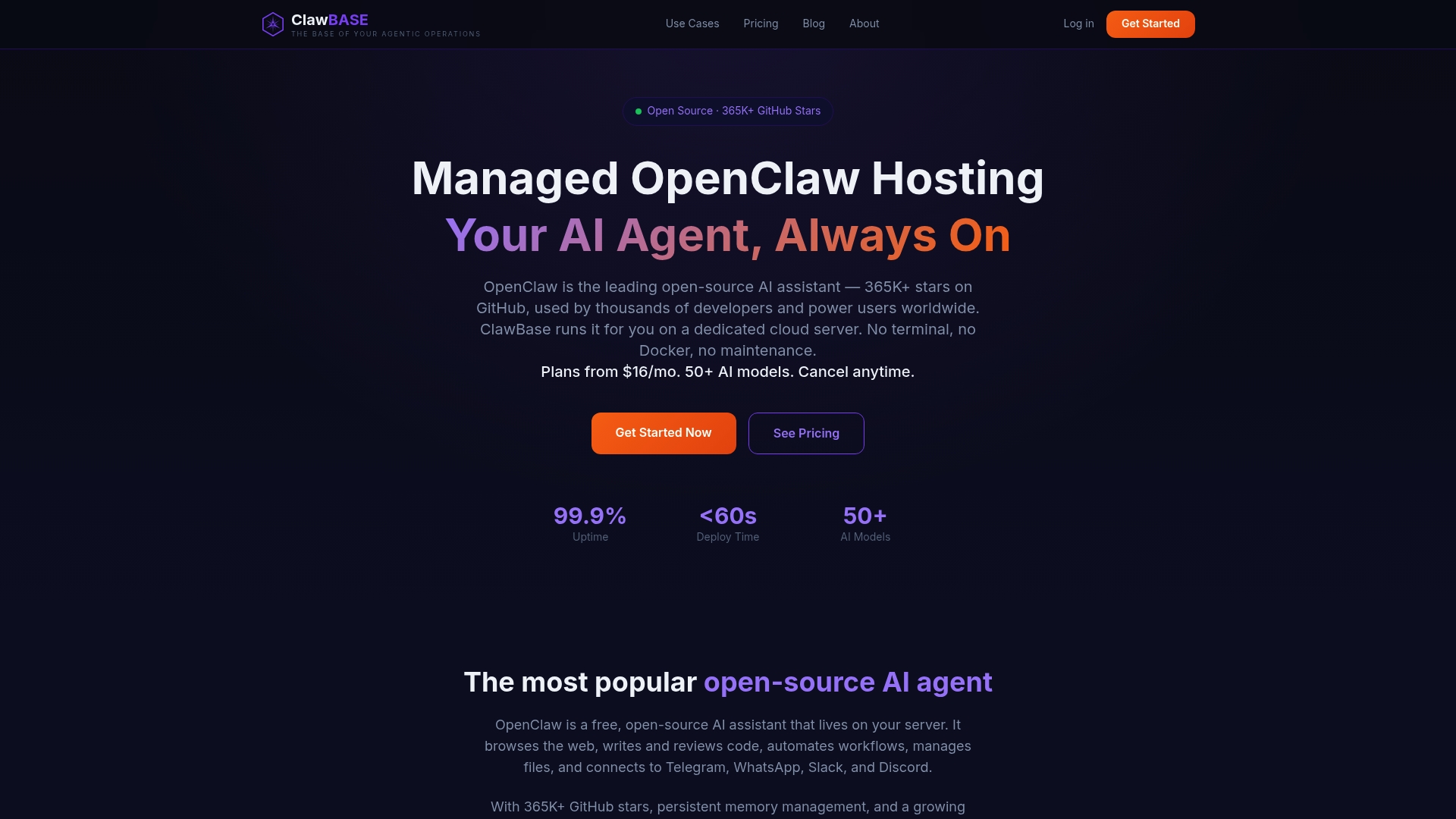
You get 99.9% uptime, access to over 50 AI models with multi-model routing, and one-click deployment on a dedicated encrypted server, without needing sysadmin expertise to keep it patched and backed up. The LITE plan starts at $16 per month, with PRO and MAX tiers available as your usage grows. If you want to see what a persistent, recoverable AI assistant can actually do for your workflows before committing, the use cases page is a good next stop, or start the trial directly from the Clawbase homepage.
Sources
- AI Disaster Recovery: Backup and Restore Patterns | COMPEL Framework
- NIST Special Publication 1339
- Joint guidance: Principles for the secure integration of AI in operational technology | CISA
- How Intuit built an agentic disaster recovery assistant with Amazon Bedrock | AWS Blog
- AWS Backup: Restore testing guidance
FAQ
What Is a Disaster Recovery Server?
A disaster recovery server is a standby system that takes over operations when a primary server fails, whether through crash, outage, or corruption. For AI workloads, it needs to restore not just application code but model artifacts, embeddings, and conversation history as distinct components.
How Is AI Being Used in Disaster Response?
AI speeds up detection and triage by scanning telemetry for anomalies and estimating blast radius before a human would spot the pattern manually. Agentic systems like Intuit's EWOK Agent propose recovery actions while a separate deterministic layer executes them under human approval.
What Are RTO and RPO in Cloud Disaster Recovery?
RTO (Recovery Time Objective) is how long a system can be down before recovery must be complete. RPO (Recovery Point Objective) is how much data loss, measured in time, is acceptable. For AI assets, both should be set per-component, since embeddings and conversation history carry very different rebuild costs.
What Are Some Popular Disaster Recovery Platforms?
Options range from major cloud provider native tools with built-in restore-testing features to open-source agentic frameworks like CanaryAIAgent that add multi-agent triage and audit logging. Managed hosting platforms like Clawbase handle backup and recovery automatically for teams that don't want to build this infrastructure themselves.
Do I Need a Separate Backup Strategy for AI Models Versus Regular Data?
Yes. Model weights, embeddings, and conversation history behave differently from relational data, and mixing embedding versions can silently degrade retrieval quality without triggering an error. Each asset type needs its own RTO/RPO and its own tested restore path.