Stop Losing Agent Memory: One-Click Deployment for Platform Engineers
2026-09-15

One-click deployment means triggering a single, explicit action (a CLI command, a dashboard button, a merged pull request) that runs the full build, provision, configure, and release sequence for you. It covers everything from a static frontend push to a full Kubernetes rollout, but stateful workloads like AI agents need extra care around memory and volumes. If you want the reproducible version of this, skip to the implementation checklist below.
***
> TL;DR:
>
> - One-click deployments automate the entire process, but they rely on coordinated actions like build, push, provision, and verification stages that often happen behind the scenes.
> - Choosing between static or serverless architectures and container-based Kubernetes setups depends on workload complexity, with stateless applications favoring speed and simplicity.
> - Ensuring idempotence in infrastructure and build processes is crucial for safe, repeatable deployments that do not cause environment drift or failures.
> - Stateful AI workloads require external storage or volumes to maintain memory across redeployments, avoiding data loss or inconsistent behavior.
> - Managed hosting services like ClawBase simplify AI deployment by handling infrastructure, persistence, and uptime, making it an easier option for small teams or solo developers.
***
Table of Contents
- What Happens When You Click Deploy
- Static And Serverless Vs. Container And Kubernetes: Which Path Fits?
- How Do You Build a Reliable One-Click Deployment Flow?
- Where Does a One-Click Trigger Actually Live?
- Keeping Stateful AI Workloads Alive Through a Redeploy
- How Do You Keep One-Click Deploys Safe in Production?
- Platform Engineering Trade-Offs: Build Your Own or Adopt Managed?
- Skip the Server Maintenance: One-Click OpenClaw Hosting
- Sources
- FAQ
What Happens When You Click Deploy
A one-click action looks simple from the outside. Underneath, it runs a fixed sequence that a typical deploy tutorial breaks into distinct stages, whether it's triggered by a CLI, a CI pipeline, or a dashboard button.
Here's the order that sequence usually follows:
- Build the application from source, producing a binary, static bundle, or container image.
- Push that artifact to a registry or storage bucket.
- Provision or update the target infrastructure: a VM, a Kubernetes cluster, or a serverless function.
- Inject configuration, meaning environment variables, secrets, and feature flags for that specific environment.
- Run migrations if the release touches a database schema.
- Verify health checks before routing traffic to the new version.
The first deploy and every deploy after it are not the same animal. Provisioning infrastructure from scratch, generating credentials, and setting DNS only happen once. Every redeploy after that skips straight to build, push, and release, which is why platforms increasingly split "setup" from "deploy" as two distinct commands.
CI systems and infrastructure-as-code tools do most of the heavy lifting inside each step. A GitHub Actions workflow might handle build and push, while a Terraform or Pulumi apply handles provisioning, and a Helm chart or Kustomize overlay handles configuration injection. One click on your end can represent a dozen coordinated actions behind the scenes, as explained in WordPress publishing automation for content teams.
Static And Serverless Vs. Container And Kubernetes: Which Path Fits?
Every one-click flow eventually forces a choice between two architecture paths, and picking the wrong one is the single most common reason teams end up over-engineering a simple app or under-provisioning a complex one.
Path A: Static and serverless. This path suits frontends, JAMstack sites, and simple APIs that don't need persistent compute. Deploy times are fast, usually under a minute, and there's no cluster to patch or scale manually. Providers in this category tend to build one-click apps around common runtimes and frameworks, letting you go from repository to live URL with almost no configuration, as Koyeb's one-click app catalog demonstrates across a range of frameworks.
Path B: Container and Kubernetes. This path becomes necessary once you have multiple services talking to each other, background workers, or routing logic that a serverless function can't express cleanly. It costs more in operational complexity: you're managing manifests, ingress rules, and often a service mesh. But it's the only realistic option for apps that need long-running processes, WebSocket connections, or fine-grained scaling per service.
- Static/serverless: minutes to deploy, near-zero ops, limited to stateless or lightly stateful workloads.
- Container/k8s: hours to set up initially, full control over networking and scaling, required for multi-service systems.
- Preview environments (ephemeral, torn down after a pull request closes) work well on either path and catch integration bugs before merge.
Pro Tip: *Don't provision a full one-click environment for every pull request if your app is stateless. Ephemeral serverless previews cost a fraction of a full container environment and close automatically, which keeps your cloud bill from creeping up unnoticed.*
How Do You Build a Reliable One-Click Deployment Flow?
A one-click flow only feels reliable once it's repeatable, and repeatability comes from treating deployment as a codified process rather than a set of manual steps someone remembers. Here's the checklist to work through, roughly in order:
- Define a project manifest. A
deploy.yaml,deploy.kind, or platform-specific config file should declare the runtime, build command, and target environment in version control, not in someone's head. - Set up credential profiles. Configure scoped, least-privilege tokens per environment rather than one master key used everywhere. A 1CLI-style deploy tutorial notes that the first deploy typically requires this profile setup, but subsequent redeploys reuse it automatically.
- Wire the build and registry steps. Build the artifact, tag it with a commit SHA or semantic version, and push it to your registry before the deploy action ever runs.
- Apply infrastructure changes idempotently. Your Kubernetes manifests, Terraform state, or server templates should produce the same result whether applied once or five times.
- Run health checks and migrations, then promote. Confirm the new version is healthy before routing production traffic to it, and have a rollback path ready if it isn't.
Quick reference for what belongs in each layer:
- Manifest and templates: repo-level, versioned, reviewed like code.
- Credentials: scoped per environment, rotated regularly, never hardcoded.
- Build and registry: tagged artifacts, immutable references, no "latest" tags in production.
- Infra apply: idempotent, dry-run capable, logged.
- Verification: automated health checks before, not after, traffic shifts.
For teams building this out on top of an existing CI/CD setup, a deeper look at AI deployment pipeline design covers how these stages typically map onto pipeline stages for AI-specific workloads.
Where Does a One-Click Trigger Actually Live?
The button or command that kicks off a deploy can sit in several places, and where you put it changes how your team works day to day.
IDE and CLI triggers vs. dashboard clicks. IDE-integrated deploy actions, the kind now common in editor extensions, let developers push a release without leaving their code, which cuts context switching significantly. The One Click Deploy extension for Visual Studio Marketplace is a working example: it triggers infrastructure changes and returns logs directly in the editor. A dashboard button, by contrast, suits less technical operators who need visibility without touching a terminal.
Registry and secrets handling matters just as much as where the trigger lives:
- Use scoped tokens per environment, not a single credential shared across staging and production.
- Store secrets in a dedicated manager (Vault, AWS Secrets Manager, or your platform's built-in equivalent), never in the manifest file itself.
- Surface deployment status through build logs, deploy events, and a health endpoint the team can check without SSHing into anything.
- Reserve manual one-click redeploys for hotfixes and rollbacks; let auto-deploy-on-push handle the routine release cadence.
Auto-deploy on every push to main works well once your test suite is trustworthy. Manual one-click redeploys stay relevant for situations where you want a human decision point, like a production hotfix that shouldn't wait for a full CI run.
Keeping Stateful AI Workloads Alive Through a Redeploy
Stateful workloads break the clean build-push-release model, because the thing you care about most (an AI agent's memory, a database's rows, a vector index) has to survive the deploy rather than get rebuilt with it.

Persistent agent memory has to live somewhere that outlives the container: a mounted volume, a managed object store, or an external database. Documentation for running a persistent OpenClaw Gateway points to exactly this pattern, storing model state and conversation memory outside the ephemeral compute layer so an update doesn't wipe it out.
The failure modes here are specific and avoidable:
- An automatic update replaces the container without remounting the volume, and the agent starts fresh with no memory.
- A migration runs non-transactionally, leaving the schema half-updated if it fails partway through.
- A backup job runs on a schedule that doesn't align with peak write activity, so a restore loses recent state.
Statistic Callout: Idempotence, the principle that running an operation twice produces the same result as running it once, is a foundational concept in deployment automation. It's the property that makes rolling updates and retried migrations safe rather than destructive.
Pro Tip: *Before you flip on automatic updates for any stateful service, manually kill and restart the container once and confirm the mounted volume still has last week's data. A brief test catches the mount misconfiguration that would otherwise surface in production.*
How Do You Keep One-Click Deploys Safe in Production?
Idempotence is the property that separates a safe one-click flow from a dangerous one: running a deploy script twice, or retrying it after a partial failure, shouldn't leave your environment in a worse state than before. Side-effectful scripts that don't check current state before acting are the most common source of production incidents tied to automated deploys.
A few defensive habits reduce that risk substantially:
- Wrap destructive migration steps in existence checks (add a column only if it's missing, for instance) rather than assuming a clean slate.
- Roll out risky changes behind feature flags so you can disable new code paths without a full redeploy.
- Use canary releases and automatic rollback triggers tied to health check failures, not just manual monitoring.
- Keep a runbook that lists the first three things to check when a deploy fails: build logs, health endpoint response, and recent config changes.
Platform Engineering Trade-Offs: Build Your Own or Adopt Managed?
The build-versus-buy decision on one-click deployment comes down to three variables: how often you deploy, how big your team is, and how much you're willing to spend maintaining infrastructure nobody enjoys touching. A team shipping multiple times a day with five or more engineers usually justifies the investment in internal platform engineering, because the cost of a flaky pipeline compounds daily. A smaller team, or one running a single persistent service like an AI agent, often gets more value from a managed provider than from owning the plumbing.
Persistent AI workloads sharpen this trade-off further. Every item on the checklist above, credential scoping, idempotent applies, volume verification, backup scheduling, still has to happen somewhere. Managed hosting for something like OpenClaw simply moves that responsibility off your team's plate rather than eliminating it. That's a legitimate trade, not a shortcut, and it's worth evaluating against your own managed versus self-hosted constraints before deciding.
> *— Iosif Peterfi*
Skip the Server Maintenance: One-Click OpenClaw Hosting
If everything above sounds like a lot of infrastructure to babysit just to keep one AI agent's memory intact, that's because it is. Clawbase runs that entire checklist for you: one-click deployment on a dedicated, encrypted server, persistent memory management that survives updates, and 99.9% uptime without a single Kubernetes manifest touching your hands.
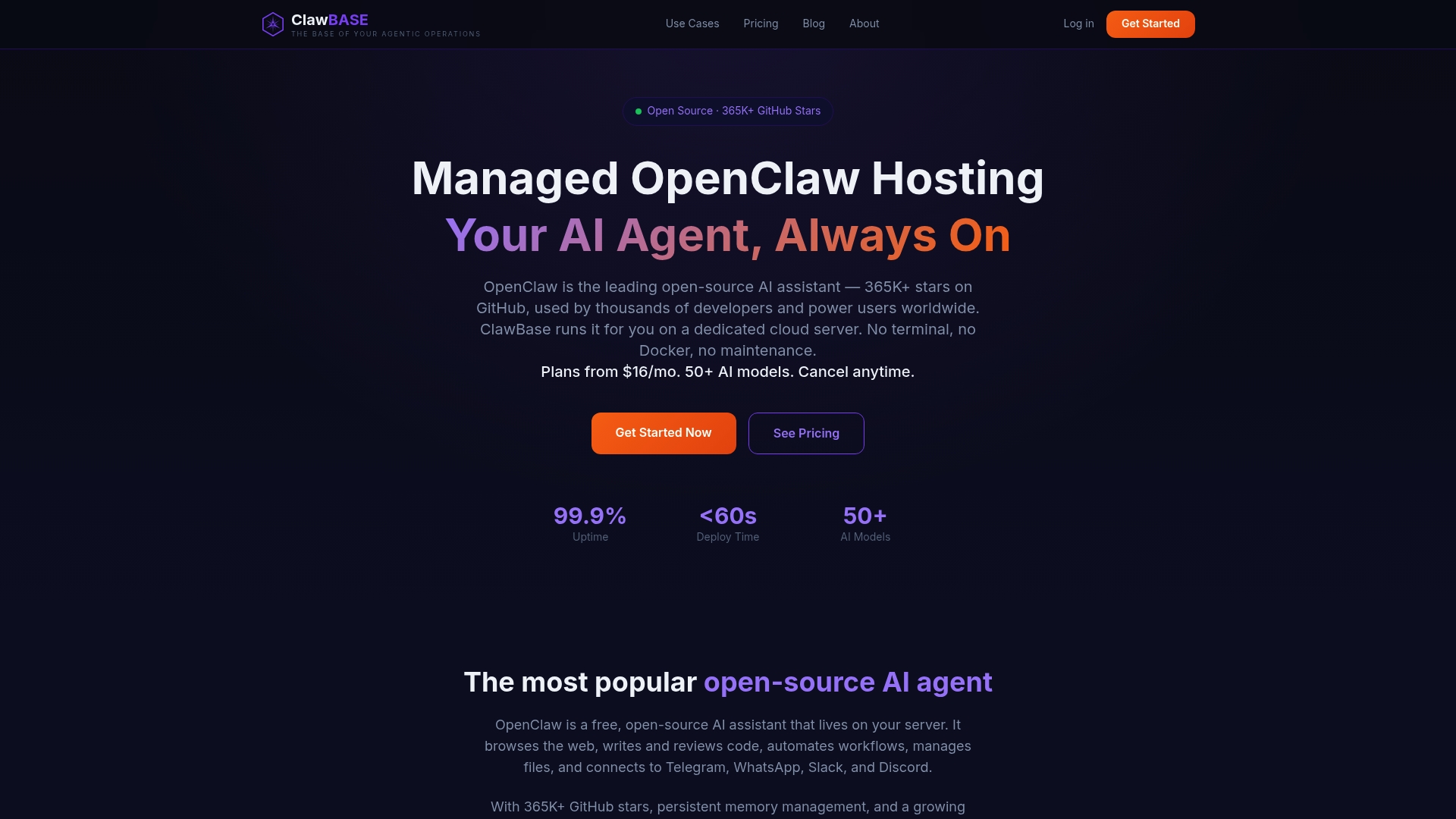
The service includes access to multiple AI models with multi-model routing, integrations with messaging platforms like Telegram, Discord, Slack, and WhatsApp, plus daily encrypted backups running in the background. For a solo developer or a small team that wants a private, always-on AI assistant without hiring a platform engineer to keep it alive, managed hosting is the faster and lower-risk path compared to self-hosting OpenClaw from scratch. Start with the free trial on ClawBase and see your assistant live in minutes, not after a weekend of server configuration.
Sources
- Deploy tutorial — one deploy flow
- One Click Deploy - Visual Studio Marketplace
- Run a persistent OpenClaw Gateway on Hostinger — 1-click option
FAQ
What Are the Main Stages of a Deployment?
Most one-click flows compress deployment into build, push to registry, provision infrastructure, configure the environment, run migrations, and verify health checks before routing traffic.
What Are the Top Deployment Strategies?
Rolling updates, blue-green deployments, canary releases, feature-flagged rollouts, and recreate deployments are the strategies most teams choose between, with canaries and blue-green favored when uptime matters most.
What Counts as a One-Click Application?
A one-click application is a pre-packaged app or environment that a provider can deploy from a single trigger, handling build, provisioning, and configuration automatically instead of requiring manual setup for each step.
Can I Deploy Something Like a Replit App for Free?
Many platforms offer free tiers for lightweight, low-traffic apps, though persistent or resource-heavy workloads like an always-on AI agent typically need a paid tier to guarantee uptime and storage.
Is Managed Hosting Better Than Self-Hosting for an AI Assistant?
Managed hosting trades some control for guaranteed uptime, automatic backups, and persistent memory handling. Clawbase, for instance, handles all of that for OpenClaw without requiring sysadmin skills, which makes it a practical choice for teams that would rather not own that infrastructure.