43 Minutes a Month: When a 99.9% Uptime SLA Won't Cover Buyers' Losses
2026-09-28

99.9% uptime means roughly 43 minutes of counted downtime per 30-day month, or about 8 hours and 45 minutes across a year, but whether an outage actually triggers a credit depends on exclusions, measurement windows, and scope. SLAs are contractual documents with defined terms, not blanket promises against failure. Service credits, the usual remedy, reimburse part of your bill but rarely cover the operational cost of the outage itself.
***
> TL;DR:
>
> - Providers often exclude scheduled maintenance, customer-caused failures, and third-party issues from uptime calculations, reducing the effective protection.
> - A 99.9% SLA permits roughly 43 minutes of downtime per month and about 8 hours and 45 minutes annually, but actual breaches depend on measurement scope and exclusions.
> - Moving from 99.9% to 99.99% uptime requires significantly more investment in redundancy and operational discipline, which may not be justified for all workloads.
> - Achieving higher uptime beyond contractual SLAs involves architecting for multi-zone deployment, active failover, and independent monitoring to minimize real user impact.
> - Always verify measurement scope, exclusion details, claim procedures, and request access to monitoring data before selecting a provider or relying on SLA figures.
***
Table of Contents
- 1. What 99.9% means in minutes across different time windows
- 2. How uptime gets measured, and why the same number can hide different experiences
- 3. Exclusions and service credits: what reduces your effective protection
- 4. Calculating a breach and the credit you're owed
- 5. Choosing the right target: three nines, four nines, or five
- 6. Reducing downtime beyond what any SLA covers
- 7. How managed hosting operationalizes a 99.9% commitment
- 8. What most buyers get wrong about SLA percentages
- Managed 99.9% hosting without the maintenance burden
- Sources
- FAQ
1. What 99.9% means in minutes across different time windows
The math behind "three nines" is simple once you see it laid out, but the practical allowance shifts depending on which window you're measuring against. A 30-day month gives you about 43 minutes of downtime, while a 31-day month stretches that slightly, and February trims it. Annually, that adds up to roughly 8 hours and 45 minutes.
| Window | Downtime allowed at 99.9% |
|---|---|
| Full day | About 1 minute |
| 30-day month | About 43 minutes |
| Calendar year | About 8 hours 45 minutes |
| Business hours (varies) | A small amount of downtime weekly |
The formula is downtime allowed equals total minutes in the period multiplied by 0.001. Say a provider suffers a 20-minute outage mid-month: you'd still have roughly 23 minutes of budget left before that month would qualify as a breach.
2. How uptime gets measured, and why the same number can hide different experiences
Providers rarely measure uptime the way customers assume. Google Cloud's SLA defines Monthly Uptime Percentage as total operating minutes minus downtime, divided by total operating minutes, expressed as a percentage. That sounds precise, but the aggregation method changes what actually gets counted.
Some vendors track availability annually instead of monthly, which smooths out a bad week inside a otherwise solid year and can delay when a breach becomes visible to you. Others measure per-minute outages, while some use request-success ratios that tolerate brief failures as long as most calls succeed. Scope matters just as much: a per-instance SLA might look fine even while your specific region struggles, since the provider's aggregate platform number stays healthy.

If your uptime figure is calculated across an entire fleet rather than your slice of it, a personally painful outage might never register as a contractual breach.
3. Exclusions and service credits: what reduces your effective protection
Almost every SLA carves out categories of downtime that don't count against the provider, and these exclusions do most of the real work in the contract. Law Insider's clause library shows the pattern repeats across vendors: scheduled maintenance windows, customer-caused failures, third-party network issues, DDoS attacks, and force majeure events are routinely excluded from the downtime tally.
That means a provider can announce maintenance, take the system offline for two hours, and that time never touches your 43-minute budget. Credit structures follow a similar logic:
- Credits usually scale in tiers, with a larger percentage of your bill returned as measured uptime drops further below the target.
- Most contracts make the credit the exclusive remedy, meaning you waive other legal claims by accepting it.
- Claims are typically not automatic. You file a request within a defined window, often 30 days, with supporting evidence.
The gap between a credit and your actual loss can be significant. A retailer losing sales during a checkout outage won't recover that revenue through a percentage knocked off next month's hosting bill. When negotiating, push for automatic credits instead of a manual claims process, and try to narrow the exclusion list, particularly around what counts as "scheduled" maintenance and how much notice qualifies.
4. Calculating a breach and the credit you're owed
Figuring out whether an outage actually breaches your SLA, and what you're entitled to, follows a reproducible process.
- Confirm the measurement window your contract uses (monthly or annual) and the total minutes in that period.
- Calculate your allowed downtime using the 0.001 formula for 99.9%, or Uptimia's conversion reference for other targets.
- Add up every outage minute the provider's monitoring recorded, excluding anything covered by the contract's exclusion clauses.
- Compare counted downtime to your allowance. If it exceeds the budget, you've crossed into breach territory and can file a claim.
- Apply the credit tier specified in your contract to the percentage of Monthly Uptime Percentage actually delivered.
Say a 30-day month allows 43 minutes and your logs show 90 minutes of downtime after exclusions. That's a clear breach, and depending on the provider's tiered schedule, you might land in a bracket worth 10% to 25% of that month's fee as a credit. Providers typically want timestamped logs, monitoring exports, or ticket records as evidence, so keep your own independent monitoring running rather than relying solely on the vendor's dashboard.
5. Choosing the right target: three nines, four nines, or five
Chasing extra nines sounds appealing until you see what each one costs. AWS's Well-Architected guidance is direct about this: moving from 99.9% to 99.99% or 99.999% requires disproportionately more architectural investment, redundancy, and operational discipline for each additional nine. The jump isn't linear, it's closer to exponential.
Before locking in a target, match it to what your business actually needs:
- Internal tools or batch workloads rarely justify anything beyond 99.9%, since a 43-minute gap rarely disrupts operations.
- Customer-facing transactional systems often warrant 99.95% or higher, where downtime directly costs revenue or trust.
- Systems with strict RTO/RPO requirements, like financial trading platforms, may need 99.99% or better, paired with active failover.
Pro Tip: *Before signing, ask the vendor to specify measurement scope, exclusion list, escalation path, and whether you get read access to their monitoring dashboard. A vague answer to any of those is worth more than the percentage itself.*
6. Reducing downtime beyond what any SLA covers
An SLA is a financial remedy, not a technical safeguard, so the architecture underneath it still determines what your users actually experience. Multi-zone or multi-region deployment, paired with load balancers and automated failover, keeps a single provider incident from becoming your outage. Teams running latency-sensitive or always-on workloads increasingly treat this as table stakes rather than an upgrade, and the cost tradeoffs of running redundant infrastructure are worth mapping out before you commit to a design.

Independent, third-party monitoring matters just as much as the architecture itself. Synthetic checks that ping your service from outside the provider's own infrastructure give you evidence a vendor's internal dashboard won't, which becomes critical if you ever need to file a credit claim. Round it out with incident playbooks, regular backup testing, and recovery drills, since a well-rehearsed response often shortens real-world downtime more than any contractual clause does.
7. How managed hosting operationalizes a 99.9% commitment
Running your own infrastructure to hit 99.9% takes real sysadmin work: patching, monitoring, failover configuration, and log retention for evidence.
Managed hosting also simplifies evidence collection if you ever need to reference an outage. Even so, verify the scope, exclusions, and claim process ClawBase or any provider states before assuming coverage extends to your specific use case.
8. What most buyers get wrong about SLA percentages
Most people fixate on the headline number and skip the sections that determine whether it means anything. I'd rather see a buyer negotiate for narrower exclusions, a measurement scope that matches their actual usage, and read access to monitoring data than chase a jump from 99.9% to 99.99% without understanding the tradeoff. Insist on defined claim timelines and, where possible, automatic credits instead of a manual request process. An SLA is a financial backstop, not insurance against outages: pair it with your own monitoring and redundancy, and treat the percentage as one input among several rather than the whole decision.
> *— Iosif Peterfi*
Managed 99.9% hosting without the maintenance burden
Some managed hosting providers deploy OpenClaw on dedicated encrypted servers with one-click setup and offer a 99.9% uptime commitment, delivering a private, always-on AI assistant without requiring users to configure failover or patch servers themselves.
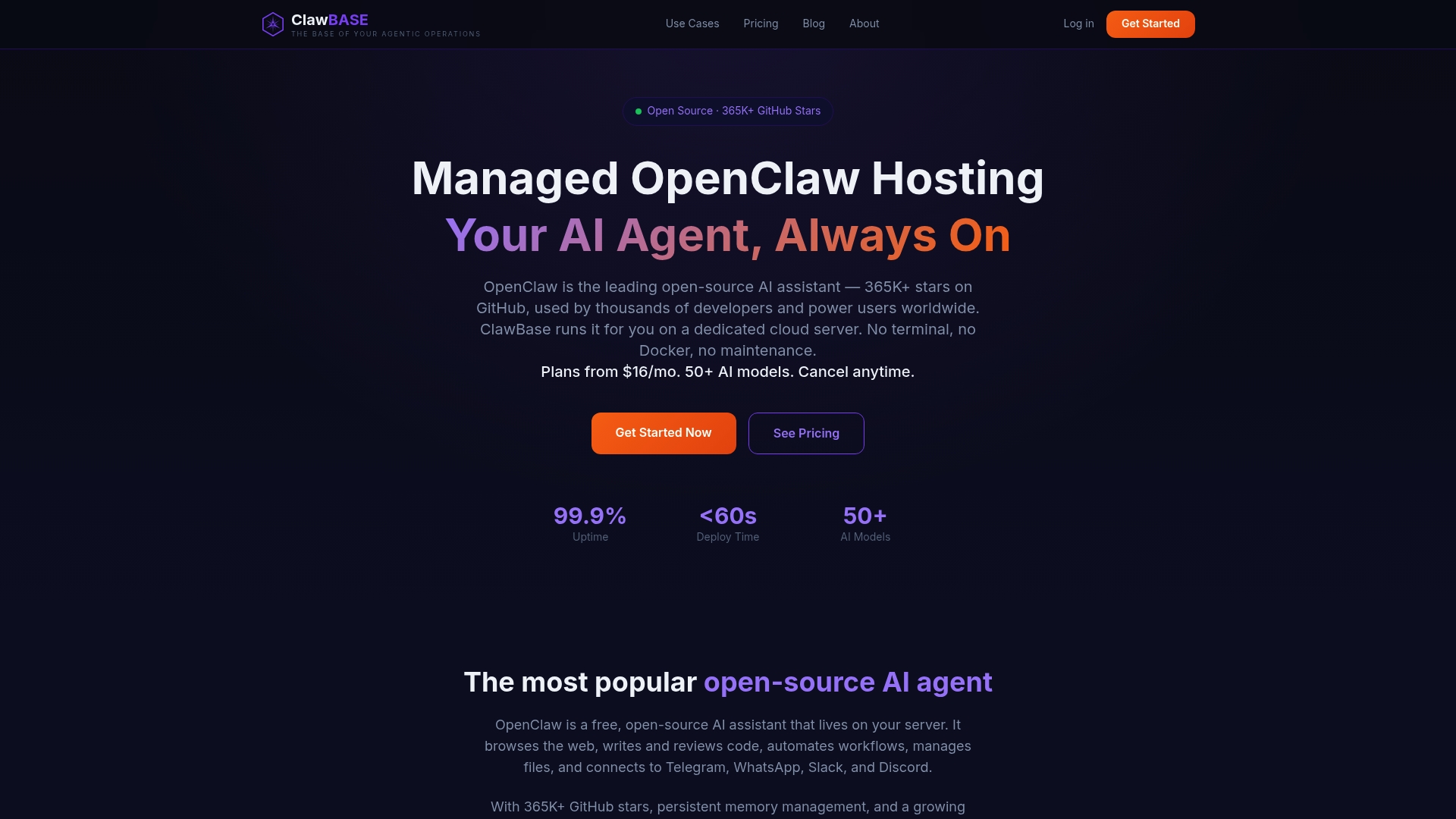
Plans start at $16 per month on the LITE tier, scaling up through PRO and MAX for teams needing more model access and headroom. Before subscribing to any host, including this one, confirm how uptime is measured and what's excluded from the count. Explore what OpenClaw agents can actually do to see if the fit matches your workload.
Sources
- 99.9999% uptime: how much downtime is that? — Uptimia
- SLA exclusions clause — Law Insider
- Reliability pillar — AWS Well-Architected
FAQ
What does a 99.9% uptime SLA mean?
In practice, that allows about 43 minutes of downtime per 30-day month, though exclusions and scope determine what actually counts toward that limit.
Is 99.99% uptime good?
Whether it's worth the added cost and architectural complexity depends on how much a brief outage actually costs your business.
How much downtime does 99.9% uptime indicate?
A 99.9% uptime target allows about 43 minutes of downtime in a 30-day month, or roughly 8 hours and 45 minutes across a full year. The exact figure shifts slightly depending on the calendar month's length and whether the provider measures monthly or annually.
How many minutes a year is 99.99% uptime?
At 99.99%, the allowed downtime works out to about 4 minutes per month, which adds up to roughly 4 minutes monthly depending on the period measured.