How to Use AI for Essay Research: A 2026 Guide
2026-07-23

The most effective way to use AI for essay research is to treat it as a thinking partner, not a ghostwriter. AI tools like ChatGPT, Claude, and Perplexity can accelerate brainstorming, sharpen your research questions, and organize your source inventory. But every sentence you submit must be your own, and every citation AI suggests must be manually verified before it appears in your paper.
Here is how to put that into practice from day one:
- Brainstorm and outline with AI, then write all prose yourself
- Generate research questions by prompting AI to explore multiple angles of your topic
- Organize evidence by asking AI to categorize sources by theme or argument role
- Identify logical gaps by prompting AI to find the weakest points in your thesis
- Verify every citation AI produces against your university library database before use
- Check your institution's AI policy before you start, not after
How does generative AI actually work, and why does that matter for research?
Generative AI is a class of language models that predict the next word in a sequence based on statistical patterns learned from massive text datasets. Tools like ChatGPT, Bard, and Claude do not "know" facts the way a database does. They generate text that is statistically likely to follow your prompt, which is a fundamentally different process from reasoning, inferring, or verifying truth.
That distinction has direct consequences for academic research. Because these models are pattern matchers at their core, they can produce text that sounds authoritative while being factually wrong. The phenomenon is called hallucination, and it is not a bug that will eventually be patched. Hallucination is a structural limitation of how generative models work, meaning it will persist regardless of how capable the underlying model becomes.

The practical risk for students is fabricated citations. An AI can confidently produce a plausible-looking journal article title, author name, and volume number that does not exist. If you paste that citation into your paper without checking, you have submitted fabricated evidence. No AI tool currently available can fully replace human critical thinking or expert judgment when it comes to evaluating source credibility or understanding nuanced academic arguments.
Key limitations to keep in mind:
- AI cannot access paywalled academic databases unless explicitly integrated
- AI training data has a knowledge cutoff, so recent publications may be absent
- AI cannot evaluate methodological quality in primary research
- AI-generated summaries may misrepresent an author's actual argument
What are the real benefits and drawbacks of AI in essay writing?
AI genuinely accelerates the early stages of research. Generating a list of potential research questions, mapping out competing perspectives on a topic, or getting a rough outline reviewed for logical flow are all tasks where AI delivers fast, useful output. Using AI for discovery can be dramatically faster than manual database searching, which matters when you are working against a deadline.
Writer's block is another area where AI earns its place. Asking an AI to summarize what you already know about a topic, or to push back on your working thesis, can break the paralysis that hits before a first draft. Students who use AI for feedback and critique tend to identify blind spots and wordiness that are easy to miss when you have been staring at your own writing for hours.
The drawbacks are real, though. Overreliance on AI for prose generation can quietly erode your own analytical writing skills over time. There is also the academic dishonesty risk: submitting AI-generated text as your own work violates most institutional policies, and AI detection tools are increasingly common in university grading workflows. AI also struggles with nuanced academic arguments, particularly in fields like philosophy, law, or literary criticism, where meaning depends heavily on context and interpretation.
Benefits at a glance:
- Faster topic exploration and research question generation
- Structured outlines and argument maps
- On-demand revision feedback and clarity checks
- Reduced writer's block during early drafting stages
Drawbacks to watch:
- Hallucinated citations that look real but are not
- Risk of academic dishonesty if AI prose is submitted as your own
- Potential skill atrophy from over-dependence on AI suggestions
- Limited ability to handle nuanced or discipline-specific arguments
What do universities actually say about using AI for academic work?
Most major universities have moved from blanket bans to nuanced, course-specific policies. The general principle across institutions is consistent: submitting AI-generated prose as your own original work constitutes academic dishonesty. Harvard's guidelines and Walden University's AI use policy both frame AI as a tool that can support learning without replacing the intellectual work the student is expected to do.

Transparency is the operative word. When a course permits AI assistance, most policies require you to disclose how and where you used it. Some instructors ask for an AI use statement appended to the submission. Others require you to retain chat logs as evidence of your process. Check your syllabus and your institution's academic integrity office before you begin any AI-assisted research.
George Mason University's guidelines go further, requiring students to confirm that any paper an AI cites actually exists and that the AI's summary accurately reflects the original source. That is a reasonable baseline for any institution. A few additional best practices:
- Disclose AI use in your methods or acknowledgments section when permitted
- Never submit unedited AI-generated prose, even for low-stakes assignments
- Treat AI-suggested citations as leads to investigate, not sources to cite directly
- Understand that AI detection tools analyze writing patterns and can flag inconsistencies
Pro Tip: *Before starting any AI-assisted research project, search your university's website for its current AI policy. Policies updated in 2025 and 2026 often differ significantly from earlier versions, and "I didn't know" is not a defense in an academic integrity hearing.*
Which AI tools are best suited for academic essay research?
Different tools serve different stages of the research process. Knowing which one to reach for, and when, prevents you from using a general-purpose chatbot for a job that a specialized research tool handles far better.
For research discovery and source organization:
- Perplexity searches the live web and academic sources, provides cited answers, and links directly to its sources. It is particularly useful for getting an overview of a topic with real references you can then verify.
- Elicit is purpose-built for academic literature search. It uses embedding-based semantic search to surface relevant papers, summarize abstracts, and extract key findings across multiple studies simultaneously.
- Semantic Scholar is a free AI-powered academic search engine from the Allen Institute for AI. It indexes millions of papers and surfaces citation networks, helping you trace how ideas develop across the literature.
- Paperguide helps students upload PDFs and interact with them directly, asking questions about specific papers and organizing notes across multiple documents.
For brainstorming, outlining, and argument feedback:
- ChatGPT (GPT-4 and later) handles open-ended brainstorming, outline generation, and argument stress-testing well. Do not use it to generate citations.
- Bard (now Gemini) integrates with Google Search, giving it access to more recent information than models with fixed training cutoffs.
- Claude tends to produce longer, more structured analytical responses and handles document uploads for feedback on your own drafts.
None of these tools should be your citation source. Use them for discovery and organization, then verify every reference through your library's databases or Google Scholar. You can also explore a broader breakdown of AI learning tools in 2026 to understand where each category fits in an academic workflow.
How to build a step-by-step AI-assisted research workflow
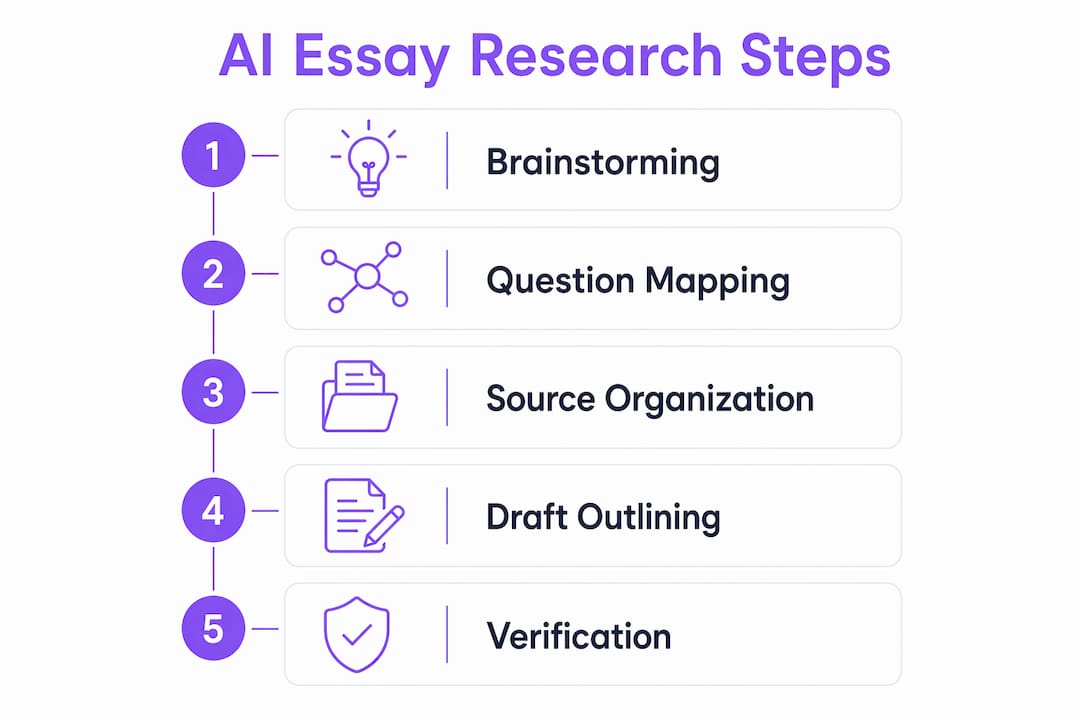
The most productive approach separates AI-assisted discovery from manual drafting, using AI to build structure and surface sources while keeping all prose writing in your hands. Here is a concrete workflow:
- Read the assignment carefully before touching any AI tool. Understand the required argument type, source count, citation format, and any explicit AI restrictions. This step is entirely manual.
- Do a brain dump. Write down everything you already know about the topic and sketch a tentative thesis. This gives AI a meaningful starting point rather than a blank slate.
- Use AI to refine your research questions. Paste your tentative thesis into ChatGPT or Claude and ask it to generate five competing perspectives and identify the three weakest assumptions in your argument. Narrowing broad topics into specific research questions before drafting is one of the highest-value uses of AI in academic writing.
- Search academic databases independently. Use JSTOR, PubMed, Google Scholar, or your library's catalog to build a source list. Run parallel searches in Elicit or Semantic Scholar to surface papers you might have missed.
- Verify every AI-suggested source manually. If an AI tool names a paper, look it up in your library database before adding it to your bibliography. Confirm the paper exists and that the AI's summary matches what the paper actually argues.
- Build a detailed outline with AI feedback. Draft your outline yourself, then ask Claude or ChatGPT to identify gaps in the argument structure. Use AI's suggestions as prompts for your own thinking, not as directives.
- Write the full draft yourself. AI's role here is limited to targeted rewrites of a single sentence when clarity is genuinely unclear, not paragraph-level generation. If you need help making AI-assisted text sound more like your own voice, resources on humanizing AI text for academic writing can guide that process.
- Use AI as a critical reader after drafting. Paste a section into Claude or ChatGPT and ask: "What is the strongest objection to this argument?" or "Where is the logic weakest?" Prompting AI to identify weak points forces you to engage with counterarguments before your professor does.
- Run a final factual and originality check. Cross-reference every statistic and claim against its original source. Run your draft through your institution's plagiarism detection tool before submission.
Pro Tip: *Never copy an AI-generated citation directly into your bibliography. AI models, including the most capable ones, regularly produce citations with incorrect page numbers, wrong publication years, or authors who never wrote the paper. Always look up the source yourself.*
Key Takeaways
AI works best in essay research when it handles discovery and structure while you handle all writing and verification.
| Point | Details |
|---|---|
| AI as thinking partner | Use AI for brainstorming, outlining, and argument feedback, never for writing your prose. |
| Hallucination is structural | AI fabricates citations because of how language models work, not due to a fixable bug. |
| Verify every citation manually | Confirm every AI-suggested source exists in your library database before citing it. |
| Know your institution's policy | Most universities permit AI assistance but prohibit submitting AI-generated text as your own work. |
| Separate discovery from drafting | Use specialized tools like Elicit and Semantic Scholar for source discovery, then draft independently. |
***
*Want a persistent AI assistant that works across your research workflows without requiring technical setup? Clawbase gives you access to over 50 AI models with one-click deployment, persistent memory, and 99.9% uptime, so your research assistant is always ready when you are.*