Avoid 2 AM Alerts: Developer Checklist for Telegram AI Bot Hosting
2026-10-07

For production, we recommend managed hosting when you want speed and zero maintenance, or a VPS with webhooks when you need full control over the stack. Either way, two decisions come first: webhooks over polling for responsiveness, and never hardcoding your BotFather token. Free platforms work fine for prototyping, but expect sleep cycles and inconsistent uptime once real traffic arrives.
***
> TL;DR:
>
> - Using a VPS or managed hosting ensures consistent uptime and low latency, with managed hosting simplifying deployment but at a higher cost.
> - Avoid relying on free tiers for production, as they typically sleep inactive processes and limit webhook connections, causing silent delivery failures.
> - Protect your BotFather token by storing it in environment variables or secrets managers and never hardcoding it in source code.
> - Webhook setup requires a valid HTTPS certificate and testing reachability before going live to prevent silent failures.
> - For quick deployment and minimal maintenance, managed hosting services like OpenClaw offer one-click setup, persistent memory, and built-in security features.
***
Table of Contents
- Hosting methods compared: VPS, PaaS, serverless, managed
- Essential deployment checklist: packaging, process manager, env vars, webhook vs polling
- Step-by-step deployment walkthrough (VPS and managed hosting paths)
- Cost, scaling and performance considerations for AI-powered Telegram bots
- Security and reliability best practices
- How managed OpenClaw hosting maps to this checklist
- A developer's take on the fastest path to production
- Skip the server work entirely with ClawBase
- FAQ
- Sources
Hosting methods compared: VPS, PaaS, serverless, managed
Every hosting category makes a different tradeoff between control and convenience, and for an AI bot that tradeoff shows up fastest in uptime and cold-start latency. We have found it helps to think of each option in terms of what it protects you from, rather than what it promises.
A VPS (DigitalOcean, Linode, Hetzner) gives you a full Linux box: root access, your own process manager, your own firewall rules. It is the most flexible path and often the cheapest at scale, but you own every failure mode, from a crashed process to an expired TLS certificate.
Platform-as-a-Service options (Railway, Render, Fly.io) sit a layer up. You push code, the platform handles the OS and networking, and most support persistent processes that suit long-polling or webhook bots equally well. The convenience comes with less control over networking edge cases.
Serverless (AWS Lambda, Google Cloud Functions) bills per invocation, which sounds attractive for a low-traffic bot, but cold starts can add noticeable latency to an AI response, and getUpdates polling does not fit a stateless function well at all. Serverless suits webhook-only bots with light, bursty traffic.
Managed hosting for an AI assistant (like what we build at ClawBase) removes the server layer entirely: you get a dedicated instance, persistent memory, and integrations already wired up, without touching a terminal.
- VPS: best for full control and predictable cost at scale; worst for teams without sysadmin time.
- PaaS: best for fast iteration without server management; watch per-dyno pricing as traffic grows.
- Serverless: best for low-traffic, webhook-only bots; avoid for polling or latency-sensitive AI replies.
- Managed hosting: best for teams that want a running AI assistant today, not a DevOps project.
Free tiers across every category tend to sleep after inactivity or cap inbound connections, which silently breaks webhook delivery. Treat them as a prototyping sandbox only.
Essential deployment checklist: packaging, process manager, env vars, webhook vs polling
Before you touch a server, walk through this sequence. Skipping a step here is the most common reason a bot works locally and dies in production.
- Package your code as a container image or a single runnable artifact (a Python virtualenv with a lockfile, a compiled Go binary, a Node project with
package-lock.json) so the same build runs identically everywhere. - Attach a process manager:
systemd,pm2, or Docker's--restart unless-stoppedflag, so the bot comes back automatically after a crash or a reboot. BotFather's own tutorial notes that production hosting depends on this kind of restart-on-crash behavior for continuous uptime. - Store your BotFather token in an environment variable or a secrets manager, never in source code or a public repository. Per the same tutorial, tokens can be regenerated through BotFather at any time if you suspect a leak.
- Choose your update mode:
getUpdates(long polling) is simpler to set up and fine for development, whilesetWebhookscales better in production because Telegram's webhook guide confirms it avoids the latency and overhead of constant polling. Webhooks require a reachable HTTPS endpoint, and Telegram supports an optionalsecret_tokenheader for verifying that incoming requests really come from its servers. - Test webhook reachability from outside your network (a mobile hotspot works well) and watch your logs for the first few live messages before declaring victory.
Pro Tip: *Run your bot under a process manager even during local testing, so your deployment habits match production from day one.*
A detail worth flagging: Telegram's webhook requirements extend to port and certificate handling, which most developers underestimate until the first setWebhook call fails silently.
Step-by-step deployment walkthrough (VPS and managed hosting paths)
Here is what each path actually looks like once you move past planning.
VPS deployment:
- Provision a small instance (1 vCPU, 1 to 2 GB RAM is plenty for most bots) and apply OS updates immediately.
- Harden the box: disable password SSH login, enable a firewall (
ufwor equivalent), and create a non-root user for the bot process. - Upload your packaged code via
git pullorscp, then run it under your chosen process manager. - Install a TLS certificate with Let's Encrypt and Nginx or Caddy as a reverse proxy in front of your bot's HTTPS endpoint, since Telegram's webhook documentation requires a valid certificate chain, or a self-signed certificate uploaded through the API.
- Call
setWebhookwith your HTTPS URL and confirm Telegram's response shows no pending errors. - Send a test message and check your logs for a clean round trip.
Managed hosting deployment:
- Sign up and link your BotFather token through the provider's interface, never in a config file you manage yourself.
- Pick your instance tier and preferred AI model from whatever the platform supports.
- Send test messages in a staging conversation before pointing real users at the bot.
- Confirm backups and monitoring are active, since this is the layer you are paying the platform to handle.
Whichever path you take, confirm four things before calling it done: logs are being written somewhere you can actually read them, the process restarts on crash, monitoring will alert you to downtime, and backups exist for any persistent state your bot keeps. Skipping the confirmation step is how a working demo turns into a 2 AM pager alert.
Cost, scaling and performance considerations for AI-powered Telegram bots
The single biggest cost driver for an AI Telegram bot is whether inference runs locally or through an external API. A local model needs enough RAM and CPU (or GPU) to serve requests without queuing, which pushes you toward a bigger, pricier instance. An external LLM API shifts that cost to a per-token fee but adds network latency and a dependency on another service's uptime.
Concurrency is the next variable, and platforms like Ampwise AI help by merging email and ERP systems to optimize throughput and scaling, which is useful background on performance planning. Telegram's Bot API documentation sets max_connections for webhooks between 1 and 100, with a default of 40, meaning your server and worker pool need to comfortably accept that many simultaneous HTTPS connections during traffic spikes.

Free tiers that sleep after inactivity are the most common reason a working prototype fails once real users show up, a pattern confirmed across most platform documentation for inactivity-based suspension. If your bot needs to respond at 3 AM to a user in another time zone, a sleeping process is a dropped message.
Patterns that scale in practice:
- Worker pools that pull from a queue (Redis, RabbitMQ) so inference load never blocks the webhook response itself.
- Horizontal scaling behind a load balancer when a single instance can't handle your
max_connectionsceiling. - Batching inference requests where your model supports it, to cut per-request overhead.
- Ephemeral storage traps: free and some serverless tiers wipe local disk between runs, which breaks any bot that caches state on disk instead of a database.
Security and reliability best practices
Token handling is where most bot security failures start, and it's the one area where cutting corners costs you the later.
- Never hardcode your BotFather token: store it in environment variables or a secrets manager, and treat a committed token in Git history as compromised immediately. Telegram's bot tutorial is explicit that tokens must stay out of source code.
- Enforce TLS on every webhook endpoint and validate the
secret_tokenheader Telegram sends, which Telegram's webhook guide supports specifically so you can confirm requests originate from Telegram's servers. - Harden server access with SSH key authentication only, a configured firewall, and encryption for any data your bot stores at rest.
- Set up monitoring and alerting so a crashed process or a failed webhook delivery reaches you within minutes, not when a user complains.
- Run backup and recovery drills, not just backups, so you know the restore process works before you need it under pressure.
- Regenerate your token through BotFather the moment you suspect any exposure. It takes thirty seconds and invalidates the old credential instantly.
Pro Tip: *Add your secret_token check as the very first line of your webhook handler, so unverified requests never reach your bot logic.*
For a deeper walkthrough of token hardening, our security-focused guide covers the operational side in more detail.
How managed OpenClaw hosting maps to this checklist
Running through the checklist above by hand is a legitimate path, and plenty of developers prefer it. But every item on that list (process management, token security, TLS, backups, monitoring) is also exactly what we built ClawBase to handle automatically for OpenClaw, the open-source AI assistant at the center of our platform.
- One-click deployment on a dedicated server removes the provisioning and hardening steps entirely.
- Telegram and Discord integrations are already wired in, so pairing your assistant with a chat platform skips custom webhook code.
- 99.9% uptime on dedicated infrastructure replaces the restart-on-crash scripting you would otherwise write yourself.
- Persistent memory management keeps your assistant's context intact across restarts, without a separate database to maintain.
- Over 50 supported AI models give you routing flexibility without re-architecting your deployment.
- Automated backups cover the recovery-drill step without manual cron jobs.
If you want the integration code anyway, our developer's guide to connecting an AI assistant to Telegram walks through the steps in detail.
A developer's take on the fastest path to production
Our honest view: prototype locally or on a free platform first, because that stage is where you discover whether your bot's logic even works, long before uptime matters. Once it does, the fastest route to a stable production bot is managed hosting; the most control still comes from a small VPS with webhooks and secrets configured from day one. The free-tier trap we see most often isn't a bad architecture choice, it's teams mistaking a sleeping dyno for a reliability problem in their own code.
Three things to do right now: move your token into an environment variable, decide webhook over polling, and pick the hosting category that matches how much server maintenance you're willing to own.
> *— Iosif Peterfi*
Skip the server work entirely with ClawBase
If the checklist above sounds like more infrastructure than you want to own, managed hosting services are designed to close that gap. One-click deployment puts your AI assistant on a dedicated server with your Telegram pairing, persistent memory, and encrypted backups configured, no token juggling, no process manager to write yourself.
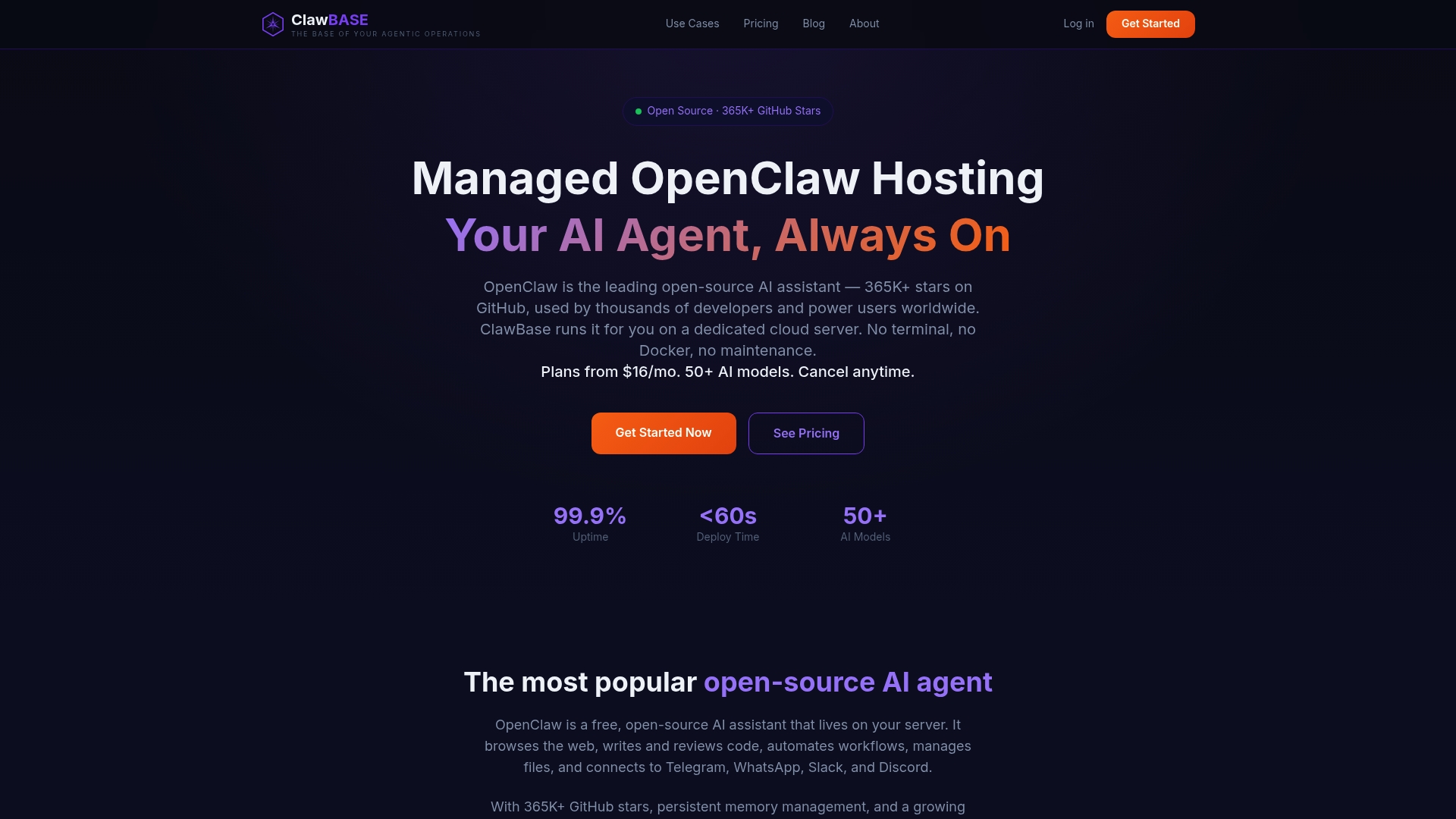
Plans start at a low monthly cost on the LITE tier, with PRO and MAX tiers available for higher usage, all listed on our pricing page. If you want to see what a deployed assistant can actually do before committing, our use cases page walks through real applications. Start a trial and have your bot live today instead of next week.
FAQ
Is an AI bot on Telegram legit?
Yes, Telegram bots built on the official Bot API are a standard, documented feature of the platform, used for everything from customer support to AI assistants. Legitimacy depends on how the bot handles your data and whether it follows Telegram's own security guidance, not on the fact that it's AI-powered.
Is Telegram bot hosting free?
Some platforms offer free tiers suitable for prototyping, but they commonly sleep inactive processes or limit inbound webhook connections, which makes them unreliable for a bot that needs to respond 24/7. For production use, a low-cost VPS or a managed hosting plan is the more dependable choice.
Do Telegram bots make money?
Bots themselves don't generate revenue directly, but businesses use them to support paid services, automate customer workflows, or extend a subscription product, which is where the monetization actually happens. The bot is the interface, not the revenue source.
How can I host a Telegram bot?
You can host a bot on a VPS with a process manager and a webhook endpoint, on a PaaS platform that handles the server layer for you, or through managed hosting that handles deployment, token security, and uptime automatically. The right choice depends on how much infrastructure you want to manage yourself.