The Role of AI in Thesis Writing: A 2026 Guide
2026-07-22

AI has become a genuine working partner in thesis writing, not a novelty. Tools like Grammarly, ChatGPT, Elicit, Consensus, OpenScholar, and SciSpace now cover everything from grammar correction and argument structuring to embedding-based semantic search across thousands of research papers. The core function is assistance, not authorship. AI handles the mechanical and organizational layers so you can focus on the intellectual contribution that actually defines your thesis.
Here is a quick map of what AI brings to the table:
Benefits:
- Faster literature review through semantic search and evidence synthesis
- Improved argument structure and writing clarity
- Accelerated drafting and revision cycles
- Automated citation formatting and reference management
- Summarization of long papers and research corpora
Limitations:
- Hallucination risk, including fabricated citations that look real
- No genuine understanding of your research context or original argument
- Outputs require human verification at every stage
- Overreliance can erode your own analytical skills over time
- AI detection tools are unreliable, shifting accountability to process transparency
***
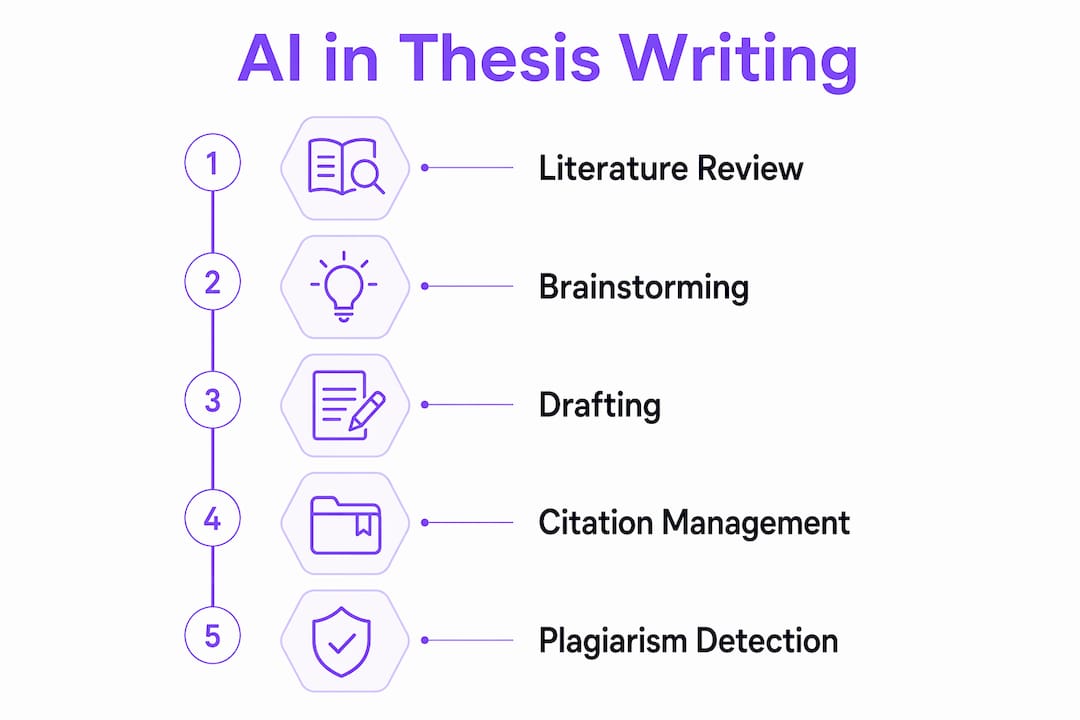
How AI is used in thesis writing across every stage
The practical role of AI in academic writing spans the full research lifecycle, from the first literature search to the final proofread. Each stage has its own tools and its own risks.
Literature review and evidence synthesis
This is where AI delivers the clearest efficiency gain. Tools like Elicit, Consensus, OpenScholar, and SciSpace use embedding-based semantic search rather than simple keyword matching. That means you can ask a conceptual question and get back a ranked set of papers with extracted findings, study designs, and sample sizes already surfaced. At scale, this kind of evidence synthesis would take weeks to do manually.
Grammarly and ChatGPT operate differently. They work at the sentence and paragraph level, catching grammar errors, tightening prose, and flagging unclear arguments. For non-native English speakers especially, language refinement tools like these reduce the friction between having a strong idea and expressing it clearly in academic English.
Brainstorming, outlining, and drafting
ChatGPT is particularly useful for generating outlines from rough notes or expanding a sketched argument into a structured draft. The key is that your ideas need to be in the prompt. When you feed the model a set of concepts and ask it to organize them, the output reflects your thinking, not generic filler. Asking it to generate an outline from scratch, with no input, produces something generic and usually wrong for your specific research question.

AI also helps with brainstorming counter-arguments. If you are writing a discussion section and want to stress-test your conclusions, prompting a model to argue against your position can surface objections you had not considered.
Citation management and plagiarism risk detection
Reference managers like Zotero and EndNote use algorithmic metadata parsing to format citations, though the metadata is often imperfect and needs manual checking. AI writing assistants can flag passages that read as too close to source material, giving you an early warning before you submit. That said, AI-generated references are a known problem: models sometimes produce citations that look real but do not exist. Every AI-suggested reference needs verification against a reputable database like PubMed, Google Scholar, or your institution's library catalog.
| Thesis Stage | AI Tool Examples | Primary Function |
|---|---|---|
| Literature review | Elicit, Consensus, OpenScholar, SciSpace | Semantic search, evidence synthesis |
| Brainstorming | ChatGPT | Idea generation, counter-argument testing |
| Outlining | ChatGPT | Structure generation from existing notes |
| Drafting | ChatGPT | Expanding outlined sections into prose |
| Grammar and style | Grammarly | Sentence-level correction and clarity |
| Citation formatting | Zotero, EndNote | Reference management and style formatting |
| Plagiarism check | Grammarly, institutional tools | Similarity detection and risk flagging |
Pro Tip: *Use AI learning tools that are purpose-built for research tasks rather than general-purpose chatbots. Specialized tools surface structured evidence; general models surface plausible-sounding text.*
***
What ethical AI use actually looks like in academic writing
The ethical line in AI-assisted thesis work is not about whether you use AI. It is about what you use it for and whether you are transparent about it.
Assistance versus generation
Academic institutions draw a clear distinction between acceptable AI assistance and AI-generated content. Grammar checking, literature searching, and readability improvements generally do not require disclosure. Generating text that appears in your thesis does. The rule of thumb: if AI produced words that ended up in your submitted document, that needs to be acknowledged, including which tool you used and how.
This framing matters. The question your institution is really asking is not "did you use AI?" but "is this your intellectual work?" A thesis that uses AI to polish prose and organize structure, while the research design, analysis, and argument are genuinely yours, is a different thing from one where AI drafted the core sections.
How professors actually detect AI use
AI detection tools like GPTZero are notoriously unreliable. Paraphrasing AI output is often enough to fool them. What professors increasingly rely on is process evidence: draft history, supervisor meeting notes, annotated bibliographies, and the depth of engagement visible in your methodology. If you cannot explain your own literature review in a conversation with your advisor, that is a problem no detection tool needs to surface.
Process-based assessment is gaining ground precisely because it is harder to fake. Keeping records of your research process is not just good practice for transparency. It is your best defense if your work is ever questioned.
Best ethical practices
- Disclose all AI tool use in your thesis acknowledgments or methods section, including tool name and version
- Keep your original drafts and revision history to demonstrate intellectual ownership
- Never submit AI-generated text as your own without substantial rewriting and verification
- Verify every AI-suggested citation against a primary database before including it
- Ask your advisor or institution for their specific AI use policy before you start, not after
- Treat AI output as a first draft or a thinking prompt, never as a finished product
***
Benefits and real limitations of AI-assisted thesis work
The adoption data is striking. A survey of 83 MBA thesis students found that 95.2% reported using AI in their thesis work, with 77.1% describing their use as heavy. Students reported a mean perceived quality improvement of 6.27 out of 7. The most commonly cited gains were clearer argument and structure (82.3% of respondents), better revision quality (73.4%), and faster writing (70.9%).
Those numbers reflect what AI does well: it reduces the friction in writing mechanics and organizational tasks, freeing up cognitive bandwidth for the parts of thesis work that actually require original thought. That is the "cognitive scaffold" framing that researchers recommend: AI offloads repetitive tasks so you can focus on analysis, interpretation, and argument.
Where the risks concentrate
The same survey flagged concerns about output accuracy among 75.9% of respondents, with citation handling as a persistent problem. Hallucination is not a minor edge case. AI models generate plausible-sounding text, and plausible-sounding citations are a specific failure mode. A fabricated reference in a thesis is an integrity violation regardless of whether you knew it was fabricated. The responsibility for verification sits with you.
Overreliance is the subtler risk. If AI is drafting your arguments, structuring your chapters, and summarizing your sources, the thesis may pass review but you will have learned less. The thesis is partly a demonstration of your research capability. Outsourcing that capability to a model undermines the point of the exercise.
Pros:
- Faster literature synthesis across large paper corpora
- Improved writing fluency and argument clarity
- Reduced time on grammar, formatting, and citation management
- Accessible support for non-native English speakers
Cons:
- Fabricated citations require manual verification of every AI-suggested reference
- Hallucination risk in factual claims, especially in niche research areas
- Generic outputs when prompts lack specificity or context
- Potential erosion of independent research and writing skills with heavy use
***
How to responsibly integrate AI into your thesis workflow
The researchers who get the most out of AI in thesis work treat it as a multi-agent workflow rather than a single tool. One model handles argument logic and structural organization. Another handles language fluency and grammar refinement. Specialized research tools like Elicit handle literature synthesis. Each tool does what it is actually good at, and you stay in the loop at every handoff.
Build an audit trail from day one
Keeping a log of your AI interactions is not bureaucratic overhead. It is the practical foundation of transparent AI use. Record the tool name and version, the prompts you used, and which outputs you incorporated or discarded. This documentation shifts the perception of AI use from a potential integrity concern to a methodological choice you can explain and defend. It also helps you reconstruct your reasoning if a supervisor asks how you arrived at a particular argument or structure.
Pro Tip: *Keep a running ai_log.md file in your thesis folder. For each session, note the date, tool, prompt, and what you did with the output. This takes two minutes per session and gives you a complete audit trail if your institution ever asks.*
Practical do's and don'ts
Do:
- Use AI to generate outlines from your own notes, then rewrite them in your voice
- Run your drafted sections through Grammarly or a similar tool for sentence-level polish
- Use Elicit or Consensus to surface relevant papers, then read the actual papers before citing them
- Disclose AI use proactively in your methods or acknowledgments section
- Discuss your AI workflow with your advisor early, not after submission
- Check AI proofreading tools that are designed for academic writing rather than general editing
Don't:
- Submit AI-generated text without substantial rewriting and verification
- Cite any reference that you have not confirmed exists in a primary database
- Use AI to generate your research questions, hypotheses, or core analysis
- Rely on AI detection tools as a proxy for your own ethical judgment
- Assume your institution's policy is permissive because you have not seen a prohibition
Talk to your advisor before you start
This is the step most students skip. Advisor expectations vary widely, and institutional policies are evolving fast. Some supervisors want to see your AI log as part of your research documentation. Others are comfortable with AI-assisted editing but want all literature review done manually. Getting clarity upfront saves you from a difficult conversation after submission. It also signals that you are approaching AI use thoughtfully, which builds trust rather than eroding it.
When you do have that conversation, come prepared with specifics: which tools you plan to use, at which stages, and how you will verify AI outputs. That level of preparation tends to land well, regardless of where your advisor sits on the AI spectrum.
***
Clawbase and AI-powered academic workflows
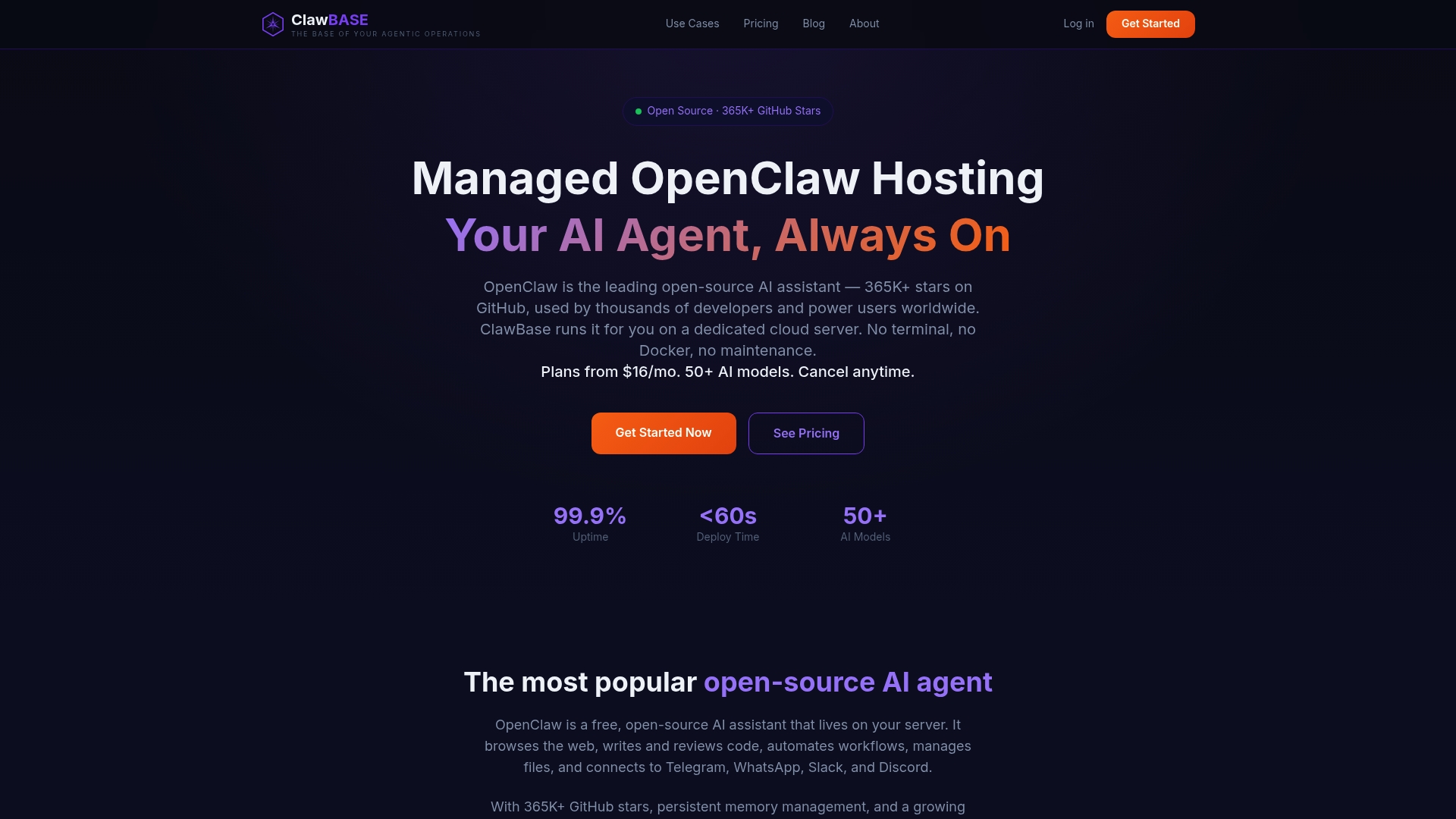
If you are building a more advanced AI workflow for your thesis, Clawbase offers a different kind of setup. Rather than juggling multiple browser-based tools, Clawbase gives you a private, always-on AI agent running on a dedicated server with access to over 50 AI models, persistent memory across sessions, and integrations with platforms like Telegram and Discord. There is no sysadmin work involved. One-click deployment means you can have a configured research assistant running in minutes, not days.
For researchers who want to experiment with AI agent use cases beyond standard writing tools, including automated workflow management, file handling, and multi-model task routing, Clawbase is worth exploring. The persistent memory layer is particularly useful for long thesis projects where context continuity across weeks of work actually matters.
***
Key Takeaways
AI works best in thesis writing when it handles the mechanical layers and you retain ownership of the intellectual contribution.
| Point | Details |
|---|---|
| Adoption is nearly universal | 95.2% of surveyed MBA thesis students used AI, with 77.1% reporting heavy use. |
| Quality gains are real but conditional | Students reported a mean perceived quality improvement of 6.27 out of 7, concentrated in argument structure and revision quality. |
| Fabricated citations are a hard risk | Every AI-suggested reference must be verified against a primary database before inclusion in your thesis. |
| Transparency is your best protection | An audit trail of prompts, tools, and outputs is more defensible than relying on AI detection tools. |
| Multi-agent workflows outperform single tools | Using specialized models for structure, language, and literature search produces better results than one general-purpose chatbot. |