60 Second Command Ladder to Fix OpenClaw Setup Errors for Developers
2026-09-27

Most OpenClaw setup errors trace back to one of three things: a missing gateway.mode value, a broken model authentication step, or a Git dependency that never installed. Run openclaw triage, then openclaw status --all, then openclaw doctor, and read what comes back. If the log says "Gateway start blocked," set gateway.mode or re-run openclaw onboard. If install failed outright, check for Git first.
***
> TL;DR:
>
> - The most common setup errors involve an incorrect or missing gateway.mode value, failed authentication, or unresolved Git dependencies during installation.
> - Running a quick sequence of commands to diagnose, including openclaw triage and status checks, can identify specific subsystem failures within a minute.
> - Gateway start failures are usually caused by misconfigured gateway.mode or version mismatches, and should be fixed with config adjustments and validation rather than manual edits.
> - Git-related install failures typically stem from missing Git binaries or restrictive npm lifecycle settings, which are resolved by installing Git or switching package managers.
> - Using ClawBase removes the need for complex troubleshooting by offering managed, zero-maintenance OpenClaw deployment, starting at $16 per month with a free trial.
***
Table of Contents
- Fast Triage for OpenClaw Setup Errors: The 60-Second Command Ladder
- Why Does the OpenClaw Gateway Fail to Start?
- What Causes OpenClaw Installation Issues With Git and npm?
- How Do You Fix OpenClaw Runtime and Agent Errors?
- Advanced Diagnostics: When to Repair vs. Reinstall OpenClaw
- Should You Use ClawBase Instead of Self-Hosting OpenClaw?
- An Operator's Take on Preventing OpenClaw Setup Failures
- A Lower-Effort Path Than Self-Hosted OpenClaw Troubleshooting
- Where to Go Next for OpenClaw Documentation
- Sources
- FAQ
Fast Triage for OpenClaw Setup Errors: The 60-Second Command Ladder
Before you touch a config file, run the ladder. It takes about a minute and tells you exactly which subsystem is broken, which saves you from guessing your way through openclaw setup troubleshooting.
openclaw triage— runs a bundled health check across install, config, and gateway state in one pass.openclaw status— quick pulse check: is the agent running, and is the gateway reachable?openclaw status --all— the verbose version, and the one you paste into a support ticket.openclaw gateway status— isolates gateway-specific failures from agent-level ones.openclaw doctor— the deepest scan; flags config schema issues, stale versions, and auth gaps.openclaw logs --follow— live tail so you can watch the exact moment something breaks.
Each rung points to a different fix path. This is the recommended fast-triage flow in the official runbook, and it holds up in practice:
- Gateway unreachable? Run
openclaw gateway probenext. - Config flagged invalid? Run
openclaw doctor --fix. - Auth or model errors? Run
openclaw onboardagain.
Save the status --all output before you start changing anything. If the fix doesn't land, that report is what a support thread or GitHub issue needs to actually help you.
Why Does the OpenClaw Gateway Fail to Start?
The Gateway won't boot with a missing or misconfigured gateway.mode value, and this single field is behind a large share of post-update and post-reset startup failures. The failure signature is a blunt one: your log simply says Gateway start blocked.
This isn't a bug so much as a design choice. OpenClaw's config validation is strict by intent. Unknown keys or malformed values make the Gateway refuse to boot rather than start in a half broken state, and it keeps the last known good config on hand so a bad edit doesn't corrupt anything. The Gateway fails closed on purpose, the same logic a database uses when it rejects a write instead of committing garbage.
When you hit this, work through it in order:
- Set the mode directly:
openclaw config set gateway.mode local(swap toremoteif that's your setup). - Validate the whole file:
openclaw config validate. - Locate the active config:
openclaw config file. - Check for rejected edits:
ls -lt $CONFIG.clobbered.*and$CONFIG.rejected.*. - Let the doctor repair what it can:
openclaw doctor --fix.
Split-brain installs show up here too. If meta.lastTouchedVersion in your config doesn't match your installed binary, check which openclaw and openclaw --version before you assume the config itself is the problem.
Pro Tip: *Never hand-edit a rejected config back into place wholesale. Pull only the specific keys you need from the .clobbered.* file with openclaw config set, then re-validate. Pasting the whole broken file back in just reproduces the same rejection.*
What Causes OpenClaw Installation Issues With Git and npm?
A clean install failing with spawn git ENOENT almost always means Git isn't installed on the machine, and OpenClaw's dependency tree needs it. One transitive dependency, baileys, resolves through libsignal-node via a git+https reference rather than a standard npm registry package. No Git binary, no resolution, no install.
The maintainers have already merged fixes upstream that stop this eager bundled-plugin install and drop the root-level Baileys dependency, but that fix may not be in whatever npm release you just pulled. That's confirmed directly in the open GitHub issue tracking the failure, and it's worth reading if you want the exact packaging details.
Your options, in order of least to most disruptive:
- Install Git. On Debian or Ubuntu that's
apt install git; on macOS,xcode-select --installgets you there. - Switch package managers. pnpm and bun handle git-sourced deps with fewer edge cases than plain npm.
- Watch lifecycle script policy. Some npm and pnpm configurations block postinstall scripts by default, which can silently skip steps OpenClaw needs. Allow scripts explicitly for the OpenClaw package if your install seems to finish without actually finishing.
Operators running containerized builds have already worked around this at the source: preinstalling Git in the base image during CI avoids the failure entirely, rather than debugging it on every fresh container.
Before you call it done, run through a short checklist: confirm your Node version meets the minimum, confirm Git is on PATH (you might want to use a Claude Visibility Audit to check your environment), confirm the global bin directory is on PATH, then run openclaw --version followed by openclaw doctor.
How Do You Fix OpenClaw Runtime and Agent Errors?
Runtime errors look different from install errors, and they need different fixes.
- Tokens stuck at 0. If onboarding shows the "Wake up, my friend!" screen and the token counter never moves, the agent never actually initialized. This means model provider authentication is missing or wrong. Re-run
openclaw onboardand confirm credentials, then check withopenclaw models status. Token counts frozen at zero are a reliable signal of an authentication failure, not a network hiccup. - Storage errors. "Database is locked," disk full, or read-only filesystem messages usually trace to permissions, ownership, or a full disk. Check available space, confirm the process owns its data directory, and restart the worker. Cross-reference the timestamp against
openclaw logsto see what triggered it. - Endless "thinking…" with no tool execution. This is often a model capability mismatch, not a bug in OpenClaw itself. Some models chat fine but never emit structured tool calls, or the context window fills up mid-task. Test the model directly, outside OpenClaw, with something like
ollama runto separate a model problem from a config problem.--verbose
Pro Tip: *If a model works fine in isolated testing but stalls inside OpenClaw, the issue is almost always context window exhaustion from a long session, not the model's raw capability. Start a fresh session before you start rewriting config.*
Advanced Diagnostics: When to Repair vs. Reinstall OpenClaw
For field-level precision, skip the surface-level status commands and go straight to the schema. openclaw health --json gives you structured output you can pipe into a script, and config.schema.lookup tells you exactly which field failed validation and why.
When a config edit gets rejected, don't guess at what changed. Diff your active config against the most recent $CONFIG.clobbered.* file, then copy over only the specific keys you intended to change using openclaw config set or config.patch. The Gateway's hot reload treats external edits as untrusted until they fully validate, so partial pastes get rejected outright.
Sometimes repair isn't worth it, and a clean reinstall is faster. Before you wipe anything, copy both your state directory and your workspace to preserve memory, session history, and channel connections.
| Situation | Repair path | Reinstall path |
|---|---|---|
| Single rejected config key | `openclaw doctor --fix`, then diff `.clobbered.*` | Not needed |
| Version/PATH split-brain | Reinstall matching binary version | Optional if versions can't align |
| Corrupted state directory | Rare to repair cleanly | Copy state + workspace, reinstall, run `openclaw doctor` |
Should You Use ClawBase Instead of Self-Hosting OpenClaw?
Every fix above assumes you have the time and the sysadmin instincts to chase config schemas and Git dependencies. If you don't, or you'd rather not, that's the exact gap ClawBase fills with one-click deployment on a dedicated server, no maintenance required.
If you're migrating from a self-hosted setup, the path is the same one covered in the advanced diagnostics section: copy your state directory and workspace, onboard on ClawBase, and run openclaw doctor to confirm everything landed clean.
An Operator's Take on Preventing OpenClaw Setup Failures

Most OpenClaw setup errors are self-inflicted in a very specific way: someone updated one component and assumed the rest would just keep up. Take a snapshot of your working config before any update. Pin the version that works, and don't touch it on a whim.
The bigger habit, and the one people skip, is upgrading OpenClaw, your models, and your runtime environment separately, in staging, before any of it touches production. A version bump that works fine for the CLI can quietly break Gateway compatibility, which is exactly the split-brain scenario covered earlier. Keep Git and basic dev tooling baked into your minimal images from day one, and write down the exact install path your team used. Six months from now, nobody will remember it, including you.
> *— Iosif Peterfi*
A Lower-Effort Path Than Self-Hosted OpenClaw Troubleshooting
If the command ladder above feels like more debugging than you signed up for, ClawBase is built for exactly that reader. It skips the Git dependency traps, the config schema fights, and the version mismatch headaches entirely by deploying OpenClaw on a managed, encrypted dedicated server with no sysadmin work on your end.
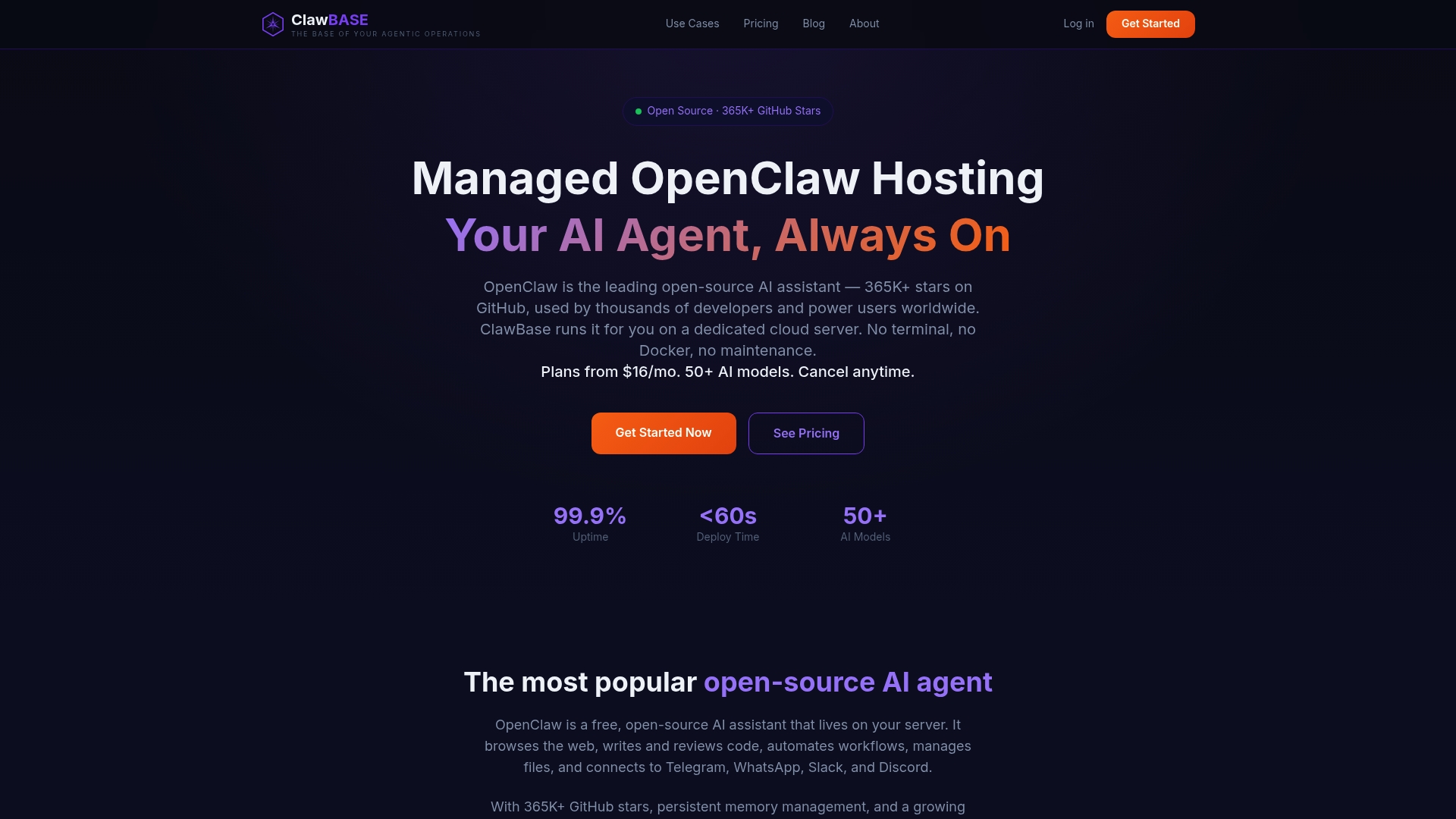
Plans start at the LITE tier for $16 a month, with PRO and MAX tiers available if you need more model access or heavier workflows, and a 7-day free trial on the entry plan means you can test it against your own use case before committing. If you're curious what a managed agent actually looks like in daily use, the OpenClaw use cases page walks through real examples. Otherwise, head straight to ClawBase and start the trial.
Where to Go Next for OpenClaw Documentation
A few official references are worth bookmarking before your next install or update:
- Gateway troubleshooting docs for startup and update failures.
- Gateway configuration and validation for schema and
.clobbered.*details. - The open GitHub issue on the Git dependency failure for install-time blockers.
- ClawBase's quickstart guide if you want the managed-hosting version of setup.
Sources
- Troubleshooting — OpenClaw Gateway
- Install fails on clean Node environments: transitive git+https dep
- FAQ — First run (OpenClaw docs bundle)
FAQ
My OpenClaw Installation Isn't Working. What Should I Check First?
Run openclaw triage followed by openclaw status --all and openclaw doctor. These three commands localize almost every failure, whether it's a config problem, a gateway issue, or a missing dependency, in about a minute.
How Do I Reset an OpenClaw Installation?
Copy your state directory and workspace first to preserve sessions and memory, then run openclaw doctor --fix before resorting to a full wipe. If a clean reinstall is genuinely necessary, restore those two folders and run openclaw doctor again on the fresh install to confirm everything reconnected.
How Do I Fix "Gateway Start Blocked" in OpenClaw?
This error means gateway.mode is missing or set incorrectly. Run openclaw config set gateway.mode local (or remote, depending on your setup) and restart, or re-run openclaw onboard if you're not sure what the original value should have been, per the official Gateway troubleshooting guide.
Why Does OpenClaw Say "Something Went Wrong, Please Try Again"?
This generic message usually points to a session or model call that failed midstream, often from an auth issue or a context window limit. Check openclaw logs --follow for the actual underlying error, and if tokens show as stuck at 0 during setup, re-run openclaw onboard to fix the authentication gap.
Is It Easier to Use ClawBase Instead of Fixing These Errors Myself?
If you don't have the time for config debugging or Git dependency chasing, yes. ClawBase deploys OpenClaw on a managed server with no setup required, starting at $16 a month on the LITE plan, with a 7-day free trial to test it first.