How AI Assistants Process Requests: A Full Breakdown
2026-07-05

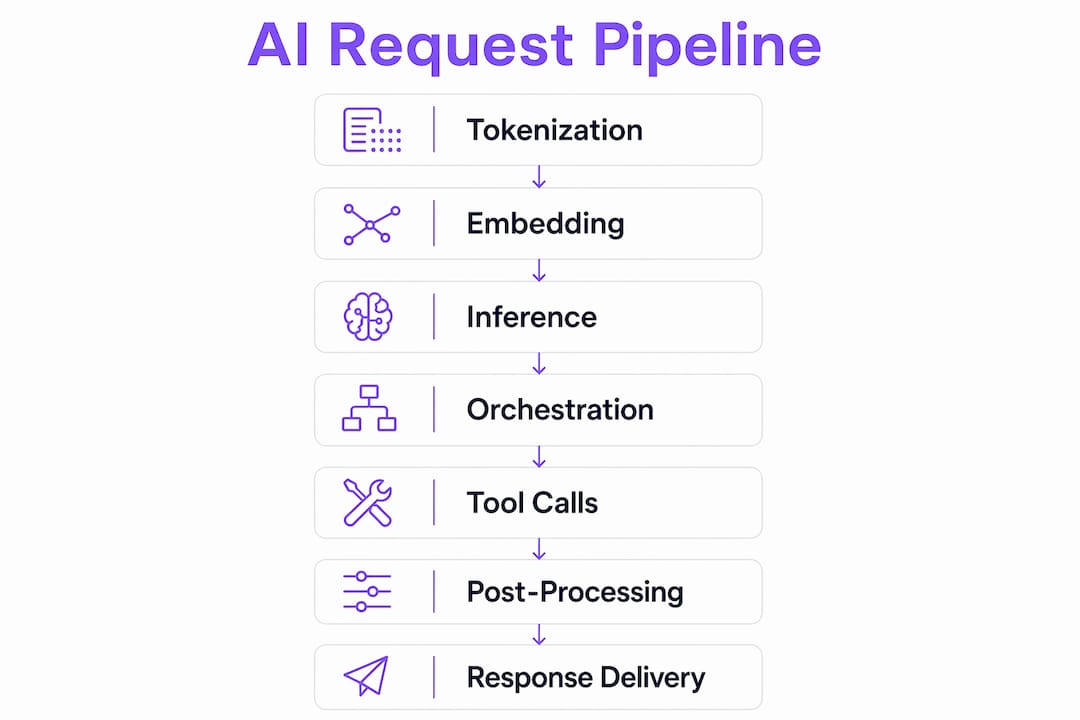
AI request processing is defined as the end-to-end pipeline that transforms a user's typed or spoken input into a coherent, contextually relevant response. Understanding how AI assistants process requests means looking past the chat interface and into a sequence of 7–10 computational stages, including tokenization, transformer inference, orchestration, and post-processing. These stages rely on techniques like Reinforcement Learning from Human Feedback (RLHF) and retrieval-augmented generation (RAG) to produce answers that feel natural. The gap between what users see and what actually happens under the hood is significant, and closing that gap makes you a sharper user and a better builder.
How do AI assistants process requests step by step?
The pipeline begins the moment you hit send. Your message does not travel to the model as plain text. Instead, it passes through a structured sequence of stages that each serve a distinct purpose.
Here is how the stages unfold:
- Ingress. The platform receives your HTTP request and logs it for monitoring.
- Authentication. The system verifies your API key or session token and checks your quota.
- Orchestration. A routing layer classifies your request and decides which model or tool should handle it.
- Retrieval. If the system uses RAG, it fetches relevant documents or memory chunks from a vector database.
- Prompt construction. The orchestrator assembles a final prompt from your message, retrieved context, and system instructions.
- Model inference. The transformer model runs token prediction cycles to generate a response.
- Post-processing. Output is validated against safety rules and schema requirements.
- Streaming UI. The response is delivered word by word using server-sent events (SSE).
AI request pipelines span 7–10 stages in production systems. That means a single "simple" question triggers nearly a dozen coordinated operations before you read the first word.
What happens during tokenization and inference

Your message is first broken into tokens, which are word fragments mapped to numerical vectors. One token equals roughly 0.75 words, so a 300-word response requires approximately 400 prediction cycles through the transformer. Each cycle uses self-attention to weigh relationships between all tokens in the context window. The model then selects the statistically most likely next token and repeats the process until the response is complete.
Pro Tip: *If you want faster responses, shorter and more specific prompts reduce the number of tokens the model must process, which cuts inference time noticeably.*
Does an AI assistant actually understand you?
The short answer is no, not in the way humans understand language. AI assistants predict text statistically based on learned patterns, functioning more like advanced calculators for words than reasoning agents. The perception of understanding comes from the accuracy of probabilistic token prediction, not from cognition. When a response feels insightful, it is because the training data contained similar patterns, not because the model grasped your intent.
This distinction matters practically. It explains why AI assistants can fail on novel problems, produce confident errors, and struggle with tasks that require genuine logical deduction outside their training distribution.
How conversation memory actually works
AI assistants are stateless. Each new request triggers a full reconstruction of conversation context rather than retrieving a stored memory. The application layer manages this by resending the system prompt, all prior messages, and any relevant user data with every request. The model itself has no inherent memory between turns.
- Context windows have hard token limits. When a conversation grows long enough to exceed those limits, earlier messages get dropped.
- Without active management, the model effectively "forgets" the beginning of a long conversation.
- Systems handle this with retrieval (fetching relevant past messages via vector similarity) or summarization (compressing prior turns into a shorter representation).
- Persistent memory in production systems is an engineering feature, not a model capability.
Pro Tip: *When working with a long conversation, periodically summarize key decisions or facts in a single message. This gives the model a compact, high-priority context block that survives window compression.*
What training methods shape AI assistant responses?
Raw language models predict text. AI assistants do more than that. The difference comes from three training stages applied after initial pretraining.
- Pretraining. The model trains on massive text datasets, learning statistical patterns across language, facts, and reasoning structures. This stage builds the model's general knowledge base.
- Instruction tuning. Training on task-specific datasets teaches the model to respond to requests rather than simply continue text. This is what makes a language model behave like an assistant.
- RLHF (Reinforcement Learning from Human Feedback). Human raters evaluate model outputs, and those ratings train a reward model. The AI then optimizes toward responses that score higher on helpfulness and safety.
> RLHF converts a raw text predictor into an assistant that follows instructions and refuses harmful requests. Without this stage, the model would generate plausible text with no regard for user intent or safety constraints.
The practical result is that two models with identical architectures can behave very differently depending on their instruction tuning and RLHF data. This is why understanding AI response quality requires looking at training choices, not just parameter counts.
What role does software architecture play beyond the AI model?
Most users think of the AI model as the product. Engineers know the model is one component inside a larger system. The surrounding architecture determines whether that model is reliable, safe, and cost-efficient in production.
| Responsibility | Model inference | Orchestration layer |
|---|---|---|
| Token prediction | Yes | No |
| Request routing | No | Yes |
| Tool execution | No | Yes |
| Safety validation | Partial | Yes |
| Cost optimization | No | Yes |
| Schema enforcement | No | Yes |
Middleware and routing
Middleware handles authentication, input sanitation, and quota enforcement before the request ever reaches the model. Efficient production systems use smaller router models to classify incoming requests and decide whether a lightweight or large model should handle each query. Routing by task complexity reduces latency and cost compared to sending every request to the largest available model.
Orchestration and tool calling
The orchestrator manages tool calls by intercepting model-generated JSON commands and executing them externally before feeding results back into the conversation. The model pauses its prediction cycle, outputs a structured tool call, and resumes only after the orchestrator returns the result. This is how AI assistants search the web, run code, or query databases mid-conversation.
Post-processing and validation
Separating orchestration from model inference improves reliability because guardrails and validation layers can catch hallucinations before delivery. Post-processing enforces output schemas and validates answers for safety and correctness. This layer is what prevents a model's confident but wrong answer from reaching the user unchanged.
Pro Tip: *If you are building on top of an AI API, treat post-processing as non-negotiable. Schema enforcement and a basic factual sanity check catch the majority of production errors before they affect users.*
Key Takeaways
AI assistants operate as multi-layer systems where model inference is one stage inside a pipeline that includes orchestration, retrieval, validation, and memory management.
| Point | Details |
|---|---|
| Tokenization drives inference | Every message converts to numerical vectors; a 300-word response requires roughly 400 prediction cycles. |
| AI assistants are stateless | Memory is an engineering feature; applications reconstruct context with every request. |
| RLHF shapes assistant behavior | Human feedback training converts raw text predictors into assistants that follow instructions and refuse harmful requests. |
| Orchestration is as critical as the model | Routing, tool calling, and post-processing determine production reliability more than model size alone. |
| Context window limits are real | Long conversations lose early content without active retrieval or summarization strategies. |
The part most people get wrong about AI systems
I have spent a lot of time testing AI assistants across different deployment setups, and the single most common mistake I see is treating the model as the system. Developers spend weeks tuning prompts and swapping models, then wonder why their assistant still hallucinates or fails on edge cases. The answer is almost always in the layers around the model, not the model itself.
The engineering focus has shifted. Production AI reliability now depends on orchestration, validation, and error handling as much as it depends on model quality. A well-orchestrated system with a mid-tier model consistently outperforms a poorly orchestrated system with a frontier model. That is not a theoretical claim. I have seen it in practice repeatedly.
The next frontier is not bigger models. It is better memory handling, tighter tool integration, and multi-model orchestration that routes intelligently based on task type. The assistants that will matter in two years are the ones built on solid architecture, not just impressive benchmarks. If you are building or evaluating AI systems now, the pipeline deserves as much attention as the model card.
> *— Iosif Peterfi*
Clawbase and the full AI processing stack
Running a capable AI assistant in production means managing every layer of the pipeline, from inference to orchestration to memory. Clawbase handles that infrastructure for you with one-click deployment of OpenClaw on a dedicated server, 99.9% uptime, and access to over 50 AI models.
Clawbase gives developers and professionals a private, always-on AI agent with persistent memory management and integrations for Telegram and Discord. No sysadmin expertise required. You get the full processing stack without the setup overhead. Explore what AI agents can do with Clawbase, or go straight to managed hosting starting at $16 per month.
FAQ
How does an AI assistant convert my message into a response?
Your message is broken into tokens and mapped to numerical vectors. A transformer model runs self-attention across those vectors and predicts the next token repeatedly until the response is complete.
Why does an AI assistant sometimes forget earlier parts of a conversation?
AI assistants are stateless. Each request reconstructs context from scratch, and long conversations can exceed the model's context window, causing earlier messages to be dropped.
What is RLHF and why does it matter?
RLHF stands for Reinforcement Learning from Human Feedback. It trains the model to prioritize helpful, safe responses by using human ratings to build a reward signal that shapes output behavior.
What is the difference between the AI model and the orchestration layer?
The model handles token prediction. The orchestration layer manages routing, tool execution, retrieval, and post-processing validation. Both are required for a reliable production assistant.
What is retrieval-augmented generation in AI query handling?
Retrieval-augmented generation (RAG) fetches relevant documents or memory chunks from a vector database before prompt construction. This gives the model accurate, up-to-date context it was not trained on directly.