Start for $16/Month: Managed OpenClaw Discord AI Bot Hosting with Token and Pairing
2026-10-03

Yes, managed OpenClaw hosting can deploy a private, always-on AI assistant into Discord without requiring you to run servers or be a sysadmin. The OpenClaw Discord channel docs and Discord's own OAuth2 and permissions guidance lay out the technical pieces, and providers like ClawBase handle them for you. The result is a private assistant that lives in your server, remembers context, and answers through Discord instead of a browser tab.
***
> TL;DR:
>
> - Managed hosting automates the entire deployment process, including updates, backups, and security setup, reducing setup time to less than configuring a webhook.
> - A dedicated server instance ensures privacy, with 99.9% uptime advertised by providers like ClawBase, and strict security measures such as secrets management and routine audits.
> - Initial setup requires creating a Discord application, generating invite links, and securely sharing the bot token, with most configurations done through host-provided guides.
> - Enabling advanced features like voice, streaming mode, or privileged intents demands deliberate planning to avoid rate limits and ensure responsiveness in busy or large servers.
> - Managed providers like ClawBase offer plans starting at $16 per month, suitable for teams seeking quick, private AI assistants without deep technical expertise.
***
Table of Contents
- What managed OpenClaw Discord hosting delivers
- What to prepare before a managed deployment
- Step-by-step: how a managed host connects OpenClaw to Discord
- Security and privacy defaults for a hosted Discord bot
- Operational limits and optional features worth knowing
- Why non-ops teams should default to managed hosting
- How ClawBase handles the setup for you
- Key official docs and guides to read next
- Sources
- FAQ
What managed OpenClaw Discord hosting delivers
A managed host takes the parts of OpenClaw that normally demand a Linux box, a reverse proxy, and patience, and turns them into a one-click deployment. You get the server, the updates, the backups, and the uptime monitoring; the host handles the plumbing while you handle the decisions.
- One-click deployment on a dedicated, encrypted server, with no manual installation.
- Automated updates and daily backups, so the Gateway process stays current without you touching a terminal.
- Persistent memory and access to more than 50 AI models through a single assistant.
- A private deployment: your own server instance, not a shared multi-tenant bot.
ClawBase advertises 99.9% uptime for its managed deployments, which in practice means the host, not you, is on call for restarts and monitoring. The division of labor is simple: the host provisions and secures the Gateway, while you supply the Discord application, the invite permissions, and the allowlist decisions that define who the assistant talks to.
What to prepare before a managed deployment
A managed host can move fast once you hand over a short list of decisions. Most of the delay in these setups comes from waiting on the customer, not the infrastructure.
- Create a Discord application and bot in the Discord developer portal.
- Know how to generate an invite URL and confirm you (or an admin) have Manage Server rights to add it.
- Decide the bot's name, which guilds and channels it should join, your DM policy, and whether you need privileged intents like message content.
- Gather your AI model preferences or provider credentials the host will ask for during setup.
- Plan how you will deliver the bot token securely, and name who approves the first DM pairing.
Pro Tip: *Keep the bot token out of chat and email entirely; a password manager's secure note or a one-time secret-sharing link is safer than pasting it anywhere that gets archived.*
Step-by-step: how a managed host connects OpenClaw to Discord
The sequence splits cleanly between what the host does on the server and what you do inside Discord. Here's roughly how it runs, based on the setup documented in the OpenClaw Discord channel docs:
- The host provisions an encrypted OpenClaw Gateway on a dedicated instance, typically binding it to loopback or placing it behind a proxy per the exposure guidance.
- You create the Discord application and bot, then enable the minimal OAuth2 scopes it needs, usually
botand, if you want to slash commands,applications.commands, per Discord's OAuth2 and permissions documentation. - You either click an invite link the host generates or hand over the bot token through a secure channel, never through plain chat.
- The host writes the
channels.discordconfiguration: the token stored as a secret reference, environment variable, or file, plus yourdmPolicy,allowFromlist, and guild mappings. - The Gateway restarts with the new configuration live.
- You approve the first DM pairing, which binds your Discord account to your OpenClaw session.
- The host runs the security audit and tunes the allowlists based on what the audit flags.
- The host finalizes per-channel behavior, deciding whether the bot requires an @ mention to respond, which streaming mode it uses for replies, and whether voice is enabled.
- You receive a short operator guide covering how to add channels later, rotate the token, or widen access.
A few things matter across every step:
- Pairing happens once per user and is the gate that keeps a private deployment private.
- The invite step only grants what the OAuth2 scopes and permissions integer specify, not blanket administrative access.
- Restarting the Gateway after a config change is routine and doesn't interrupt existing sessions for more than a few seconds.
The whole flow usually takes less time than configuring a webhook integration by hand, because the host has already done the parts that involve reading documentation and testing edge cases.
Security and privacy defaults for a hosted Discord bot
A reputable host treats your bot token the way a bank treats a vault key, not the way a free Node.js host treats a .env file. The OpenClaw security documentation and Gateway exposure runbook describe the baseline, and a managed provider should apply it without you asking:
- Loopback-only binding for single-user personal deployments, since there's no reason for the Gateway to be reachable from the open internet.
- An identity-aware proxy in front of the Gateway when broader access is genuinely needed, never a direct public port forward.
- DM pairing and explicit allowlists instead of open DM policies, plus mention gating in guild channels so the bot doesn't respond to every message.
- Bot tokens stored as secrets through a
SecretRef, environment variable, or file provider, never hardcoded in a config file that gets copied around. - A security audit (
openclaw security audit) run before go-live, with any flagged defaults corrected rather than overridden.
Pro Tip: *Treat a leaked token like a compromised password: rotate it immediately, re-run the security audit, and re-lock your allowlists before reconnecting the bot.*
Daily encrypted backups and audit logs round out the picture, giving you a record to check if something behaves unexpectedly and a way to roll back if a config change breaks pairing.
Operational limits and optional features worth knowing
Discord bots built on OpenClaw can do more than answer messages, but every extra capability comes with a tradeoff worth understanding before you flip it on.
- Privileged intents like message content and presence are separate from invite permissions. Discord has to grant them, and you should request them only when a feature genuinely needs them.
- Voice and text-to-speech features require additional permissions (Connect, Speak) and change how the bot behaves in a channel.
- Streaming mode affects how replies are chunked as they arrive, which matters for responsiveness in busy channels.
- Large servers can run into rate-limit considerations and occasional READY timeouts during reconnects, something a managed host should monitor for rather than leave you to debug.
- Per-channel session bindings and exec approvals reduce the blast radius of a mistake in shared or multi-user servers, but they take a little upfront planning to configure well.
None of these are reasons to avoid the features. They're reasons to enable them deliberately instead of by default.
Why non-ops teams should default to managed hosting
Self-hosting OpenClaw is entirely workable if you already run servers for a living. For most developers and nearly all non-technical teams, though, the time between "I want a Discord assistant" and "it's actually answering messages" shrinks from a weekend of reading docs to an afternoon when a managed host handles the Gateway, the proxy, and the audit. You keep the privacy of a dedicated encrypted server and persistent memory. You just don't have to be the one patching it at 11 p.m. Teams that need deep customization, custom plugins, or exotic networking might still prefer to self-host, and that's a legitimate choice. Most teams I've talked through this with don't need that level of control; they need a private assistant that works.
> *— Iosif Peterfi*
How ClawBase handles the setup for you
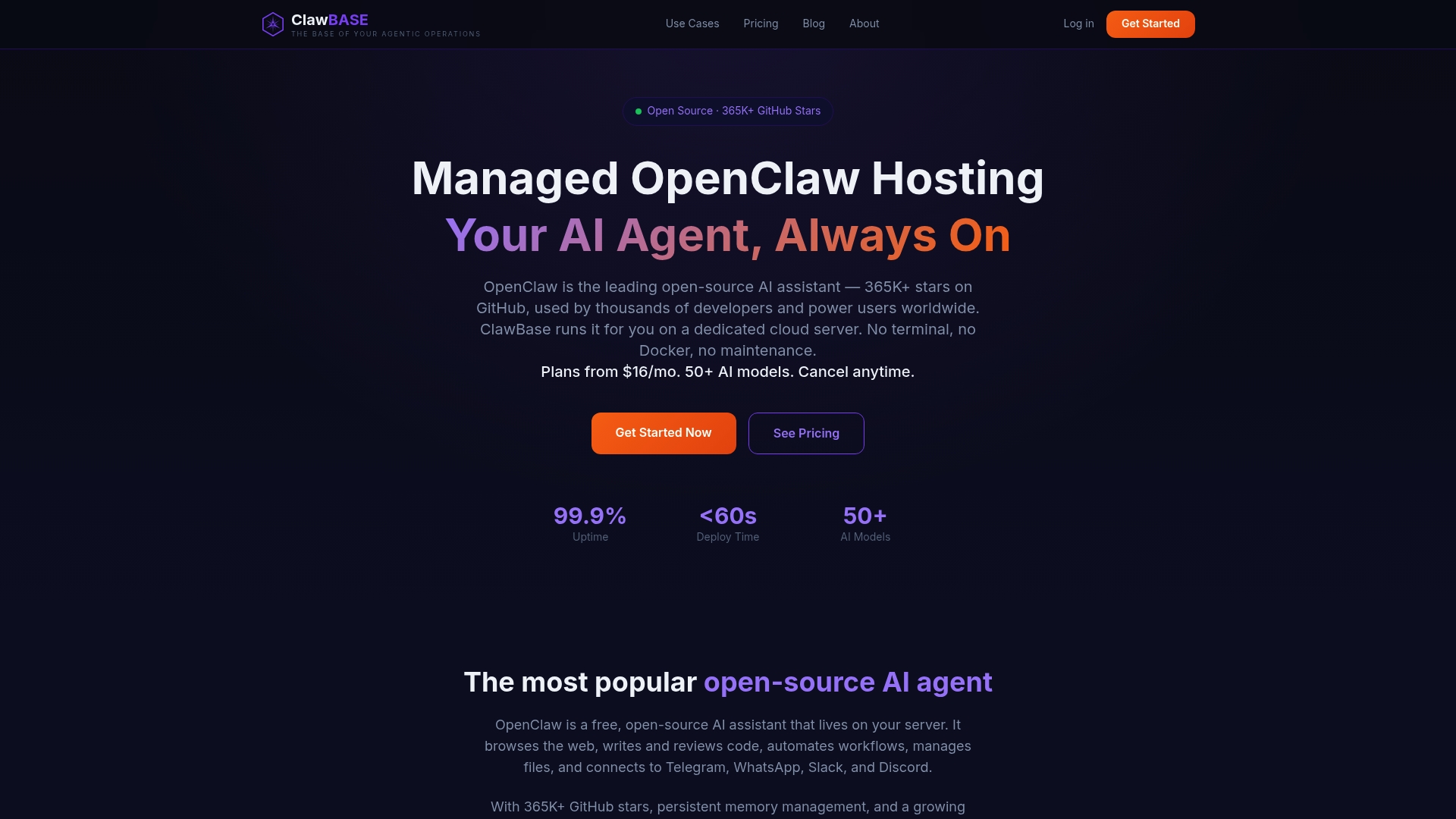
ClawBase turns everything described above into a one-click deployment: a dedicated encrypted server, persistent memory that carries context between sessions, access to more than 50 AI models, and Discord integration configured as part of onboarding rather than left for you to figure out.
Getting started mostly means showing up with your Discord application ready and a sense of which channels you want the assistant in.
- Create your Discord application and bot ahead of time, since the host will ask for it early.
- Check the pricing page for plan details, which start at LITE for $16 per month.
- Browse real OpenClaw use cases to see what an assistant like this handles day to day.
- Start with the entry plan's 7-day trial before committing to a longer term.
If you'd rather read through the mechanics first, the beginner walkthrough on setting up a Discord AI bot covers the same ground in more procedural detail, and the main ClawBase page has the trial sign-up.
Key official docs and guides to read next

For the exact commands and config fields referenced above, read the OpenClaw Discord provider guidance and Discord's quick-start and intents docs. If you want a sense of how a managed provider's own hands-on setup compares, Tatem Web Design's walkthrough of OpenClaw setup for Florida small businesses shows a similar process from a different vendor's angle.
Sources
FAQ
Do I need coding skills to get a Discord AI bot through managed hosting?
No. Managed OpenClaw hosting handles the server, the Gateway configuration, and the Discord channel setup for you; you mainly need to create a Discord application and approve the first pairing.
What's the difference between OAuth2 scopes and privileged intents?
OAuth2 scopes and bot permissions control what your bot is allowed to do when you invite it, while privileged intents like message content and presence are a separate layer that Discord's developer documentation requires you to request and enable deliberately. A managed host should ask for only what your chosen features actually need.
Is it safe to expose the OpenClaw Gateway directly to the internet?
No. OpenClaw's own exposure runbook recommends loopback-only binding for personal use and an identity-aware proxy for broader access, explicitly avoiding direct public port forwarding.
How much does managed OpenClaw hosting for Discord cost?
ClawBase's LITE plan starts at $16 per month or $199 per year, with PRO and MAX tiers available for higher usage or more models, each offering a 7-day trial on the entry tier.
Can one assistant serve multiple Discord servers safely?
It can, using separate guild allowlists and per-channel session bindings, though OpenClaw's security documentation notes it isn't designed as a hostile multi-tenant boundary. For mixed-trust environments, running separate gateways per trust boundary is the safer pattern.